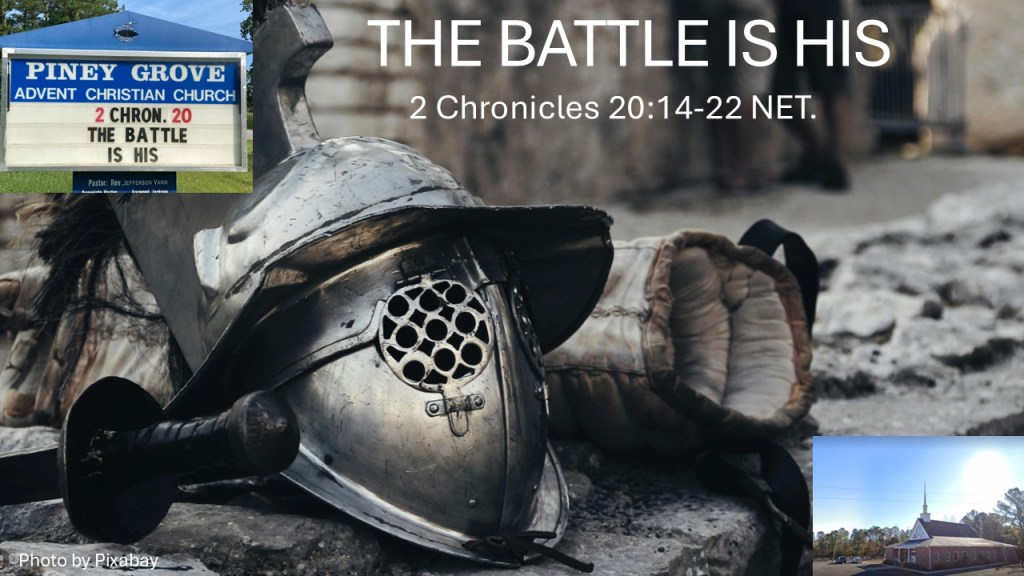
THE BATTLE IS HIS

THE BATTLE IS HIS

2 Chronicles 20:14-22 NET.

14 Then in the midst of the assembly, the LORD’s Spirit came upon Jachaziel son of Zechariah, son of Benaiah, son of Jeiel, son of Mattaniah, a Levite and descendant of Asaph. 15 He said: “Pay attention, all you people of Judah, residents of Jerusalem, and King Jehoshaphat! This is what the LORD says to you: ‘Don’t be afraid and don’t panic because of this huge army! For the battle is not yours, but God’s. 16 Tomorrow march down against them as they come up the Ascent of Ziz. You will find them at the end of the ravine in front of the Desert of Jeruel. 17 You will not fight in this battle. Take your positions, stand, and watch the LORD deliver you, O Judah and Jerusalem. Don’t be afraid and don’t panic! Tomorrow march out toward them; the LORD is with you!'” 18 Jehoshaphat bowed down with his face toward the ground, and all the people of Judah and the residents of Jerusalem fell down before the LORD and worshiped him. 19 Then some Levites, from the Kohathites and Korahites, got up and loudly praised the LORD God of Israel. 20 Early the next morning they marched out to the Desert of Tekoa. When they were ready to march, Jehoshaphat stood up and said: “Listen to me, you people of Judah and residents of Jerusalem! Trust in the LORD your God and you will be safe! Trust in the message of his prophets and you will win.” 21 He met with the people and appointed musicians to play before the LORD and praise his majestic splendor. As they marched ahead of the warriors they said: “Give thanks to the LORD, for his loyal love endures.” 22 When they began to shout and praise, the LORD suddenly attacked the Ammonites, Moabites, and men from Mount Seir who were invading Judah, and they were defeated.

When we study the word of God in the Bible, it is meant to transform us. It’s like exercise. If we stay committed, it can make us stronger. But for that to happen, we need to keep increasing the challenge—adding weights to the bar or extending our running distance. Strength doesn’t come from doing the same exercise day after day, week after week, and year after year. That’s why we are spending some time this year on some lesser-known Old Testament passages.

Let me remind you again of those verses in the New Testament that describe the purpose of Scripture. “Every scripture is inspired by God and useful for teaching,  reproof, correction, and training in righteousness, that the person dedicated to God may be capable and equipped for every good work” (2 Timothy 3:16-17). That quote begins with the word “every.” In order to serve as messengers of God’s word, we need to know more than just the familiar passages from our favorite books. We need to add more weights to the bar. We need to go further than we did last year.

Amy Grant sang a song about a person who refused to do that. The song goes like this:

“I know a man, maybe you know him, too
You never can tell; he might even be you
He knelt at the altar, and that was the end
He’s saved, and that’s all that matters to him
His spiritual tummy, it can’t take too much
One day a week, he gets a spiritual lunch
On Sunday, he puts on his spiritual best
And gives his language a spiritual rest
He’s just a faaa…
He’s just a fat little baby!
Wa, wa, waaaaa…
He wants his bottle, and he don’t mean maybe
He sampled solid foods once or twice
But he says doctrine leaves him cold as ice
Ba, ba, ba, ba…ba, ba…ba, ba!
He’s been baptized, sanctified, redeemed by the blood
But his daily devotions are stuck in the mud
He knows the books of the Bible and John 3:16
He’s got the biggest King James you’ve ever seen!
I’ve always wondered if he’ll grow up someday
He’s momma’s boy, and he likes it that way
If you happen to see him, tell him I said,
“He’ll never grow, if he never gets fed”
He’s just a fat, fat, fat, fat, fat, fa-at, fat…
Fat, Fat, Fat, Fat, Fat, Fa-at, Fat…
Fat, Fat, Fat, Fat, Fat, Fat, Fatttt…
Baby…”[1]

It’s funny when we think about it, but it’s scary when we realize that all of us can be guilty of that kind of attitude toward the Bible. We like certain parts, but there are whole sections of the Word of God that we don’t go to that often. We need to be reminded of the significance of that word “every.” God wants us to master every word, every book in both Testaments. All Scripture is inspired. All Scripture is profitable.

In today’s text, we are back in the Chronicles of the Kings of Judah. Last week, Solomon, and the week before that, David. All three kings were praying, but for different reasons. David prayed to halt a plague, and Solomon prayed to dedicate the temple. Today’s chapter begins with a prayer by King Jehoshaphat. He was one of the good kings of Judah. But at this time, his nation was facing an invasion. Three armies had gathered on the East side of the Dead Sea.

I want to talk a little about the King’s work today. We don’t often think about that aspect of what a king does, but we see it in these three kings of Judah. David prayed, his son Solomon prayed, and his great-great-grandson Jehoshaphat prayed. When the nation had a challenge, it was their leader’s first responsibility not to rule them, but to intercede for them. He declared a fast.

Then he stood before the assembly of Judah and Jerusalem at the LORD’s temple, in front of the new courtyard. He prayed: “O LORD God of our ancestors, you are the God who lives in heaven and rules over all the kingdoms of the nations. You possess strength and power; no one can stand against you. Our God, you drove out the inhabitants of this land before your people Israel and gave it as a permanent possession to the descendants of your friend Abraham. They settled down in it and built a temple to honor you, saying, ‘If disaster comes on us in the form of military attack, judgment, plague, or famine, we will stand in front of this temple before you, for you are present in it. We will cry out to you for help in our distress, so that you will hear and deliver us.’ Now the Ammonites, Moabites, and men from Mount Seir are coming! When Israel came from Egypt, you did not allow them to invade these lands. They bypassed them and did not destroy them. Look how they are repaying us! They come to drive us out of the land you assigned to us! Our God, will you not judge them? For we are powerless against this vast army attacking us! We don’t know what to do; we look to you for help.

Notice also the People’s work in today’s story. While the king was praying, the whole nation had gathered and was fasting—all the men, with their wives and children, even the infants.  The Holy Spirit spoke to one of those men. He was a Levite of the clan of Asaph. His name was Jachaziel. The Lord spoke through him and told the soldiers to march down to meet the enemy the next day. He told them exactly where they would meet the enemy. He also told them not to be afraid. He said they would meet the enemy, but they would not have to defeat them. He said the battle was not theirs, it was the LORD’s. He said they will not fight in this battle. He said, “Take your positions, stand, and watch the LORD deliver you, O Judah and Jerusalem. Don’t be afraid and don’t panic! Tomorrow, march out toward them; the LORD is with you!'”

The people had a responsibility to take their positions, even though the LORD himself would be the one engaging in battle. Even when our Lord Jesus was doing his great miracles of healing and deliverance, he always required the recipient to do something. He wanted them to show their dependence on him and their faith in him. That is what God was doing for the nation of Judah under Jehoshaphat. He is saying that he intends to fight for us, but he requires that we take our positions. Many are refusing even to do that. He wants to bless us all, and all we have to do is show up. But we don’t show up. We hide in our houses with our private religion, and we don’t dare declare our faith in God, yet we still hope that he might bless us.

God has ordained the gathering as one way for us to declare our allegiance to him and our dependence on him. When we gather, the Holy Spirit can come upon some like he did for Jachaziel. That was when God’s people got their marching orders. The king had ordered a fast and an assembly, but the people had to show up. The marching orders were given, but the soldiers had to take their positions. The people had a responsibility to take their positions, even though the LORD himself would be the one engaging in battle.

The people’s natural response upon hearing what Jachaziel said was to bow down and worship the LORD. Then, their natural reaction was to get up and loudly praise the Lord. They worshipped before the battle took place, before the victory came. Their worship was another declaration of their faith in God. That is what worship is for us today as well. It is not us getting together only when we have some testimony of something exciting the Lord has done for us. We come together to declare our faith in what the Lord is going to do for us. Even when we are down, discouraged, and heartbroken, we get together because we have a God who fights for us. We worship before the victory comes because our God is faithful and the battle is his!

Even during the battle, Jehoshaphat commanded that musicians play before the Lord and praise his majestic splendor. He appointed them to march ahead of the soldiers. They were chanting. They chanted the same chant we did last week when we responsively read Psalm 136: “Give thanks to the LORD, for his loyal love endures.”

Notice also what today’s text says about the LORD’s work. While the musicians were chanting praise to God and the soldiers were marching forward, the LORD suddenly attacked the opposing armies. He caused the Ammonite armies and the Moabite armies to attack the armies of the men from Mount Seir. The armies annihilated each other!

When the men of Judah reached the lookout overlooking the desert and saw the vast army, they noticed dead bodies on the ground—there were no survivors! Jehoshaphat and his men went to gather the spoil. They found a massive amount of supplies, clothing, and valuables. They took everything they could carry. The spoil was so great that it took them three days to haul it all away.

That is what happens when God’s people declare their faith in him and trust him to fight their battles. It could have happened very differently if the king hadn’t prayed, if the people hadn’t come together and fasted, or if Jachaziel hadn’t been open to the Holy Spirit.

God wants to do mighty work in this community as well, and he wants all the Christian congregations to witness that work. All he asks of us is that we gather, pray, fast, and take our positions. He wants us to praise and worship him like the victory has already happened.

The situation for King Jehoshaphat and the kingdom of Judah was critical. They faced three enemy armies that might have destroyed them and taken their land. But God wanted them to know that they had nothing to fear. They had access to a power far greater than the power of these armies. They worshipped in faith, knowing that God would intervene, but not knowing the details. None of them could have imagined that they would be spending three days just picking up the loot left behind by those armies!

God was not caught off guard by this battle. It was not a surprise to him. In fact, he didn’t just allow it, he ordained it. It was his way of blessing his people with a blessing that they did not see coming. They should have brought croker sacks to this battle because they were going to need them. It was going to take a few days for them to haul off all the blessings that God intended. The ordeal that they had feared was actually a blessing in disguise.

The lesson for you and me today is that our God does not just want to prevent the battles we might face. He wants to fight those battles for us. He is prepared to go above and beyond what we can even imagine asking him to do. The battle is his. But are there people who dare to trust him and praise him before the battle starts? Where are our musicians confidently chanting, going ahead of the soldiers? Where are the soldiers, going where the battle will take place, following the orders of the Holy Spirit? Where are the congregations, praying and fasting and trusting in the Lord to intervene?

The New Testament tells us that our enemy, the devil, is like a roaring lion on the prowl, looking for someone to devour. It tells us to resist him. Yes, it says we are to resist the devil, but we don’t have the power to resist him. Nevertheless, that is what we are told to do. To God belongs the power forever. The battle is his forever.


[1] Fat Baby (Songwriters: Rodney S. Robison / Steve Millikan).

Genesis 23

Genesis 23

Genesis 23:1 Sarah lived 127 years, the years of Sarah’s life.

Genesis 23:2 And Sarah died at Kiriath-arba (also known as Hebron) in Canaan, and Abraham went in to mourn for Sarah, to cry over her loss.

Genesis 23:3 And Abraham rose from before his dead and spoke to the Hittites, and this is what he said,

Genesis 23:4 “I am a foreign guest among you; give me some property for a burying place, that I may bury my dead out of my sight.”

Genesis 23:5 The Hittites answered Abraham, and this is what he said,

Genesis 23:6 “Hear us, my lord; you are a prince from God among us. Bury your dead in the choicest of our tombs. None of us will hold back from you his tomb to hinder you from burying your dead.”

Genesis 23:7 Abraham rose and bowed to the Hittites, the people of that land.

Genesis 23:8 And he said to them, “If your throats are willing that I should bury my dead out of my sight, hear me and entreat for me Ephron the son of Zohar.

Genesis 23:9 Ask him to give me the cave of Machpelah, which he owns; it is at the end of his field. For the full price, let him give it to me in your presence as property for a burying place.”

Genesis 23:10 Now Ephron was sitting among those Hittites, and Ephron the Hittite answered Abraham in the hearing of the other Hittites, of all who went in at the gate of his city,

Genesis 23:11 “No, my lord, hear me: I will give you the field, and I will give you the cave that is in it. In the sight of the sons of my people, I give it to you. Bury your dead.”

Genesis 23:12 Then Abraham bowed down before the people of the land.

Genesis 23:13 And he said to Ephron in the hearing of the people of the land, “But if you will, hear me: I will give the price of the field. Accept it from me that I may bury my dead there.”

Genesis 23:14 Ephron answered Abraham, and this is what he said,

Genesis 23:15 “My lord, listen to me: a piece of land worth four hundred shekels of silver, what is that between you and me? Bury your dead.”

Genesis 23:16 Abraham listened to Ephron, and Abraham weighed out for Ephron the silver that he had named in the hearing of the other Hittites, four hundred shekels of silver, according to the weights current among the merchants.

Genesis 23:17 So the field of Ephron in Machpelah, which was to the east of Mamre, the field with the cave that was in it and all the trees that were in the field, throughout its whole area, was sold

Genesis 23:18 to Abraham as a possession in the presence of the Hittites, before all who went in at the gate of his city as witnesses.

Genesis 23:19 After this, Abraham buried Sarah, his wife, in the cave of the field of Machpelah east of Mamre (also known as Hebron) in the land of Canaan.

Genesis 23:20 The field and the cave that is in it were sold to Abraham as property for a cemetery by the Hittites.

Genesis 23 quotes:

“The story in Genesis 23 is filled with the detailed circumstances surrounding the purchase of the burial site. Such detail befits the occasion. It may also be that the Holy Spirit, in his marvelous choice of diverse literature and diction, means to emphasize hereby the first transfer of a tiny piece of the promised land into Abrahams possession. This was no small matter, and the recording of this incident should be duly noted.”

Woudstra, Marten H. The Abraham Stories: A Study Guide. 2nd ed, 2nd ed., CRC Publications, 1995. p. 43.

“After a deal was reached and Abraham paid Ephron for the land, the transaction was “made sure” (Genesis 23:17), or witnessed, by members of Ephron’s clan, as well as others who passed through the city gate. In Bible times business was transacted in the gateway of the city (see note on Genesis 19:1).”

Knight, George. The Illustrated Guide to Bible Customs and Curiosities More Than 750 Entries on Why They Did What They Did. Barbour Pub, 2014. p.15.

“A Hittite enclave flourished around Hebron in the Patriarchal Age. Genesis 23 portrays Abraham buying a plot of land from Ephron, the Hittite, in the presence of the whole Hittite community there because land could not be sold to an alien unless the community sanctioned the sale. The transaction, moreover, is according to Hittite law, rather than Hebrew or Mesopotamian law. The issue raised during the dickering before the sale has nothing to do with haggling over price, though this had usually been read into the text by moderns in spite of the clear wording. The issue is whether Abraham will be permitted to buy only the corner of the estate containing the cave for burying his dead, or whether he will have to buy the whole estate in order to get the cave. In Hittite law, a property owner continues to render feudal obligation on land until he sells all of it. Thus the issue is clear: Abraham wanted the burial plot without assuming feudal obligations; but Ephron, the Hittite, insisted that Abraham buy all or nothing. Since Abraham had on his hands a corpse requiring burial, he had no time for protracted negotiations; instead he yielded and bought the land on Ephron’s terms. The inclusion of the trees on the land, in the statement of the sale, is also typical of Hittite law.”

Gordon, Cyrus H. The Common Background of Greek and Hebrew Civilizations. Norton Library, 1965. p. 94.

Genesis 23 links:

Abraham- Machpelah
Property in Canaan
soul searching


Maranatha Daily Devotional – Friday, January 13, 2023
Maranatha Daily Devotional – June 4, 2015
Maranatha Daily Devotional – Monday, January 14, 2019

GENESIS in Jeff’s library

Genesis 22

Genesis 22

Genesis 22:1 And it happened after these things that God tested Abraham and said to him, “Abraham!” And he said, “Notice me.”

Genesis 22:2 So he said, “Now take your only son, Isaac, whom you love, and go to the land of Moriah, and sacrifice him there as an ascending offering on one of the mountains of which I will tell you.”

Genesis 22:3 So Abraham got up early in the morning, tying his pack to his donkey, and took two of his young men and his son Isaac with him. And he cut the wood for the ascending offering and started out for the place of which God had told him.

Genesis 22:4 On the third day, Abraham lifted his eyes and saw the place from a distance.

Genesis 22:5 Then Abraham told his young men, “Stay here with the donkey; I and the boy will go over there and worship and return to you.”

Genesis 22:6 And Abraham took the wood of the ascending offering and laid it on Isaac his son. And he took in his hand the fire and the knife. So, they went both of them together.

Genesis 22:7 And Isaac told his father Abraham, “My father!” And he said, “Here I am, my son.” He said, “Notice, the fire and the wood, but where is the lamb for an ascending offering?”

Genesis 22:8 Abraham said, “God will provide for himself the lamb for a burnt offering, my son.” So, they went both of them together.

Genesis 22:9 When they came to the place of which God had told him, Abraham built the altar there and arranged the wood and bound Isaac his son and laid him on the altar, on top of the wood.

Genesis 22:10 Then Abraham reached out his hand and took the knife to slaughter his son.

Genesis 22:11 But the agent of Yahveh called to him from heaven and said, “Abraham, Abraham!” And he said, “Notice me.”

Genesis 22:12 He said, “Do not lay your hand on the boy or do anything to him, because now I know that you fear God, seeing you have not held back your only son, from me.”

Genesis 22:13 And Abraham lifted his eyes and looked, and noticed behind him a ram, caught in a bush by his horns. And Abraham went and took the ram and offered it up as an ascending offering instead of his son.

Genesis 22:14 So Abraham called the name of that place, “Yahveh will see to it”; as it is said to this day, “On the mount of Yahveh it will be seen to.”

Genesis 22:15 And the agent of Yahveh called to Abraham a second time from the sky

Genesis 22:16 and said, “By myself I have sworn, declares Yahveh, because you have done this and have not held back your only son,

Genesis 22:17 Blessing I will bless you, and multiplying I will multiply your seed like the stars of the sky and the sand upon the beach. And your seed will possess the gate of his enemies,

Genesis 22:18 and because of your seed all the nations of the land will be blessed, because you have obeyed my voice.”

Genesis 22:19 So Abraham returned to his young men and set out together to Beersheba. And Abraham lived at Beersheba.

Genesis 22:20 Now after these things, it was told to Abraham, “Notice, Milcah also has borne children to your brother Nahor:

Genesis 22:21 Uz his firstborn, Buz his brother, Kemuel the father of Aram,

Genesis 22:22 Chesed, Hazo, Pildash, Jidlaph, and Bethuel.”

Genesis 22:23 (Bethuel fathered Rebekah.) These eight Milcah gave birth to Nahor, Abraham’s brother.

Genesis 22:24 His concubine, Reumah, also gave birth to  Tebah, Gaham, Tahash, and Maacah.

Genesis 22 quotes:

“In truth I am utterly shocked by Genesis 22—repeatedly shocked. I have finally persuaded myself that this story should be perpetually shocking. Given all that has transpired in the journey of Abraham and Sarah thus far, how could God make such a demand! But God does, and once again we are reminded that the future is not controlled by humans.”

Gossai, Hemchand. Barrenness and Blessing : Abraham, Sarah, and the Journey of Faith. Lutterworth Press, 2010. p. 106.

“For many people, Genesis 22 represents ‘that story which still causes controversy and alarm.”

Kessler, Edward. Bound by the Bible: Jews, Christians and the Sacrifice of Isaac. Cambridge University Press, 2004. p. 33.

” There is no question who Abraham was to sacrifice. In a very plain and repetitive way, God made it very, very clear that Abraham was to sacrifice Isaac. In five ways in the precept in our text God makes absolutely certain that it is Isaac whom Abraham is to offer as a burnt offering. It is (1) “thy son,” (2) “thine only son,” (3) “Isaac,” (4) “whom thou lovest,” and (5) “him.””

Bulter, John G. Isaac: The Promised Son. LBC Publications, 2008. p. 47.

Genesis 22 links:


Maranatha Daily Devotional – Thursday, January 12, 2023

GENESIS in Jeff’s library

Genesis 21

Genesis 21

Genesis 21:1 Yahveh visited Sarah like he had said he would, and Yahveh did to Sarah as he had promised.

Genesis 21:2 And Sarah conceived and gave birth to a son for Abraham in his old age at the time of which God had spoken to him.

Genesis 21:3 Abraham called the name of his son who was born to him, whom Sarah gave birth to for him, Isaac.

Genesis 21:4 And Abraham circumcised his son Isaac when he was eight days old, as God had commanded him.

Genesis 21:5 Abraham was a hundred years old when his son Isaac was born to him.

Genesis 21:6 And Sarah said, “God has made me a cause for laughter; everyone who hears will laugh about me.”

Genesis 21:7 And she said, “Who would have said to Abraham that Sarah would nurse children? Yet I have given birth to him a son in his old age.”

Genesis 21:8 And the child grew and was weaned. And Abraham made a great feast on the day that Isaac was weaned.

Genesis 21:9 But Sarah saw the son of Hagar the Egyptian, whom she had borne to Abraham, laughing.

Genesis 21:10 So she said to Abraham, “Expel this slave woman with her son because the son of this slave woman will not be an heir along with my son Isaac.”

Genesis 21:11 And the thing seemed very evil to Abraham because he was thinking of his son.

Genesis 21:12 But God said to Abraham, “Do not consider this an evil thing because of the boy and because of your slave woman. Whatever Sarah says to you, do as she tells you because through Isaac will your seed be named.

Genesis 21:13 And I will make a nation of the son of the slave woman also because he is your seed.”

Genesis 21:14 So Abraham rose early in the morning and took bread and a skin of water and gave them to Hagar, putting them on her shoulder, along with the child, and sending her away. And she left and wandered in the open country of Beer-sheba.

Genesis 21:15 After the water in the skin was gone, she put the child under one of the shrubs.

Genesis 21:16 Then she went and sat down across from him a good way off, about the distance of a bowshot, because she said, “Let me not watch the child die.” And as she sat opposite him, she raised her voice and wept.

Genesis 21:17 And God heard the boy’s voice, and the agent of God called to Hagar from heaven and said to her, “What troubles you, Hagar? Do not be afraid because God has heard the boy’s voice where he is.

Genesis 21:18 Get up! Lift up the boy and hold him strongly with your hand because I will make him into a great nation.”

Genesis 21:19 Then God opened her eyes, and she saw a well of water. And she went and filled the skin with water and gave the boy a drink.

Genesis 21:20 And God was with the boy, and he grew up. He lived in the open country and became an expert archer.

Genesis 21:21 He lived in the open country of Paran, and his mother took a wife for him from the land of Egypt.

Genesis 21:22 At that time, Abimelech, through Phicol, the commander of his army, spoke to Abraham, saying: “God is with you in all that you do.

Genesis 21:23 Now, therefore, swear to me by God that you will not deal deceptively with me or with my descendants or with my posterity, but as I have shown covenant faithfulness with you, so you will deal with me and with the land where you have stayed as a guest.”

Genesis 21:24 And Abraham said, “I do swear.”

Genesis 21:25 When Abraham later complained to Abimelech about a well of water that Abimelech’s slaves had seized,

Genesis 21:26 Abimelech said, “I do not know who has done this thing; you did not tell me, and I have not learned about it until today.”

Genesis 21:27 So Abraham took sheep and oxen and gave them to Abimelech, and the two men made a covenant.

Genesis 21:28 Abraham set seven ewe lambs of his flock apart.

Genesis 21:29 And Abimelech asked Abraham, “What is the purpose of these seven ewe lambs you have set apart?”

Genesis 21:30 He said, “These seven ewe lambs you will obtain from my hand, that this gift may be a witness for me that I dug this well.”

Genesis 21:31 Therefore, that place was called Beersheba because they both swore an oath.

Genesis 21:32 So they made a covenant at Beersheba. Then Abimelech and Phicol, the commander of his army, rose up and returned to the land of the Philistines.

Genesis 21:33 It was there in Beersheba that Abraham planted a tamarisk tree and called on the name of Yahveh, the Permanent God.

Genesis 21:34 And Abraham was a guest for many days in the land of the Philistines.

Genesis 21 quotes:

“The birth of Isaac was a miracle birth. Everything about it—from the conception to the actual birth of the child required Divine power. Repeatedly Scripture, in reporting the coming of Isaac, emphasizes the great problems which required a miracle of God’s great power to bring the birth to pass. Our text on the coming of Isaac not only emphasizes the Divine prediction in the coming of Isaac, but it also emphasizes the need for Divine power for his coming. The need of a miracle of Divine power in the lives of Abraham and Sarah regarding the coming of Isaac had to do chiefly with age and the fact that the advanced age of Sarah and Abraham made having children impossible from the human standpoint. Three times in our text the age problem is mentioned—[1] “bare Abraham a son in his old age . . . [2] Abraham was a hundred years old, when his son Isaac was born to him. . . [3] I have born him a son in his old age.” Elsewhere the age problem of Sarah is mentioned, too. “Now Abraham and Sarah were old and well stricken in age, and it ceased to be with Sarah after the manner of women” (Genesis 18:11). Paul also cited the problem of Abraham and Sarah for child bearing when he said, “his [Abraham’s] own body now dead, when he was about an hundred years old . . . the deadness of Sarah’s womb” (Romans 4:19). “

Bulter, John G. Isaac: The Promised Son. LBC Publications, 2008. p. 13.

“Just as Sarah’s harshness in Genesis 16:6 alludes intertextually to the harshness that the Israelites suffer at the hands of the Egyptian task masters (Exod 1:11-14), so also Genesis 21 (Hagar’s departure from her house of bondage to find herself wandering) alludes to the descendants of Abraham and Sarah, who will leave their bondage to wander in the wilderness. Perhaps worse than the later Israelites, Hagar and Ishmael wander in a state of uncertainty with no particular destination (Gen 21:14). Moreover, as we discover, divine provision comes without Hagar’s complaint or murmuring; God provides, as God would do for the Israelites later (Gen 21:17-20).”

Gossai, Hemchand. Barrenness and Blessing: Abraham, Sarah, and the Journey of Faith. Lutterworth Press, 2010. p. 35.

“The name given to this promised son was “he laughs” or “laughter.” Sarah cites her laughter and her own surprise at bearing a child in her old age (Genesis 21:6-7). The play on words is very interesting. The Hebrew word is yits-chag—appending the “jot” to tsachaq. The yod is the tenth letter of the Hebrew alphabet, the smallest letter and the “jot” mentioned by the Lord Jesus in Matthew 5:18. “Isaac” is the only translation for the 108 times that Yitschag (the proper name) appears in the Scriptures. It might well be translated “he mocks me!” Or maybe “the joke is on us!””

Morris, Henry M. The Book of Beginnings: A Practical Guide to Understand and Teach Genesis. Institute for Creation Research, 2012. p. 74.

Genesis 21 links:


Maranatha Daily Devotional – June 2, 2015
Maranatha Daily Devotional – Wednesday, January 13, 2021

GENESIS in Jeff’s library

Genesis 20

Genesis 20

Genesis 20:1 Abraham traveled from that place to the territory of the Negev and lived between Kadesh and Shur, and he lived as a guest in Gerar.

Genesis 20:2 And Abraham told people regarding Sarah his wife, “She is my sister.” So, Abimelech king of Gerar sent and took Sarah.

Genesis 20:3 But God came to Abimelech in a dream at night and said to him, “Notice, you are a dead man because of the woman whom you have taken, for she is another man’s wife.”

Genesis 20:4 But Abimelech had not had relations with her. So, he said, “Lord, will you kill a blameless nation?

Genesis 20:5 Did he not himself say to me, ‘She is my sister’? And she herself said, ‘He is my brother.’ I have done this with integrity in my heart and with innocent hands.”

Genesis 20:6 Then God said to him in the dream, “Yes, I know that you have done this in the integrity of your heart, in fact, it was I who kept you from failing[1] me. For this reason, I did not let you touch her.

Genesis 20:7 So, return the man’s wife now because he is a prophet, and he will pray for you, and you will stay alive. But if you do not return her, know that you will definitely die, you, and everyone associated with you.”

Genesis 20:8 So Abimelech got up early in the morning and called all his slaves and told them all these things. And the men were very frightened.

Genesis 20:9 Then Abimelech called Abraham and said to him, “What have you done to us? And how have I failed you, that you have caused me and my kingdom to commit a great failure?[2] You have done to me things that ought not to be done.”

Genesis 20:10 And Abimelech asked Abraham, “What were you thinking that possessed you to do this thing?”

Genesis 20:11 Abraham said, “I did it because I thought, There is no fear of God at all in this place, and they will kill me because of my wife’s beauty.

Genesis 20:12 Besides, she really is my sister, the daughter of my father though not my mother’s daughter, and she later became my wife.

Genesis 20:13 And when God caused me to roam from my father’s house, I told her, ‘This is the covenant faithfulness you must show me: at every place where we go, say of me, He is my brother.'”

Genesis 20:14 Then Abimelech took sheep and oxen, and male slaves and female slaves, and gave them to Abraham, and returned Sarah his wife to him.

Genesis 20:15 And Abimelech said, “Notice, my land is before you; live wherever you want to.”

Genesis 20:16 To Sarah, he said, “Notice, I have given your brother a thousand pieces of silver. It is a sign of your innocence in the eyes of all with you, and before everyone, you are vindicated.”

Genesis 20:17 Then Abraham prayed to God, and God healed Abimelech and also healed his wife and female slaves[3] so that they could again give birth to children.

Genesis 20:18 You see, Yahveh had closed all the uteruses of the house of Abimelech because of Sarah, Abraham’s wife.


[1] חָטָא = fail. Genesis 20:6, 9; 31:39; 39:9; 40:1; 42:22; 43:9; 44:32.

[2] חֲטָאָה = failure.

[3] אָמָה = female slave. Genesis 20:17; 21:10, 12, 13; 30:3; 31:33.

Genesis 20 quotes:

“The portrayal of the monarch in this tale is as interesting as the portrayal of husband and wife. He is scrupulously honest. The divine being directly reveals the truth to this person. The effect, as in Genesis 12, is to show the foreigner’s implicit fear of God. The character who should be playing the role of adversary plays a veritable patriarchal role in his close and positive relationship with the divine. Implicit here is a certain respect for people such as Abimelech who are in positions of power, a respect that is not grudging or implicitly mocking but genuine. It is also significant that he is a non-Israelite. Such people are capable of deserving respect, human and divine. As noted in the morphological analysis, the should-be “adversary” in Genesis 20 is the victim, his problem and its rectification a focus of the tale equally important to the focus on the hero and his wife. This is a tale without a villain.”

Niditch, Susan. A Prelude to Biblical Folklore: Underdogs and Tricksters. University of Illinois Press, 2000. p. 56.

“I chose to do an Old Testament Exegesis to show that healing not only happened in the New Testament, but also in the Old Testament. Canonically, this is important because it shows that healing is an integral part of the message of the Holy Bible. The Bible is Holy because it is to be read as a whole, not as fragments, and this wholeness brings in healing as an integral message of the whole Bible (to heal is to make whole). I chose Genesis 20:17-18 particularly because it is the first recorded healing in the Bible, and as such, lays a foundation for the rest of the healing in the Bible.”

Moore, Les. Healing in the Christian Spiritual Tradition. Author, 2003. p.2.

“Abraham is described not only as dwelling in the Negeb but also as sojourning in Gerar. The word “sojourn,” which is used also of Abraham’s stay in Egypt (Genesis 12:10), contains the word ger or “foreigner,” and really means that he lived there as a foreigner. Gerar itself must have been a city of importance in the time of Abraham, since it is described as under a king named Abimelech (Genesis 20:2).”

Finegan, Jack. In the Beginning; a Journey through Genesis. [1st ed.] ed., Harper, 1962. p. 89.

Genesis 20 links:

Abraham- last minute rescue
Door to disaster


Maranatha Daily Devotional – Tuesday, January 12, 2021

GENESIS in Jeff’s library