2 Chronicles 20

Photo by Pixabay on Pexels.com

2 Chronicles 20

2 Chronicles 20:1 After this, the Moabites and Ammonites, together with some of the Meunites, came to fight against Jehoshaphat.

2 Chronicles 20:2 People came and told Jehoshaphat, “A vast number from beyond the Dead Sea and from Edom has come to fight against you; notice, they are already in Hazazon-tamar” (that is, En-gedi).

2 Chronicles 20:3 Jehoshaphat was afraid, and he resolved to cry out to Yahveh. Then he proclaimed a fast for all Judah,

2 Chronicles 20:4 who gathered to seek Yahveh. They even came from all the cities of Judah to seek him.

2 Chronicles 20:5 Then Jehoshaphat stood in the congregation of Judah and Jerusalem in Yahveh’s house before the new courtyard.

2 Chronicles 20:6 He said: Lord, God of our ancestors, are you not the God who is in the sky, and do you not rule over all the kingdoms of the nations? Power and might are in your hands, and no one can stand against you.

2 Chronicles 20:7 Are you not our God who dispossessed[1] the inhabitants of this land before your people, Israel, and who gave it permanently to the seed[2] of Abraham whom you cared for?

2 Chronicles 20:8 They have lived in the land and have built you a sanctuary in it for your name and have said,

2 Chronicles 20:9 “If disaster comes on us — sword or judgment, pestilence or famine — we will stand before this house and before you, for your name is in this house. We will cry out to you because of our distress, and you will hear and rescue.”[3]

2 Chronicles 20:10 Now notice the Ammonites, Moabites, and the inhabitants of Mount Seir. You did not let Israel invade them when Israel came out of the land of Egypt, but Israel turned away from them and did not exterminate[4] them.

2 Chronicles 20:11 Notice how they repay us by coming to drive us out of your inheritance that you gave us to take possession of.

2 Chronicles 20:12 Our God, will you not judge them? For we are powerless before this vast number that comes to fight against us. We do not know what to do, but we look to you.

2 Chronicles 20:13 All Judah was standing before Yahveh with their dependents, their wives, and their children.

2 Chronicles 20:14 In the middle of the congregation, the Breath of Yahveh came on Jahaziel (son of Zechariah, son of Benaiah, son of Jeiel, son of Mattaniah, a Levite from Asaph’s descendants),

2 Chronicles 20:15 and he said, “Listen carefully, all Judah and you inhabitants of Jerusalem, and King Jehoshaphat. This is what Yahveh says: ‘Do not be afraid or discouraged because of this vast number, for the battle is not yours, but God’s.

2 Chronicles 20:16 Tomorrow, go down against them. You will notice them coming up the Ascent of Ziz, and you will find them at the end of the valley facing the open country of Jeruel.

2 Chronicles 20:17 You do not have to fight this battle. Position yourselves, stand still, and see the salvation of Yahveh. He is with you, Judah, and Jerusalem. Do not be afraid or discouraged. Tomorrow, go out to face them, for Yahveh is with you.'”

2 Chronicles 20:18 Then Jehoshaphat knelt low with his face to the ground, and all Judah and the inhabitants of Jerusalem fell before Yahveh to worship him.

2 Chronicles 20:19 Then the Levites from the sons of the Kohathites and the Korahites stood up to praise Yahveh, the God of Israel, shouting loudly.

2 Chronicles 20:20 In the morning, they got up early and went out to the open country of Tekoa. As they were about to go out, Jehoshaphat stood and said, “Hear me, Judah and you inhabitants of Jerusalem. Believe in Yahveh your God, and you will be established; believe in his prophets, and you will succeed.”

2 Chronicles 20:21 Then he consulted with the people and appointed some to sing for Yahveh and some to praise the splendor of his holiness. When they went out in the face of the armed forces, they kept singing: Give thanks to Yahveh, for his covenant faithfulness endures permanently.

2 Chronicles 20:22 The moment they began their shouts and praises, Yahveh set an ambush against the Ammonites, Moabites, and the inhabitants of Mount Seir who came to fight against Judah, and they were defeated.

2 Chronicles 20:23 The Ammonites and Moabites turned against the inhabitants of Mount Seir, set them apart for destruction[5] and exterminated them. When they had finished with the inhabitants of Seir, they helped destroy each other.

2 Chronicles 20:24 When Judah came to a place overlooking the open country, they looked for the large army, but noticed there were only corpses[6] lying on the ground; nobody had escaped.

2 Chronicles 20:25 Then Jehoshaphat and his people went to capture the plunder. They found among them an abundance of goods on the bodies and valuable[7] Items, so they stripped[8] They carried them until nobody could carry any more. Because there was so much, they captured the plunder for three days.

2 Chronicles 20:26 They collected in the Valley of Beracah on the fourth day, because there they praised Yahveh. Therefore, that place is still named the Valley of Beracah today.

2 Chronicles 20:27 Then all the men of Judah and Jerusalem turned back with Jehoshaphat their leader, returning joyfully to Jerusalem, for Yahveh enabled them to rejoice over their enemies.

2 Chronicles 20:28 So they came into Jerusalem to Yahveh’s house with harps, lyres, and trumpets.

2 Chronicles 20:29 God’s terror was upon all the kingdoms of the lands when they heard that Yahveh had fought against Israel’s enemies.

2 Chronicles 20:30 Then Jehoshaphat’s kingdom was quiet, for his God allowed him rest on every side.

2 Chronicles 20:31 Jehoshaphat became king over Judah. He was thirty-five years old when he became king and reigned twenty-five years in Jerusalem. His mother’s name was Azubah, daughter of Shilhi.

2 Chronicles 20:32 He walked in the ways of Asa his father; he did not turn away from it but did what was right in Yahveh’s sight.

2 Chronicles 20:33 The high places were certainly[9] not taken away; the people had not yet set their hearts on the God of their ancestors.

2 Chronicles 20:34 Notice, the rest of Jehoshaphat’s reign, from beginning to end, is written in the Events of Jehu son of Hanani, which are recorded in the Book of Israel’s Kings.

2 Chronicles 20:35 After this, Judah’s King Jehoshaphat allied with Israel’s King Ahaziah, who was guilty of wrongdoing.

2 Chronicles 20:36 Jehoshaphat allied with him to make ships to go to Tarshish, and they made the ships in Ezion-geber.

2 Chronicles 20:37 Then Eliezer, son of Dodavahu of Mareshah, prophesied against Jehoshaphat, saying, “Because you formed an alliance with Ahaziah, Yahveh has broken up what you have made.” So, the ships were wrecked and could not go to Tarshish.


[1] יָרָשׁ = take possession of, dispossess. 2 Chronicles 20:7, 11; 28:3; 33:2.

[2] זֶרָע = seed. 2 Chronicles 20:7; 22:10.

[3] יָשַׁע = save, help, rescue. 2 Chronicles 20:9; 32:22.

[4] שָׁמַד = exterminate, be exterminated. 2 Chronicles 20:10, 23; 33:9.

[5] חָרָם = set apart for destruction. 2 Chronicles 20:23; 32:14.

[6] פֶּגֶר = corpse. 2 Chronicles 20:24.

[7]חמד

[8] נָצַל = strip. 2 Chronicles 20:25; 25:15; 32:11, 13, 14, 15, 17.

[9] אַךְ = certainly. 2 Chronicles 20:33; 30:11.
links:

divine intervention
our eyes are on you

The 2 Chronicles shelf in Jeff’s library

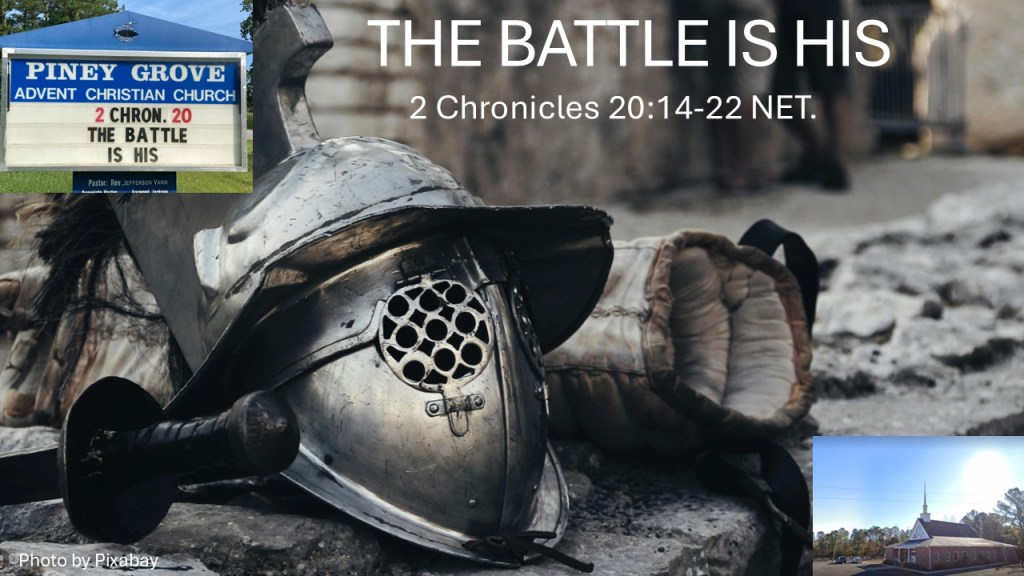
THE BATTLE IS HIS

THE BATTLE IS HIS

2 Chronicles 20:14-22 NET.

14 Then in the midst of the assembly, the LORD’s Spirit came upon Jachaziel son of Zechariah, son of Benaiah, son of Jeiel, son of Mattaniah, a Levite and descendant of Asaph. 15 He said: “Pay attention, all you people of Judah, residents of Jerusalem, and King Jehoshaphat! This is what the LORD says to you: ‘Don’t be afraid and don’t panic because of this huge army! For the battle is not yours, but God’s. 16 Tomorrow march down against them as they come up the Ascent of Ziz. You will find them at the end of the ravine in front of the Desert of Jeruel. 17 You will not fight in this battle. Take your positions, stand, and watch the LORD deliver you, O Judah and Jerusalem. Don’t be afraid and don’t panic! Tomorrow march out toward them; the LORD is with you!'” 18 Jehoshaphat bowed down with his face toward the ground, and all the people of Judah and the residents of Jerusalem fell down before the LORD and worshiped him. 19 Then some Levites, from the Kohathites and Korahites, got up and loudly praised the LORD God of Israel. 20 Early the next morning they marched out to the Desert of Tekoa. When they were ready to march, Jehoshaphat stood up and said: “Listen to me, you people of Judah and residents of Jerusalem! Trust in the LORD your God and you will be safe! Trust in the message of his prophets and you will win.” 21 He met with the people and appointed musicians to play before the LORD and praise his majestic splendor. As they marched ahead of the warriors they said: “Give thanks to the LORD, for his loyal love endures.” 22 When they began to shout and praise, the LORD suddenly attacked the Ammonites, Moabites, and men from Mount Seir who were invading Judah, and they were defeated.

When we study the word of God in the Bible, it is meant to transform us. It’s like exercise. If we stay committed, it can make us stronger. But for that to happen, we need to keep increasing the challenge—adding weights to the bar or extending our running distance. Strength doesn’t come from doing the same exercise day after day, week after week, and year after year. That’s why we are spending some time this year on some lesser-known Old Testament passages.

Let me remind you again of those verses in the New Testament that describe the purpose of Scripture. “Every scripture is inspired by God and useful for teaching,  reproof, correction, and training in righteousness, that the person dedicated to God may be capable and equipped for every good work” (2 Timothy 3:16-17). That quote begins with the word “every.” In order to serve as messengers of God’s word, we need to know more than just the familiar passages from our favorite books. We need to add more weights to the bar. We need to go further than we did last year.

Amy Grant sang a song about a person who refused to do that. The song goes like this:

“I know a man, maybe you know him, too
You never can tell; he might even be you
He knelt at the altar, and that was the end
He’s saved, and that’s all that matters to him
His spiritual tummy, it can’t take too much
One day a week, he gets a spiritual lunch
On Sunday, he puts on his spiritual best
And gives his language a spiritual rest
He’s just a faaa…
He’s just a fat little baby!
Wa, wa, waaaaa…
He wants his bottle, and he don’t mean maybe
He sampled solid foods once or twice
But he says doctrine leaves him cold as ice
Ba, ba, ba, ba…ba, ba…ba, ba!
He’s been baptized, sanctified, redeemed by the blood
But his daily devotions are stuck in the mud
He knows the books of the Bible and John 3:16
He’s got the biggest King James you’ve ever seen!
I’ve always wondered if he’ll grow up someday
He’s momma’s boy, and he likes it that way
If you happen to see him, tell him I said,
“He’ll never grow, if he never gets fed”
He’s just a fat, fat, fat, fat, fat, fa-at, fat…
Fat, Fat, Fat, Fat, Fat, Fa-at, Fat…
Fat, Fat, Fat, Fat, Fat, Fat, Fatttt…
Baby…”[1]

It’s funny when we think about it, but it’s scary when we realize that all of us can be guilty of that kind of attitude toward the Bible. We like certain parts, but there are whole sections of the Word of God that we don’t go to that often. We need to be reminded of the significance of that word “every.” God wants us to master every word, every book in both Testaments. All Scripture is inspired. All Scripture is profitable.

In today’s text, we are back in the Chronicles of the Kings of Judah. Last week, Solomon, and the week before that, David. All three kings were praying, but for different reasons. David prayed to halt a plague, and Solomon prayed to dedicate the temple. Today’s chapter begins with a prayer by King Jehoshaphat. He was one of the good kings of Judah. But at this time, his nation was facing an invasion. Three armies had gathered on the East side of the Dead Sea.

I want to talk a little about the King’s work today. We don’t often think about that aspect of what a king does, but we see it in these three kings of Judah. David prayed, his son Solomon prayed, and his great-great-grandson Jehoshaphat prayed. When the nation had a challenge, it was their leader’s first responsibility not to rule them, but to intercede for them. He declared a fast.

Then he stood before the assembly of Judah and Jerusalem at the LORD’s temple, in front of the new courtyard. He prayed: “O LORD God of our ancestors, you are the God who lives in heaven and rules over all the kingdoms of the nations. You possess strength and power; no one can stand against you. Our God, you drove out the inhabitants of this land before your people Israel and gave it as a permanent possession to the descendants of your friend Abraham. They settled down in it and built a temple to honor you, saying, ‘If disaster comes on us in the form of military attack, judgment, plague, or famine, we will stand in front of this temple before you, for you are present in it. We will cry out to you for help in our distress, so that you will hear and deliver us.’ Now the Ammonites, Moabites, and men from Mount Seir are coming! When Israel came from Egypt, you did not allow them to invade these lands. They bypassed them and did not destroy them. Look how they are repaying us! They come to drive us out of the land you assigned to us! Our God, will you not judge them? For we are powerless against this vast army attacking us! We don’t know what to do; we look to you for help.

Notice also the People’s work in today’s story. While the king was praying, the whole nation had gathered and was fasting—all the men, with their wives and children, even the infants.  The Holy Spirit spoke to one of those men. He was a Levite of the clan of Asaph. His name was Jachaziel. The Lord spoke through him and told the soldiers to march down to meet the enemy the next day. He told them exactly where they would meet the enemy. He also told them not to be afraid. He said they would meet the enemy, but they would not have to defeat them. He said the battle was not theirs, it was the LORD’s. He said they will not fight in this battle. He said, “Take your positions, stand, and watch the LORD deliver you, O Judah and Jerusalem. Don’t be afraid and don’t panic! Tomorrow, march out toward them; the LORD is with you!'”

The people had a responsibility to take their positions, even though the LORD himself would be the one engaging in battle. Even when our Lord Jesus was doing his great miracles of healing and deliverance, he always required the recipient to do something. He wanted them to show their dependence on him and their faith in him. That is what God was doing for the nation of Judah under Jehoshaphat. He is saying that he intends to fight for us, but he requires that we take our positions. Many are refusing even to do that. He wants to bless us all, and all we have to do is show up. But we don’t show up. We hide in our houses with our private religion, and we don’t dare declare our faith in God, yet we still hope that he might bless us.

God has ordained the gathering as one way for us to declare our allegiance to him and our dependence on him. When we gather, the Holy Spirit can come upon some like he did for Jachaziel. That was when God’s people got their marching orders. The king had ordered a fast and an assembly, but the people had to show up. The marching orders were given, but the soldiers had to take their positions. The people had a responsibility to take their positions, even though the LORD himself would be the one engaging in battle.

The people’s natural response upon hearing what Jachaziel said was to bow down and worship the LORD. Then, their natural reaction was to get up and loudly praise the Lord. They worshipped before the battle took place, before the victory came. Their worship was another declaration of their faith in God. That is what worship is for us today as well. It is not us getting together only when we have some testimony of something exciting the Lord has done for us. We come together to declare our faith in what the Lord is going to do for us. Even when we are down, discouraged, and heartbroken, we get together because we have a God who fights for us. We worship before the victory comes because our God is faithful and the battle is his!

Even during the battle, Jehoshaphat commanded that musicians play before the Lord and praise his majestic splendor. He appointed them to march ahead of the soldiers. They were chanting. They chanted the same chant we did last week when we responsively read Psalm 136: “Give thanks to the LORD, for his loyal love endures.”

Notice also what today’s text says about the LORD’s work. While the musicians were chanting praise to God and the soldiers were marching forward, the LORD suddenly attacked the opposing armies. He caused the Ammonite armies and the Moabite armies to attack the armies of the men from Mount Seir. The armies annihilated each other!

When the men of Judah reached the lookout overlooking the desert and saw the vast army, they noticed dead bodies on the ground—there were no survivors! Jehoshaphat and his men went to gather the spoil. They found a massive amount of supplies, clothing, and valuables. They took everything they could carry. The spoil was so great that it took them three days to haul it all away.

That is what happens when God’s people declare their faith in him and trust him to fight their battles. It could have happened very differently if the king hadn’t prayed, if the people hadn’t come together and fasted, or if Jachaziel hadn’t been open to the Holy Spirit.

God wants to do mighty work in this community as well, and he wants all the Christian congregations to witness that work. All he asks of us is that we gather, pray, fast, and take our positions. He wants us to praise and worship him like the victory has already happened.

The situation for King Jehoshaphat and the kingdom of Judah was critical. They faced three enemy armies that might have destroyed them and taken their land. But God wanted them to know that they had nothing to fear. They had access to a power far greater than the power of these armies. They worshipped in faith, knowing that God would intervene, but not knowing the details. None of them could have imagined that they would be spending three days just picking up the loot left behind by those armies!

God was not caught off guard by this battle. It was not a surprise to him. In fact, he didn’t just allow it, he ordained it. It was his way of blessing his people with a blessing that they did not see coming. They should have brought croker sacks to this battle because they were going to need them. It was going to take a few days for them to haul off all the blessings that God intended. The ordeal that they had feared was actually a blessing in disguise.

The lesson for you and me today is that our God does not just want to prevent the battles we might face. He wants to fight those battles for us. He is prepared to go above and beyond what we can even imagine asking him to do. The battle is his. But are there people who dare to trust him and praise him before the battle starts? Where are our musicians confidently chanting, going ahead of the soldiers? Where are the soldiers, going where the battle will take place, following the orders of the Holy Spirit? Where are the congregations, praying and fasting and trusting in the Lord to intervene?

The New Testament tells us that our enemy, the devil, is like a roaring lion on the prowl, looking for someone to devour. It tells us to resist him. Yes, it says we are to resist the devil, but we don’t have the power to resist him. Nevertheless, that is what we are told to do. To God belongs the power forever. The battle is his forever.


[1] Fat Baby (Songwriters: Rodney S. Robison / Steve Millikan).