HEZEKIAH’S CHOICE

HEZEKIAH’S CHOICE

2 Kings 19:1-4 NET.

1 When King Hezekiah heard this, he tore his clothes, put on sackcloth, and went to the LORD’s temple. 2 He sent Eliakim the palace supervisor, Shebna the scribe, and the leading priests, clothed in sackcloth, with this message to the prophet Isaiah son of Amoz: 3 “This is what Hezekiah says: ‘This is a day of distress, insults, and humiliation, as when a baby is ready to leave the birth canal, but the mother lacks the strength to push it through. 4 Perhaps the LORD your God will hear all these things the chief adviser has spoken on behalf of his master, the king of Assyria, who sent him to taunt the living God. When the LORD your God hears, perhaps he will punish him for the things he has said. So pray for this remnant that remains.'”

The superpower during this time was the Assyrian Empire under King Sennacherib. The empire had already invaded the holy land and taken control of the entire northern kingdom, Israel. It had also captured all the fortified cities in Judah, except for Jerusalem itself. Sennacherib fully intended to complete the task and conquer Jerusalem as well. However, he first wanted to play with them a little. He sent his commanding general and chief adviser along with a taunting letter. The letter cautioned Judah not to rely on an alliance with Egypt to save them. It stated that they could not depend on Yahveh, the God of the Jews, either, since Yahveh had instructed Assyria to march against the land and destroy it.

While he was reading this letter, some officials in Judah asked the commanding general not to speak in Hebrew but to deliver his message in Aramaic. They were concerned that ordinary people would be discouraged by this news. However, the commanding general refused. He stated, “My master did not send me to speak these words only to your master and to you. His message is also for the men who sit on the wall, for they will eat their excrement and drink their urine along with you.” He proclaimed this message in Hebrew so everyone could hear it: “This is what the king says: ‘Don’t let Hezekiah mislead you, for he is not able to rescue you from my hand! Don’t let Hezekiah talk you into trusting in the LORD when he says, “The LORD will certainly rescue us; this city will not be handed over to the king of Assyria.” Don’t listen to Hezekiah!’ For this is what the king of Assyria says, ‘Send me a token of your submission and surrender to me. Then each of you may eat from his own vine and fig tree and drink water from his cistern, until I come and take you to a land just like your own — a land of grain and new wine, a land of bread and vineyards, a land of olive trees and honey. Then you will live and not die. Don’t listen to Hezekiah, for he is misleading you when he says, “The LORD will rescue us.” Have any of the gods of the nations actually rescued his land from the power of the king of Assyria? Where are the gods of Hamath and Arpad? Where are the gods of Sepharvaim, Hena, and Ivvah? Indeed, did any gods rescue Samaria from my power? Who among all the gods of the lands has rescued their lands from my power? So how can the LORD rescue Jerusalem from my power?”

The king of Judah at that time was Hezekiah. He was not a perfect man; in fact, the Bible records some of his failures. However, today’s passage focuses on a time when he and his city faced a terrible crisis, and he made the right choice. That is what I want to discuss this morning. The Bible recounts instances where the people of God faced insurmountable odds and emerged triumphant. These stories are God’s gift to us, guiding us in making the right choices. So, here is what I observe in today’s text.

What Hezekiah wore (1).

He tore his clothes and put on sackcloth, which is funeral attire. It is what someone wears when they are in deep mourning. Hezekiah ripped up his royal robe and donned the dress of the seriously afflicted. He did not strap on his sword and call his captains to battle. He understood that would not work. The enemy was too great, and he had no confidence that he could prevail. Now was not the time to pull himself up by his bootstraps. Now was not the time for a stirring speech to motivate his troops into battle. Now was the time for the king to serve as a representative of the people and appeal to a power greater than himself and more potent than his army.

The book of the prophet Jonah describes such a time. Jonah appeared to the Ninevites and proclaimed their impending destruction. The King of the Ninevites declared a fast and led his people to repent and seek God’s favor. That is not what Jonah wanted, but it is always what God desires. He does not wish for anyone to be destroyed; He wants everyone to repent. By the way, do you know what Nineveh was? It was the capital city of this same Assyrian empire. It was a large, evil, and violent city, but even Nineveh was not a lost cause. The lesson we learn from all this is that it does not matter who you are or what your reputation is. In times of crisis, the best choice is to humble yourself.

But there’s more. Look at where Hezekiah went (1).

He did not barricade himself in his palace. He did not lock himself in his royal panic room. Instead, he went into the temple courts. When all else fails – or, in this case, is about to fail – seek God. Cast your cares on the Lord because he cares for you. In times of trouble, seek God. In times of crisis, go to the Lord’s house.

Contact any medical facility in this area, and you will likely first encounter a recording. What does that recording say? The first thing you will probably hear is this: “If this is an emergency, hang up and dial 9-1-1.” Don’t waste time trying to get help from a clinic that isn’t equipped to provide the assistance you need. You need an ambulance. You need the police. You need firefighters. This is not a normal situation. This is a crisis that requires a first responder.

Hezekiah realized he had to go to God’s house. God was the only qualified first responder in this crisis. While all the fortified cities of Judah had walls, those walls could not stop the invasion of the Assyrian armies. Hezekiah understood that the walls of Jerusalem wouldn’t be sufficient. However, he recognized that Jerusalem possessed something none of the other cities had: the temple of Yahveh. God is present everywhere, but the symbol of His presence is located in a specific place in this city.

Notice also what Hezekiah said (3).

From his position in the temple courts, Hezekiah summoned his cabinet members: his chief of staff, Eliakim; his secretary, Shebna; and the leading priests. He gave them all the same instruction: to find Isaiah. The king had a message for Isaiah: Now is the time. The baby is ready, but the mother lacks the strength to give birth. Isaiah was the most prominent prophet of Yahveh during Hezekiah’s reign. King Hezekiah understood that he needed the Lord, so he went to the temple. He also recognized that he needed the word of the Lord, so he called for Isaiah. All he required was a message from God.

Notice what Hezekiah prayed (4).

He said, “Perhaps the LORD your God will hear all these things the chief adviser has spoken on behalf of his master, the king of Assyria, who sent him to taunt the living God. When the LORD your God hears, perhaps he will punish him for the things he has said. So pray for this remnant that remains.’

Hezekiah does not pray for the walls of Jerusalem to be strong enough to withstand Sennacherib’s army or for the defeat of the Assyrian Empire. Instead, he prays for two things: that God would punish Sennacherib for his blasphemy—his insult to God himself—and that God would help the remnant.

When Isaiah responds, his message goes beyond the specific requests that Hezekiah mentioned. We should not be surprised by this, as that is how God always works. He is able to do far more than we ask Him to do or even think of asking Him for (Ephesians 3:20). Hezekiah didn’t need to get all the wording of his prayer correct. What was important was that Hezekiah knew where to go and to whom to pray.

Isaiah sent back this message: “’This is what the LORD says: ‘Don’t be afraid because of the things you have heard — these insults the king of Assyria’s servants have hurled against me. Look, I will take control of his mind; he will receive a report and return to his land. I will cut him down with a sword in his land.”

That did happen, but it would occur many years later. It was the answer to Hezekiah’s prayer, but it did not lead to an immediate end to the siege. God took care of that problem as well, even though Hezekiah did not specifically pray for it at that time. In a later prayer, Hezekiah would say, “Yahveh, God of Israel, who is enthroned on the cherubs! You alone are God over all the kingdoms of the earth. You made the sky and the land. Pay attention, Yahveh, and hear! Open your eyes, Yahveh, and observe! Listen to the message Sennacherib sent and how he taunts the living God! It is true, Yahveh, that the kings of Assyria have destroyed the nations and their lands. They have burned the gods of the nations, for they are not really gods, but only the product of human hands, manufactured from wood and stone. That is why the Assyrians could destroy them. Now, O Yahveh our God, rescue us from his power, so that all the kingdoms of the earth will know that you, Yahveh, are the only God.

In response to that prayer, the Lord halted Senacherib’s army without Judah firing a single shot. While the soldiers in the Assyrian camp were sleeping, an angel from God entered the camp and killed 185,000 of them. They broke camp the next day and returned to Nineveh.

If you visit London today, you can check out a museum housing a message penned by Sennacherib boasting about all his conquests. The message lists the nations he defeated. Notably absent from that list is any reference to his conquest of the great city of Jerusalem. The Bible explains why he stopped at that point. It was all due to a prayer.

I had mentioned at the beginning of today’s message that Hezekiah was not a perfect man. It is essential that we also understand where Hezekiah failed (ch. 20).

The Old Testament documents the people of God’s failures and successes. We must understand that even if God has used us in the past, we are not immune to making poor choices now. Chapter 20 recounts how a delegation from the King of Babylon visited Hezekiah. He welcomed them and treated them to a tour of his palace and all his treasures. That was not a wise decision. 

Isaiah told Hezekiah that a time would come when everything in his palace and the belongings his ancestors had accumulated would be carried away to Babylon; nothing would remain. He mentioned that some of Hezekiah’s descendants would be taken captive and made eunuchs in the king of Babylon’s palace. Hezekiah replied that at least there would be peace during his lifetime.

We cannot afford to make choices that will lead to challenging times for our children and grandchildren. We cannot look around at all the blessings we have now and not think about the world in which our children and grandchildren will live.

On this day, as we celebrate the fathers among us, we must learn from the mistake Hezekiah made as a father. Fathers all over the planet are currently making the same error. They are befriending the enemy, not realizing that their children will bear the consequences of that friendship. A little accommodation here, a little compromise there, and they are creating a world that enslaves their children and grandchildren.

Some of you have not been blessed with a believing father. That is unfortunate. However, the real tragedy would be this: it would be a tragedy if your children do not experience the blessing of having a believing father. Our faith in Christ must be firm, built on the unshakable foundation of the word of God. We owe our children that legacy. We may not have a wealth of material possessions to leave them, but we must pass on that faith. If we fail them in this regard, nothing else will matter.

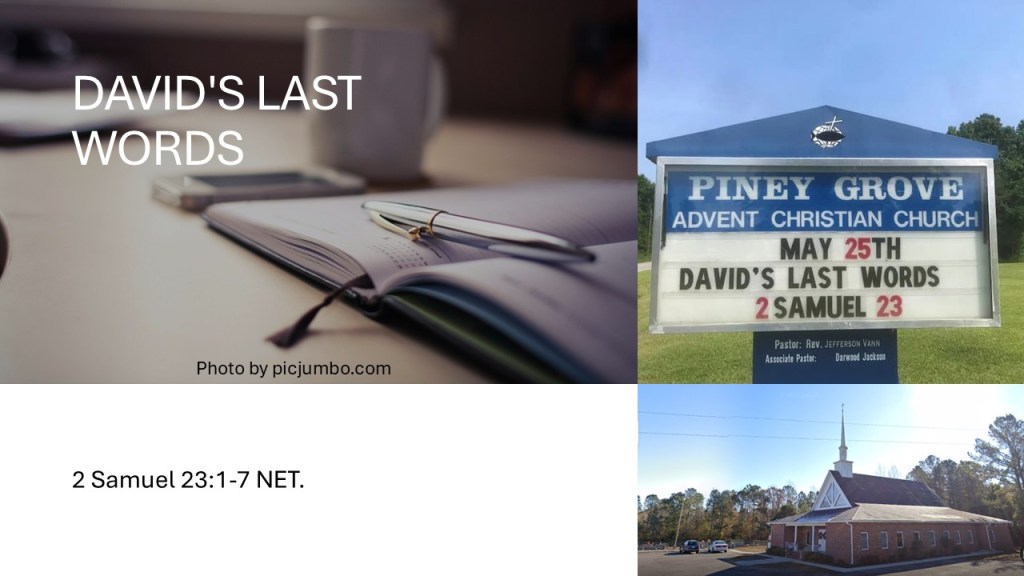
DAVID’S LAST WORDS

DAVID’S LAST WORDS

2 Samuel 23:1-7 NET.

1 These are the final words of David: “The oracle of David son of Jesse, the oracle of the man raised up as the ruler chosen by the God of Jacob, Israel’s beloved singer of songs: 2 The LORD’s spirit spoke through me; his word was on my tongue. 3 The God of Israel spoke, the protector of Israel spoke to me. The one who rules fairly among men, the one who rules in the fear of God, 4 is like the light of morning when the sun comes up, a morning in which there are no clouds. He is like the brightness after rain that produces grass from the earth. 5 My dynasty is approved by God, for he has made a perpetual covenant with me, arranged in all its particulars and secured. He always delivers me, and brings all I desire to fruition. 6 But evil people are like thorns — all of them are tossed away, for they cannot be held in the hand. 7 The one who touches them must use an iron instrument or the wooden shaft of a spear. They are completely burned up right where they lie!”

When people train for an advanced degree in ministry beyond the initial bachelor’s degree, they usually go to a seminary. I had the opportunity to study at three seminaries, and graduated from two of them. While I was at seminary, in addition to the classes, I also attended regular worship services during the week – chapel services. Sometimes we would have guest speakers at the chapels, but many times it would be the same teachers we had in regular classes. In one of my chapel experiences, they put on a series called The Last Sermon. Each professor would give a message as if it were the last message the speaker could give before dying. When I attended those messages, I did not hear anything new. It was a lot of what I had heard in the classes. The speakers wanted to emphasize the things that they had stressed in their teaching throughout the years. They tried to pass on their legacy.

Reading today’s text, I get the impression that David is doing the same thing. He had one last chance to make an impact on the people who would read these words, so he focused on the things that really mattered to him. He could have recounted the significant victories of his life, like his defeat of Goliath, or his many victorious battles against the surrounding enemies. He could have apologized for his disastrous failures. He could have recounted all his friendships and loyal supporters. But of all the things that David could have spoken about, it is revealing that he chose to say these things.

David is not the only one whose last words are given to us in Scripture. Peter told his readers that the Day of the Lord is coming, that there will be a new heaven and a new earth, and that they should make every effort that when Jesus comes, he finds them at peace and without stains or blemishes (2 Peter 3). John said that he has no greater joy than hearing that his children are living according to the truth (3 John). Paul says that he is already being poured out as an offering, and the time for him to depart is at hand. He says he has competed well; he has finished the race; he has kept the faith! He says the crown of righteousness is reserved for him. The Lord, the righteous Judge, will award it to him on that day — and not to him only, but also to all of us who have set our affection on his appearing (2 Timothy 4).

We all want two things: to live life well and to make a difference in the lives of others. David made some terrible mistakes, but as he surveys his life, he can still see that he made an impact. He wanted to pass on his legacy, and that is what this little poem is all about.

It tells us who David said he was (1).

David identifies himself first as the son of Jesse. If you remember the story, Samuel was told by the LORD to go to Jesse’s house and anoint one of his sons. He gets there and surveys seven sons of Jesse, but the Spirit tells him that none of them is the one. Then he discovers that Jesse had another son, the youngest, who was not invited to the party. He was tending the flocks. His father did not see greatness in him. His father saw potential in the others, but not in him. We could say that God saw into David’s heart and knew he had what it takes. But that is not what David noted in his last words. He calls himself “the man raised up as the ruler chosen by the God of Jacob.” He implied that all his accomplishments were the result of the plan of God. God raised him up, and God chose him.

Our ladies are watching and studying the video series called “The Chosen.” It is about the apostles whom Jesus chose to proclaim his teachings and to begin the process of evangelizing the world. They are the chosen. That is what David wanted to be remembered as. He wanted people to know that he was an ordinary man whom God chose to do extraordinary things. He was just the son of Jesse, but God chose him. God raised him up. Everything he experienced – his life in the field, his ordeals in exile and under threat from Saul, his battles – everything was preparation for the life God wanted him to live.

David calls himself Israel’s beloved singer of songs. Music and poetry set to music was David’s legacy. It turns out that the words of David’s songs would be more influential than he would ever dream. His words would outlast his life. His words are still changing lives today, thousands of years later. We have been reading the history of David’s life and reign, and some of the things that happened to him encourage us, and some of the things confuse us. But when we read his songs, that is when we see the man’s true legacy.

Today’s text tells us what David said God did for him (2-5).

David does not brag about what he did. He brags about what the Lord did for him. He says that the LORD’s Spirit spoke through him. God’s word was literally on his tongue and came out of his mouth. He was the one who told us that the person whom God blesses will be like a tree planted by flowing streams, yielding its fruit and brandishing leaves that never fall off. He was the one who told us that the LORD is his shepherd, and because of that relationship, he will never need anything. His shepherd takes care of him today and gives him hope for eternity. He was the one who wrote the longest chapter in the Bible, an acrostic poem that praises the excellency of God’s word. After 3000 years, the words of David are still being read, studied, translated, sung, paraphrased, preached, and published.

David tells us about God’s ruler. He calls his poem an oracle. That clues us in that David is not just talking about the past. He is prophesying. He speaks of his dynasty because he sees a future king who will do more for humanity than even he was able to accomplish. It is this ruler who rules in the fear of God and is like the morning sunlight, producing divine growth. It is this ruler who is the reason that God made a covenant with David. God made the covenant, arranged all the particulars, and will see to it that all the stipulations of the covenant are met. In order to really understand the legacy of David, we have to look beyond David. We have to realize that David is a type. A type predicts a coming antitype. A type prophesies the future fulfillment. David’s existence helps us to focus on the one greater than David who was to come. David is a prophecy of Jesus.

When Matthew wrote his Gospel, he called Jesus the son of David and the son of Abraham. The last part of Matthew’s Gospel is all about the crucifixion and resurrection of Jesus. He was fulfilling the type of the son of Abraham: Isaac. Isaac was the one and only son that God told Abraham to sacrifice on Mount Moriah. The first part of Matthew’s Gospel contains stories about how God preserved Jesus from destruction. An evil king wanted to destroy him because he saw this child as a threat to his reign. The wizards had seen in the stars that a new king of Israel had been born. Jesus was the descendant of David. God still has a plan that includes a future reign of this son of David. In his legacy poem, David spoke of God’s approving of his dynasty. Many of the kings of his dynasty were not approved by God. But Jesus was the reason that God approved of his dynasty.

Today’s text tells us what David said God did not do to him (6-7).

Verse six changes the imagery. Here, David speaks of evil people and says that they are like thorns. Nobody keeps a thorn collection. If I am out in my garden and I find a thorn bush, I pull it up and toss it away. Thorns cannot be held in the hand, and they serve no purpose. David says that if I want to hold on to thorns, I use an iron instrument or the wooden shaft of a spear. Thorns are best disposed of and burned. David had some times in his life when he definitely felt like thorns that God would be justified in burning up.

For example, in Psalm 51, David cries out for God to have mercy on him because he has committed such a terrible sin that he knows all he deserves is to be treated like those thorns and burned up. He knows he deserves condemnation, and so he cries out for God to cleanse him and let him see the joy of forgiveness. He deserves for God to reject him, to take the Holy Spirit away from him. God would have been entirely justified if he had done just that. But David pleads for God to act in grace and mercy.

David’s ultimate legacy is twofold. First, he set the stage for the king who would come after him. He was a type of Christ and started the dynasty from which Christ came. Second, David serves as an example for all of us in recognizing the gravity of his rebellion, turning to God in repentance, and seeking his forgiveness and restoration.

Every Sunday, we have a member ministry time, and one of the things we have an opportunity to do during that time is to give our testimony. Not many of us have given our testimony. I imagine many of you want to say something, but you don’t know what to say. Maybe we can take our cue from David. In today’s text, he draws our attention to the thorns – the evil people. What David is saying is that he has been a thorn. He had the opportunity to do the right thing, but he blew it. He failed God. He deserves to be burned to a crisp. But God, in his grace, chose to forgive him instead. He was dirty, and God in his grace decided to clean him up rather than throw him out. He deserved to be cursed, but God in his grace chose to bless him instead.

LORD, give us all a legacy! Use us to impact those around us and lead them to you.

EXTENDING GOD’S KINDNESS

EXTENDING GOD’S KINDNESS

2 Samuel 9:1-7 NET.

1 Then David asked, “Is anyone still left from the family of Saul, so that I may extend kindness to him for the sake of Jonathan?” 2 Now there was a servant from Saul’s house named Ziba, so he was summoned to David. The king asked him, “Are you Ziba?” He replied, “At your service.” 3 The king asked, “Is there not someone left from Saul’s family, that I may extend God’s kindness to him?” Ziba said to the king, “One of Jonathan’s sons is left; both of his feet are crippled.” 4 The king asked him, “Where is he?” Ziba told the king, “He is at the house of Makir son of Ammiel in Lo Debar. 5 So King David had him brought from the house of Makir son of Ammiel in Lo Debar. 6 When Mephibosheth son of Jonathan, the son of Saul, came to David, he bowed low with his face toward the ground. David said, “Mephibosheth?” He replied, “Yes, at your service.” 7 David said to him, “Don’t be afraid, because I will certainly extend kindness to you for the sake of Jonathan, your father. You will be a regular guest at my table.”

We are reading through the Bible, two chapters a day, and our calendars have brought us to the story of Mephibosheth. This is a fantastic story from the Bible, and it is so relevant for us.  I have prayed that God would give me the ability to open this story to reveal all its significance because, as we read the text, it is possible to recognize some of what is going on but miss so much.

The story of Mephibosheth

The story begins when King David asks if there are any members of Saul’s family left. That question was not unusual for a king to ask. In that period, when a new king gained the throne, one of the first things he did was to seek out all the family members and supporters of the previous king and put them to death. No one would have been surprised if David had asked that question for that purpose. It would have been the politically appropriate choice for David in that position. He had spent a significant portion of his life being pursued by Saul. The former king had been envious of David and fearful of him, and that led to Saul taking aim at David and seeking to destroy him on numerous occasions.

There were even some occasions when it appeared that God had miraculously handed Saul over to David. We read about one such time when David and his men were sitting in the recesses of a cave. Saul had taken three thousand soldiers and set off to capture David. They had come to the sheepfolds by the road, and Saul had to relieve himself, so he decided to duck into this cave. David and his men were watching. The men told David that this was a fulfillment of God’s promise to give his enemy into his hand. But all David did was sneak in and cut off the edge of Saul’s robe.

That was one such incident, and there was another later on. Saul was again out with his 3,000-soldier army seeking to kill David. He and his men set up camp on a hill. David and one of his men (Abishai) came into the camp and found everyone sleeping. So they went all the way up the hill to the top, and there, in the center of the camp, they found Saul sleeping, with his commanding general Abner at his side. Abishai said, “Today God has delivered your enemy into your hands. Now let me drive the spear right through him into the ground with one swift jab! A second jab won’t be necessary!” But David would not do it. It wasn’t because David was afraid of Saul. It was because David knew that he did not have to be the one to destroy his enemy. He trusted God to do that.

That fateful day for Saul came during a battle with the Philistines at Mount Gilboa. Saul was severely wounded and chose to take his own life by falling on his sword. His sons, including Jonathan, also died in that battle. Jonathan had been a very close friend of David. He had protected and defended David.

Mephibosheth was five years old on the day his father, Jonathan, and grandfather, Saul, died. When they heard the news of that tragic battle, the members of Jonathan’s household panicked. His nanny picked him up and started to run. But she tripped, and Mephibosheth was injured in the fall. From that day on, Mephibosheth was disabled. He would live the rest of his life that way.

Our text indicates that Mephibosheth was living in hiding. He escaped destruction only by keeping his whereabouts secret. He did not announce his family history. Only a few knew where he was hiding. David interviews Ziba to find out. Ziba had been one of Saul’s slaves, but he had made a good life for himself after the death of his master. Ziba knew the secret, but he was reluctant to tell anyone. You get the sense that he was not exactly trusting David’s motivation. He reveals the fact that the man is disabled and where he is living, but he does not tell David his name.

David’s men find Mephibosheth at he house of Makir in Lo Debar. He is brought before the king, and he bows low with his face to the ground. He had every reason to expect to be put to death that day. But David says to him, “Don’t be afraid, because I will certainly extend kindness to you for the sake of Jonathan, your father. You will be a regular guest at my table.”

David showed kindness to Mephibosheth for three reasons. First, as the text says, David wanted to repay Jonathan’s kindness. He misses his friend and wants to bless Jonathan’s family.

Second, David had promised Saul that he would not eliminate all of Saul’s family when he gained the throne. David was being faithful to Saul even though Saul had not been kind to him. David was acting with integrity.

But David chose to bless Mephibosheth for a third reason, which is also in today’s text. Look more closely at verse 3, where David asks Ziba, “Is there not someone left from Saul’s family, that I may extend God’s kindness to him?” The word for “kindness” in Hebrew is very significant in the Old Testament.  It is the word חֶסֶד, a word that suggests loyalty to a covenant, mercy, and loving faithfulness.

  • It was the word Lot used to explain why God had mercifully saved him from the destruction of Sodom and Gomorrah (Genesis 19:19).
  • It was the word that Abraham’s servant used when he prayed that God would be loyal to Abraham by blessing him with a daughter-in-law (Genesis 24:12).
  • It was the word Jacob used when he praised God for all his faithful love (Genesis 32:10).
  • When the LORD passed by Moses, he proclaimed his own identity by giving himself this title: “The LORD, the LORD, the compassionate and gracious God, slow to anger, and abounding in חֶסֶד and faithfulness, keeping חֶסֶד for thousands, forgiving iniquity and transgression and sin.”

David learned that one thing is always true of God: He is always faithful to his covenant. That attribute made it possible always to approach God and get forgiveness when needed. David knew failure, but he also knew forgiveness. He knew that he could trust God to correct any of his failures. He knew that he had a friend in heaven who would never turn him away.

What David wanted to do for Mephibosheth was to bless him with the same kind of faithful love that God had blessed him with. That is why David said that he wanted to extend God’s kindness to this young man. He did not know Mephibosheth. The man had never done anything to deserve his kindness. David wanted to bless him because God had blessed David.

We can learn some things from how Mephibosheth was blessed by David. Mephibosheth is an example of How to Receive God’s Kindness.

The man is damaged goods, and he knows it. Someone made a mistake, and he has spent his whole life paying for that mistake. His grandfather was a king, but he never felt like a king. His legacy was failure. Saul failed at being a king. He failed in battle. He failed God. He failed his family. Mephibosheth was alive, but he was not intact. He was a broken man.

The man had lived his entire adult life in hiding. He was the son of Adam and Eve, who thought that they would find freedom by transgressing God’s commandment. But as soon as they sinned, they came to know that their sin did not bring them glory, but shame. So, they hid. By one act, we are all forced to be separated from the source of life.

The man was weak. He did not function properly. He needed others to do for him because he could not manage his protection and provision.

The man was poor. He had lost all his resources, and the means to correct his poverty were out of his reach.

Mephibosheth is forced to receive David’s kindness passively, and every one of us who has come to Christ came to him the same way. We could not save ourselves, bless ourselves, or rescue ourselves.

Nothing in my hands I bring,
Simply to Thy cross I cling;
Naked, come to Thee for dress,
Helpless, look to Thee for grace:
Foul, I to the fountain fly,
Wash me, Savior, or I die.[1]

Receiving God’s kindness and forgiveness is not difficult. However, it does require letting go of one’s pride and sense of accomplishment. Repentance happens when we realize that we are like Mephibosheth—our greatness is nonexistent, our power is weakness, and our wealth is poverty.

If you are listening to my voice today and you have not come to God for forgiveness, you may think you have a life, but you are missing out. Mephibosheth was ready to give up his life in hiding because he stood to gain a life at the king’s table. A life of blessing awaits all those who humbly come to God and receive his kindness.

We also learn some things from David’s actions in today’s story. He had been a recipient of God’s kindness, and he chose to extend that kindness to Mephibosheth. He showed us How to Extend God’s Kindness.

David was blessed, and he decided to be a blessing. This was not an arbitrary decision. He chose to bless Mephibosheth because he knew that God expected him to extend the kindness he received to others. When we were studying the commands of Christ, we learned that. We learned that Jesus taught his disciples how to live, not because they needed to do those things in order to be saved. They were already saved because they had put their faith in Christ. No, Jesus began his sermon on the mount by pronouncing a blessing on his apostles. He blessed them because they were already the light of the world. Then he taught them how to shine. They were not to shine in order to become the light of the world. They were to shine in order to bless others so that they could know salvation as well. They were not to be obedient in order to get saved. They were to be obedient so that others could get saved.

So, Jesus taught us to love our enemies and do good to those who abuse us. By so doing, we extend God’s kindness to them, and it might result in their recognizing their need for God’s salvation in Christ. The Apostle Paul wrote to the Roman Christians, “If your enemy is hungry, feed him; if he is thirsty, give him a drink; … Do not be overcome by evil, but overcome evil with good” (Romans 12:20-21). The Apostle Peter wrote, “Do not return evil for evil or insult for insult, but instead bless others” (1 Peter 3:9). The Apostle John wrote that “love is from God, and God has fathered everyone who loves and knows God. The person who does not love does not know God, because God is love” (1 John 4:7-8).

This theme, revealed in the story of David and Mephibosheth, reverberates throughout the entire Bible. It tells us that people who are saved will pass on the blessing of their relationship with God by blessing others so that they also have an opportunity to be blessed. That is extending God’s kindness because it all began with a loving God who decided to save sinners by his grace when we all deserved his wrath.

My challenge to you, brothers and sisters, is to extend God’s kindness. If we do so, miracles will happen, but they might not be the miracles we expect. David blessed Mephibosheth, but he remained disabled all his life. The miracles in that story happened in the hearts of both David and Mephibosheth.

We can extend God’s kindness by reacting to hurt and being agents of healing, helping the needy when we are able, and befriending the people that everybody else ignores. We can extend God’s kindness by taking down some of the walls that we have built to protect ourselves from other people’s problems. Our Lord himself is the master at doing this. He told his disciples to spread his gospel to every nation. There are Mephibosheths everywhere. It won’t be hard to find them. The hard part will be loving them out of hiding and giving them a place at our dinner tables. That will take a kindness greater than any natural inclination. It will take the supernatural blessing that David called “God’s Kindness.”


[1] Rock of Ages, cleft for me

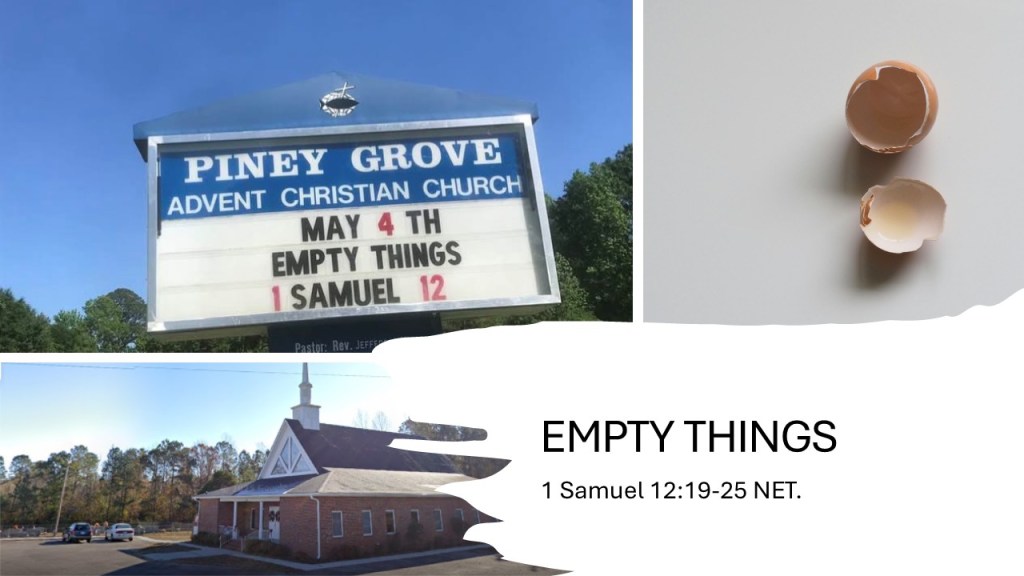
EMPTY THINGS

EMPTY THINGS

1 Samuel 12:19-25 NET.

19 All the people said to Samuel, “Pray to the LORD your God on behalf of us — your servants — so we won’t die, for we have added to all our sins by asking for a king.” 20 Then Samuel said to the people, “Don’t be afraid. You have indeed sinned. However, don’t turn aside from the LORD. Serve the LORD with all your heart. 21 You should not turn aside after empty things that can’t profit and can’t deliver, since they are empty. 22 The LORD will not abandon his people because he wants to uphold his great reputation. The LORD was pleased to make you his own people. 23 As far as I am concerned, far be it from me to sin against the LORD by ceasing to pray for you! I will instruct you in the way that is good and upright. 24 However, fear the LORD and serve him faithfully with all your heart. Just look at the great things he has done for you! 25 But if you continue to do evil, both you and your king will be swept away.”

We started reading 1 Samuel on Tuesday. We read about Hannah, who prayed so desperately for a child that the priest thought she was drunk. But the LORD answered her desperate prayers, and she gave birth to Samuel. When the boy was old enough, she gave him to be raised in God’s presence permanently.

In a sense, all of us who are believers experience what Hannah did. We knew the fruitlessness of a barren life until we met Christ and were born again. But our vow to God is to give the life he gave us back to him. We can do so with joy because life came from him in the first place.

Samuel lived with the elder priest, Eli. Samuel grew up respecting God and the priesthood, but Eli’s sons did not. They sinned and brought shame upon the land. But the LORD spoke to Samuel, and Samuel listened to his voice. So many of us put our spiritual cellphones on “do not disturb” because we cannot be bothered with a vision from God. Like it was in Eli’s day, the word of Yahveh is rare. We have God’s written word, but we often ignore that.

On Wednesday, we read about the Philistines capturing the ark. This battle resulted in the deaths of Hophni and Phineas, Eli’s sons. Eli died as well. This was a reminder that even those who profess faith in God will not always live in victory, especially if there are areas of our lives that we do not surrender to him.

This week, we read through most of Samuel’s narrative, and by this time, we notice that he is already an older man. Under his leadership, the people had gotten tired of God working out his will among them. They wanted a king and demanded that Samuel appoint one. The LORD told Samuel to relent and give them a king, and also to warn them of the price they would have to pay.

The people turned aside after empty things (21).

Samuel told the people that they should not turn aside after empty things. The Hebrew word he used was תֹּהוּ, a word that we had encountered in the first chapter of Genesis. We are told that when God first created the planet, it was formless and void. The word for formless is תֹּהוּ. It means something that doesn’t matter: a something that is a nothing.

The Israelites’ pursuit of a king and executive leadership did not seem like nothing to them. It looks like our modern society here in the USA is obsessed with the same thing. People talk, fight, plan, and scheme to get their person elected or to get who they think is the wrong person out. All the network news services join in the fight. It seems like every segment has to mention the President’s name somehow. The United States has over 300 million people, but somehow, no one matters but POTUS.

The Israelites decided that they needed a king. Samuel initially rejected their request, but the LORD told him to go along with it. The LORD sometimes refuses to give us what we want if we ask for the wrong thing. But sometimes, he gives us what we ask for to reveal the selfishness behind our asking.

We have just finished the book of Judges. The Judges were a special group of temporary and local leaders that God gave the Israelites before the monarchy. Samuel was the last of the Judges. He presided over the transition, and it must have hurt him deeply to be the last. He felt the sting of rejection behind the people’s request for a king. But he was also upset because he saw what the kings of all the nations around Israel were doing to their people. The kings led their people to acts of sacrilege and violence. The kings led their people away from God and his word. This is why Samuel called the desire for a king turning aside after empty things that cannot profit or deliver. The real power of any nation is not in its executive branch but in its relationship with God.

Samuel warned of the consequences of seeking empty things (25).

Samuel saw that a king could only make a selfish people more selfish. He warned his people that if they continued to do evil, both they and their precious king would be swept away. The people did not want to hear that. They suffered under the delusion of permanence. They assumed that they would always be around and keep doing what they were doing. But God, through Samuel, was warning them that they were not as steady as they thought they were.

Jesus teaches us the same thing. He warns his readers that they are building their houses on the sand. But he warns us that when the rain falls and the flood comes, the winds will beat on those houses and they will collapse and be utterly destroyed. We love our houses. We spend our time cleaning them, repairing them, remodeling them, and beautifying them. But if those houses are not built on the rock, then none of our efforts will matter. The house itself is just another empty thing that we have turned aside from God and run after. There are consequences of seeking empty things. Even when the empty things seem like important things, we need to keep them in perspective. We need to seek God’s kingdom and his righteousness first. All other things are empty things.

Samuel offered God’s good things (22-24).

He challenged his people to review their history and consider the great things God had done for them. We have been reading about those great things this year. I hope that we have done so, realizing that God expected his people to respond to his miraculous acts of love by returning the love. Samuel challenged his people to fear the LORD and serve him faithfully with all their heart.

When I meet a stranger and that person shows disrespect for me, I may be confused, but I don’t let it bother me. I tell myself that if that person actually knew me, they would not treat me that way. But if I get the same disrespect from one of my children, it makes me angry. Why do I get angry at the same behavior from one of my children? The reason is apparent. My children know how much I love them. They have decades of evidence of my care and concern for them. For that reason, if they disrespect me, it hurts more.

History would reveal the people’s response to Samuel’s offer.

Samuel makes a bargain with his people. He commanded them to stay faithful to God despite their past failures and to fear and follow him faithfully without getting caught up in trivial pursuits. For his part of the

bargain, Samuel promised to pray for them consistently, which is what they asked for. But he also promised to teach them the good and proper way to follow God. As we continue reading the Old Testament, we are going to see evidence that a few leaders got it right and brought reform and revival to the land and its people. But many failed to stay focused on God and his word. When that happened, God stayed faithful to his covenant. He brought punishment to his people because he had to remain faithful to his covenant with them.

Holy Communion service:

Colossians 2:14 NET

He has destroyed what was against us, a certificate of indebtedness expressed in decrees opposed to us. He has taken it away by nailing it to the cross.

I want to confess. I like to pay bills. I get a satisfactory feeling every time I sit at my computer and transfer funds from my account to pay my credit card bills. Before you volunteer to give me some of your bills to pay, I have to explain that I like paying my bills.

This month, I encountered some bills that were charged against me that I had not incurred. I didn’t want to pay those bills because they were not mine. I didn’t deserve them. So my bank reimbursed me for the false charges, and got the company that defrauded me to reimburse them.

Today, I want to remind you that you once had a charge against you in heaven’s court: a court that is even higher than any human supreme court. You deserve to answer all of those charges, but our Lord chose to take the punishment for them on himself. He took away your certificate of indebtedness and nailed it on the cross with his body. His blood cleansed you from every stain of every sin you committed. That is why we celebrate Jesus with these emblems of holy communion. It is all about him and what he did. It had to be him because only he was qualified. Only he was sinless. He became a sin offering for us. Every time we come to this table, we celebrate the forgiveness of a debt. We celebrate the freedom we now have to live without the condemnation we deserve because of the love and grace of God in Christ.

Thank you, heavenly Father, for the loving gift of your Son. His death on the cross has taken away our indebtedness and nailed it to the cross. Because of him, we can live free of the guilt and shame of sin. Thank you that our Lord Jesus Christ is not an empty thing. He is worth our faith and loyalty, and devotion because he has delivered us. Amen.

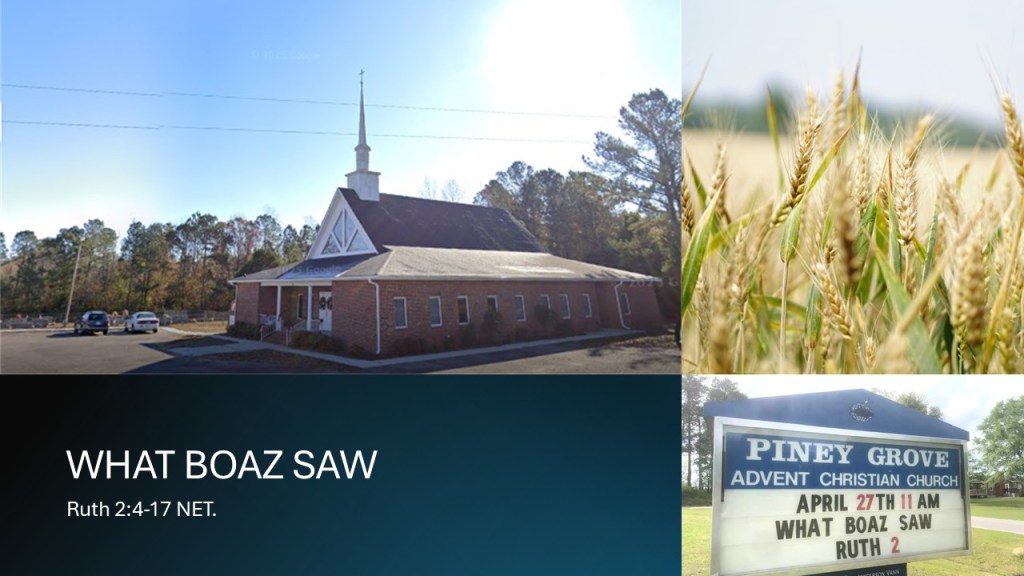
WHAT BOAZ SAW

WHAT BOAZ SAW

Ruth 2:4-17 NET.

4 Now at that very moment, Boaz arrived from Bethlehem and greeted the harvesters, “May the LORD be with you!” They replied, “May the LORD bless you!” 5 Boaz asked his servant in charge of the harvesters, “To whom does this young woman belong?” 6  The servant in charge of the harvesters replied, “She’s the young Moabite woman who came back with Naomi from the region of Moab. 7 She asked, ‘May I follow the harvesters and gather grain among the bundles?’ Since she arrived, she has been working hard from this morning until now — except for sitting in the resting hut a short time.” 8 So Boaz said to Ruth, “Listen carefully, my dear! Do not leave to gather grain in another field. You need not go beyond the limits of this field. You may go along beside my female workers. 9 Take note of the field where the men are harvesting and follow behind with the female workers. I will tell the men to leave you alone. When you are thirsty, you may go to the water jars and drink some of the water the servants draw.” 10 Ruth knelt before him with her forehead to the ground and said to him, “Why are you so kind and so attentive to me, even though I am a foreigner?” 11 Boaz replied to her, “I have been given a full report of all that you have done for your mother-in-law following the death of your husband — how you left your father and your mother, as well as your homeland, and came to live among people you did not know previously. 12 May the LORD reward your efforts! May your acts of kindness be repaid fully by the LORD God of Israel, from whom you have sought protection!” 13 She said, “You really are being kind to me, sir, for you have reassured and encouraged me, your servant, even though I am not one of your servants!” 14 Later, during the mealtime Boaz said to her, “Come here and have some food! Dip your bread in the vinegar!” So she sat down beside the harvesters. Then he handed her some roasted grain. She ate until she was full and saved the rest. 15 When she got up to gather grain, Boaz told his male servants, “Let her gather grain even among the bundles! Don’t chase her off! 16 Make sure you pull out ears of grain for her and drop them so she can gather them up. Don’t tell her not to!” 17 So she gathered grain in the field until evening. When she threshed what she had gathered, it came to about thirty pounds of barley!

We are continuing to read through the Bible, two chapters per day. Our reading has brought us to the period of the judges, and today’s text describes events that happened during that period. This was a time when the Israelites were not known for their loyalty to the LORD. There was no king, so people pretty much did whatever they wanted, with very little to prevent wickedness. It was a time and a culture much like that of our own. If you asked anyone whether what they were doing was right, they would say yes. But they were doing what was right in their own eyes. They had been given God’s law through Moses, but they paid very little attention to that law. If they wanted to do something, they did it. They did not stop to ask if what they were doing honored God. Most of the people during this time lived like that.

But there were exceptions. The life stories of some of those exceptional people are recorded in Scripture. The book of Ruth represents the islands of light in the sea of darkness. People like Ruth, Naomi, and Boaz were reminders that even during times of rampant wickedness, one can still choose to follow the Lord and be the light of the world. Many sermons have been preached that highlight the way Ruth and Naomi pierced the darkness by their faith and the actions brought about by that faith. For today’s message, I have chosen to look more closely at Boaz. The reason I want to focus on Boaz is that he had a character quality that very few in his time possessed. He had insight into the things that really mattered. He discerned how to make the right choices based on an awareness of what was significant and what was not.

I want to focus on how today’s text identifies Boaz’s insight. Each part of the passage introduces a new way of thinking that Boaz understood, but few around him did. He was set apart as an example of someone who could see opportunities where others only saw problems. He could see God at work where others only saw the mundane—the ordinary.

Boaz saw an opportunity to honor God in everything he did (4, 12).

The easiest facet of Boaz’s insight to recognize is what we see in these two verses. In verse 4, Boaz is greeting his harvesters. He does not begin by barking out orders, or even by requesting a report on the progress of the harvest. No, he starts with a formal greeting. It looks like this is a tradition with Boaz. We don’t see too many examples of this kind of greeting in Scripture, particularly not in this period. But Boaz is an exception. The first thing out of Boaz’s mouth is a blessing. He invokes God’s presence among his workers. He says, “May the LORD be with you.” They respond in turn, “May the LORD bless you.” They put the LORD first in their conversation. This is a clue that they have put the LORD first in their lives. They are harvesters, but they prioritize the LORD over their harvest. Boaz is the master of the harvest. He puts the LORD first over himself.

Jesus teaches that we should prioritize the LORD first. He taught us to pray, “Our Father… hallowed be thy name.” He taught us to seek first his kingdom and his righteousness. If we seek God’s kingdom first, then everything we do can be in his name. Boaz was not about making himself look great. He was not even about making Israel great. His priority was making the name of God great.

Later in the text, Boaz reflects the same insight when he asks the LORD to reward Ruth’s efforts (vs. 12). Boaz saw Ruth as someone who had taken refuge in the LORD. He asks God to repay her for seeking the LORD’s protection. She was not depending on Naomi or Boaz. She was showing dependence upon God himself, and Boaz praised her for it.

Boaz saw beyond national and ethnic prejudices (5-6).

He had asked his servants who Ruth was. Their answer seems to indicate that they had written Ruth off because she was not a natural-born citizen of Israel. They said, “She’s the young Moabite woman who came back with Naomi from the region of Moab. Their answer focuses on only one aspect of Ruth’s personality: her ethnic lineage. To them, the most important thing about Ruth was that she was one of them. Her ancestors were children of Lot, not children of Abraham.

The Moabites were very different from the Israelites. They claimed a different territory. They worshipped and served other gods. They sometimes clashed with and fought against the Israelites. But even beyond that, the Israelites often viewed the Moabites with suspicion because Lot’s daughters had gotten their father drunk and become impregnated by him to preserve his family line. So, when Naomi came back to Israel, tongues wagged because of that Moabite girl she brought with her.

Boaz had the spiritual insight to see beyond Ruth’s physical background and see Ruth for who she was on the inside. Of course, it helped Boaz that he himself came from a mixed family. His father was Salmon of the clan of Elimelech. But Salmon had married Rahab. Yes, the Rahab who had been a citizen of Jericho until she took a leap of faith and protected the Israelite scouts. After that, she became one of them. Before, she was one of them – the outsiders. Since Boaz probably grew up with tongues wagging all around him about his foreign mother, he was sensitive to what prejudice can do to a person.

Boaz saw potential where others saw a problem (8-9).

He invited Ruth to stay close to his workers and not to stray to other fields. He told his men to help her out and not to harass her. He did this because he recognized that she could be an asset, not a liability. Some property owners might have told their workers to shoo away the foreigners, but not Boaz. He looked beyond her background and responded only to her actions as a hard worker.

Boaz saw faith where others saw mere kindness (10-12).

When Ruth asked Boaz why he was being so kind to her, even though she was one of them, Boaz answered her. He said that he had been given a full report of all she had done for Naomi. Naomi had given both of her daughters-in-law permission to leave her and go back to their people. Orpah chose to do that. But Ruth chose to stay with Naomi. She decided to remain loyal to Naomi, even when that meant leaving her people and going to live among Naomi’s people.

Ruth’s loyalty to Naomi is so well-stated that it is often used to express marital fidelity even today. She was the one who first said, “Intreat me not to leave thee, or to return from following after thee: for whither thou goest, I will go; and where thou lodgest, I will lodge: thy people shall be my people, and thy God my God” (Ruth 1:16 KJV). Ruth was not just being kind to Naomi. She had decided to be all in. Boaz recognized that choice as an act of faith.

Boaz saw Ruth’s heart and sought to encourage her (13-17).

It was one thing for Boaz to appreciate Ruth for her loyalty to her mother-in-law. It was another to go beyond that and actively show deference to Ruth. Boaz was hooked. She had won his heart, and so he went out of his way to encourage hers. From that point on, it was Boaz who was going out of his way to pay attention to Ruth and bless her beyond what was expected.

When Ruth arrived home that night, she had about thirty pounds of barley with her. That was way more than your average yield for a day’s gleaning. Naomi knew right then that Ruth had caught Boaz’s attention.

We can learn from Boaz a thing or two about making a difference in the lives of those around us. He had been blessed, and he returned the blessing. This is more than just a love story. This is a story about a man who decided to live by the covenant that he had inherited from his family. Everything Boaz did was in obedience to the commands of God through Moses. We learned in our study of Deuteronomy that God expected his people to show deference to the poor, the foreign resident, and the widow. Ruth was all three of these. Boaz looked at this woman, and he saw more than a potential wife. Their courtship began because he chose to obey God’s word.

Jesus said that the second greatest commandment is to love our neighbors as we love ourselves. There is a reason God wants us to do that. He wants us to show that he loves the world and demonstrate that love. We demonstrate love by loving. We demonstrate that God cares by caring for people ourselves. There is a planet full of Ruths just waiting for someone to care. They are amazing people, but most of the world does not see their potential because they are different from us. Boaz challenges us to look at others with love in our hearts. The Good Samaritan challenges us to take the time to help the needy. Maybe the next Ruth is gleaning in our fields today. Will we dare to care for them?