
2 Samuel 23

Photo by Quang Nguyen Vinh on Pexels.com

2 Samuel 23

2 Samuel 23:1 These are the last words of David: The declaration of David son of Jesse, the declaration of the man raised on high, the one anointed by the God of Jacob. This is the most delightful of Israel’s songs.

2 Samuel 23:2 The Breath of Yahveh spoke through me, his word was on my tongue.

2 Samuel 23:3 The God of Israel spoke; the Rock of Israel said to me, “The one who rules the people with justice, who rules in the fear of God,

2 Samuel 23:4 is like the morning light when the sun rises on a cloudless morning, the glisten of rain on sprouting grass.”

2 Samuel 23:5 Is it not true my house is with God? For he has established a permanent covenant with me, ordered and secured in every detail. Will he not bring about my whole salvation and my every desire?

2 Samuel 23:6 But all the wicked are like thorns raked aside; they can never be picked up by hand.

2 Samuel 23:7 The man who touches them must be armed with iron and the shaft of a spear. They will be completely burned up on the spot.

2 Samuel 23:8 These are the names of David’s warriors: Josheb-basshebeth the Tahchemonite was chief of the officers. He wielded his spear against eight hundred men that he killed at one time.

2 Samuel 23:9 After him, Eleazar son of Dodo son of an Ahohite was among the three warriors with David when they defied the Philistines. The men of Israel retreated in the place they had gathered for battle,

2 Samuel 23:10 but Eleazar stood his ground and struck the Philistines until his hand was tired and stuck to his sword. Yahveh brought about a great victory that day. Then the people came back to him, but only to plunder the dead.

2 Samuel 23:11 After him was Shammah son of Agee the Hararite. The Philistines had gathered in formation where there was a field full of lentils. The people fled from the Philistines,

2 Samuel 23:12 but Shammah took his stand in the middle of the field, defended it, and struck down the Philistines. So Yahveh brought about a great victory.

2 Samuel 23:13 Three of the thirty leading warriors went down at harvest time and came to David at the cave of Adullam, while a company of Philistines was camping in the Valley of Rephaim.

2 Samuel 23:14 At that time David was in the stronghold, and a Philistine garrison was at Bethlehem.

2 Samuel 23:15 David was extremely thirsty and said, “If only someone would bring me water to drink from the well at the city gate of Bethlehem!”

2 Samuel 23:16 So three of the warriors broke through the Philistine camp and drew water from the well at the gate of Bethlehem. They brought it back to David, but he refused to drink it. Instead, he poured it out to the Lord.

2 Samuel 23:17 David said, “Lord, I would never do such a thing! Is this not the blood of men who risked their throats. So he refused to drink it. Such were the exploits of the three warriors.

2 Samuel 23:18 Abishai, Joab’s brother and son of Zeruiah, was leader of the Three. He wielded his spear against three hundred men and killed them, gaining a reputation among the Three.

2 Samuel 23:19 Was he not more honored than the Three? He became their commander even though he did not become one of the Three.

2 Samuel 23:20 Benaiah son of Jehoiada was the son of a brave man from Kabzeel, a man of many exploits. Benaiah struck two sons of Ariel of Moab down, and he went down into a pit on a snowy day and killed a lion.

2 Samuel 23:21 He also struck an Egyptian, an impressive man. Even though the Egyptian had a spear in his hand, Benaiah went down to him with a club, snatched the spear out of the Egyptian’s hand, and then killed him with his own spear.

2 Samuel 23:22 These were the exploits of Benaiah son of Jehoiada, who had a reputation among the three warriors.

2 Samuel 23:23 He was the most honored of the Thirty, but he did not become one of the Three. David put him in charge of his bodyguard.

2 Samuel 23:24 Among the Thirty were Joab’s brother Asahel, Elhanan son of Dodo of Bethlehem,

2 Samuel 23:25 Shammah the Harodite, Elika the Harodite,

2 Samuel 23:26 Helez the Paltite, Ira son of Ikkesh the Tekoite,

2 Samuel 23:27 Abiezer the Anathothite, Mebunnai the Hushathite,

2 Samuel 23:28 Zalmon the Ahohite, Maharai the Netophathite,

2 Samuel 23:29 Heleb son of Baanah the Netophahite, Ittai son of Ribai from Gibeah of the Benjaminites,

2 Samuel 23:30 Benaiah the Pirathonite, Hiddai from the wadis of Gaash,

2 Samuel 23:31 Abi-albon the Arbathite, Azmaveth the Barhumite,

2 Samuel 23:32 Eliahba the Shaalbonite, the sons of Jashen, Jonathan son of

2 Samuel 23:33 Shammah the Hararite, Ahiam son of Sharar the Hararite,

2 Samuel 23:34 Eliphelet son of Ahasbai son of the Maacathite, Eliam son of Ahithophel the Gilonite,

2 Samuel 23:35 Hezro the Carmelite, Paarai the Arbite,

2 Samuel 23:36 Igal son of Nathan from Zobah, Bani the Gadite,

2 Samuel 23:37 Zelek the Ammonite, Naharai the Beerothite, the armor-bearer for Joab son of Zeruiah,

2 Samuel 23:38 Ira the Ithrite, Gareb the Ithrite,

2 Samuel 23:39 and Uriah the Hethite. There were thirty-seven in all.
links:

famous last words
mighty men

The 2 SAMUEL shelf in Jeff’s library

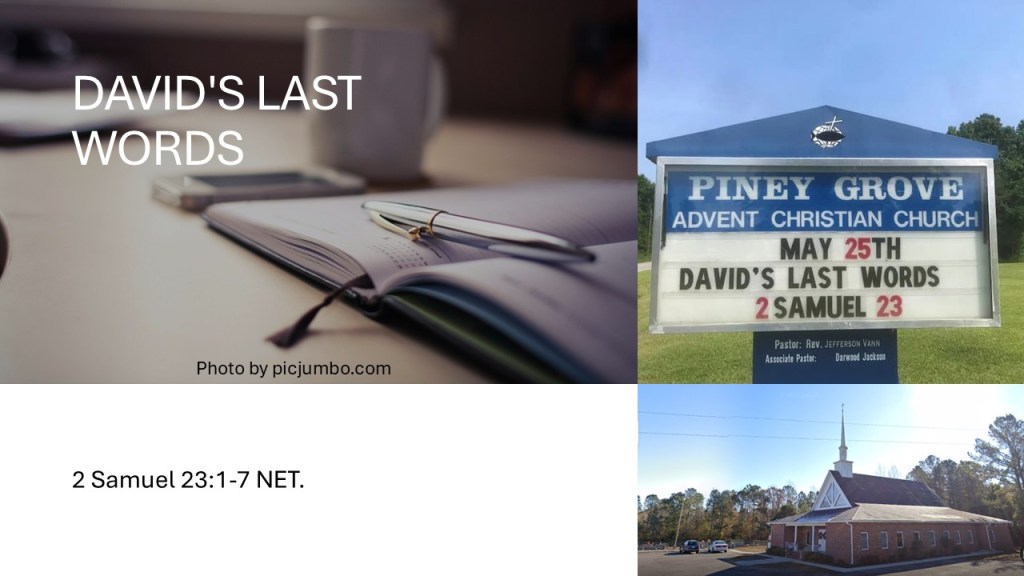
DAVID’S LAST WORDS

DAVID’S LAST WORDS

2 Samuel 23:1-7 NET.

1 These are the final words of David: “The oracle of David son of Jesse, the oracle of the man raised up as the ruler chosen by the God of Jacob, Israel’s beloved singer of songs: 2 The LORD’s spirit spoke through me; his word was on my tongue. 3 The God of Israel spoke, the protector of Israel spoke to me. The one who rules fairly among men, the one who rules in the fear of God, 4 is like the light of morning when the sun comes up, a morning in which there are no clouds. He is like the brightness after rain that produces grass from the earth. 5 My dynasty is approved by God, for he has made a perpetual covenant with me, arranged in all its particulars and secured. He always delivers me, and brings all I desire to fruition. 6 But evil people are like thorns — all of them are tossed away, for they cannot be held in the hand. 7 The one who touches them must use an iron instrument or the wooden shaft of a spear. They are completely burned up right where they lie!”

When people train for an advanced degree in ministry beyond the initial bachelor’s degree, they usually go to a seminary. I had the opportunity to study at three seminaries, and graduated from two of them. While I was at seminary, in addition to the classes, I also attended regular worship services during the week – chapel services. Sometimes we would have guest speakers at the chapels, but many times it would be the same teachers we had in regular classes. In one of my chapel experiences, they put on a series called The Last Sermon. Each professor would give a message as if it were the last message the speaker could give before dying. When I attended those messages, I did not hear anything new. It was a lot of what I had heard in the classes. The speakers wanted to emphasize the things that they had stressed in their teaching throughout the years. They tried to pass on their legacy.

Reading today’s text, I get the impression that David is doing the same thing. He had one last chance to make an impact on the people who would read these words, so he focused on the things that really mattered to him. He could have recounted the significant victories of his life, like his defeat of Goliath, or his many victorious battles against the surrounding enemies. He could have apologized for his disastrous failures. He could have recounted all his friendships and loyal supporters. But of all the things that David could have spoken about, it is revealing that he chose to say these things.

David is not the only one whose last words are given to us in Scripture. Peter told his readers that the Day of the Lord is coming, that there will be a new heaven and a new earth, and that they should make every effort that when Jesus comes, he finds them at peace and without stains or blemishes (2 Peter 3). John said that he has no greater joy than hearing that his children are living according to the truth (3 John). Paul says that he is already being poured out as an offering, and the time for him to depart is at hand. He says he has competed well; he has finished the race; he has kept the faith! He says the crown of righteousness is reserved for him. The Lord, the righteous Judge, will award it to him on that day — and not to him only, but also to all of us who have set our affection on his appearing (2 Timothy 4).

We all want two things: to live life well and to make a difference in the lives of others. David made some terrible mistakes, but as he surveys his life, he can still see that he made an impact. He wanted to pass on his legacy, and that is what this little poem is all about.

It tells us who David said he was (1).

David identifies himself first as the son of Jesse. If you remember the story, Samuel was told by the LORD to go to Jesse’s house and anoint one of his sons. He gets there and surveys seven sons of Jesse, but the Spirit tells him that none of them is the one. Then he discovers that Jesse had another son, the youngest, who was not invited to the party. He was tending the flocks. His father did not see greatness in him. His father saw potential in the others, but not in him. We could say that God saw into David’s heart and knew he had what it takes. But that is not what David noted in his last words. He calls himself “the man raised up as the ruler chosen by the God of Jacob.” He implied that all his accomplishments were the result of the plan of God. God raised him up, and God chose him.

Our ladies are watching and studying the video series called “The Chosen.” It is about the apostles whom Jesus chose to proclaim his teachings and to begin the process of evangelizing the world. They are the chosen. That is what David wanted to be remembered as. He wanted people to know that he was an ordinary man whom God chose to do extraordinary things. He was just the son of Jesse, but God chose him. God raised him up. Everything he experienced – his life in the field, his ordeals in exile and under threat from Saul, his battles – everything was preparation for the life God wanted him to live.

David calls himself Israel’s beloved singer of songs. Music and poetry set to music was David’s legacy. It turns out that the words of David’s songs would be more influential than he would ever dream. His words would outlast his life. His words are still changing lives today, thousands of years later. We have been reading the history of David’s life and reign, and some of the things that happened to him encourage us, and some of the things confuse us. But when we read his songs, that is when we see the man’s true legacy.

Today’s text tells us what David said God did for him (2-5).

David does not brag about what he did. He brags about what the Lord did for him. He says that the LORD’s Spirit spoke through him. God’s word was literally on his tongue and came out of his mouth. He was the one who told us that the person whom God blesses will be like a tree planted by flowing streams, yielding its fruit and brandishing leaves that never fall off. He was the one who told us that the LORD is his shepherd, and because of that relationship, he will never need anything. His shepherd takes care of him today and gives him hope for eternity. He was the one who wrote the longest chapter in the Bible, an acrostic poem that praises the excellency of God’s word. After 3000 years, the words of David are still being read, studied, translated, sung, paraphrased, preached, and published.

David tells us about God’s ruler. He calls his poem an oracle. That clues us in that David is not just talking about the past. He is prophesying. He speaks of his dynasty because he sees a future king who will do more for humanity than even he was able to accomplish. It is this ruler who rules in the fear of God and is like the morning sunlight, producing divine growth. It is this ruler who is the reason that God made a covenant with David. God made the covenant, arranged all the particulars, and will see to it that all the stipulations of the covenant are met. In order to really understand the legacy of David, we have to look beyond David. We have to realize that David is a type. A type predicts a coming antitype. A type prophesies the future fulfillment. David’s existence helps us to focus on the one greater than David who was to come. David is a prophecy of Jesus.

When Matthew wrote his Gospel, he called Jesus the son of David and the son of Abraham. The last part of Matthew’s Gospel is all about the crucifixion and resurrection of Jesus. He was fulfilling the type of the son of Abraham: Isaac. Isaac was the one and only son that God told Abraham to sacrifice on Mount Moriah. The first part of Matthew’s Gospel contains stories about how God preserved Jesus from destruction. An evil king wanted to destroy him because he saw this child as a threat to his reign. The wizards had seen in the stars that a new king of Israel had been born. Jesus was the descendant of David. God still has a plan that includes a future reign of this son of David. In his legacy poem, David spoke of God’s approving of his dynasty. Many of the kings of his dynasty were not approved by God. But Jesus was the reason that God approved of his dynasty.

Today’s text tells us what David said God did not do to him (6-7).

Verse six changes the imagery. Here, David speaks of evil people and says that they are like thorns. Nobody keeps a thorn collection. If I am out in my garden and I find a thorn bush, I pull it up and toss it away. Thorns cannot be held in the hand, and they serve no purpose. David says that if I want to hold on to thorns, I use an iron instrument or the wooden shaft of a spear. Thorns are best disposed of and burned. David had some times in his life when he definitely felt like thorns that God would be justified in burning up.

For example, in Psalm 51, David cries out for God to have mercy on him because he has committed such a terrible sin that he knows all he deserves is to be treated like those thorns and burned up. He knows he deserves condemnation, and so he cries out for God to cleanse him and let him see the joy of forgiveness. He deserves for God to reject him, to take the Holy Spirit away from him. God would have been entirely justified if he had done just that. But David pleads for God to act in grace and mercy.

David’s ultimate legacy is twofold. First, he set the stage for the king who would come after him. He was a type of Christ and started the dynasty from which Christ came. Second, David serves as an example for all of us in recognizing the gravity of his rebellion, turning to God in repentance, and seeking his forgiveness and restoration.

Every Sunday, we have a member ministry time, and one of the things we have an opportunity to do during that time is to give our testimony. Not many of us have given our testimony. I imagine many of you want to say something, but you don’t know what to say. Maybe we can take our cue from David. In today’s text, he draws our attention to the thorns – the evil people. What David is saying is that he has been a thorn. He had the opportunity to do the right thing, but he blew it. He failed God. He deserves to be burned to a crisp. But God, in his grace, chose to forgive him instead. He was dirty, and God in his grace decided to clean him up rather than throw him out. He deserved to be cursed, but God in his grace chose to bless him instead.

LORD, give us all a legacy! Use us to impact those around us and lead them to you.