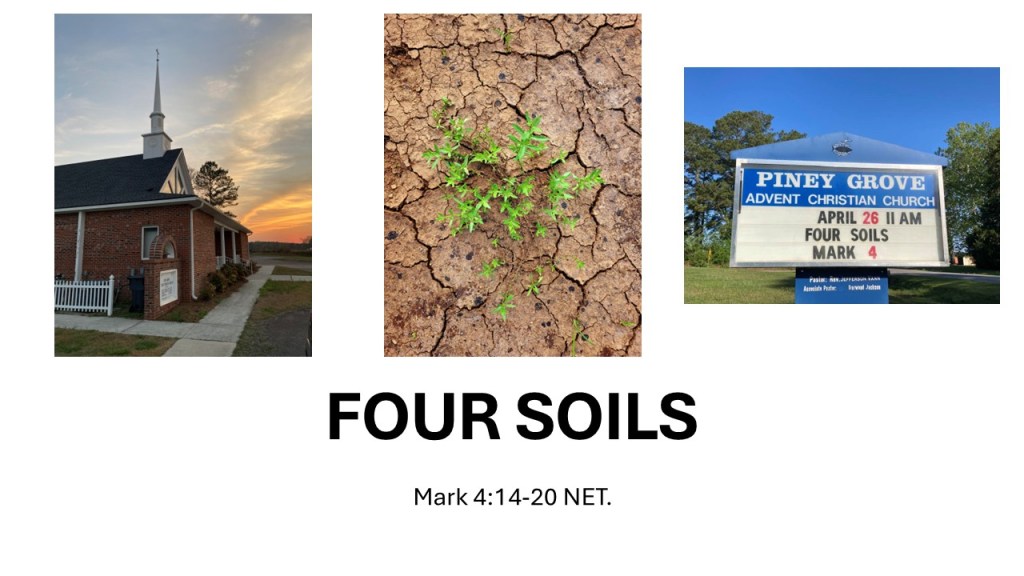
FOUR SOILS
Mark 4:14-20 NET.
14 The sower sows the word. 15 These are the ones on the path where the word is sown: Whenever they hear, immediately Satan comes and snatches the word that was sown in them. 16 These are the ones sown on rocky ground: As soon as they hear the word, they receive it with joy. 17 But they have no root in themselves and do not endure. Then, when trouble or persecution comes because of the word, immediately they fall away. 18 Others are the ones sown among thorns: They are those who hear the word, 19 but worldly cares, the seductiveness of wealth, and the desire for other things come in and choke the word, and it produces nothing. 20 But these are the ones planted in good soil: They hear the word and receive it and bear fruit, one thirty times as much, one sixty, and one a hundred.”
When Jesus told the parable of the planter, He wasn’t giving a lesson in agriculture. He was giving a lesson in evangelism. He was describing the most important interaction any human being will ever have: the moment when the word of God is planted in the heart. And in His explanation of the soils, Jesus shows us something both sobering and hopeful. Sobering—because not every heart receives the word. Hopeful—because God still produces a harvest in good soil.
But before we walk through each soil, we must notice something Jesus emphasizes—something we often overlook. Every soil hears the word—every single one. The path hears it. The rocky soil hears it. The thorny soil hears it. The good soil hears it. The difference is not in the hearing. The difference is in the response.
And that means something crucial for us: the word must be spoken. The seed must be scattered. The message must be proclaimed. If the word is not planted, there is no possibility of a harvest. We are not responsible for the condition of the soil. We are responsible for getting the seed out of the bucket.
Let’s walk through Jesus’ interpretation and let His voice shape our calling.
1. The Path — Where Satan Snatches the Word
Jesus says the first group is like seed that falls along the path. The ground is hard. The seed cannot penetrate. It simply lies exposed on the surface. And before it can sink in, before it can be considered, before it can be understood, Satan comes immediately and snatches it away.
This is not a poetic exaggeration. Jesus is telling us that spiritual warfare happens every time the word is shared. The enemy is not passive. He is not indifferent. He is not waiting politely for the sermon to end. He is active, alert, and aggressive. He knows the power of the word better than many Christians do. He knows that if the word ever gets inside a person—if it ever takes root—it will change everything. So, he works overtime to keep it from entering.
Sometimes he distracts. Sometimes he confuses. Sometimes he stirs up cynicism or pride or boredom. Sometimes he whispers, “This isn’t for you.” Sometimes he whispers, “You already know this.” Sometimes he whispers, “You can deal with this later.” But the result is the same: the seed never enters the heart.
And yet the seed was heard. The message was proclaimed. The opportunity was given. The soil rejected it, but the sower was faithful.
This is why we must never measure our ministry by immediate visible results. Some hearts are hard. Some minds are closed. Some people are spiritually asleep. But our responsibility is not to soften the soil. Our responsibility is to sow the seed.
2. The Rocky Soil — Where Shallow Faith Collapses Under Pressure
The second soil is rocky ground. The seed falls in, and at first, it looks promising. There is quick growth. There is enthusiasm. There is joy. There is emotion. But there is no depth. No root. No endurance. And when the sun rises—when pressure comes, when persecution comes, when hardship comes, this shallow faith collapses.
Jesus is not describing a rare situation. He is describing a common one. Many people respond to the gospel with excitement. They love the idea of forgiveness. They love the idea of eternal life at the resurrection. They love the idea of God’s love. But they do not understand the cost of discipleship. They do not understand that following Jesus means dying to self. They do not understand that the Christian life is not a sprint of emotion but a marathon of endurance.
And when the heat comes, when obedience becomes costly, when faithfulness becomes unpopular, when trials come, they wither.
But again—they heard the word. The seed was sown. The opportunity was real. The response was shallow, but the planter was faithful.
This reminds us that emotional responses are not the same as spiritual transformation. We rejoice when people respond with joy, but we also pray that God will give them depth, roots, endurance, and perseverance. And we keep planting.
3. The Thorny Soil — Where Worries, Wealth, and Desires Choke the Word
The third soil is perhaps the most tragic, because it looks the most promising. The seed enters. It grows. It begins to develop. But it is surrounded by thorns—worries, wealth, and worldly desires. And these thorns grow faster than the seed. They wrap around it. They suffocate it. They choke it until it becomes unfruitful.
Jesus is describing the danger of divided hearts. Hearts that want God but also want the world. Hearts that want the kingdom but also want comfort. Hearts that want salvation but also want control. Hearts that want to follow Jesus but also want to follow their own desires.
Worry chokes the word by making us believe that our problems are bigger than God’s promises. Wealth chokes the word by making us believe that our security is found in what we possess. Desires choke the word by making us believe that satisfaction is found outside of God’s will.
This soil is not hostile. It is crowded. And a crowded heart cannot bear fruit. When we get ready to plant, we don’t just go and throw the seed and hope for the best. We remove the weeds, so the seed does not have to compete against them. We don’t have to sow the weeds, they are already there, and they had a head start.
But again, this soil heard the word. The seed was sown. The opportunity was given. The thorns and other weeds choked it, but the planter was faithful.
This reminds us that discipleship is not just about hearing the word but about clearing the heart and removing idols, cutting away distractions, and making room for God to work. We can model that for the people we are trying to reach. Or we can be just as busy and distracted as they are. If we prioritize evangelism, it will mean cleaning up the clutter in our lives.
4. The Good Soil — Where the Word Is Heard, Accepted, and Fruitful
Finally, Jesus describes the good soil. This soil hears the word. It accepts the word. It holds onto the word. And it bears fruit—thirtyfold, sixtyfold, a hundredfold.
This is the miracle of grace. This is the work of God. This is what happens when the word enters a heart that is open, humble, receptive, and surrendered. The seed does what seeds do—it grows. It transforms. It multiplies. It produces a harvest far beyond what was planted.
And notice again—this soil also heard the word. The difference was not in the hearing. The difference was in the response.
This is why we preach. This is why we teach. This is why we evangelize. This is why we share the gospel with our families, our neighbors, our coworkers, our communities, and our nations. Because somewhere out there is good soil. Somewhere out there is a heart God has prepared. Somewhere out there is someone who will hear and believe and be transformed.
We do not know who the good soil is. We do not know where the good soil is. We do not know when the good soil will appear. But we know this: if we sow the seed, God will produce a harvest.
The Common Denominator: Every Soil Hears the Word
This is the point Jesus wants us to see. Every soil hears. Every heart receives the seed. The difference is not in the message. The difference is not in the planter. The difference is in the soil.
And that means something essential for us: the message must be communicated. The seed must be scattered. The gospel must be spoken. If the word is not spoken, there is no possibility of fruit.
We are not responsible for the response. We are responsible for the opportunity. We cannot control the soil. We can only scatter the seed.
And God delights to use faithful planters.
Some of us hesitate to share the gospel because we fear rejection. But Jesus already told us: some soil will reject it. Some will ignore it. Some will choke it. Some will abandon it. But some—by God’s grace—will receive it and bear fruit.
Some of us hesitate because we think we need perfect words. But the power is not in our eloquence. The power is in the seed.
Some of us hesitate because we think we need perfect timing. But the planter in the parable scatters generously, freely, widely. He does not analyze the soil. He does not test the ground. He sows.
And God brings the harvest.
If you have been sowing faithfully, keep going. If you have been discouraged by hard hearts, keep going. If you have been disappointed by shallow responses—keep going. If you have been heartbroken by people choked by the world, keep going.
Because somewhere, God is preparing good soil. Somewhere, the seed you sow today will bear fruit tomorrow. Somewhere, the words you speak will change a life, a family, a generation.
Our job is not to produce the harvest. Our job is to scatter the seed.
How to scatter the seed without preaching:
Christians can evangelize powerfully without ever delivering a sermon by letting the gospel become visible, audible, and tangible in everyday life. Here are four distinct, practical ways to do that.
1. Live a Life of Quiet Integrity
Consistence in honesty, humility, repentance, and compassion speaks louder than arguments. People are drawn to a life that looks whole and grounded.
2. Practice Intentional Kindness and Service
Helping neighbors, supporting coworkers, volunteering, or meeting practical needs makes the gospel visible. Love embodied becomes its own invitation.
3. Share Your Story, not a Speech
Testimony—how Christ has met you in fear, failure, or joy—opens hearts without pressure. It’s personal, not confrontational. And the more we testify to the truth, the more the seed has the chance to germinate in other people’s hearts. Most people will hear the gospel at least eleven times before they respond to it. Sow your story and sow it faithfully.
4. Offer Prayer When People Share Their Burdens
A simple “Can I pray for you about that?” is gentle evangelism. God often uses answered prayer to awaken curiosity and trust.
But I want to make it clear that our goal is not to be silent about things that really matter to us. The gospel is important, and we must communicate it. We cannot avoid saying words like God and Jesus and quoting from the Bible. We evangelize when our communication of his word becomes such a part of who we are that people see it as natural, not an act that we perform. The more we know God and his word, the easier it will be to plant his seed on every soil.
That is why our faithful reading of the Bible is so important. We are getting the word into us so that it can come out of us at the appropriate time to sow it.
LORD, help us to get Your excellent message out to our families, our communities, and our nations. Make us faithful sowers. Give us courage to speak, compassion to share, and perseverance to keep scattering the seed even when we cannot see the results. Prepare hearts. Break up hard ground. Remove stones. Cut away thorns. Pull up the weeds. And by Your grace, produce a harvest that brings glory to Your name. Amen.