
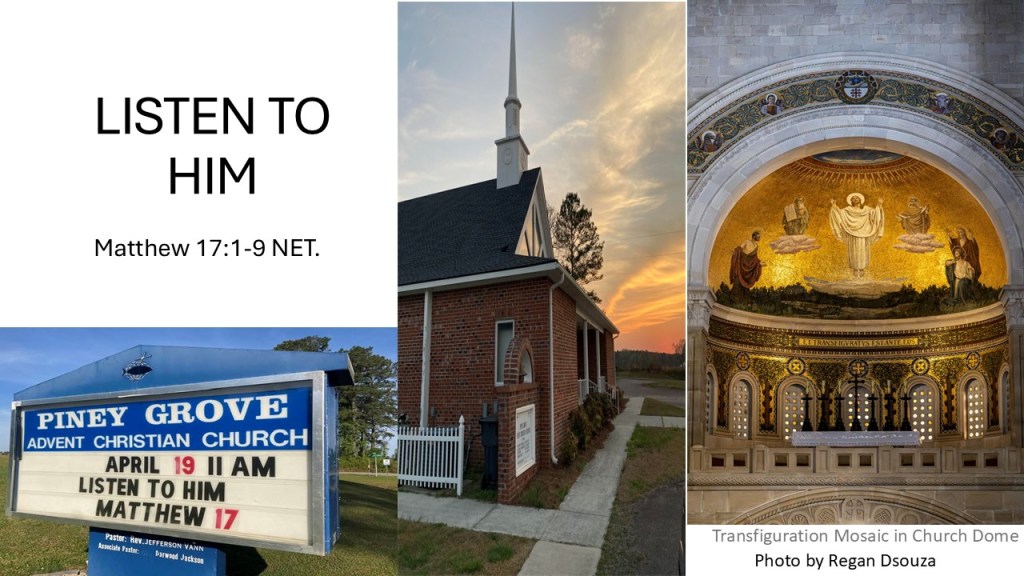
LISTEN TO HIM
Matthew 17:1-9 NET.
1 Six days later, Jesus took with him Peter, James, and John, the brother of James, and led them privately up a high mountain. 2 And he was transfigured before them. His face shone like the sun, and his clothes became white as light. 3 Then Moses and Elijah also appeared before them, talking with him. 4 So Peter said to Jesus, “Lord, it is good for us to be here. If you want, I will make three shelters — one for you, one for Moses, and one for Elijah.” 5 While he was still speaking, a bright cloud overshadowed them, and a voice from the cloud said, “This is my one dear Son, in whom I take great delight. Listen to him!” 6 When the disciples heard this, they were overwhelmed with fear and threw themselves down with their faces to the ground. 7 But Jesus came and touched them. “Get up,” he said. “Do not be afraid.” 8 When they looked up, all they saw was Jesus alone. 9 As they were coming down from the mountain, Jesus commanded them, “Do not tell anyone about the vision until the Son of Man is raised from the dead.”
After fifteen months in the Old Testament, it feels good to return to the New Testament. But today’s passage helps us understand why those months mattered. The Transfiguration was a vision—a special moment where God pulled back the curtain so the disciples could see who Jesus really is. Moses and Elijah did not come back from the dead to talk with Him. Instead, God gave the disciples a picture, a lesson made clear through a vision. Jesus even told them not to share the vision until after His resurrection. So what was God showing them? He was revealing the truth about His Son, and that is what we will explore together in this text.
A Walk through the Transfiguration
Jesus takes Peter, James, and John up a mountain.
Jesus chooses Peter, James, and John to go with Him up a high mountain. He doesn’t take all the disciples—just these three. This shows that sometimes Jesus brings certain people closer so they can learn something special. The climb up the mountain also matters. It takes effort, and it pulls them away from the busy crowds below. Many important moments in the Bible happen on mountains, where God shows His power and His plans. By taking these three with Him, Jesus is preparing them for the hard and important things they will face later. They will see His glory here, and later they will see His deep sorrow in the garden. They need both moments to understand who He really is. Going up the mountain teaches them that following Jesus means trusting Him even when the path is steep or confusing. It also reminds us that sometimes we need to step away from noise and distractions so we can see Jesus more clearly. When we follow Him, He often leads us to places where our faith grows stronger. The question for us is whether we are willing to follow Him, even when the climb feels hard.
He is transfigured — His face shines, His clothes become radiant.
On the mountain, something amazing happens. Jesus’ face begins to shine like the sun, and His clothes become bright and white. This moment is called the “transfiguration.” It doesn’t mean Jesus changed into someone else. Instead, His true glory—who He really is—shines through. The disciples get to see that Jesus is not just a teacher or a miracle‑worker. He is the Son of God, full of power and light. This shining glory shows that Jesus is greater than anyone else they have ever known. It also reminds us of stories in the Old Testament, like when Moses’ face glowed after meeting with God. But Jesus’ light is even greater, because it comes from inside Him. This moment is like a preview of what Jesus will look like after He rises from the dead. It helps the disciples understand that even though Jesus will soon suffer and die, He is still the King who rules forever. For us, the transfiguration teaches that Jesus is always glorious, even when we cannot see it. When life feels dark or confusing, we can remember that His light never fades. He is always powerful, always good, and always worthy of our trust.
Moses and Elijah appear, representing the Law and the Prophets.
While Jesus is shining with glory, two important men from Israel’s history appear—Moses and Elijah. Moses represents the Law, and Elijah represents the Prophets. Together, they stand for the whole Old Testament. Their appearance shows that everything God taught before was pointing to Jesus. Moses once asked to see God’s glory, but he only saw a small part. Elijah met God on a mountain, too, but only in a whisper. Now both of them stand with Jesus, seeing His full glory. This shows that Jesus is the One they were waiting for. He is the One who completes God’s plan. Moses and Elijah do not shine like Jesus. They do not speak from the cloud. They are important, but Jesus is greater. Their presence teaches the disciples—and us—that Jesus is the center of the whole Bible. All the stories, laws, and prophecies lead to Him. When we read Scripture, we should look for how it points to Jesus’ love, power, and saving work. Moses and Elijah standing with Jesus remind us that God’s plan has always been moving toward this moment, when His Son would come to rescue the world.
The Father speaks: “This is my beloved Son… listen to Him.”
As Peter tries to speak, a bright cloud covers them, and God the Father speaks. His voice says, “This is my beloved Son… listen to Him.” These words are powerful. God is telling the disciples that Jesus is not just another leader or prophet. He is God’s own Son, loved and chosen. The Father’s command—“listen to Him”—shows that Jesus’ words are the most important words they will ever hear. This moment also connects to the Old Testament, where Moses said that God would one day send a special prophet, and the people must listen to Him. Now God Himself says that Jesus is the promised One. Today, many voices try to tell us what to believe or how to live. Some voices are loud, and some sound wise. But God tells us clearly that Jesus’ voice must come first. Listening to Jesus means trusting what He says, obeying His teachings, and letting His words shape our choices. It means believing that He knows what is best for us. The Father’s voice reminds us that Jesus is the center of our faith. When we listen to Him, we find truth, hope, and life.
The disciples fall in fear; Jesus comforts them.
When the disciples hear God’s voice and see the bright cloud, they fall to the ground in fear. They are overwhelmed by God’s power and holiness. This reaction is common in the Bible—when people see God’s glory, they often fall because it is so great and so different from anything on earth. But Jesus comes to them gently. He touches them and tells them not to be afraid. The same Jesus who shines like the sun also bends down to comfort His friends. When they look up, they see only Jesus. Moses and Elijah are gone, the cloud is gone, and the bright light is gone. But Jesus remains. This teaches us something important: God’s glory is real, but so is His kindness. Jesus does not leave His followers shaking on the ground. He lifts them and helps them stand again. In our lives, we may feel afraid or overwhelmed, too. But Jesus is near. He reaches out to us with love and tells us not to fear. His presence gives us courage. The disciples learned that day that Jesus is both powerful and gentle, and we can trust Him in every moment.
The Transfiguration confirms Jesus’ identity.
The Transfiguration shows the disciples exactly who Jesus is. They had seen His miracles and heard His teaching, but on the mountain, they saw His true glory. His face shone like the sun, and His clothes became bright. This was God’s way of reminding them that Jesus is not just another leader. He is God’s Son. The vision helped the disciples refocus their hearts and minds on Jesus Himself. They had grown up honoring Moses and Elijah, two of the greatest heroes in Israel’s history. But now God was showing them something new: even the best traditions and the greatest leaders must take second place to Jesus.
When Moses and Elijah appeared, it might have been easy for the disciples to think all three were equal. But then the Father’s voice came from the bright cloud and made everything clear: “This is my beloved Son… listen to Him.” God did not say to listen to Moses or Elijah. He pointed only to Jesus. This means that every part of our faith must be centered on Christ. He is the One who shows us what God is like. He is the One we follow. The Transfiguration teaches us that Jesus deserves our full attention, our trust, and our obedience.
The Transfiguration foreshadows Jesus’ resurrection and coming glory.
The Transfiguration gives the disciples a small preview of what Jesus will look like after His resurrection. On the mountain, His face shines, and His clothes glow, showing His true power and glory. This moment helps the disciples understand that Jesus is not only going to suffer and die—He will also rise again and return in glory as the true King. Moses and Elijah appear beside Him, and they represent the Law and the Prophets. All of the Old Testament pointed forward to the coming of the Messiah, and now the disciples see that Jesus is the One those Scriptures were talking about.
Peter gets excited and offers to build three shelters—one for Jesus, one for Moses, and one for Elijah. But this idea is mistaken. Peter is treating all three as if they are equal. God quickly corrects him. A bright cloud covers them, and the Father’s voice speaks from heaven: “This is my beloved Son… listen to Him.” God does not tell them to listen to Moses or Elijah. He points only to Jesus.
This teaches us that Jesus is the center of God’s plan. He is the King of the coming kingdom, and His words explain the meaning of the Law and the Prophets. Our job is simple: listen to Him.
Coming King, help us to keep our focus securely on you. Give us the wisdom to remain Christocentric. May we value the Old Testament because it is a testament of you. May we value the church because it is your church. But may we never lose sight of your words because they are the foundation for your coming kingdom.


 jeffersonvann