MADE ALIVE

MADE ALIVE

1 Corinthians 15:20-26 NET.

20 But now Christ has been raised from the dead, the firstfruits of those who have fallen asleep.21 For since death came through a man, the resurrection of the dead also came through a man.22 For just as in Adam all die, so also in Christ all will be made alive.23 But each in his own order: Christ, the firstfruits; then when Christ comes, those who belong to him.24 Then comes the end, when he hands over the kingdom to God the Father, when he has brought to an end all rule and all authority and power.25 For he must reign until he has put all his enemies under his feet.26 The last enemy to be eliminated is death.

We are reading through the Bible – two chapters a day – and our Sunday morning messages have usually been based on one of the passages we have encountered in our reading. But we have been taking a short break from that practice these past two Sundays. Because last Sunday was Palm Sunday and today is Easter, we are taking a detailed look at what Paul says in 1 Corinthians 15, which is Paul’s presentation of the gospel message. For Paul, the gospel message is focused on the reality of Christ’s resurrection. That is what Easter is all about. When we take away all the cultural traditions and external wrapping, Easter is the holiday of the resurrection. But our holiday does not simply celebrate the hope of resurrection in general. As Paul makes it clear in this chapter, our hope of a future resurrection is forever linked to who Jesus is and the fact of his resurrection.

If we take Christ away from Easter, we will still have all the external celebrations and rituals, but they will have been robbed of their true meaning. That is why we need to focus first on what happened to Jesus on Easter Sunday morning. Before we jump to some other focus, we should be sure what the Bible says about that empty tomb as it relates to the man who was inside that tomb.

Christ is the first to be made alive (20).

The Scripture says that Christ has been raised from the dead. That tells us that he was not merely pretending to be dead, nor was he only partially dead. There is a category of human beings that we refer to as “the dead,” and for a brief period of days, Jesus Christ was in that category. All of us are familiar with the concept. We have enjoyed the company of friends and family members, but we have also lost some of them to the enemy dead. To use Paul’s analogy, death is reigning over us. Even if we are perfectly healthy and completely alive, the spectre of death hangs over us all like a dark cloud, predicting dark days and final defeat by that enemy.

But it is not all bad news. In today’s passage, the Apostle Paul describes the significance of Jesus’s resurrection by painting three different pictures. This first picture is that of a planting and a harvest. Death is compared to the planting of a seed. There is a natural similarity. When we plant seeds, we bury them in the ground. Later, the seeds germinate and sprout, eventually becoming a whole crop of new plants, alive and fruitful. Planting involves a period of dormancy. The seed is there in the ground, hidden from our eyes and sleeping. It is inactive.

Paul describes Christ as having experienced that period of dormancy. Before Easter Sunday morning, he was among the dead, asleep in Hades, but Scripture says that he was not abandoned there. He was among those who had fallen asleep in death. But then he was wakened to life again. He had been planted, but all was not lost. He was planted with a view of experiencing new life again. He did not immediately experience that new life. His death was not an illusion. It was a real death. But it did not end his life permanently. He has been raised from the dead.

The planting analogy continues as we examine the title Paul gives Jesus in these early verses: He is the firstfruits, the first harvest of all those planted. All the other dead continue sleeping in their graves, but not Jesus. It is not simply the fact that he has been resuscitated. Many die and are revived, either by a miracle (like Lazarus was) or but jump-starting their bodies again. But Jesus’s resurrection was different. He was revived, never to experience being planted again. The life he lives now is a different kind of life that the lives you and I live. We live with that dark cloud over us. Even on our best days, our mortality slips through and spoils our joy of living. But Jesus was raised never to die again. He is the only person who has ever experienced what the Bible calls the resurrection unto life.

The word “firstfruits ” offers hope. It speaks of a larger harvest yet to come. It says that Jesus is the first of a larger group of seeds, planted, dormant, and then sprouting to life. The life he is living now is the life we will inherit from him. Every Easter, we have the opportunity to look on our Savior as the first of a new category of human beings. Eternal, immortal, perfected human beings. Human beings free of our present imperfections and made anew into the image of Christ himself. He is the firsfruits, and there will be a later harvest. We can live in expectation not only of living again but of living his kind of life. As John the Baptist went before and prepared the world for Jesus, so Jesus went before us, tasting death for us, but also tasting the new life for us. That is something to celebrate! Jesus is our firstfruits!

Christ is the second Adam (22).

The Bible tells us all about the first Adam. He failed God, and because of his failure, all of us die. We die because when our first ancestors rebelled against God in the garden of Eden, that failure was passed on to everyone that their union would produce. All of their descendants die like they did. We are all born mortal and will all eventually die. That is what it means to be in Adam. We share the characteristics of our first parents. Many of us share characteristics of our immediate parents. We can see and hear the parents of our friends and family members in their children. We sometimes suffer ailments because we inherit deficiencies in our DNA. We are linked to those who have gone on before us through our bloodline. But what is true on that level is also true on the global, planetary level. We inherit things from Adam. He is the first, and we are next down the line. Mortality is one of those things we have inherited from Adam.

But Jesus is the second Adam. All of us belong to Adam, but verse 23 says that some of us also belong to Christ. Because we who have put our faith in Christ now belong to him, we will experience the same kind of resurrection that Christ did when he comes again. There is a resurrection unto life, and there is a resurrection unto condemnation that will end in the second death. Jesus was the second Adam because his resurrection was the first in the chain of resurrections unto life. Today’s text even gives us the order of the resurrections. Christ’s resurrection came first, and our resurrections unto life will happen when Christ comes. The second Adam is alive today in heaven. He wants all of us to experience the fantastic immortal life he is now living. He knows that will happen. But he also knows that it has to happen in the proper order. So, the Lord said that he is coming, and his reward is with him. He does not pass on that reward to people when they die. Death is not graduation day. His return is when all those in Christ will be made alive.

The phrase “second Adam” offers hope. We all know how fantastic it is to be part of the human race. We are amazed at the potential power, beauty, and wisdom that human beings are capable of. Even the lowest of us can think amazing thoughts and overwhelm others with our actions. An unassuming person comes to the auditorium, and the judges of the contest are introduced to the contestant. But for a brief moment, nobody knows what is coming next. Then, the contestant starts to sing or dance or do some acrobatic stunt. All of a sudden, people realize that this is no mere average human being. This is a star. This is a winner. This is exceptional among all us normals.

But the phrase “second Adam” tells us that God plans to create a new category of human beings. We are currently in the normal first-Adam generation. But we will inherit a world of stars, a world of winners, a world of people who are patterned after Christ himself. He is the next big thing, and we have the opportunity to be like him. That is why Paul said that he made it his aim to know Christ and to experience his resurrection. He was not satisfied with simply living out his first-Adam life. He wanted more. Easter reminds us that God wants more of us as well.

So, if you have ever asked yourself, “Is this all there is?” or “Is there nothing more?” you were getting at the question that Easter answers. God has much more in store for you and me than we can imagine. The second Adam has begun a revolution that will spread throughout the universe. We are invited to be part of that new thing.

 Christ will end the reign of death (25-26).

Another way of seeing the reality that Easter reveals is that God plans to undo all that is wrong with this reality. Paul teaches in today’s text that God will not be satisfied with simply collecting all the believers and transporting them to a good place. He plans to cleanse the impure things and make new the old things. He plans to make an end to all the things corrupted by sin. Those things are currently reigning over us. They dominate us. And the worst of all is the enemy death. Paul teaches here that Christ intends to put an end to all rule, authority, and power. Those are all the things in this life that dominate us and keep us from walking in freedom. Not only will Christ free us from the bondage of Hades, but he will also put all these other enemies under his feet. He will eliminate them from the universe. They are his enemies, and they are also our enemies.

The last and most potent of these enemies is death itself. Today, we have no choice but to welcome this enemy into our lives, our homes, and our families. But it will not be welcome in Christ’s new universe. Its reign has peppered our landscapes with monuments and memorial stones. But there will be no such thing on the Earth made new. The last battle will be fought, the last coffin emptied, the last flag rolled. The second death will be the last death. The lake of fire will be the last place of destruction.

Verse 22 says that everyone in Adam dies. We know that from experience. But the verse also says that everyone in Christ will be made alive. This is an easy text to misinterpret – especially as it reads in the NET. The clause “all will be made alive” only applies to the prepositional phrase “in Christ.” The promise of the resurrection unto eternal life only applies to those who are in Christ. Believers will live again never to die again. That is a promise worth living for. That is a hope worth celebrating.


ASLEEP IN CHRIST

ASLEEP IN CHRIST

1 Corinthians 15: 12-19 NET.

12 Now if Christ is being preached as raised from the dead, how can some of you say there is no resurrection of the dead 13 But if there is no resurrection of the dead, then not even Christ has been raised.14 And if Christ has not been raised, then our preaching is futile and your faith is empty.15 Also, we are found to be false witnesses about God, because we have testified against God that he raised Christ from the dead, when in reality he did not raise him, if indeed the dead are not raised.16 For if the dead are not raised, then not even Christ has been raised.17 And if Christ has not been raised, your faith is useless; you are still in your sins.18 Furthermore, those who have fallen asleep in Christ have also perished.19 For if only in this life we have hope in Christ, we should be pitied more than anyone.

It’s the time of year when we celebrate Easter again. It is fitting that we set aside a time every year to meditate on its meaning because, more than any other holiday, Easter forces us to think about the Bible’s most essential message and the most significant event in history.

The message of Easter is that Christ has been raised.

Like all holidays, Easter has attracted many traditions and rituals that compete with the event that we actually celebrate. Christmas is like that, too. Hopefully, we all know that Christmas is not about the man in the red suit who carries a bag. It’s not about reindeer—even ones with mutated noses. It’s not about trees or packages or family get-togethers. All those traditions are tacked on to the essential message of Christmas, which celebrates an event—the birth of our Savior.

Easter has its own set of tacked-on traditions as well. It’s not about a bunny. It’s not about hiding Easter eggs. Nowadays, we are hiding our eggs in a vault because they are so expensive. Easter is also not about Springtime. I gave an Easter sermon when I was pastoring in New Zealand. March and April are not in the Springtime in New Zealand because it is in the Southern Hemisphere. Easter comes in the Fall there. But that culture has its traditions about Easter.

It is essential for us as Christians not to get so caught up in cultural traditions that we lose sight of Easter’s real meaning. We need to peel back the traditions, reveal the actual event we are celebrating, and then focus on its significance.

Easter is really about Christ’s resurrection. The Apostle Paul spent this entire chapter of his first letter to the Corinthians focusing on the event and its significance. That is the true meaning of Easter, and its message is essential to the presentation of the gospel and our understanding of the gospel.

If I were to ask the average Christian what the gospel is all about, they would probably say that Christ died for our sins and if we believe in him we can have eternal life. That’s not wrong, but interestingly, that is not how the apostle Paul chose to explain the gospel here. In verse one of this chapter, we find that the Apostle wanted his readers to be clear about the gospel message. For that reason, he goes on for the following 57 verses to write about the event of Christ’s resurrection and its significance for believers. He does say that Christ died for our sins in verse 3. But he goes on to say that Christ was raised on the third day. His focus was not on trying to convince the Corinthians that Christ died for them. Instead, he focused on the fact of Christ’s resurrection. He did not want the faith of the Corinthian Christians to be focused on a dead Savior.

The message of Easter and the gospel is not centered on the death of Christ – as important as that fact is. The gospel Easter message says that the Christ who died as our substitute was raised and became the firstfruits. Later in this chapter (verse 23), Paul mentions that the idea of Christ as the firstfruits is essential to Paul’s gospel message. Sadly, even those who are all the time talking about the gospel often fail even to bring up the idea of the firstfruits. But that truth is gospel truth. If we don’t correctly understand how Christ is God’s firstfruits, we don’t yet fully comprehend the gospel.

Believers who die have fallen asleep in Christ.

In this chapter, Paul identifies three types of people. There is Christ, who is in a category all by himself because he alone has been raised from the dead, never to die again. He is the firstfruits—the first part of the harvest.

I really enjoy it when the garden crops start coming in. I like sharing the first part of the harvest with others because it is proof that God has given a harvest. But it is just the firstfruits. Part of the joy of the firstfruits is the anticipation of the whole harvest, which comes later.

So, Christ is the firstfruits because he is proof that God raises the dead. But the rest of the harvest will come later.

The second category of people that Paul mentions in 1 Corinthians 15 is the enemies of Christ. We read in verse 25 that when Christ returns to the Earth, he is going to reign until he puts all his enemies under his feet. Some people reading that verse think that Paul is saying that Christ is going to put his enemies in jail where they will live for eternity, always suffering for their rejection of him. But that is not what Paul means. In the ancient Near East, to put an enemy under your feet means to kill the enemy. We know that is what Paul means here because he goes on to say in the next verse that the last enemy to be eliminated is death itself. That’s a critical gospel verse because it tells us that the enemy death is real, and it is not yet eliminated.

So, now we get to the third category of people. Remember, Christ is the firstfruits. He is the only one, so he is the only person who is now living in eternal victory over death. The second category is God’s enemies. They are all mortal, so they will die for Adam’s sin. But when Jesus comes back, he will raise them from the dead, judge them, and then finally put them under his feet – that is, eliminate them.

So, the third category is believers in Christ. When Christ returns, he will raise us immortal, and we will begin our eternal lives at that point. We are the next phase of the harvest. But what about now? What is the status of those who have put their faith in Christ and die before his return? The Apostle Paul explains what happens to these believers. He says in verse 17 that they have fallen asleep in Christ.

Before I explain what being asleep in Christ means, I want to make clear what it does not mean. Being asleep in Christ does not mean that you have gone to be with the Lord.

There is only one place in Scripture that discusses believers being with the Lord. That is 1 Thessalonians 4:13-18. In this passage, Paul says that the believing dead are in the same state that he said they are in in 1 Corinthians 15. In 1 Corinthians, Paul said that they have fallen asleep in Christ. In 1 Thessalonians, Paul says that they are asleep (verse 13) and that they have fallen asleep as Christians (verse 14), and that they have fallen asleep (verse 15). When Christ returns, they will rise from their sleep. Only at that time are believers said to be with the Lord (verse 17).

Being asleep in Christ does not mean that you have gone to heaven. In John 3:13, we learn that no one has ascended to heaven except Jesus himself. The only human being in heaven today is Christ, the firstfruits.

Being asleep in Christ does not mean that you have gone to a better place. The better place is the new Earth, which Jesus is going to create when he returns. Dead believers are sleeping in the same place that dead unbelievers are sleeping. That place is called Hades in the New Testament. When Jesus returns, he is going to open the gates of Hades; He is going to raise all the dead. So, being asleep in Christ does not mean that you are in a better place than the unbelievers are. It just means that when you rise, you will experience the better resurrection. The Bible says there is a resurrection unto life and there is a resurrection unto condemnation that will conclude with the lake of fire – the second death. So, the only comfort we have if our loved ones have died is that they will inherit eternal life when Jesus comes again.

Being asleep in Christ does not mean that you have gone on to your reward. In Revelation 22:12, Jesus says that he is coming soon and his reward is with him. So, believers who are asleep in Christ are waiting for Christ to come again so that they can receive their reward.

The hope of Easter is in the Christ who has been raised.

Bunnies hop away. Easter eggs don’t last. Springtime comes and goes. But the hope of a resurrection unto eternal life is the confidence we have in Christ.

Paul says that if our hope in Christ is merely for this life, we should be pitied more than anyone. The reason we put our hope in Christ is that his tomb is empty. One day, he is coming back, and he is going to wake the dead in every cemetery. The word cemetery actually means “sleeping place.” He is going to bring back to life all who have ever lived.

The gospel is not anthropocentric, not man-centered. It is Christocentric, centered on the person and work of Jesus Christ. That is why we celebrate Easter. Our hope is in the one who has conquered death and brought life and immortality to light through the gospel.

Paul says, “We know that since Christ has been raised from the dead, he is never going to die again; death no longer has mastery over him” (Romans 6:9).

Paul says, “We know that the whole creation groans and suffers together until now” (Romans 8:22). Our day has not yet come, and our resurrection and eternal life have not returned.

Paul says, “We know that the one who raised up Jesus will also raise us up with Jesus and will bring us with you into his presence” (2 Corinthians 4:14).

But Paul also says he aims to know Christ and to experience the power of his resurrection (Philippians 3:10). He hasn’t experienced it yet because he is currently asleep in Christ. We haven’t experienced it yet either, but we will!

Paul knows the one in whom his faith is set, and he is convinced that Christ is able to protect him until the day of Christ’s return (2 Timothy 1:12).

Easter is a time for all Christians to declare what we know. We declare Christ crucified for our sins, raised to life as the firstfruits, and coming again to set us all free from the slavery to death and give us glorious eternal life.

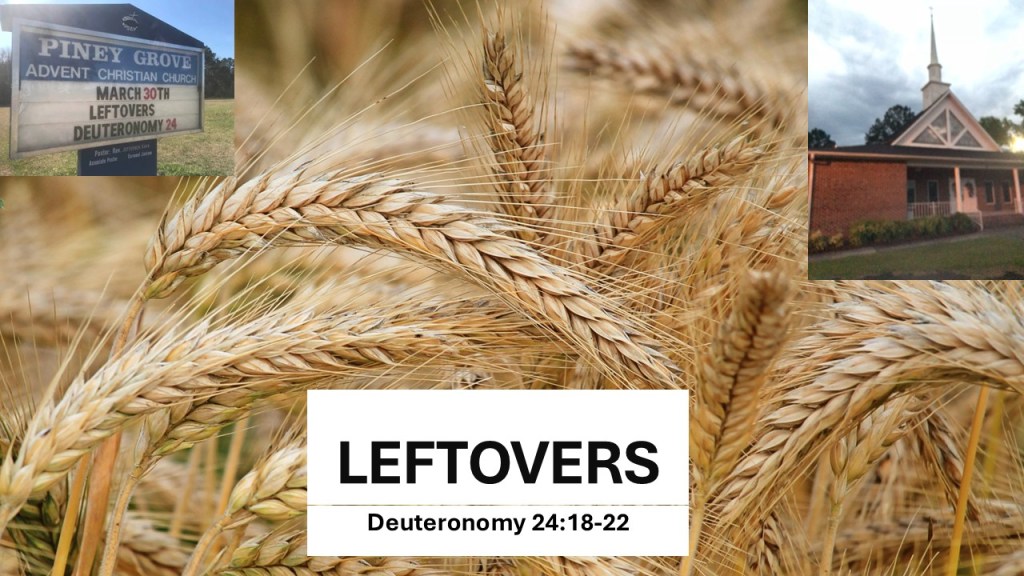
LEFTOVERS  

LEFTOVERS  

Deuteronomy 24:18-22 NET.

18 Remember that you were slaves in Egypt and that the LORD your God redeemed you from there; therefore I am commanding you to do all this.

19 Whenever you reap your harvest in your field and leave some unraked grain there, you must not return to get it; it should go to the resident foreigner, orphan, and widow so that the LORD your God may bless all the work you do. 20 When you beat your olive tree you must not repeat the procedure; the remaining olives belong to the resident foreigner, orphan, and widow. 21 When you gather the grapes of your vineyard you must not do so a second time; they should go to the resident foreigner, orphan, and widow. 22 Remember that you were slaves in the land of Egypt; therefore, I am commanding you to do all this.

It is merely coincidental that I am preaching this sermon after two weeks of dealing with a personal crisis with my family. Penny’s accident meant that I had to take on the role of full-time caregiver. It has been difficult for both of us to adjust to the new normal in our household. It would have been even more difficult if it had been necessary for me to provide all the meals as well as do all the cleaning. But many of you stepped in and provided some excellent meals for us. As a consequence, all I had to do most days is figure out which leftovers I would heat up. In fact, most of the time, I didn’t even have to go to the freezer to thaw anything out. The only drawback was that many of our meals looked and tasted just like the meals we had previously. That’s Okay. We are very grateful for your help.

So, as I said, it is merely coincidental that the title of today’s sermon is “LEFTOVERS.”  The title comes from the command that the LORD gave the Israelites for when they crossed over the Jordan into the Promised Land. He told them to leave some grain in their fields when they harvested. That leftover grain would be for the poor: particularly the resident foreigners, the orphans, and the widows who lived near them. He told them to treat their orchards the same way they treated their fields. They could harvest their olive trees, but they should not make a second pass over them. Instead, anything left over should be reserved for the poor: that is, the resident foreigners, the orphans, and the widows. They should treat their vineyards the same way. They could gather the grapes once. But anything left over should go to the resident foreigners, the orphans, and the widows.

It is important as we study these particular laws to understand that each of them is merely a single application of an over-arching principle. If we don’t do that, then most people who read these words will be disinterested and feel that nothing applies to them. After all, some of you own fields and plant them. Fewer of you own gravevines – and even those do not own entire vineyards. As far as I know, none of you have an olive orchard. To understand the relevance of today’s text, we need to look at the principles that it teaches, not just the practices it lists.

The redeemed should remember (18, 22).

The LORD tells the Israelites to remember that they were slaves in Egypt. Once they get into the Promised Land, their status will change from a nation of slaves to a nation of landowners. They will own land and property and will not have to give the proceeds to any master. They will be free to gain wealth. Whereas their masters in Egypt had exploited them, now they would be tempted to exploit others. The shoe will be on the other foot. So, the LORD commands them to remember what it felt like to be on the receiving end of exploitation and oppression.

They were to remember that the LORD redeemed them from Egypt. So, they were not to recreate the same situation that they faced in another land. They had been slaves, so they were not to become enslavers. They were to look out for those with fewer opportunities than they had. Unless they remembered how they had been exploited, history was liable to repeat itself, with the Israelites now on the potential giving end of the exploitation.

The command was for them to keep their greed in check. Instead of looking out for number one, they were to look out for all those little people who would not experience the immediate advantages of the new land.

This was not the only law that God established to take care of the poor among his people. Note Deuteronomy 14:28-29. It says that “At the end of every three years you must bring all the tithe of your produce, in that very year, and you must store it up in your villages. Then the Levites (because they have no allotment or inheritance with you), the resident foreigners, the orphans, and the widows of your villages may come and eat their fill so that the LORD your God may bless you in all the work you do.” The produce of the land was to be tithed, and every three years, it would be distributed to four groups. The three groups already mentioned: the resident foreigners, the orphans, and the widows, and also the Levites because they are not distributed territory by tribe like the other tribes are.

Not also Deuteronomy 26:12-15. It says, When you finish tithing all your income in the third year (the year of tithing), you must give it to the Levites, the resident foreigners, the orphans, and the widows so that they may eat to their satisfaction in your villages. Then you shall say before the LORD your God, “I have removed the sacred offering from my house and given it to the Levites, the resident foreigners, the orphans, and the widows just as you have commanded me. I have not violated or forgotten your commandments. I have not eaten anything when I was in mourning, or removed any of it while ceremonially unclean, or offered any of it to the dead; I have obeyed you and have done everything you have commanded me.             Look down from your holy dwelling place in heaven and bless your people, Israel, and the land you have given us, just as you promised our ancestors- a land flowing with milk and honey.” The same four groups of underprivileged among the Israelites are mentioned. But this passage points to another principle about taking care of the needy:

The redeemed should seek blessing (19).

That verse says, “Whenever you reap your harvest in your field and leave some unraked grain there, you must not return to get it; it should go to the resident foreigner, orphan, and widow so that the LORD your God may bless all the work you do.” The blessing on the crops was conditional on the sharing of the wealth with the lesser advantaged. If God looked down and saw a greedy farmer who did not share, he would withhold his blessing on that farmer and his family.

Jesus told a parable about a farmer who was greedy like that. He said, “Beware! Guard against every kind of greed. Life is not measured by how much you own”  (Luke 12:15). That statement is just as radical today as it was two millennia ago. Today, the popular belief is that those who have the most stuff have the best life.  The rich are idolized no matter what they believe and no matter who they serve.

Then he told them a story: “A rich man had a fertile farm that produced fine crops.  He said to himself, ‘What should I do? I don’t have room for all my crops.’  Then he said, ‘I know! I’ll tear down my barns and build bigger ones. Then I’ll have room enough to store all my wheat and other goods.  And I’ll sit back and say to myself, ‘My friend, you have enough stored away for years to come. Now, take it easy! Eat, drink, and be merry!”(Luke 12:16-19).

This was the man’s 401K – his retirement plan.  He said, “I got some good stuff.  I’m going to make bigger barns so that I can hold all my stuff.  Then I’m going to kick back, go to Barbados, and get some sand between my toes.”  Well, that was the plan.  But God knew something that the would-be retiree did not know:

But God said to him, ‘You fool! You will die this very night. Then who will get everything you worked for?’ (Luke 12:20).

The man was rich, resourceful, productive, and successful. He had made a plan that would provide for his needs and (presumably) those of his family.  He would have been praised by the popular culture of his day and ours.  But in just one moment – one last heartbeat – he was going to lose all that he had ever gained. 

 “Yes, a person is a fool to store up earthly wealth but not have a rich relationship with God”(Luke 12:21)

This is the moral of the story.  Jesus tells his disciples and the others who have ears to hear, “Don’t waste your life just collecting stuff.  Bigger barns are not the answer.”  So, what is the answer?  The answer is “a rich relationship with God.”  But how do we get that?  One way is to use our wealth to do what God would do: help the needy!

We can build bigger barns, or we can give our excess to help those less well off. It is no secret which option Jesus would want us to choose. He taught people that when they put on a banquet, they should invite those who cannot repay them. In his parable of the wedding banquet, the original invitees did not respond, so the king told his slaves to scour the streets and invite everyone. In the parable, God is the king, and we are his slaves. He wants us to share the blessing the king has in store, and that is how we will be blessed. But according to today’s text, the opposite is also true. The Israelites who hoarded their crops would lose the blessing. If we don’t pass on the blessings of our redemption, we displease the one who redeemed us.

The redeemed should be redeemers (19-21).

The story of Ruth shows how this principle is appropriately illustrated. Boaz was an Israelite who was greatly blessed. He shared that blessing with one who was a qualified member of one of the disadvantaged classes. She was a foreign resident. She was an outsider: an immigrant. Most people consider the Book of Ruth a love story, and that is exactly what it is. But it is more than a romance. It is the story of a man who was redeemed who chose to become a redeemer. The tradition of the kinsman redeemer came out of a desire to obey commands such as the ones highlighted in today’s text.

Ruth asked Naomi for permission to go and gather in the fields. Boaz obeyed the biblical command to leave some grain to glean. In fact, he went out of his way to show compassion to Ruth. He told his slaves to pull out some ears of grain and drop them so that she could gather them up.

The lesson for us is that our God wants us to be like Boaz. He wants us to demonstrate his compassion toward those who are underprivileged and needy. When we start helping the needy in Christ’s name, then the world around us will be more interested in what we say about him. Being a witness means drawing people to God, and one of the ways we can do that is by showing compassion. We can love people into the kingdom. But that love has to be more than emotional. It has to be tangible. Love is leaving some grain to glean.

LOVE PRIORITIES

LOVE PRIORITIES

Deuteronomy 10:12-22 NET.

12 Now, Israel, what does the LORD your God require of you except to revere him, to obey all his commandments, to love him, to serve him with all your mind and being, 13 and to keep the Lord’s commandments and statutes that I am giving you today for your own good? 14 The heavens — indeed the highest heavens — belong to the LORD your God, as does the earth and everything in it. 15 However, only to your ancestors did he show his loving favor, and he chose you, their descendants, from all peoples — as is apparent today. 16 Therefore, cleanse your heart and stop being so stubborn! 17 For the LORD your God is God of gods and Lord of lords, the great, mighty, and awesome God who is unbiased and takes no bribe, 18      who justly treats the orphan and widow, and who loves resident foreigners, giving them food and clothing. 19 So you must love the resident foreigner because you were foreigners in the land of Egypt.

20 Revere the LORD your God, serve him, be loyal to him and take oaths only in his name. 21 He is the one you should praise; he is your God, the one who has done these great and awesome things for you that you have seen. 22 When your ancestors went down to Egypt, they numbered only seventy, but now the LORD your God has made you as numerous as the stars of the sky.

The title of the book of Deuteronomy comes from the Latin for second Law. Moses is in the final phase of his life and ministry. He knows that he will not be going with the children of Israel when they cross over the Jordan and begin occupying the Promised Land. So, he writes Deuteronomy – not as a new Law for his people, but as a reflection on the basic principles of the Law God had given him at Sinai. He knows that if his people are to succeed, they will have to get over their stubborn selfishness and think and live God’s way. He searches for a way to summarize all that it means to live like the people who have been redeemed from slavery by a loving, compassionate God.

The big picture – the basic principles that Moses writes about in today’s text is the same message we get from Jesus in the New Testament. When the experts in the religious law came to Jesus to interrogate him, they asked him which commandment in the Law was the greatest. Jesus quickly answered that question by quoting from Deuteronomy. He said, “‘Love the LORD your God with all your heart, with all your soul, and with all your mind.’ – a quote from Deuteronomy 6:5. Before the lawyers had a chance to redirect, he went on to say, “This is the first and greatest commandment. The second is like it: ‘Love your neighbor as yourself.’ That is a quote from Leviticus 19:18, but the principle is taught again in today’s text from Deuteronomy. These two commands go together and constitute the gist of God’s requirements for his people. He wanted them to love him and others. Jesus condemned his generation of Israelites because they sought to love God by hating others. But what Moses taught in Deuteronomy and what Jesus taught in his parable of the Good Samaritan is that you cannot truly love God if you refuse to love all those around you – particularly those who need you.

Today, I want to break down the message of Deuteronomy 10:12-22 into its various parts and analyze each part. I want to do essentially what an appliance repair technician does. I realize I am dating myself by this illustration. Nowadays, when you have a toaster that does not work, you throw it away and get another toaster. But back in the old days, we had people that we called appliance repair technicians. What these people did was take apart the appliance and examine each part to find out which parts were working and which needed to be repaired or replaced. Once they repaired the damaged part, they put the toaster back together again, and now your old useless toaster was new and useful again.

What we want to do for today’s text is examine all the principles in the word carefully to see which ones are working and which ones need to be understood and applied correctly. The problem is not really like the problem in the toaster. There is no part of God’s word anywhere that is defective and needs to be replaced.  But it is entirely possible that – like the Israelites in Jesus’ day – we are incorrect in our application of God’s word. So, here we go. We will break down all the principles taught in today’s text to see which ones we need to refresh and apply more correctly.

Loving God must be the priority.

Moses taught the children of Israel that their first priority in life was to love their Creator and Savior, God. He also broke down that principle into its component parts, wanting his relatives to know precisely which God they were to prioritize.

So, he talks about God the way we sometimes do when we pray the simple prayer at meals: God is great, and God is good. He is great because there is no one higher than him. Everything and everyone belongs to him. The whole planet and everything above it also belong to him. He “ is God of gods and Lord of lords, the great, mighty, and awesome God.”

The theologians speak of this aspect of who God is when they define him by pointing out the three ways that he is different from all his creations.

We cannot measure up to God in terms of space because he is everywhere, and we are not. We are confined to one place and one time, while he lives in every place at all times.

Also, unlike us, God is unchangeable. His greatness and nature do not change. Nothing we do can change him into something else other than what he has always been.

The third way God is different from us is his life does not and cannot ever come to an end. He existed before anything or anyone ever lived. The Bible says that he alone possesses immortality (1 Timothy 6:16). The only way any creature can ever become immortal is by means of his grace. God has promised believers eternal life, but we should not be arrogant like those who claim that all people are born immortal. That is not what the Bible teaches.

In summary, God is great because he is unmeasurable, immutable, and immortal. We are challenged to love God with all our mind and being. We will find it difficult to obey that command because God is so different from us. But God makes it easier because of what he has done for us. He gave us life to begin with. He gave us forgiveness, restoration, and deliverance. God is great, but he is also good. We can love God by focusing on all the good things he has done for us and all of his internal goodness. This includes his holiness, righteousness, faithfulness, integrity, graciousness, loyalty to his covenant, and kindness toward those who believe and trust in him.

We have many reasons for loving God, but it still comes down to our choice. He has created us with the power to love freely, which means we also can reject him, be unfaithful to him, rebel against him, and disobey his commands.

Loving God requires a change of attitude and action.

Moses outlines all of the components of this toaster and identifies all the changes in our attitude that will be necessary if we are to love God truly.

We need to stop being indifferent about God and start revering him. Reverence is a kind of fear. It is not the fear a person might have of a rabid, snarling animal. That is fear, but it is not reverence. Reverence is like the attitude you might have toward your boss if you are starting work at a new job. If you have decided to work for this new boss, you want to please her. You want to say and do the things that will make your new boss happy. You want her to be grateful that you are working in her office. You might notice that your new boss’s desk is neat and orderly, so you will decide to tidy up your desk so she is not displeased with its appearance. You might notice that when you come to work, your boss is always there already. You will decide to be punctual so that your boss will approve. That is what reverence is. It is not fear of punishment. It is seeking to please someone to whom you are already committed. That is the first attitude change that Moses suggests in verse 12.

We need to determine to stop ignoring all of God’s commands and start obeying them. Obedience is an attitude that is expressed by actions. Human beings are created with the ability to follow commands. Unfortunately, we are also capable of resenting commands, rebelling against the ones who give commands, and demanding independence from any authority. God does not tell us to unthinkingly submit to anyone who wants us to do anything. He tells us to obey him. He requires that we follow all of his commandments. He does not say that we can make a list of his commandments and cross off all the ones that we cannot understand or that we do not want to obey. Obedience is the attitude that predisposes us to pay attention to what God wants and directs us away from the inclination only to do what we want.

God does not tell us to stop caring about ourselves. What he wants us to do is to care about him as well. He wants us to change our focus so that who we care about is not determined by our needs and desires. He wants us to love him first.

God does not want us to stop serving ourselves and others. He wants us to focus on serving him with all our mind and being. The Hebrew literally says all our hearts and throats. The heart is the symbol for the blood’s circulation, and the throat is the symbol for the breath’s circulation. He wants us to serve him as if our lives depend on serving him. That is not easy to do.

Loving God entails loving as God does.

The priest and the Levite in Jesus’ parable of the Good Samaritan thought that loving God wholeheartedly meant staying focused on their religious traditions. Their lives centered around sacrifices and ceremonies and things they did for their congregations. It is very easy for 21st-century evangelical Christians to live like that, too. If we think that loving God means getting together for a special service every week and singing and praying together, we can become very much like that priest and Levite were.

But notice what Moses said about who God is and what he is focused on in verses 17-18:

“… God who is unbiased and takes no bribe, who justly treats the orphan and widow, and who loves resident foreigners, giving them food and clothing.”

If we revere our boss, we want to do things like she does, things that identify with what she focuses on. God is great, and God is good, and he demonstrates his goodness by internal integrity. He does not take bribes to pervert justice. He is unbiased. He does not treat some people with preferential treatment, nor does he ignore the needs of others. The priest and Levite in Jesus’ parable thought that they could ignore the man lying in a heap on the road because they had more important things to do rather than stop and help him. But God’s priority is helping the needy. If loving God is our priority, then we need to care for the needy too.

Loving others is loving as God loves.

God loves the orphan and the widow. He loves the resident foreigner, giving him food and clothing. Rahab and Ruth were resident foreigners. These were people who chose to live in the Israelite community even though they were not ethnically Jews.

When Jesus answered the lawyer’s question about the greatest commandments, he said the second greatest commandment was to love your neighbor as yourself. Immediately, the lawyer asked, “Who is my neighbor?”  He was not thinking according to the Law in Deuteronomy 10, or he would not have asked that question. According to Deuteronomy 10, loving our neighbors is loving the dispossessed and the underprivileged. It is reaching out to people who are not in the same socio-economic category as we are.

The LORD told the Israelites that they must love the resident foreigner because they were resident foreigners in the land of Egypt. When they get into the Promised Land, they will be first-class citizens. The resident foreigners will be those who choose to submit to their laws and live in their communities. God wanted his people to love those people. He wanted them to draw those people to him by their actions and by their care and consideration. He wanted his people to be his witnesses. He wanted them to testify to his character by their character.

Jesus told his disciples the same thing. He said they were to be his “witnesses in Jerusalem, and in all Judea and Samaria, and to the farthest parts of the earth” (Acts 1:8). He wanted them to spread his love to every nation on the planet. Loving others had to be a priority for them, and it needs to be a priority for us.

CALLING AND CREW

CALLING AND CREW

Numbers 18:1-5 NET.

1 The LORD said to Aaron, “You and your sons and your tribe with you must bear the iniquity of the sanctuary, and you and your sons with you must bear the iniquity of your priesthood. 2 “Bring with you your brothers, the tribe of Levi, the tribe of your father, so that they may join with you and minister to you while you and your sons with you are before the tent of the testimony. 3 They must be responsible to care for you and to care for the entire tabernacle. However, they must not come near the furnishings of the sanctuary and the altar, or both they and you will die. 4        They must join with you, and they will be responsible for the care of the tent of meeting, for all the service of the tent, but no unauthorized person may approach you. 5 You will be responsible for the care of the sanctuary and the care of the altar, so that there will be no more wrath on the Israelites.

We are continuing our bunny-hop through the Bible. This week, we have landed on the Book of Numbers, chapters 18-19. Last week, we were still at Sinai preparing for launch into the wilderness and on the way to Canaan.

On Monday, we learned about the Nazarite vow. It was the consecration of a period during which a person could set himself apart for God. The others could look around and see visible examples of those who had chosen to dedicate themselves to the LORD, which would encourage the whole community to seek God’s purity and holiness.

Also, on Monday, we read the Aaronic blessing. The LORD dictated these words through Moses to Aaron, the high priest. Aaron and his sons—the priests—were instructed to say this prayer as a blessing from God upon the whole congregation.

They were to say, “Yahveh bless you and keep you; Yahveh make his face to light upon you and be gracious to you; Yahveh lift his face to you and give you peace.” They asked Yahveh to protect the people from outside enemies and evil within. They asked Yahveh to manifest his presence among the people, shining a joyful face of grace and lifting a face of favor. They asked Yahveh to bring wholeness, health, and peace to the people. We all need these blessings from God every day. We need his protection, his presence, and his peace.

On Tuesday, we learned some special instructions about lighting the lamps in the lampstand, the dedication of the priests, and the annual Passover.

On Wednesday, woo-hoo! The camp dismantled the Tabernacle and began marching toward their destination! But it did not take long for the people to start complaining. They complained that they didn’t have any meat to eat – just this Manna stuff. So, God gave them the quail. But while they were still chewing these birds, God struck them with a plague.

You would think that they would straighten up and fly right after this punishment, but on Thursday, it got worse. Miriam and Aaron, with words of criticism and if that had not been dealt with immediately, it would have resulted in rebellion. The LORD stepped in and defended Moses. Miriam was struck with leprosy, and Aaron confessed their sin and pleaded for Moses’ intercession. Moses prayed for them, and God took away their punishment. But she did have to be shut outside the camp for seven days.

Then the LORD instructed Moses to send 12 men to explore the land that they were heading to. One man from each tribe was chosen for this duty. When they returned, ten of the men said that conquering the land would be impossible.

On Friday, we learned that this majority report of the scouts led to the attempt at rebellion that Aaron and Miriam came close to. They even planned to stone Moses and return to Egypt. The two faithful scouts – Joshua and Caleb – pleaded for the larger community not to rebel. The LORD was ready to destroy them all and start over with just Moses. But Moses interceded and prayed for God’s mercy. The LORD agreed to spare the nation, but they did suffer for their disobedience.

Yesterday’s chapters tell of another rebellion—this one aimed at the priests. Another plague killed thousands, but God showed his approval for Aaron and his priests in an obvious way. He had each tribe contribute a wooden staff, and Levi’s staff had Aaron’s name written on it. Moses placed the staffs in the Tent of Meeting. The next day, Levi’s staff sprouted. Then all Israel knew that God himself had appointed Aaron and his family to serve as priests for the whole community.

Now we know why the action stops again at this point—in Chapter 18 —and the LORD gives instruction concerning the priests and Levites. There had been an attempted rebellion in the camp centered around who was qualified to speak to God on behalf of the people and administer the sacrifices at the Tabernacle.

Both the priests and the Levites were from the tribe of Levi. Why was that tribe set apart and chosen for this peculiar ministry? When the 12 tribes sent out scouts (you might have noticed from your reading) that one tribe was not included. The tribe of Joseph had been split into two, and both his sons became tribal leaders. So, there was a tribe of Ephraim and a tribe of Manasseh. Each of those tribes sent out a scout, so Levi’s tribe did not participate in the scouting party. So, Levi’s tribe was the only one that would not be punished for the attempted rebellion.

The priests: called and accountable.

The Lord told Aaron and his sons that they would bear the guilt of offenses connected with the sanctuary. They were called to a unique position, and that calling made them accountable before God for a unique ministry. They were allowed to minister within the Tabernacle, but when they did so, they would be coming on behalf of a stubborn, rebellious, and sinful people. It was their task to approach a holy God and plead for forgiveness for their nation. The sacrifices offered before God in the Tabernacle were symbols of the confession of those sins and the prayers for restoration and atonement. Without the ministry of the priest, the nation would have to perpetually suffer the wrath of God for their transgressions and violations of his law.

If this unique group of servants had not been there, no nation would have made it to the Promised Land. They were a gift from God. What they did on a regular basis was essential for the survival and success of the Israelite nation.

The Levites: called to assist.

A special group of holy soldiers from the tribe of Levi assisted them in meeting their practical needs. The Levites were God’s chosen partners in the ministry of the priests, and the whole tribe of Levi had a special calling to assist the priests with their unique calling. But there were limits to where the Levites could go and what ministry they could perform. Korah had been a Levite who overstepped the boundary of his function and tried to do the work of a priest. He and others dared to come near the articles in the sanctuary and the altar, and they all died as a result of their rebellion.

The Levites were there to help and make it possible for the priests to do what only they could do. They were to be a gift to the priests, who were a gift to the nation.

Jesus saw hypocrisy in priests and Levites.

Jesus told the story of a man who robbers attacked on his way to Jericho. He said a priest was going down that road. When he saw the poor victim, he passed by on the other side. He was too busy to stop and help this injured man. Then he said a Levite was walking down the same road and saw the same victim. He also passed by on the other side. Why did Jesus use the priest and the Levite as examples in his story? Both the priests and the Levites in Jesus’s day were expected to be super-spiritual. They were called to unique positions in their community and were expected to be accountable to God for their actions. But in Jesus’s story, both of these individuals acted hypocritically. Instead of representing God’s love and compassion, they used their positions as religious professionals to ignore the hurt and the needy. By so doing, they testified that God did not care for the poor and needy. By contrast, the Samaritan had no unique position. No one expected this foreigner to care, but he did. He was the only example of someone who loved his neighbor as himself. He was the only one who obeyed the great commandment.

The New Testament priesthood.

Jesus did not command a special priestly class for his New Testament church or a Levitical class of assistants of the priests. He abolished the Aaronic priesthood and started a new priesthood. He, himself, serves as the high priest of that new order. The Old Testament had predicted that God would establish an eternal priest after the pattern of Melchizedek (Psalm 110:4). The Book of Hebrews, chapters 5, 6, and 7, describe this new priesthood.

With Jesus as our High Priest, every believer is now a priest in this new pattern. Offering sacrifices at the Tabernacle of the temple is no longer necessary because Jesus’ death on the cross has once and for all time made atonement for sin. But the priestly role of intercession is still ours to accomplish. We still have a rebellious world that needs our prayers in order to give them access to God’s presence.

1 Peter 2:5 states that believers are living stones built up as a spiritual house to be a holy priesthood and to offer spiritual sacrifices that are acceptable to God through Jesus Christ. There is no longer an exclusive priesthood of a single tribe or group. There is equality in the church. All Christians are equal in their ability to approach God directly, without needing a priest to intercede on their behalf. When you go to God in prayer, you don’t need a pastor or church leader to pave the way for you. Jesus spoke against the modern church’s tendency to create hierarchies. The priesthood belongs to all believers. We have different ministries depending on our gifting, but we are all gifted with the same Holy Spirit, so each of us can access God’s throne.

Under the new covenant, there are no Levites because they were excluded from service within the Tabernacle. Now, the veil has been torn by the blood of Christ. Access to God’s presence is available to all. New Testament priests also have a new ministry: building the body of Christ through evangelism and discipling. Not only can we bring people to God by intercession, but we can also bring God to people by sharing the gospel with them.

LORD, we accept your call to the privileged ministry of the New Testament priesthood. Use us to reconcile people to you and share the good news of salvation by grace.