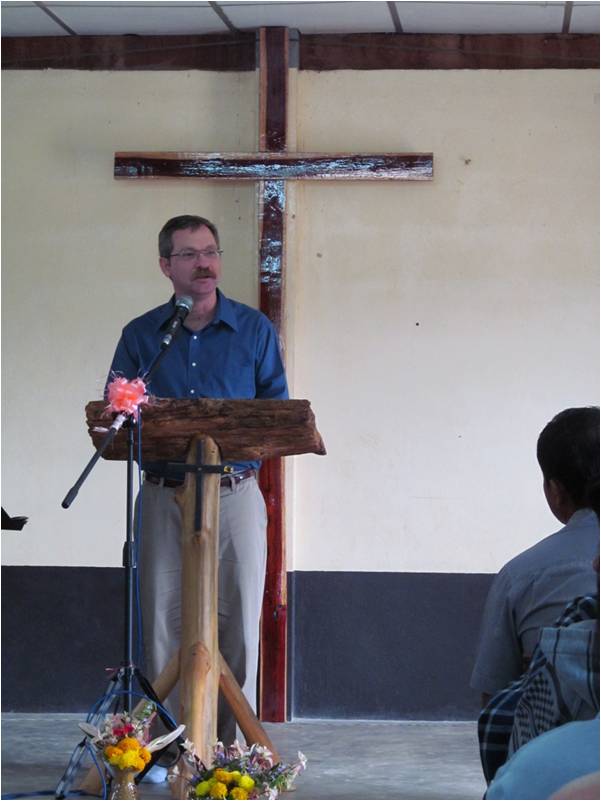
India Journal–smiling faces

IMG_0731

We went on a long road trip today.  From Chennai south to Sankarapuram and back (304 miles).  I saw lots of things that I was familiar with, because much of the terrain and buildings and traffic reminded me of travels during my years in the Philippines.  The colorful Hindu shrines were an obvious difference, and I did not see one basketball court.  So, no, it was not in the Philippines.

IMG_0724 We stopped along the way for some traditional Indian coffee, and Immanuel showed me how it is cooled for drinking.  It was surprisingly refreshing, considering the fact that it is served piping hot, in 80+ degree weather.  I could definitely develop a habit on that stuff.


IMG_0779The highlight (and purpose) of our trip was a visit to Christ Special High School in Sankarapuram, a special school for disabled children and children from single-parent families. The campus is clean and simple, with not a lot of fancy adornment. But it is decorated with the smiling faces of (currently) about 100 wonderful kids.  The atmosphere changed as soon as we saw those children.  All those miles were worth it.


IMG_0738

We had just arrived when some of the girls wanted to show us the craft projects they were working on.  There was little shyness here.  The kids wanted to get to know us, and they seemed genuinely happy that we had visited.  It was hard not to fall in love with them.


IMG_0747

There were smiles, songs, and dances as the kids put on a special program for us.  We exchanged gifts, greeted one another, and prayed.  We especially thanked God for the gifted teachers who have been giving of themselves to allow these kids to have a chance at a better life.


IMG_0772

I appreciated meeting with pastor Paul Nilavan. It was impressive to see a man give so much of himself for the ministry, and sacrifice without complaining.  Since 1993, this school has been making a difference in children’s’ lives, and providing a better future for the community.  People like Paul and the other members of his team have been taking the hurting and helpless and putting smiles on their faces.

India journal – encouragement

IMG_0020

We have had a long day of meetings, and a trip into the heart of the city of Chennai.  I came to India to learn more about the missions, schools, orphanages and other such ministries my organization is currently helping to support.  I also wanted to be an encouragement to the workers, many of whom are toiling long hours in difficult situations with little or no contact with the people who have been praying for them.  I wanted to be a face to the “we’re praying for you” message that these good people have been hearing. Please pray that I fulfill that mission of encouragement.

Today I was given more encouragement than I gave.  I saw first-hand some men of God who are pouring their lives into ministry and making a difference.  Let me highlight two such men:

M. M. Immanuel is one of those people who is always doing something.  He and his cellphone are constantly connected.  He’s the man many of us come to for answers, particularly when the questions are hard.  Immanuel does not always tell us what we want to hear, but he has the courage to tell us the truth we need to hear.  We thank the LORD for him.  Please hold this servant up in prayer.

Ravi Paul is one of the more enigmatic characters I have met today.  He is an impressive lawyer with an analytical mind and a reserved composure.  Yet underneath his calm is a man passionate about the gospel.  When he told us about the ministry his church is doing among the slum residents in his area, you could hear that passion.  They are helping to transform entire communities by giving young people a help out of the trap of poverty, not by just giving away food or money, but by assisting in their education.  Their church provides a place for young people to study, and covenants with parents to keep distractions away so that the students can succeed.  It is working. Already several of the youth have obtained good jobs and are on their way to a future that would have been much different if it weren’t for people like Ravi.  Join me in thanking the LORD for Ravi, and pray that he continues to display integrity in a profession that is often type-casted for the lack of it.

ACST 57: The Transformed

SDC10061The author of Hebrews identifies the church as a people caught up in what God is doing. At first, the prophets spoke of Jesus in the Old Testament, then Jesus fulfilled what they predicted, then the apostles and other early believers attested to that truth. Finally, God has continued the testimony through the church, verifying our words “by signs and wonders and various miracles and by gifts of the Holy Spirit distributed according to his will.”[1]

Just how does the Holy Spirit verify the gospel we preach? There are at least three ways: 1) He transforms us into the image of Christ, 2) He brings about new growth in the church by helping us reach people with the gospel, 3) He breaks through the normal issues of life and manifests supernatural interference – i.e., miracles.

new people

When the religious traditionalists of Jesus’ day complained that his disciples did thing differently that theirs, Jesus responded to their complaint. He implied that we should expect his church to be different. Believers in Christ were “new wine” and cannot be contained in the “old wineskins.”[2] If anyone dared to put new wine in a wineskin that had been previously expanded, it would expand again, and he would have a mess to clean up. That is why those who make wine start afresh with a new skin. That is what God has done.

It is true that there is continuity between ancient Judaism and Christianity. Most of our biblical content is the same. Most of the spiritual principles taught in the New Testament have their origin in the Old Testament. But the questions asked in the Old Testament which had no answer are answered in the New Testament. In many cases, the Old Testament testified to a “what” but did not prescribe “how.” The New Testament fills in its blanks.

One of those all-important “whats” is the concept of the new covenant. Jeremiah predicted this:

“Behold, the days are coming, declares the LORD,

when I will make a new covenant with the house

of Israel and the house of Judah, 32 not like the

covenant that I made with their fathers on the day

when I took them by the hand to bring them out of

the land of Egypt, my covenant that they broke,

though I was their husband, declares the LORD.

33 But this is the covenant that I will make with

the house of Israel after those days, declares the

LORD: I will put my law within them, and I will

write it on their hearts. And I will be their God,

and they shall be my people. 34 And no longer

shall each one teach his neighbor and each his

brother, saying, ‘Know the LORD,’ for they shall

all know me, from the least of them to the

greatest, declares the LORD. For I will forgive

their iniquity, and I will remember their sin no

more.”[3]

The old covenant was the result of God’s grace rescuing his people from Egypt, and leading them to a new life governed by his laws in the promised land. There was a time when that was the new covenant. It promised the newness of freedom rather than the oldness of slavery. Yet, following it proved to be problematic. It can be stated in this way: if God’s people will follow his laws, he will keep them free and give them new hearts. We all know what happened. The people of Israel as a whole never got to the “new hearts” part.

The new covenant would reverse the process. It would be the work of the Holy Spirit, who would first write God’s laws on the hearts of the forgiven, enabling them to know him. Then, he would bring them to their new land. Instead of being attested to by the sacrifice of a lamb, this new covenant would begin with the death of Christ on a cross.[4] Once initiated, the new covenant was meant to replace the old one, making its provisions obsolete.[5] There was nothing wrong with the old covenant, except that it only offered a temporary inheritance. It was designed to point us all to the new covenant, which promises an “eternal inheritance.”[6]

It is in that sense that the church today can be called the new Israel. God’s new covenant with Israel is not intended to add to one nation but to multiply through all nations. The blessing of faith that Abraham manifested is now possible for all of those who believe in Christ, no matter who they descended from. Rights to that new covenant were purchased for all through the blood of Christ.

Just as people served under the old covenant, we also serve under the new covenant. The difference is “that we serve not under the old written code but in the new life of the Spirit.”[7] We begin with grace and we end with glory. If we attempt to get to the glory by means of keeping the law, we will fail. But if we dare to walk by the same Holy Spirit who has regenerated us, we can become like Christ. We can give others a taste of that new wine.

new growth

There was a missions aspect of the old covenant. People were supposed to be drawn to God by seeing his blessings and glory manifested in loyal Israel. God wanted Abraham’s faith to result in blessings for all the nations surrounding Israel.[8] The surrounding nations were blessed occasionally, but the process was often overshadowed by the opposite affect: people ridiculing God because of the sufferings and disloyalty of Israel.

Missions was built into the DNA of the new covenant. Jesus commanded his church to make disciples of all nations,[9] to proclaim the gospel to all nations,[10] to offer repentance and forgiveness of sins to all nations.[11] If the old covenant could be described as “come to us,” the new covenant is best described as “go to them.” In the Great Commission text, the participle “go” does not have the same weight as the imperative “make disciples.” However, the fact that Jesus was sending his disciples somewhere (in actuality, Jerusalem) was significant. It set the stage for a church that would always be going with the gospel.[12]

That role of expanding ourselves through reaching new lands and cultures with the gospel is also described by Jesus in his “vine and branches” message. He told his disciples “You did not choose me, but I chose you and appointed you that you should go and bear fruit.”[13] Jesus did not simply command us to stay where we are and bear fruit. He appointed us to “go” and “bear fruit.” The word translated “go” in that text is not the same word used in Matthew 28. It is the word used for sending someone off in a particular direction for a particular purpose. The mission of reaching new lands, peoples, and cultures with the gospel is built into our new identity as branches of Christ’s vine.

The church is made of people who have found the greatest thing that could ever be found. It is therefore no surprise when we selflessly abandon all that we have for that treasure. As Jesus put it, “The kingdom of heaven is like treasure hidden in a field, which a man found and covered up. Then in his joy he goes and sells all that he has and buys that field.”[14] Here again, the words “he goes” are a form of that same mission we were appointed to by Jesus. However, the motivation for our mission is made clear in this text: “in his joy.” The church expands and permeates not because we are bound by some solemn obligation. We have good news to share with the nations. We go in our joy.

The cultural mandate is also part of our great commission mandate. Jesus told the rich young ruler to “go, sell your possessions and give to the poor, and you will have treasure in heaven. Then come, follow me.”[15] Some people will never be able to come to Jesus because they will always refuse to go away from their possessions. The rich young ruler went away sad and unchanged, because what he had was more important to him than what he could gain in Christ. There are some people who are like this with their homes and families. They will not come to Christ because Christ would require that they give up life in their comfort zone.

For believers in Christ, what we have now is his to give away through us. We embrace the cultural mandate to bless the nations with food, clothing, and other things they need. We do not see this as something separate from spreading the gospel. It is a way of our divesting ourselves of that which is superfluous in our lives so that we can share him. It is also something that brings us joy. We can either give as Christ compels us, and gain joy in doing so, or we will “go away sad” as this young man did.

The mission to go does not always mean to cross geographical boundaries. Sometimes we want to go away and the LORD calls us to go home. The delivered Gerasene wanted to hop in the boat and go away with Jesus and the other disciples. Jesus would not allow him to do so. Instead he said “Go home to your friends and tell them how much the Lord has done for you, and how he has had mercy on you.”[16] Sometimes abiding in the Vine means abiding in your own hometown. It is still a mission, when it is responding to the “go” from the Master. It is still a mission when its end result is more people in the kingdom.

new normal

The new people that is the church of Jesus Christ is a people born of the Spirit,[17] having the firstfruits of the Spirit,[18] set free by the law of the Spirit,[19] and setting their minds on the things of the Spirit.[20] Outwardly, they still look like they did when they were merely of the flesh, but inwardly, they have undergone a transformation. Normal is no longer what it was. There is a new normal, because everything believers think and do is now judged by a new standard: the image of Christ within. People without the experience of regeneration cannot understand this new disposition. The things of the Holy Spirit are foolishness to them.[21]

That original disposition toward exalting and caring for the body of flesh has now been – not removed – but challenged. Believers still want to be preserved from death and hunger and the like, but they also have a strong desire to care for and promote the welfare of Christ’s body, which they are now a part of. Just one look into the eyes of Jesus makes the born again person want to be like him, to introduce others to him, and to experience his power. The Holy Spirit inside believers wants our sanctification, our involvement in evangelism, and our experience and demonstration of his miracles.

The Holy Spirit is an amazing person. Although fully equal to the Father and Son in deity, he seeks to manifest himself through mortal and imperfect human beings. He is both the key to unity in the church, and the reason for our glorious diversity. He embraces our differences, and instead of causing us to suppress them, he utilizes those differences to mature us, and to reach the most with the gospel. Any time the church seeks too zealously to manufacture an artificial unity, we tend to squelch the Holy Spirit’s work. He is too big to fit within our carefully constructed labels.

The Holy Spirit works within each believer individually, and wants to manifest his power through each believer “for the common good.”[22] He makes each believer a gift to the group as a whole, by ministering his spiritual gifts, and manifesting his spiritual fruit. He is the author of supernatural miracles, transformed character, and church growth. Church traditions tend to push cooperation with him in one area or the other, but he seeks all three at the same time. To put it negatively, a believer has not yielded to the Holy Spirit unless she is willing to let him manifest his power in her life through miracles, renewed holiness, and outreach.

The Spirit and the word

The word of God is the Spirit’s weapon – the sword of the Spirit.[23] Those who hear and believe the word are sealed with the Holy Spirit.[24] He uses the written and spoken word to accomplish his purposes in and with the church. He uses the Scriptures to catch us, change us, turn us into evangelists, and give us faith to receive his miracles. Theoretically, one might say that the word alone is powerless to do anything. For example, demons laugh when unbelievers attempt, apart from the Holy Spirit, to use texts from the Bible as some sort of animistic charm to ward off evil. In the church’s hands, however, the word is backed by the power of the Holy Spirit. In that case, the word is anything but powerless.

Prayer and the Holy Spirit

The Holy Spirit is also the key person in the prayer ministry of the church. Paul encouraged believers to pray at all times, but added the explanatory phrase “in the Spirit.”[25] The prayers of unbelievers are always heard by God, but the church’s prayers are actually sponsored by God. When we pray in the Spirit, we are praying words which are not just intended to reach the throne, but words which actually originate there. Prayer by believers is cooperation with God and affirmation of what he is doing and wants to do.

Refusing to pray leads to powerless people, limited growth, and hardened hearts in the church. A church can have all the right theology of the Holy Spirit in their creeds, but if they do not pray, those words are empty. The act of prayer substantiates what a person or group believes about the Holy Spirit. In fact, the Holy Spirit is so eager to touch this world with manifestations of himself, he often uses praying people who have seriously defective theologies. This happens to the shame of many more “orthodox” churches, because they do not pray as they aught.

Worship and the Holy Spirit

One of the ways that the Holy Spirit speaks to believers, and through them, is the act of corporate worship. He is the means by which we manifest authentic worship: it is by the Spirit.[26] The apostle Paul taught that the true circumcision – that which really matters – is that which is done by the Holy Spirit, and it results in praise from God.[27] The text is a bit ambiguous about whether that praise is being received by the true Jew, or given by him. It could be interpreted either way, because God honors authenticity, and authentic people give authentic worship.

One of the Old Testament predictions about life under the new covenant is that believers would be characterized by gladness and joy instead of sadness and sorrow.[28] When the church worships, we celebrate the reality of this age of grace, and our new status as part of that reality. Worship flows from who we are, who Christ is, and what our future is because of what Christ did. The Holy Spirit within us serves as our guarantee of this future inheritance.[29] No matter what might distract us in the present, he helps us remember what we were made for – glorifying, enjoying, and worshipping God throughout eternity. While we are worshipping, we are more in touch with who we truly are and will be than at any other time.

Recognizing the Holy Spirit

Jesus is the only person of the Holy Trinity who can be seen in bodily form, because he is the only one who has taken on flesh. If one wants to look for the Holy Spirit, one has to look for the evidence. If you want to see the wind, you look for open sails and fast moving sailboats. If you want to see the Holy Spirit, you look for growing, maturing, gift-manifesting churches. The transformed church is his calling-card.


[1] Hebrews 2:4 ESV.

[2] Matthew 9:17.

[3] Jeremiah 31:31-34 ESV.

[4] Luke 22:20; 1 Corinthians 11:25.

[5] Hebrews 8:8-13.

[6] Hebrews 9:15.

[7] Romans 7:6 ESV.

[8] Genesis 18:18; 22:18; 26:4.

[9] Matthew 28:19.

[10] Mark 13:10.

[11] Luke 24:47.

[12] When Jesus gave his Great Commission, it was to the eleven in Galilee, just before they were to return to Jerusalem. It would make sense to take the participle of poreuomai (go) as adverbial of time, which would result in Jesus telling them that after they go (to Jerusalem) they were to make disciples. Translators usually take the participle as having a practically equal status with the imperative (matheteusate from matheteuo) in that text. Each case when Matthew uses the aorist participle of pereuomai with an accompanying verb, the stress is on the action of that accompanying verb. See Matthew 2:8; 9:13; 11:4; 21:6; 27:66. The command in Matthew 28:18 is to make disciples. Going places is incidental, but necessary to obeying that command.

[13] John 15:16.

[14] Matthew 13:44 ESV.

[15] Matthew 19:21 ESV.

[16] Mark 5:19 ESV.

[17] John 3:5-8.

[18] Romans 8:23.

[19] Romans 8:2.

[20] Romans 8:5.

[21] 1 Corinthians 2:14.

[22] 1 Corinthians 12:7.

[23] Ephesians 6:17.

[24] Ephesians 1:13.

[25] Ephesians 6:18.

[26] Philippians 3:3.

[27] Romans 2:29.

[28] Isaiah 61:3.

[29] 2 Corinthians 1:22; 5:5; Ephesians 1:14.

road trip

SDC13851


Have you ever had one of those “Aha” moments, where you realize that the LORD is making your schedule for you, and you are meeting just the people you need to meet to get the job done?  Penny and I had lots of those moments in our recent road trip to Florida, South Carolina, and North Carolina. 

Each of us wear a number of “hats” – having three part-time jobs apiece, and a number of volunteer positions.  We had initially planned a trip to Florida so that I could do some church business as elder of the McAlpin Advent Christian Church.  As time went on, we began to see that we could kill a whole flock of birds with this stone.  So, we planned meetings at the Advent Christian Village, and Bixler Memorial Advent Christian Church.  The LORD provided key people for us to meet with about some projects we are working on as Asia Pacific Area Directors.  He provided key people for us to meet with concerning the new ACGC Global Training Initiative.  We were amazed at the number of new contacts and the amount of helpful information we received – all in one place.

IMG_0617The return trip was just as helpful.  We stopped at Columbia International University for some missions research, and – you guessed it – meetings.  We caught up with people who had studied with us when we attended there. We met and prayed with one of Penny’s former professors.  One of the things that has always impressed me about CIU is how its core commitments are clear in all the classes. It can even be seen on campus.  There are monuments throughout the campus to EVANGELICAL UNITY, AUTHORITY OF SCRIPTURE, WORLD EVANGELIZATION, and VICTORIOUS CHRISTIAN LIVING.  In many ways, coming back to the CIU campus is like coming home for us.

Lastly, we stopped off to visit the Walsh family, and for some … wait for it .. meetings at the ACGC denominational offices in Charlotte NC.  We have been meeting quite regularly with Jeff Walsh, the ACGC world outreach director, by video conferences.  The face-to-face meetings we had with Jeff and all the other helpful people in the denominational offices were encouraging and productive.

This is just a summary of our road trip.  It was busy. We had the chance to interact with some great people – some of whom we have not even mentioned. (You know who you are).  Returning home to Virginia now, we thank the LORD that he has allowed us to serve him through ACGC, and to be a part of this team.  He is sovereign, and there are no chance happenings with him.


defining conditionalism

Some recent online discussions have centered around what is meant by the term “conditional immortality” or its synonym “conditionalism.” These are essentially anthropological terms. They describe the nature of humanity as the Bible represents it. They affirm that human beings have the potential to become immortal, but that immortality is not innate: it is not something we are born with.

Conditionalism in Genesis

The early chapters of Genesis prove to be very helpful as a guide to understanding human nature. They show that human beings are creatures, like the animals, but that human beings were intended to be more than that. They were created in God’s image and likeness, which implies a special authority from God and responsibility to him. God tested this responsibility in the Garden of Eden by planting two special trees in Eden: the tree of life (which, if eaten would have granted Adam and Eve immediate immortality), and the tree of knowing good and evil.

Of these two trees, only the latter was prohibited. The first humans were allowed to eat of all the other trees, including the tree of life. If our ancestors had simply made the correct decision, they would have remained alive forever, along with all their descendants.

Instead, they were deceived to believe that it was the other tree that actually held promise. Satan had told them “For God knows that in the day you eat from it your eyes will be opened, and you will be like God, knowing good and evil” (Genesis 3:5). That statement was the truth, but it implied a lie: that the tree offered immunity from death. Instead “being like God” merely meant having experienced both good and evil. God had known both the good of his original creation and the evil of Satan’s rebellion. Taking of the tree of knowing good and evil would cause humans to experience evil personally – thus wreck the purity of Eden, and human intimacy with their creator.

God’s response to that sin led to a further consequence: human mortality. The persons of the Triune One speak among themselves and say …

“Behold, the man has become like one of us in knowing good and evil. Now, lest he reach out his hand and take also of the tree of life and eat, and live forever-” therefore the LORD God sent him out from the Garden of Eden to work the ground from which he was taken. He drove out the man, and at the east of the Garden of Eden he placed the cherubim and a flaming sword that turned every way to guard the way to the tree of life.” (Genesis 3:22-24)

Before the fall, human beings had the potential to become immortal. They had the potential to become something more than what they were. As a consequence of the rebellion in Eden, this opportunity was taken away.

God wanted human beings to be immortal. He still does. He wants to establish a relationship with us that will bring glory and joy to both parties forever. Yet God cannot endure unrighteousness forever. Until a solution can be found that will undo the Eden rebellion, God cannot grant immortality to human beings. He was thus forced by his own nature to banish us from paradise.

So, although intended for immortality, human beings are now reduced to the same nature as the animals God has placed us over. The ancient scientist Solomon recognized this:

“I said in my heart with regard to the children of man that God is testing them that they may see that they themselves are but beasts. For what happens to the children of man and what happens to the beasts is the same; as one dies, so dies the other. They all have the same breath, and man has no advantage over the beasts, for all is vanity. All go to one place. All are from the dust, and to dust all return.” (Ecclesiastes 3:18-20).

This is the bad news the Bible gives us, which serves as the backdrop for the good news of eternal life available through Christ.

Conditional Immortality

Conditionalists proclaim Christ, and his second coming as the time when God is going to grant immortality to the saved and undo the Edenic curse. But we have also championed the truth of this bad news: that all humanity is mortal and subject to real death. We feel that it is dishonoring God’s word to say that humans are both mortal and immortal at the same time.[1] We also feel that it is inconsistent evangelism to claim that Jesus offers eternal life and then teach people that they already have eternal life.

So, instead of teaching people that immortality is innate (that is, that all human beings are born with it), we teach that it is conditional. God offers eternal life to those who put their faith in Christ: those are the conditions. One of the first post-apostolic writers to express conditionalism was Theophilus of Antioch:

“God did not create humanity as either mortal or immortal, but, …with the capacity for them both. If humanity inclined towards those things which relate to immortality by keeping the commandments of God, then it would receive immortality as a reward from God… On the other hand, if humanity should incline towards those things which relate to death by disobeying God, then humanity would be the cause of its own death.” [2]

When a certain man came to Jesus once, asking “what good deed must I do to have eternal life?”[3] – Jesus did not challenge his theological inference that eternal life is something that must be obtained. If immortality were innate, then Jesus should have stopped the man and pointed that out. Instead, Jesus agreed with the man that he needed eternal life, and then challenged the man to follow him – that he might get what he was asking for.[4]

The Gospel is all about how God offers us what we do not have on the basis of his grace, through the atoning death of Christ. Christ’s death has met the conditions. Following Christ is the solution to the curse of Eden. A conditionalist is someone who does not trust in her own innate ability to live forever, but trusts in Christ’s completed work on the cross, and looks forward to the day when Christ will make her immortal.

Conferred Immortality

Conditionalists also take death seriously, and that leads to our special appreciation of the gift of immortality. We understand the awful consequences that are the result of sin entering God’s creation, and that makes us appreciate Christ all the more. When we read Romans 6:23, it makes perfect sense as it is: “For the wages of sin is death, but the free gift of God is eternal life in Christ Jesus our Lord.” But if a person believes that immortality is not conferred as a gift, but is an innate possession, they have to supply some interpretation for Romans 6:23 to fit their view. It then reads “For the wages of sin is death (but only death of the body, because the real person is the soul and it cannot die), but the free gift of God is eternal life in Christ Jesus our Lord (except that eternal life is actually a right we have by birth, so Christ does not give it).”

William Newton Clarke complained that conditionalists “argue from the silence of scripture regarding the natural immortality of man, and from the uniform association of ‘eternal life’ with Christ.”[5] He was exactly right – although it is hardly reason for complaint. Scripture is silent on the natural immortality of humans because it rejects the notion. Eternal life is either conferred upon the faithful or it is innate by reason of creation. There is no logic that allows for both, or any scripture that proves both.

Future Immortality

Conditionalists have never argued against the concept of human immortality. We simply insist that that great gift will be given to humans at the appropriate time. It has not been the possession of all humans from birth. Instead, it will be given to some humans at the return of Christ. Speaking of that return, Paul says that it will happen “in a flash, in the twinkling of an eye, at the last trumpet. For the trumpet will sound, the dead will be raised imperishable, and we will be changed. For the perishable must clothe itself with the imperishable, and the mortal with immortality” (1 Corinthians 15:52-53 NIV).

That glorious day will be the beginning of “the times of restoration of all things, which God has spoken by the mouth of all His holy prophets since the world began.”[6] The fact that raising the dead is first on Christ’s list when he returns should be an encouragement to us. It should enable us to face the death of our loved ones (or even our own eventual death) with courage, knowing that although death is real, it is only temporary.

Life Only In Christ

The doctrine of human mortality is Christocentric, not anthropocentric.[7] It reveals Christ as the giver of life, not just the one who can “get you to heaven.” John states the options bluntly: “Whoever has the Son has life; whoever does not have the Son of God does not have life.”[8] The Bible is about Jesus Christ. The Old Testament pointed forward to him, the New Testament points back to him. Human mortality is the need which only Christ could meet. Paul says that God “saved us and called us to a holy calling, not because of our works but because of his own purpose and grace, which he gave us in Christ Jesus before the ages began, and which now has been manifested through the appearing of our Savior Christ Jesus, who abolished death and brought life and immortality to light through the gospel.”[9]

Over against this clear teaching from the Bible on human mortality is the persistent mistaken notion that humans are born with immortal souls or spirits that consciously survive the death of their bodies. This view sees the references to death in the scripture as usually referring to this physical death, and therefore irrelevant on the subject of the soul’s survival. The view thus confirms both mortality and immortality at the same time. Any scriptural evidence in favor of human mortality can immediately be dismissed as not pertinent, since it (in the innate immortality view) always refers to the material aspect of human existence, and not the spiritual.

Scriptures that Clash with the Innate Immortality Tradition

The innate immortality tradition reflects Greek dualism. It is a worldview that is read into scripture, rather than being a part of it. It has become embedded in Christianity the way many other non-biblical traditions have. By taking a closer look at doctrines taught in scripture, the clashes between those doctrines and the innate immortality tradition become more evident.

1 Timothy 6:16

In chapter 15 we noted that scripture teaches that God “alone has immortality” (1 Timothy 6:16). The innate immortality view denies this, although its proponents do exercise a great deal of verbal gymnastics to try to affirm it.[10] At issue, then, is not simply the doctrine of human nature, but the doctrine of God’s nature as well. To claim immortality for sinful humanity is to deny it as an exclusive attribute of God. But when the first humans sinned, God said that they “must not be allowed to … live forever.”[11] Their sin had not only affected their relationship with God (resulting in banishment from his presence in Eden), but it changed them. They had been immortable (capable of becoming immortal by eating of the tree of life). Now they were simply mortal.

Some argue that the term “immortality,” when it refers to God, has a different meaning than when it refers to all other beings. They argue that “the meaning of ‘immortality’ in the Bible largely depends on its context.”[12] They see this as adequate justification for ignoring the contradiction found in the traditional doctrine of the immortal soul, and affirming both the exclusive immortality of God and the universal immortality of humanity as dependent upon him. Conditionalists see this as double-speak. While it is true that all words depend on their context for meaning, there is nowhere in the context of 1 Timothy 6:16 that redefines the term or assumes a distinction between how it is used by Paul there, compared to how he or other biblical authors use it elsewhere.

Genesis 2:17

This is precisely what God (with tears in his eyes) warned Adam and Eve would happen if they disobey his Edenic prohibition. He said “but of the tree of the knowledge of good and evil you shall not eat, for in the day that you eat of it you shall surely die.”[13] That phrase “you shall surely die” is a combination of two forms of the same verb. The word mot is the infinitive absolute of the verb “to die” and refers to the state of mortality that was humanity’s fate after the rebellion in Eden. From the moment they ate of the tree, humanity became a dying race. The second word is the imperfect tense of the same verb. The word tamut refers to the eventual and inevitable death that would come to each member of the race as a result of the fall. Together these two forms of a verb reflect a Hebrew idiom that accentuates the certainty of an action. Thus the translations render the phrase “you will surely die.” The innate immortality doctrine turns this into an empty threat since it claims that the real essence of a human person never dies.

Romans 5:12

Paul tells us that “When Adam sinned, sin entered the world. Adam’s sin brought death, so death spread to everyone, for everyone sinned.”[14] Sin and death have been a matched set in human experience ever since that initial sin in Eden. It is not merely the body which sins, but the whole person. That is why we need a Savior, not just someone who can raise us from the dead. Christ is both. He can restore our inner beings as well as raise our bodies. Both have been affected by sin; the wages of that sin is death to both, and the gift of God is eternal life for both.[15]

John 3:16

The Bible speaks of a coming day of judgment when all those who are not redeemed by Christ’s blood will totally perish in the fires of Gehenna hell.[16] When the Bible speaks of believers being saved, it usually refers to this event. In other words, to perish is not simply to die. To perish is to utterly die. It refers to the ultimate, permanent death in Gehenna, not to the temporary death at the end of this life. So when Jesus told Nicodemus that “God so loved the world, that he gave his only Son, that whoever believes in him should not perish but have eternal life” he was speaking of the two ultimate fates of mankind. To perish is to be ultimately destroyed. To have eternal life is to escape that destruction. Many texts point out the same distinction.[17] The innate immortality doctrine blurs that distinction because it insists that no human being ultimately perishes. Thus all human beings ultimately have eternal life.

The innate immortality view distorts a crucial and essential doctrine of the Christian faith: the purpose of Christ’s death on the cross. According to the Bible, Christ’s death was to protect us from ultimate destruction, not to get our souls to heaven when our bodies die.

1 Corinthians 15:22-23

The Bible is also explicit on the issue of just when believers will gain the gift of immortality. It did not happen at our birth, and it will not happen at our death. Believers will be made alive at the return of Christ. Paul says “For as in Adam all die, so also in Christ shall all be made alive. But each in his own order: Christ the firstfruits, then at his coming those who belong to Christ.” Paul compares two events in history. The first event was the fall of humanity in the garden of Eden. As a result of that event, human nature became a fatal condition. The second event is the return of Christ to this earth.

The analogy Paul uses to describe the resurrection is a crop harvest. Each resurrection is a stage in the harvest. Since Christ is the Firstfruits, he was resurrected first. This took place three days after his death. The second stage of the harvest includes “those who belong to Christ” when he comes. This is the believers’ resurrection. Paul does not speak of Christ restoring souls with their risen bodies. Instead he speaks of the whole person being “made alive.” This is when the promise of eternal life will be fulfilled for us.

The doctrine of innate immortality also subverts this plain teaching of scripture. According to that view, no human being ever dies, so none will ever need to be made alive. The concept of the resurrection takes a back seat to the more immediate idea of conscious survival of death. It makes the return of Christ less crucial, and rather anticlimactic.

Summary

The consequences of original sin in the Garden of Eden include the mortality of all human beings, which makes homo sapiens no different from the animals in terms of mortality and eventual death. This dark reality is the backdrop upon which the

brilliant light of eternal life offered by Christ emerges in scripture. In contrast, the tradition of innate immortality dilutes the teachings of scripture. Believing that one is already immortal by nature can make one less appreciative of the nature of God, the influence of sin, the purpose of Christ’s death on the cross, and the reason for his second coming.

Confusion in defining the term

Often in theological discourse, the same terms are used for different concepts, and sadly, this is the case for conditional immortality as well. John Stott, for example, defended the view described above, but did not call it conditional immortality. He defined conditional immortality as the view that “nobody survives death except those to whom God gives life.”[18] While that is technically accurate, it does not represent the teaching of conditionalism. In conditional immortality as described above, everyone will be resurrected and face judgment. No one will survive death apart from that resurrection.

Wayne Grudem asserts that “some versions of conditional immortality deny conscious punishment altogether, even for a brief time.”[19] The doctrine of conditional immortality as described in this article assumes both conscious punishment of the lost, and ultimate destruction of the lost.

The whole question of the final fate of the lost is not subsumed under the term conditionalism. The issue with conditionalism is whether there is anything immortal in human nature to suffer punishment for eternity. Conditionalists answer, no. We teach that death is real. The first death is real in that life ceases until the resurrection. The second death is real in that life ceases, and there is no longer any hope of resurrection.

While the second death will be preceded by a period of torment, it is the death which follows which is permanent. It is not the process of punishing which is perpetual (as if the word aionios was an adverb), but the event of punishment which is permanent (since aionios is an adjective). The Bible describes the fate of the lost as eternal punishment, not perpetual punishing.[20]

Millard Erickson uses the term “conditional immortality” to describe the state of Adam (and Eve) before the fall. Adam “was not inherently able to live forever; but he need not have died.”[21] Thus, he adds another use of the term which does not quite fit our definition. Erickson defines death as “the termination of human existence in the bodily or materialized state.”[22] He is free, then, to speak of Adam’s death as becoming certain at the fall, their “potential mortality” becoming actual.[23] Yet he still keeps the door open to Platonic dualism by drawing a sharp distinction between physical death and spiritual death. The second death is spiritual death made permanent. He does not explain why there must be a physical resurrection for that to happen.

Should we jettison the term?

Seeing that there is confusion on how the term is used, is this a case for jettisoning the term “conditional immortality” for a more precise one? Probably not. In most cases, those who disagree with us at least grant us audience so that we can explain exactly what we mean, in order to lessen any confusion. It is in the act of clarifying terms and defining meaning that we confront the text of Scripture, and that is precisely what theological debate was intended to accomplish. If, in the end, my opponent in religious dialog confronts the texts of scripture and yet still disagrees with my interpretation of them, we can still walk arm in arm as brothers.

If, for the sake of argument, we entertained the idea that the term “conditional immortality” is no longer useful as a theological instrument, what would take its place? Some prefer the term annihilationism. The church tradition that this author comes from has not chosen to adopt that term. Although we feel it accurately describes the fate of the lost, we are not comfortable with its emphasis. Conditional immortality reflects the “good news” side of the Biblical message. It speaks of the gift of eternal life which is available to all who meet the conditions of faith in Christ and repentance from sin.

It also points to the fact that Christ has met the conditions that make eternal life possible for his church. It is “our Savior Christ Jesus, who abolished death and brought life and immortality to light.”[24] Thus, the term is Christocentric. The ultimate question regarding one’s eternal destiny is not whether one has a “soul” but whether one has a Savior. It is not what you have done your eternal spirit but whether you have obeyed the Holy Spirit. As John put it, “Whoever has the Son has life; whoever does not have the Son of God does not have life.”[25] Ultimately, eternal life is not going to depend on having a part of you that survives death. Eternal life is going to depend upon your relationship with God through Jesus Christ, his Son. There are eternal haves, and eternal have-nots. That difference is what conditionalism is all about.


[1] William West explores this contradiction in Resurrection And Immortality (Xulon Press, 2006), 77.

[2] Theophilus of Antioch ad Autolycum (shortly after 180 AD) quoted in Alister E. McGrath, ed. The Christian Theology Reader (Malden Mass: Blackwell Publishing, 2007), 646.

[3] Matthew 19:16.

[4] Matthew 19:21.

[5] William Newton Clarke, An Outline of Christian Theology (BiblioBazaar, LLC, 2009), 452.

[6] Acts 3:21 NKJV.

[7] Viewing mortality as an anthropocentric issue places too much emphasis on humans as created rather than humans as redeemed. Conditionalists argue that viewing mortality as an anthropocentric issue distracts believers from seeing the connection between human need for resurrection life and the solution for that problem offered in the atonement.

[8] 1 John 5:12.

[9] 2 Timothy 1:9-10.

[10] Page 104.

[11] Genesis 3:22 NIV.

[12] Christopher W. Morgan, Robert A. Peterson, Hell Under Fire (Grand Rapids: Zondervan, 2004), 206. These authors discredit the conditionalist argument for exclusive immortality of God because they are seeking to defend the traditional concept of hell as the perpetual torture of immortal human souls.

[13] Genesis 2:17.

[14] Romans 5:12 NLT.

[15] Romans 6:23.

[16] Malachi 4:1; Matthew 5:22,29,30; 10:28; 18:9; 23:33; Mark 9:43,45,47; Luke 12:5.

[17] See also John 4:14; 5:21; 10:28; 17:2.

[18] David L. Edwards with a Response from John Stott, Evangelical Essentials (Downers Grove, Ill: InterVarsity, 1988), 316.

[19] Wayne Grudem, Systematic Theology (Grand Rapids, MI: Zondervan, 1994), 1150 (footnote 12).

[20] Matthew 25:46.

[21] Millard Erickson, Christian Theology (Grand Rapids, MI: Baker Book House, 1985), 613.

[22] Erickson, 613.

[23] Erickson, 614.

[24] 2 Timothy 1:10 ESV.

[25] 1 John 5:12 ESV.