OUR HOPE IS COMING

OUR HOPE IS COMING

1 Peter 1:3-13 (CSB)

3 Blessed be the God and Father of our Lord Jesus Christ. Because of his great mercy, he has given us new birth into a living hope through the resurrection of Jesus Christ from the dead 4 and into an inheritance that is imperishable, undefiled, and unfading, kept in heaven for you. 5 You are being guarded by God’s power through faith for a salvation that is ready to be revealed in the last time. 6 You rejoice in this,[a] even though now for a short time, if necessary, you suffer grief in various trials 7 so that the proven character of your faith—more valuable than gold which, though perishable, is refined by fire—may result in praise, glory, and honor at the revelation of Jesus Christ. 8 Though you have not seen him, you love him; though not seeing him now, you believe in him, and you rejoice with inexpressible and glorious joy, 9 because you are receiving the goal of your faith, the salvation of your souls. 10 Concerning this salvation, the prophets, who prophesied about the grace that would come to you, searched and carefully investigated. 11 They inquired into what time or what circumstances the Spirit of Christ within them was indicating when he testified in advance to the sufferings of Christ and the glories that would follow. 12 It was revealed to them that they were not serving themselves but you. These things have now been announced to you through those who preached the gospel to you by the Holy Spirit sent from heaven—angels long to catch a glimpse of these things.13 Therefore, with your minds ready for action, be sober-minded and set your hope completely on the grace to be brought to you at the revelation of Jesus Christ.

Most of the Christmas stories that we tell ourselves every year come from the first two chapters of Matthew’s Gospel and the first two chapters of Luke’s Gospel.

Matthew records the story of the angel’s appearance to Joseph, the young couple’s travel to Bethlehem, Jesus’ birth, the visit of the wise men, the escape to Egypt, and Herod’s massacre of the children.

Luke tells us about the angel Gabriel’s announcement to Zechariah about the coming birth of John the Baptist. Then he records Gabriel’s announcement to Mary that she would give birth as well. Luke then tells us what happened when pregnant Mary visited pregnant Elizabeth. Then he records the birth of John, and Zechariah’s prophecy about him.

It isn’t until chapter two that Luke gets back to the story of Jesus. He explains why Mary and Joseph were in Bethlehem when Jesus was born. He is also the only one who mentions the manger, and the only one who tells us about the angel’s announcement to the shepherds, and their visiting the baby Jesus in the manger.

Toward the end of Luke 2, there are two stories that take place when the infant Jesus is being dedicated. Two old people are featured in these stories. Simeon and Anna recognize who Jesus is when his parents bring him into the temple to be dedicated. These old saints were hoping for something. They were looking for something that Luke called “Israel’s consolation.” They recognized this infant Jesus as the key figure in God’s plan to save their people.

Over 60 years later, Peter pens the words of today’s text. He has lived the events described in the four Gospels. He wants to encourage the people who have put their hope in Jesus Christ for salvation. If I were to summarize what Peter says in chapter 1 of his epistle it would be this: “Our hope is coming.”

our hope is coming because of what Christ has done for us.

Peter mentions “the sufferings of Christ” in verse 11. By now, everybody knows the story of the trial and crucifixion of our Savior, but nobody knows it better than Peter. He was there, sleeping in Gethsemane. He was there, denying his master. He didn’t understand it at the time, but now, he understands why Jesus had to suffer what he did when he did.

Peter preached about Christ’s suffering in the early days after Pentecost. It was a major part of his gospel message. He taught that Christ’s suffering was not a mistake. It was part of God’s plan and had been announced by his prophets.

Christ’s suffering on the cross was necessary. Without the cross, humanity would have no hope. But because of what Jesus did on the cross, Peter can speak of the “glories that would follow (11).

Peter also mentions “the resurrection of Jesus Christ from the dead” in verse 3. Christ had to do more than just suffer on the cross because the wages of sin is not suffering. The wages of sin is death. But if Jesus were to merely die for us, how would we know that his death has paid the price for our sins? That is why the resurrection of Jesus was essential to God’s plan. His resurrection is also essential to our hope. Because he lives, we too will live.

Paul called Jesus the first fruits of those who are asleep. That imagery is a harvest imagery. The first fruits is the first of the crop. When the first fruits come in, people start celebrating, because there is now hope for a full crop. Because Jesus was raised from the dead, there is hope for us.

Paul even told us when we would be raised. He said “For as in Adam all die, so also in Christ all will be made alive. But each in his own order: Christ the first fruits, after that those who are Christ’s at His coming” (1 Corinthians 15:22-23 NASB).

our hope is coming because of what our faith is doing in us

Peter not only tells us what Christ has done to give us hope, but he goes on to explain what is going on right now in our lives to keep that hope alive until Jesus returns.

He says in verse 5 that we “are being guarded by God’s power through faith.” The word “guarded” suggests the picture of military protection while the battle ensues. The faith that God has given us keeps us in the interval between Christ’s first advent and his second advent.

That is why Peter can speak of his readers rejoicing during this time. He says in verse 6 “You rejoice in this, even though now for a short time, if necessary, you suffer grief in various trials.” Also, in verse 8, he says “Though not seeing him now, you believe in him, and you rejoice.” Joy is one of the manifestations of the Spirit’s presence – what Paul called the fruit of the Spirit. The joy that God has given us to express keeps our hope alive in this interval between Christ’s first advent and his second advent.

In verse 7, Peter talks about how our faith is being refined by fire in this present age. Faith is described as a precious metal, more valuable than gold. The tough times we go through test our faith, refining it so that it is even more pure.

In verse 9, Peter tells his readers that they are receiving the goal of their faith, the salvation of their souls. In verse 3, he calls this salvation a new birth. So, technically, he’s saying that we can be born-again, and not saved yet. You see, the salvation he is talking about is the permanent deliverance. We have not experienced that yet. That is why we need Jesus to return.

our hope is coming because Jesus Christ is going to return for another mission.

Just like Simeon and Anna, we who have trusted in Christ for our salvation are waiting for his advent. They waited for his first advent; we await his second advent.

They waited for him to come as a sacrifice, because he had a mission, and that mission was to die for our sins on the cross.

Check. That mission was accomplished.

Now, Peter says, Jesus has to return because he has another mission. There is “an inheritance that is imperishable, undefiled, and unfading, kept in heaven for” us (4). We do not have that inheritance yet. In fact, our lives today are the exact opposite. We are living in perishable bodies, defiled by ongoing sin, and our lives are fading away.

Jesus said that our “reward is great in heaven” (Luke 6:23). He did not mean that our reward is heaven when we die. Later on, in the book of Revelation, John records Jesus saying “Behold, I am coming quickly, and My reward is with Me” (Revelation 22:12). So our reward – what Peter calls our inheritance – is with Jesus in heaven right now, but we won’t get it until he returns.

Peter acknowledges this in verse 5 when he describes our coming inheritance as “a salvation that is ready to be revealed in the last time.” In essence, he is saying we “ain’t seen nothing yet.” Our salvation is secure, but it has not yet been revealed, because our savior has to come back for that.

Peter goes on to say in verses 6-7 that our present sufferings are turning our faith into something wonderful. We start out with the dross of condemnation, shame and dishonor, and the fire of our suffering is producing “praise, glory, and honor.” This result may not always be evident in our lives today, but it will be evident “at the revelation of Jesus Christ” – when he returns.

The Old Testament prophets usually talked about both advents as if they were going to happen at the same time. They didn’t know that there would be over two thousand years between what Peter calls in verse 11 “the sufferings of Christ and the glories that would follow.” His sufferings took place during his first advent, his glories began at his ascension and will continue into his second advent.

So, what is Peter saying to us today? In verse 13, he tells his readers to set their “hope completely on the grace to be brought to [them] at the revelation of Jesus Christ.” That is his message for us as well. Our hope is coming.

During the Advent season, it is good to be Advent Christians. We can be grateful for all that God has done for us, and all he is now doing in us. But we can also be assured that the best is yet to come.

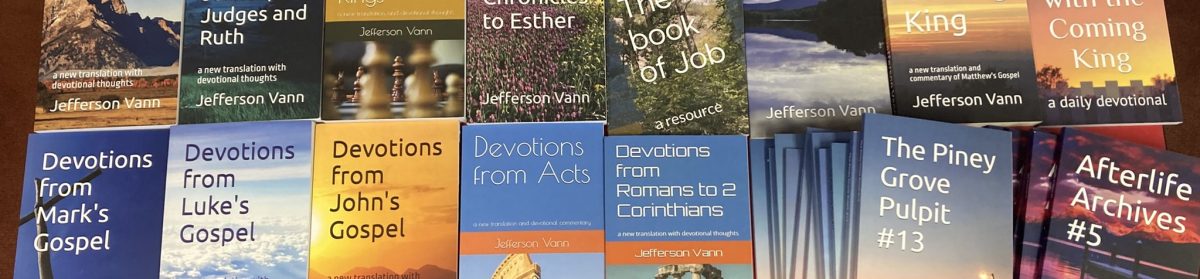
books-by-jefferson-vann-ad-1


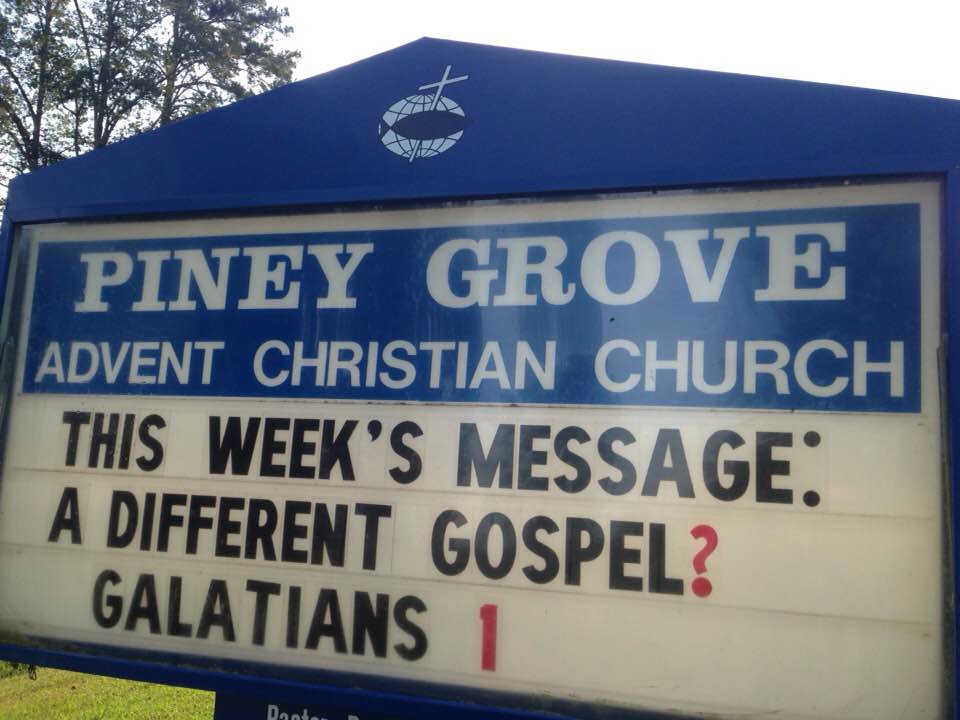
a different gospel?

a different gospel

a different gospel? (Galatians 1)

“I am amazed that you are so quickly turning away from him who called you by the grace of Christ and are turning to a different gospel—” (Galatians 1:6 CSB).

John Stott wrote that when the devil “cannot entice Christian people into sin, he deceives them with false doctrine.”

That is what is going on in the book of Galatians. A Christian church is being attacked, not by the Roman government, not by an angry Jewish persecutor, but an attack from within. A different gospel had been introduced, and the Galatians were turning to it instead of the gospel by which they had been saved! An internal battle is going on in the churches of Galatia.

The Holy Spirit gave us the book of Galatians as part of the Bible because every church is capable of turning from the true gospel to a false gospel. Anyone who claims to believe can be deceived and turn from the gospel to a different gospel.

That is why it is important for us to study this book. We need to know whether what we believe is the true gospel, or if we have already fallen for a false gospel.

So, we need to ask “What was different about the gospel that the Galatians were turning to?” The text of Galatians 1 answers that question.

it was human centered, not God centered

Paul warned that by turning toward that different gospel, the Galatians were turning away from the God who called them to himself (6). The people teaching the false doctrine now known as the Galatian heresy didn’t advertise it that way. They didn’t say “follow our teaching and you’ll turn away from God.” No, they were teaching the opposite. They came into the churches of Galatia and said. “Hey, y’all are doing okay, but if you really want to get on God’s good side, here’s what you need to do.”

The Galatians were being tempted away from God because they were trying to please people (10). These people pretended to be true believers in Christ. But they had an agenda that was different from Christ’s agenda. They wanted to introduce bondage instead of freedom.

But the gospel that Paul had preached to the Galatians, by which they were saved, was not “of human origin” (11). He didn’t dream it up. It “came by revelation of Jesus Christ” (12).

That word “revelation” is the same word that serves as the title to the last book in the New Testament. It means a disclosure, an unveiling. Paul is saying that Jesus himself revealed the gospel to him. He didn’t get it second-hand.

Paul was pretty stubbornly set on going against the gospel, so Jesus had to knock him down and blind him for awhile to get his attention. So, after learning the truth of the gospel in such a miraculous way, Paul was not about to allow it to be replaced by another gospel.

Paul learned that he could not serve Christ by hanging on to the traditions of his ancestors (14). Those traditions had led Paul to persecute true believers (23).

Now here is an important thing to remember. The traditions were not a bad thing in and of themselves. Many of the traditions had their origin in the Bible. Circumcision, submission to the law of God, separation from idolatry – all of these things were not bad things. What made these things wrong was the way they were being used to replace the gospel. You can take the best of human tradition and you can turn it into a dangerous evil by making it the gospel instead of the gospel of God.

What was different about the gospel that the Galatians were turning to?

it was a gospel of law, not a gospel of grace

The Galatian Christians had been “called by the grace of Christ” (6). Every one of those Gentiles were told that they could be saved from their sins and inherit eternal life, and they didn’t have to do anything for it except trust in the finished work of Christ on the cross. God’s grace did it all.

But these trouble-makers had come into those churches built on grace and they introduced them to the law.

They said if you really wanted to be on God’s good side, you’ll be circumcised. You’ll eat what we tell you to eat. You’ll stop living like a Gentile and live like a Jew. You’ll memorize the law and obey it.

What these trouble-makers didn’t tell the Galatians was that in contrast to the gospel, the law was designed to curse lawbreakers (8-9). Paul had told the Romans that all who sin under the law will be judged by the law (Romans 2:12). So, if we are thinking that obeying the law is going to get you brownie points with God, think again. Paul called it “the curse of the law” and he taught the Galatians that Christ has redeemed us from it by becoming a curse for us when he died on the cross (Galatians 3:13).

The law was never intended to be God’s solution to the sin problem. Even under the Mosaic covenant, it took a blood sacrifice to atone for sin. God’s grace is the only solution to the sin problem.

That is why Paul told the Galatians up-front that Christ “gave himself for our sins to rescue us” (4). The cross is our only rescue.

If the law could rescue anyone, Jesus did not need to die on the cross.

What was different about the gospel that the Galatians were turning to?

it was a gospel of works, not a gospel of faith

The gospel is about “the grace of Christ” (6). It is not about me and what I can do for God. It is about what God did for us by sending his Son to die in our place.

The different gospel was being introduced by a group of trouble-makers (7). These trouble-makers sneaked in and distorted the gospel of grace.

They added regulations. They went to the Galatians and they said, “Hey, read your Old Testament. You see all those regulations. You have to keep them or God is going to reject you. There is no salvation without Sinai.”

So, what was wrong with that picture? It got its biblical history backwards. God did not take the Israelites to Sinai first. He rescued them from Egypt by the blood of the lamb first. Sinai was not for salvation, Sinai was for witness. The content of the Mosaic covenant was intended to be a witness of God’s grace.

In the same way, we have the content of the new covenant: the commands of Christ. In his great commission, Jesus tells us that we are to make disciples and that involves teaching people to obey his commands. But we don’t even obey Christ in order to be saved, we obey him in order for others to be saved. We obey Christ so that we can draw others to him.

What else was different about the different gospel? They added levels of spirituality. They said. Oh, trusting Jesus is okay for starters. But you gotta take this thing to the next level. You gotta level up. The real power comes from how you eat, how you pray, what day you worship on…

They also added “conversions.” Apparently one conversion was not enough. You had to convert not only your heart but your stomach, and your wallet. You had to keep converting until you looked like they did.

But the gospel of grace says that one conversion is enough. One Christ is enough. One cross is enough. The message of Galatians is that believers should find our distinctiveness in Christ and the gospel of forgiveness through his sacrifice.

How do we live the message of Galatians today?

We need to turn back from the different gospel that we have been taught. We need to search ourselves to see if we have added anything to our salvation that was not done by Jesus Christ on the cross.

Then, once we have repented from all those false gospels, we should testify to the saving power of the cross alone.

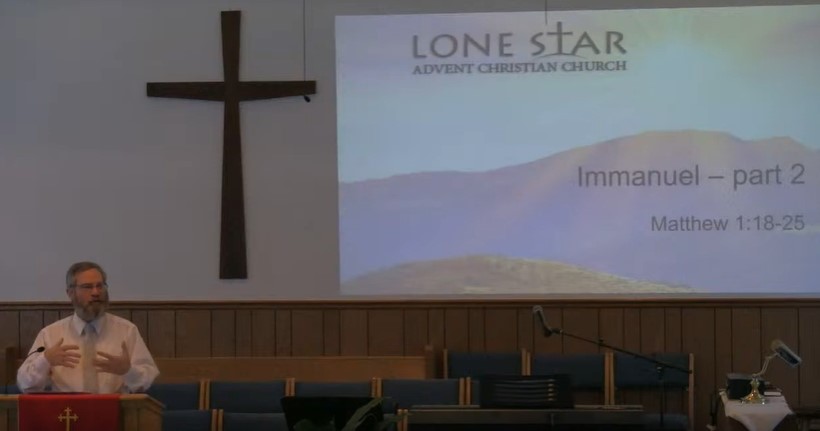
Immanuel – part 2

201912151030 Immanuel - part 2 (Matthew 1 18-25)

201912151030

Immanuel – part 2

Matthew 1:18-25 (CSB)

18 The birth of Jesus Christ came about this way: After his mother Mary had been engaged to Joseph, it was discovered before they came together that she was pregnant from the Holy Spirit.

19 So her husband Joseph, being a righteous man, and not wanting to disgrace her publicly, decided to divorce her secretly.

20 But after he had considered these things, an angel of the Lord appeared to him in a dream, saying, “Joseph, son of David, don’t be afraid to take Mary as your wife, because what has been conceived in her is from the Holy Spirit.

21 She will give birth to a son, and you are to name him Jesus, because he will save his people from their sins.”

22 Now all this took place to fulfill what was spoken by the Lord through the prophet:

23 See, the virgin will become pregnant and give birth to a son, and they will name him Immanuel, which is translated “God is with us.”

24 When Joseph woke up, he did as the Lord’s angel had commanded him. He married her

25 but did not have sexual relations with her until she gave birth to a son. And he named him Jesus.

I want to begin with a recap of what we saw in Isaiah 7, the story of Ahaz.

That story contains the prophecy that God gave king Ahaz – the prophecy of an unmarried woman who would give birth to a child whom she would nickname Immanuel.

God had given Ahaz a choice. Ahaz could have obeyed God by refusing to seek help from Assyria, and trusted God to rescue the nation of Judah himself. Ahaz chose to ignore God’s offer of help, and disobey him. God still gave the sign. That sign was the nickname that this young woman gave to her child. The sign – the name Immanuel – became a symbol of God’s plan to rescue his people another way, at a different time.

Now let me restate this. God gave Ahaz a choice to make, and he made his choice, but it was the wrong choice. Then, God intervened again and offered to prove that Ahaz could trust him by granting him a supernatural sign. Ahaz refused to ask for a sign, but God gave the sign anyway, not specifically to Ahaz, but to his dynasty – the house of David. So, we have three elements to the story of Isaiah 7: a human choice, divine intervention, and a supernatural sign.

It just so happens that those same three elements are part of today’s story, which takes place seven centuries later.

JOSEPH MAKES THE WRONG CHOICE

Matthew 1:18 The birth of Jesus Christ came about this way: After his mother Mary had been engaged to Joseph, it was discovered before they came together that she was pregnant from the Holy Spirit.

Matthew 1:19 So her husband Joseph, being a righteous man, and not wanting to disgrace her publicly, decided to divorce her secretly.

The Christmas story begins with the discovery of an unwanted pregnancy. In this culture today, if someone discovers an unwanted pregnancy, the choice seems to be between letting the child be born, or terminating the pregnancy.

But Joseph’s choice was not to abort the child. He knew that he had been responsible toward Mary, so he concluded that Mary must not have been faithful to him. But since he did not want to shame her, he decided divorce was his only option. In his culture, engagement was legally binding, so he decided to divorce her secretly.

The reason Joseph felt this was his only option was that he did not know the whole story.

Many times in our lives, we are going to be faced with decisions that are crucial and significant, but we will not have all the pertinent information we need to make the right choice. That is why we need to regularly seek God’s guidance through prayer. We also should be careful not to make judgments based on mere appearance.

Now, I am highlighting the fact that there are some major similarities between the stories in Isaiah 7 and Matthew 1, but there are also some glaring differences. Ahaz and Joseph are both prepared to make wrong choices, but that is where there is a change.

GOD INTERVENES, SO THAT HIS WILL IS ACCOMPLISHED.

Matthew 1:20 But after he had considered these things, an angel of the Lord appeared to him in a dream, saying, “Joseph, son of David, don’t be afraid to take Mary as your wife, because what has been conceived in her is from the Holy Spirit.

Matthew 1:21 She will give birth to a son, and you are to name him Jesus, because he will save his people from their sins.”

Matthew 1:24 When Joseph woke up, he did as the Lord’s angel had commanded him. He married her

Matthew 1:25 but did not have sexual relations with her until she gave birth to a son. And he named him Jesus.

God had sent a prophet to Ahaz, and Ahaz chose to ignore Isaiah, and make the wrong choice anyway. But God himself appears as an angel to Joseph in a dream. It is vitally important for the history and salvation of humanity that Joseph not make the wrong choice.

This is divine intervention. I find it interesting that the message God gives to Joseph starts out the same way his message to Ahaz did. God had told Isaiah to tell Ahaz:

“Calm down and be quiet. Don’t be afraid or cowardly because of these two smoldering sticks, the fierce anger of Rezin and Aram, and the son of Remaliah” (Isaiah 7:4 CSB).

The Lord tells Joseph in the dream “don’t be afraid.” This is something that God has to keep saying to us when he intervenes in our lives because when stuff happens to us, anxiety is our first response.

God chose to send his Son into a family that was this close to disintegrating before it even began. There was an unwanted pregnancy, a difficult trip to Bethlehem at the worst possible time. There was no place to stay. There was an evil king who wanted to kill the child. All of these things had to weigh heavily on the hearts of Mary and Joseph. They would have been tempted to give up on their marriage, on their faith, and write themselves off as hopeless.

But what I see in this story is that it is just at that point when the anxiety level was the highest that God intervened. He didn’t fix all their problems but he did remind them that they were in his will and encouraged them not to be afraid but to trust in him.

If you have lived any time at all, you have experienced times like that. Some of you are probably going through such times right now. What does it take to get through times like that? We are stronger than we think we are, so it really doesn’t take a miracle to get us through our tough times.

But it does take a message from God, assuring us that he’s got this. God told Joseph that Mary’s pregnancy is not in conflict with his plan; Mary’s pregnancy is God’s plan. Of course, we can understand that today. We have the advantage of 2000 years of hindsight. But for Mary and Joseph, they had to trust God and not give in to fear.

JESUS HIMSELF BECAME THE SUPERNATURAL SIGN TO ISRAEL AND TO US.

Matthew 1:22 Now all this took place to fulfill what was spoken by the Lord through the prophet:

Matthew 1:23 See, the virgin will become pregnant and give birth to a son, and they will name him Immanuel, which is translated “God is with us.”

There are some similarities and differences between this part of the story and Isaiah 7 as well. I want to draw attention to one of the differences.

In Isaiah’s story, the supernatural sign was the name Immanuel. It was apparently a nickname that this young woman would give her baby boy. It was a sign given not to Ahaz alone, but to his dynasty, the house of David. That sign basically said that Ahaz gave up on his God, but his God has not given upon his family. One day, God was going to rescue Judah, and he’s going to do it through another descendant of David.

We know today that the descendant of David who would rescue his people was Jesus. In fact, in the Matthew passage, it is Jesus himself who is the supernatural sign, not his name.

Matthew declares that Jesus’ virginal conception was the ultimate fulfillment of Isaiah’s prophecy. In Isaiah’s prediction, the birth of the child was to be natural, but the name the mother gave him was the supernatural sign.

When Matthew records the Isaiah 7:14 prophecy, he changes the pronoun.

  • “a virgin will be with child and bear a son, and she will call His name Immanuel” (Isaiah 7:14 NASB).

  • “the virgin shall be with child and shall bear a Son, and they shall call His name Immanuel,” (Matthew 1:23 NASB).

Immanuel was not going to be his parents’ nickname for Jesus. It was going to be his nation’s title.

Joseph was not told to name the child Immanuel. He was to be named Jesus, because he was God’s chosen savior. But his nation would come to recognize him as the sign of Immanuel – the sign that their God had not deserted them. God was still with them in the person of his Son.

The gospel message to you and me today is that Jesus can also be our Immanuel. This same Jesus who was born supernaturally came to die a death he didn’t deserve so that we can have a chance to live an eternal life that we do not deserve.

Jesus’ resurrection proves that God accepted that substitutionary death. And Jesus promises to come again and give us eternal life. Until then, Jesus being our Immanuel means this:

  • Jesus is with us “always, even to the end of the age” (Matthew 28:20 NASB).

This message was preached by Jeff on Sunday, December 15th, at Lone Star Advent Christian Church in Clifton Forge, Virginia.

The video stream of the service can be watched here.