
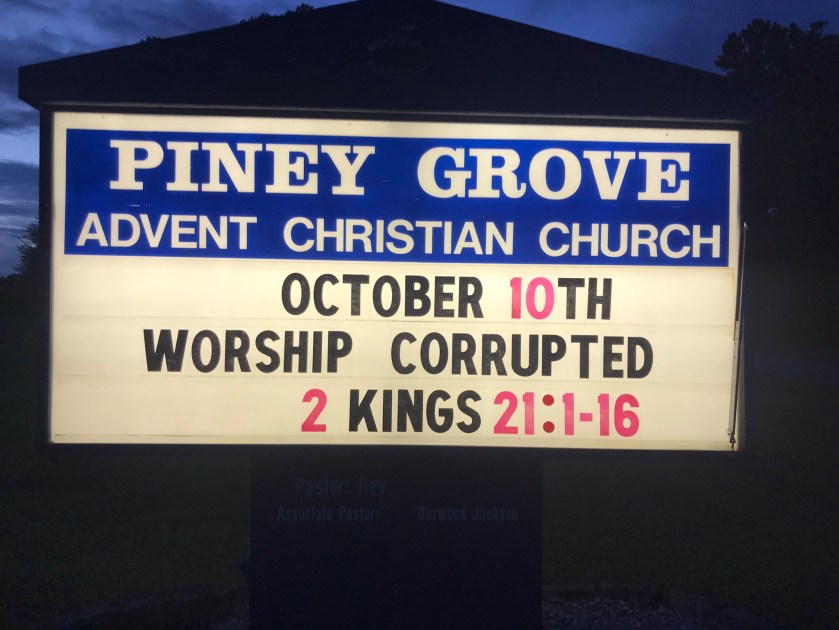
WORSHIP CORRUPTED


WORSHIP CORRUPTED

2 Kings 21:1-16 NET

1 Manasseh was twelve years old when he became king, and he reigned for fifty-five years in Jerusalem. His mother was Hephzibah. 2 He did evil in the sight of the LORD and committed the same horrible sins practiced by the nations whom the LORD drove out from before the Israelites. 3 He rebuilt the high places that his father Hezekiah had destroyed; he set up altars for Baal and made an Asherah pole just like King Ahab of Israel had done. He bowed down to all the stars in the sky and worshiped them. 4 He built altars in the LORD’s temple, about which the LORD had said, “Jerusalem will be my home.” 5 In the two courtyards of the LORD’s temple he built altars for all the stars in the sky. 6 He passed his son through the fire and practiced divination and omen reading. He set up a ritual pit to conjure up underworld spirits, and appointed magicians to supervise it. He did a great amount of evil in the sight of the LORD, provoking him to anger. 7 He put an idol of Asherah he had made in the temple, about which the LORD had said to David and to his son Solomon, “This temple in Jerusalem, which I have chosen out of all the tribes of Israel, will be my permanent home. 8 I will not make Israel again leave the land I gave to their ancestors, provided that they carefully obey all I commanded them, the whole law my servant Moses ordered them to obey.” 9 But they did not obey, and Manasseh misled them so that they sinned more than the nations whom the LORD had destroyed from before the Israelites. 10 So the LORD announced through his servants the prophets: 11 “King Manasseh of Judah has committed horrible sins. He has sinned more than the Amorites before him and has encouraged Judah to sin by worshiping his disgusting idols. 12 So this is what the LORD God of Israel says, ‘I am about to bring disaster on Jerusalem and Judah. The news will reverberate in the ears of those who hear about it. 13 I will destroy Jerusalem the same way I did Samaria and the dynasty of Ahab. I will wipe Jerusalem clean, just as one wipes a plate on both sides. 14 I will abandon this last remaining tribe among my people and hand them over to their enemies; they will be plundered and robbed by all their enemies, 15 because they have done evil in my sight and have angered me from the time their ancestors left Egypt right up to this very day!'” 16 Furthermore Manasseh killed so many innocent people, he stained Jerusalem with their blood from end to end, in addition to encouraging Judah to sin by doing evil in the sight of the LORD.

We have been studying what the Bible says about worship. We understand that worship is very important to Jesus. It is not something we can do without. We saw last week that worship is something we should do regularly, but we should reserve our worship for God alone.

Jesus affirmed this when he was being tempted by Satan. He said to the devil “You are to worship the LORD your God and serve only him” (Matthew 4:10). We can appreciate others and even respect them. But worship is exclusive to God.

One of the reasons for this is that God’s character and power are flawless. His glory is above all others. For that reason, Moses commanded Israel to worship God exclusively. But he knew that they would fail to do that.

God told Moses that “after I have brought them to the land I promised to their ancestors – one flowing with milk and honey – and they eat their fill and become fat, then they will turn to other gods and worship them; they will reject me and break my covenant” (Deuteronomy 31:20).

Worship would become corrupted.

This happened many times in the history of God’s people. Today’s text highlights how worship was corrupted during the reign of King Manasseh of Judah.

Manasseh corrupted the worship in Judah by copying the religions of the nations (1-5)

Notice that Manasseh’s father – King Hezekiah – had torn down the high places that the pagans had used for worship. So Manasseh cannot claim that he was just doing what his father did before him. He chose to undo Hezekiah’s reforms. His father had taken steps to purge Judah of its idolatry, but Manasseh reversed his policies.

Manasseh invited other gods and goddesses to take their place in Jerusalem, which God had specifically designated as his home. How would you feel if someone came into your home uninvited by you? Manasseh had no business inviting these other gods into the Lord’s home.

God had warned his people that if they tried to be like all the nations around them, they would suffer the same fate as those nations. Some of those nations had been destroyed when the Israelites came into the promised land. The Lord had warned Israel that if they became idol worshipers like those nations…

“I will destroy your high places and cut down your incense altars, and I will stack your dead bodies on top of the lifeless bodies of your idols. I will abhor you. I will lay your cities waste and make your sanctuaries desolate, and I will refuse to smell your soothing aromas. I myself will make the land desolate and your enemies who live in it will be appalled. I will scatter you among the nations and unsheathe the sword after you, so your land will become desolate and your cities will become a waste” (Leviticus 26:30-33 NET).

When it comes to worship, God does not want us to be like everyone else. He wants us to worship him exclusively and he wants us to worship him differently than all the other religions worship their gods.

In this modern age, there are two major ways we can follow in the footsteps of Manasseh and corrupt biblical worship. One is that we can borrow worship practices from other religions. We can sometimes be tempted to borrow practices from non-Christian religions and Christianize them. We need to be careful that we examine the origins of certain practices.

But there is another way we can corrupt our worship as Manasseh did. The most prominent religion of today is atheistic secular humanism. We can build our high places to the god of human progress. If it replaces our devotion and loyalty to the God of the Bible, it corrupts his worship.

But Manasseh went even further than this.

Manasseh corrupted the worship in Judah by encouraging demonic practices (6-11).

The king passed his son through the fire (in other words, he sacrificed one of his sons to the pagan god Molech) and he also practiced divination and omen reading. He set up a ritual pit to conjure up underworld spirits, and appointed magicians to supervise it.

He opened the door to every kind of demonic activity that the Lord had labeled detestable. If he had published newspapers, he would have put the daily horoscope in them. He hired palm readers, and people to hold seances. He had his own royal magicians. These were not illusionists and sleight-of-hand magicians. It was practitioners of the magic arts. When it came to corrupting worship, Manasseh boldly went where no man had gone before. He plunged his nation into the darkness.

Because Manasseh corrupted the worship of Judah, the LORD pledged to wipe Jerusalem clean (12-16).

God could not let this sacrilege continue. But notice that God was not only going to judge Manasseh. Since the king led the nation into corrupted worship, the whole nation would have to suffer.

Since Manasseh has invited false gods and Satanic magic into God’s house – God was going to have to do some house cleaning. He likened it to cleaning a plate on both sides. It doesn’t make sense to just clean a plate on one side, because if you stack the plate afterward, and it is still dirty on the bottom, it will dirty the next plate on the top.

God said he will destroy Jerusalem the same way he did Samaria and the dynasty of Ahab. He will wipe Jerusalem clean, just as one wipes a plate on both sides.

He used foreign empires to take away the kingdoms from those kings. He did that because he could not and cannot tolerate hypocrisy. He cannot allow those who worship other gods to pretend to worship him too.

James tells us to draw near to God and he will draw near to us. He tells us sinners to cleanse our hands. He tells us double-minded people to make our hearts pure (James 4:8). God hates all sin, but he particularly detests corrupted worship.

LORD, we come to you confessing that we have failed to worship you exclusively. Forgive us, LORD, and show us how to clean our hands of this sin-stain. Show us how to make our hearts pure, and our minds singular. We want to worship you the right way.

Today’s message on video.
click for my e-books

THE MAN WHO WAS TAKEN AWAY

THE MAN WHO WAS TAKEN AWAY

Hebrews 11:5-6 (Disciple’s Literal New Testament)

“By faith Enoch was removed, so as not to see death: “And he was not found because God removed him”. For before the removal, he has been attested to have pleased God. And without faith it is impossible to please Him. For the one coming-to God must believe that He is, and He becomes the rewarder to the ones seeking Him out.”

I am returning to the series on the heroes of faith that I started on November 15th of last year. In that sermon, I looked at Abel, whose story is told in Hebrews 11:1-4. He was a man who had a very short life, but he did not throw away his one shot. When he had the opportunity to demonstrate faith, he did it.

Today I am going to talk about Enoch. Now, there are three myths about Enoch, and the first time I wrote this sermon, I spent the whole time dispelling them. I dumped that sermon, and rewrote it yesterday. Every thing I said in it was true, but it is just not what I need to say about living a life of faith. Here is a summary of that message:

• Enoch did not go to heaven. The Bible says that no one has gone to heaven except Jesus. Neither Genesis nor Hebrews claims that Enoch was an exception.

• Enoch did not become immortal. The Bible says “in Adam all die” and that includes Enoch, who was the seventh generation from Adam. In fact, not one of these heroes of faith mentioned in this chapter became immortal. Hebrews 11:13 said “All these died in faith” – including Enoch. Enoch was removed so as not to see death – not his own death, but the death of his descendants in the flood.

• Enoch was not sinless. His personal righteousness was not what made him different from everybody else in his day. Genesis 5:24. says he “walked with God.” To walk with God is to have a relationship with him. How did Enoch get that relationship? Genesis does not say.

But Hebrews does. Hebrews 11 says that Enoch pleased God because of his faith. The gospel tells us that we too can please God by putting our faith in him. All you have to do is believe that God exists, and believe that he rewards the ones who seek him out.

The question I want to address in today’s sermon is this: What choices did Enoch make that set him apart from his generation as a person of faith?

Enoch chose to believe in God.

Our text says that “the one coming-to God must believe that He is” and Enoch did that. He lived in a generation that was turning its back on its creator, and he chose to acknowledge God instead.

All of these Heroes of faith that the author of Hebrews lists are remembered for different reasons. But one thing that is true of each one of them is that he or she chose to believe in God when others chose to ignore or reject him.

The disciples saw Jesus curse a fig tree. They saw the tree wither and die before their eyes. Peter thought “wow, look at that.” Jesus said “Have faith in God.” It’s not about a dead tree. It’s about a living God. That’s why Jesus used that opportunity to teach them about praying to God and expecting forgiveness from God. The same power that can destroy a tree and remove a mountain can also forgive sins. He is God, and our first choice must be to believe in him.

Enoch chose to seek God.

Our text refers to “the one coming-to God” and “the ones seeking Him out.” When his generation was seeking everything but God, Enoch was seeking the God who created everything. Ours is a generation very much like that in which Enoch lived. We have scientists who dedicate their lives to knowledge so that they can solve the world’s problems. But these very same people have often turned their back on the one who holds everything together by his wisdom and power.

The Wise Men came to Herod seeking Jesus, but soon discovered that he was not there, so they set out for Bethlehem. If they had turned back and returned home after Jerusalem, we would not know about them. They were truly wise men because they kept seeking for Jesus until they found him.

Enoch was like that. He heard about God from his parents. He heard stories about God passed on by oral tradition. But he was not satisfied with that. He wanted to have a personal experience with God.

Brothers and sisters, please don’t let family or tradition be your only reason for identifying as Christians. Seek a genuine relationship with God through Jesus Christ!

Enoch chose to please God.

Our text says that “he has been attested to have pleased God.” When the generation all around him were choosing to disappoint God, he was choosing to please God.

The apostle Paul told the Roman Christians that those who are in the flesh cannot please God because the mind set on the flesh is hostile toward God (Romans 8:7-8). He commended the Thessalonians because they were living by the instructions that he gave them, and that obedience was pleasing God (1 Thessalonians 4:1).

So, we learn from both testaments that pleasing God is possible. But in Paul’s generation and in Enoch’s generation, the natural inclination of people’s hearts was against it. Pleasing God will not come naturally. It has to be a conscious choice to go against the grain.

Enoch chose to be faithful to God.

Genesis tells us that Enoch “walked with God.” His generation had chosen to walk away from God. They had the opportunity to have a relationship with their creator and to leave a legacy of blessing and hope. But it was not to be. Their refusal to walk with God would bring death and destruction.

But Enoch’s choice to walk with God meant that he would be removed. By God’s grace, he would not live to see the devastation and destruction cause by his generation’s rebellion.

But what did it mean for Enoch to walk with God. He did not have the Bible. He did not have a church or temple. He did not have the Law or the gospel.

What did he know about walking with God? He only knew that his ancestors had heard the sound of God walking in the garden in the cool of the day, and they had hidden themselves from his presence among the trees of the garden (Genesis 3:8). Sin had kept Adam and Even from seeking God and from walking with him.

Enoch chose to come out of hiding and walk with his God. He faced his own fears and guilt and decided that his own imperfections were not going to keep him from fellowship with the Perfect One.

That is walking by faith. It is being faithful to the God who wants us to walk with him. God’s presence in the garden was an invitation. Sin kept Adam and Eve from answering the invitation. Faith enabled Enoch to answer God’s invitation for a walk.

Enoch chose to trust God for his eternal destiny.

Enoch believed that God “becomes the rewarder to the ones seeking Him out.”

Besides Genesis 5, the genealogies, and Hebrews 11, the only other biblical reference to Enoch is a prophesy he gave about the Lord coming in judgment. That prophecy is recorded in the book of Jude. So, Enoch had the spiritual insight to understand that some day God was going to judge the world.

We don’t know what Enoch believed about his personal destiny. But if he believed that the ungodly were going to be judged, he must have also believed that the faithful would be rewarded. In today’s text, the author of Hebrews gives Enoch as a witness to God as a rewarder.

One day, Enoch is going to walk with God again – and forever. God offers you and me the same invitation. He knows we have sinned and fall short of his glory. We don’t deserve to have fellowship with him. But he has sent his Son as a sacrifice to atone for our sin, so that we can once again not only enter his presence, but walk with him.

Jesus instructed John to write a letter to the church in Sardis in Revelation 3:1-6. He said that the city had a few people who had not stained their clothing by hypocrisy. He promised them that he would not erase their names from the book of life, but confess their names before his Father. He also promised them that they would some day walk with him in white clothing.

We were created to go for a walk, and for that walk to never end. Have you started your walk with God yet?

sermon-audio

OUR JOY IS COMING

OUR JOY IS COMINGOUR JOY IS COMING

John 16:20-24 (Christian Standard Bible)

“I will see you again. Your hearts will rejoice, and no one will take away your joy from you” (John 16:22b).

We sing this hymn every Christmas, but it was not originally written as a Christmas Carol. In fact, the song is more about the second advent than the first. What is it? It is “Joy to the World” by Isaac Watts.

joy banner

Watts originally wrote this hymn as an interpretation of Psalm 98, which says “Shout joyfully to the LORD, all the earth; Break forth and sing for joy and sing praises” Psalm 98:4 NASB).

It is appropriate for us to sing about joy at Christmas though. The Christmas cards remind us of that.

During Christmas, we share the joy of giving and getting gifts. We share the joy of life together with friends and family. Also, because it comes at the end of the year, we can know the joy of stepping back and seeing the year in the big picture. Even if we have had a terrible, horrible, no good, very bad year, we can usually find some reason to be joyful.

The New Testament associates the story of the birth of Christ with joy.

  • When the wise men saw the star “they rejoiced exceedingly with great joy” (Matthew 2:10).

  • The angel Gabriel told Zechariah that he would have joy and gladness, and many would rejoice at his son’s birth (Luke 1:14).

  • And that baby himself, John the Baptist – leaped in his mother’s womb for joy when his mother heard Mary’s greeting (Luke 1:41,44).

  • And who could forget what the angels told the shepherds “Do not be afraid; for behold, I bring you good news of great joy which will be for all the people” (Luke 2:10).

The New Testament also associates the Christian life with joy.

  • The apostle Paul said “the kingdom of God is not eating and drinking, but righteousness and peace and joy in the Holy Spirit” (Romans 14:17).

  • He listed joy as one of the evidences of the Spirit’s presence – what he called the fruit of the Spirit (Galatians 5:22).

  • The apostle James encouraged his readers to “consider it all joy” when they encounter various trials, because those trials test our faith and are perfecting us (James 1:2).

  • The apostle John once reflected on his writing ministry. He said “these things we write, so that our joy may be made complete” (1 John 1:4). Passing on the gospel message comes with its own joy.

I struggled with using this text from John 16 because I think it is usually misunderstood. When people comment on Jesus’ words to the disciples, they think he is explaining about his resurrection. So, let me go back a few verses to get the context. Jesus had just told his disciples that it was for their benefit that he is going away, because if he didn’t go away, the Holy Spirit would not come (16:7).

The Holy Spirit did not come while Christ was in the tomb. So, he is not talking about the interval between his death and resurrection here. He is talking about the interval between his ascension and the second coming.

Secondly, Jesus had told his disciples in the same discourse that he was going to the Father.

  • “I am going to the Father and you will no longer see me” (16:10).

  • “I came from the Father and have come into the world. Again, I am leaving the world and going to the Father” (16:28).

The reason most people misunderstand what Jesus is talking about here is that they think Jesus went to the Father when he died. He did not. He went to the grave when he died. He went to the Father at his ascension.

Remember, after his resurrection, Jesus told Mary “Don’t cling to me … since I have not yet ascended to the Father. But go to my brothers and tell them that I am ascending to my Father and your Father, to my God and your God” (John 20:17). That is when he went to the Father.

So, the joy that Jesus is predicting in John 16 is not the joy of Jesus’ resurrection. It is the ultimate joy of the return of Christ in his glory at the second advent.

when our ultimate joy comes, we will forget our sorrows

“Truly I tell you, you will weep and mourn, but the world will rejoice. You will become sorrowful, but your sorrow will turn to joy. When a woman is in labor, she has pain because her time has come. But when she has given birth to a child, she no longer remembers the suffering because of the joy that a person has been born into the world” (20-21).

Jesus is talking about a period of mourning while the world rejoices. He is talking about a time when the world celebrates, but Christians suffer.

The good news that Jesus is sharing is that the period of suffering will end. It will be like labor pains. The joy of the newborn child will overtake the memory of the suffering that preceded it.

Jesus described that period of birth pangs in his eschatological discourse in Matthew 24, Mark 13 and Luke 21.

before our ultimate joy comes, we can find joy through prayer

“In that day you will not ask me anything. Truly I tell you, anything you ask the Father in my name, he will give you. Until now you have asked for nothing in my name. Ask and you will receive, so that your joy may be complete” (23-24).

I think the “that day” that Jesus refers to in verse 23 is today: the day of the interval between the ascension of Christ, and his return. Nobody on earth can see Jesus, so we cannot ask him for anything directly. But Jesus assures us that we can ask the Father for things in his name. In fact, he wants us to pray so that our joy can be complete today.

We are in the time of sorrow and suffering, but prayer is that tool that Jesus prescribes to give us joy during this time. In other words, until Jesus returns, every day is Christmas day, but only for people who are in the habit of praying. Joy is available, but it is not going to come automatically. Even if you have faith, you will not necessarily experience joy. Joy comes to those who have the audacity to ask for it.

Just like wisdom. It is not automatic. James says “if any of you lacks wisdom, let him ask of God, who gives to all generously and without reproach, and it will be given to him” (James 1:5).

Joy is literally ours for the asking. God loves us and wants us to have it. All he asks is that we ask. In fact, our joy is always going to be incomplete unless we start asking. Jesus said “Ask and you will receive, so that your joy may be complete” (24).

when our ultimate joy comes, it will be permanent

“So you also have sorrow now. But I will see you again. Your hearts will rejoice, and no one will take away your joy from you” (22).

It is important for me to once again state that Jesus is talking about the interval between his ascension and his return here. It is true that Christ’s resurrection gave his disciples joy. But Jesus also knew that they were going to experience a long period of sorrow. He was preparing them for that.

We are living in that time. We can have joy in fellowship with God and each other in this time. We can even have a more complete joy by asking for it. But our ultimate joy still awaits.

What Jesus told his disciples, he is also telling us. He is saying “you also have sorrow now. But I will see you again. Your hearts will rejoice, and no one will take away your joy from you.” No one will be able to take away that joy because it will be permanent.

The gifts we get this Christmas cannot give us ultimate joy, because they will not last. Even the good times we share with friends and family will not last. But our ultimate joy is coming, and when he comes, he is coming to stay.


OUR PEACE IS COMING

OUR PEACE IS COMING

OUR PEACE IS COMING

One of my favorite Christmas memories dates back when I was in the army, stationed in Germany. Penny and I had been part of the brigade Choir, and the choir put on a wonderful Cantata on campus. We were also invited to be part of a local Christmas celebration. We sang “Silent Night” and then a local German choir sang “Stille Nacht.”

That wonderful Christmas carol has been bringing us into the stable to watch the baby Jesus sleep in heavenly peace for over 200 years.

For even longer than that, people have been reading the prophecy of Isaiah 9:1-7, and seeing a portrayal of Jesus as the Prince of Peace he prophesied. The question I want to consider today is: How could Jesus possibly be the Prince of Peace that Isaiah predicted?

I know, of course Jesus is who Isaiah predicted, right? After all, every year we get Christmas cards with this text on them. They all proclaim that Jesus is the Prince of Peace. Not to mention – which is what we say and then go ahead and mention anyway – all the books that have been written about Jesus entitled “The Prince of Peace.”

But let’s just imagine that we were back there in the time of Isaiah for a bit. The first thing I would like to establish is the audience to whom Isaiah was actually talking when he predicted the words which eventually became chapter 9, verses 1-7.

If you had asked the average citizen of Judah in Isaiah’s day about the north country, the land of Zebulun and the land of Naphtali – Galilee beyond the Jordan river, their assessment would have been that it was a write-off. Isaiah had just talked about how paganism and idolatry had turned out the light in the holy land, and Galilee was considered the darkest of the dark. There was no hope for Galilee in the future. But, now Isaiah says that it is in this gloomy land of darkness that the light is going to shine first. What? Galilee… are you kidding?

And what is going to be the result of that light shining there first?

Isaiah prophesied honor in the place of shame.

Isaiah said that “in the future he will bring honor to the way of the sea, to the land east of the Jordan, and to Galilee of the nations” (1). These citizens of that shameful corrupt land had no idea that some day millions would want to put their hand in the hand of the man from … Galilee! Our Lord chose to grow up in a place that was on the wrong side of the tracks. But Isaiah predicted that one day Galilee is where everybody would want to be.

Isaiah also said that Galilee was filled with “people walking in darkness” and “living in the land of darkness” but they would see “a great light” that light will dawn on them. The Bible equates darkness with sin, and sin with shame. The light that Isaiah predicted would bring honor to a land that had previously only been know for its shame and sin.

Galilee also had the reputation of being too Gentile to actually be counted as part of the Jewish nation. It had the nickname “Galilee of the nations” (1) and that word “nations” was the same word they used for Gentiles. In other words, Galilee does not count. It has too many Gentiles in it to be actually considered part of God’s kingdom.

Isaiah comes along and says “You have enlarged the nation
and increased its joy. The people have rejoiced before you
as they rejoice at harvest time and as they rejoice when dividing spoils” (3). What would the inhabitants of Galilee think about that prediction? The harvest is a picture of revival. The rejoicing over the dividing of spoils was a picture of national growth due to warfare.

So, let me put it this way: What if I told you that Delco was going to be the starting place of the next great awakening, the next great revival? You might say, “not little old us.” And the Galileans would think the same thing about this prophecy. But Isaiah was right!

Isaiah prophesied freedom in the place of bondage.

Next, Isaiah predicted that God would shatter “their oppressive yoke and the rod on their shoulders, the staff of their oppressor” (4). These are all images taken from agriculture. The yoke, rod and staff are all ways that the farmer exercises control over his animals. As such, they naturally stood for political control of oppressive tyrants over the little guys.

Isaiah also adds these words to his prediction. He says God would bring this freedom just as he “did on the day of Midian” (4). He was referring to Gideon’s defeat of the Midianites with only 300 men. I think Isaiah was drawing attention to the fact that once those 300 men gained the upper hand, they sent messengers to the tribe of Ephraim to “come down against the Midianites” as well (Judges 7:24). In other words, Gideon’s miraculous defeat of the Midianites was the beginning.

So, what was Isaiah saying to the Galileans? He was saying that they were going to start the next move of God to bring deliverance from bondage to all his people.

Isaiah prophesied peace in the place of warfare.

But this is where it really gets interesting. You would think that if the Galileans were going to be a force for deliverance, that would mean Isaiah is predicting that they would be like the 300 men under Gideon – amazing warriors. But this is what Isaiah says instead:

“For every trampling boot of battle and the bloodied garments of war will be burned as fuel for the fire” (5).

When I was a soldier, I had to keep a duffle bag ready. It had to contain load bearing equipment, a helmet, magazines for my m-16 rifle, a flashlight, cold weather gear, extra boots and a battle dress uniform.

If you are preparing for battle, you don’t burn your boots and battle dress uniform. But Isaiah told the Galileans not to prepare for war, but to prepare for peace.

He told them about a child who was going to be born “for us” and a son given “to us” and “the government will be on his shoulders.
He will be named Wonderful Counselor, Mighty God, Eternal Father, Prince of Peace” (6).

So this victory that brings honor to the shameful and freedom to the oppressed is going to be won without a battle. It is going to happen as a result of a child being born.

Then Isaiah tells us that the child will have permanent dominion over a vast territory and “its prosperity will never end. He will reign on the throne of David and over his kingdom, to establish and sustain it with justice and righteousness from now on and forever” (7).

Now, Isaiah’s words become even more mysterious because he concludes his prophecy with “The zeal of the LORD of Armies will accomplish this.” The title “LORD of Armies” was usually used to indicate that God could change the world by moving armies to execute his judgment for him. But Isaiah was saying that the same passion that God uses to destroy using the armies of the world will now be invested in the peace he is going to bring about through that one child.

the gospel of Christ’s kingdom is the gospel of peace

When the apostle Paul told the Ephesians to put on their armor for spiritual warfare, he said that their battle boots were going to be “the preparation of the gospel of peace” (Ephesians 6:15).

When we share the good news of the coming kingdom of Jesus Christ, we can tell people that he offers them honor instead of shame and humiliation. He offers them freedom instead of slavery and bondage. He offers them peace on earth, instead of war on earth.

But, let’s be careful when we tell people that. Jesus himself said that his first advent was not to bring peace to earth, but a sword (Matthew 10:34). It is his second advent that will bring peace by destroying all his enemies. At Christmas, we celebrate the peace with God that we can have in our hearts, and the permanent peace that is to come.

During the Advent season it is good to be Advent Christians. We can share the good news of the gospel. That news includes the fact that the Prince of Peace is going to return to set up his permanent kingdom. Our peace is coming.


Piney Grove Advent Christian Church, Delco North Carolina, USA.


Kindle books by Jefferson Vann