Walks in the Gardens

Auckland Botanic Gardens in Manukau is a place where Penny and I visit frequently. There are all kinds of beautiful trees and flowers, and lots of space to walk. It is just up the road from the church in Takanini where we work, so we sometimes just drop in for lunch and a quick walk on work days.

SDC11564

The lanes meander through exhibits of trees and flowers from various locations. Not all of the plants are blooming at the same time, so every time we walk the experience is a little different. I usually think to bring the camera so that I can capture the color. The pics make great backgrounds for my computer desktop.

SDC11583

Some of the hiking (tramping) trails go by green fields. I love the fields in New Zealand. They seem to go on forever. The clouds are also glorious here. Clouds remind me that Jesus is coming. The whole experience also helps Penny and me get over the fact that we are so far away from our family in the States. Cities remind us of the differences between the two countries. Landscapes remind us of the similarities.

SDC11568

Occasionally we will run across a plant like this one – one which we have never seen before. I am amazed at the variety of plant life on this planet. It seems like God wants to tell us that we will never get bored throughout eternity because he knows how to keep us guessing what he’s going to do next!

The Heart of Joel (2:25-32)

Joel 2:25-32 ESV
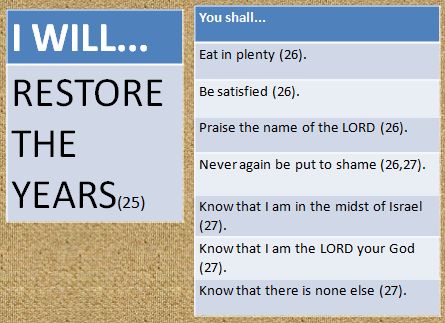
I will restore to you the years that the swarming locust has eaten, the hopper, the destroyer, and the cutter, my great army, which I sent among you. 26 “You shall eat in plenty and be satisfied, and praise the name of the LORD your God, who has dealt wondrously with you. And my people shall never again be put to shame. 27 You shall know that I am in the midst of Israel, and that I am the LORD your God and there is none else. And my people shall never again be put to shame. 28 “And it shall come to pass afterward, that I will pour out my Spirit on all flesh; your sons and your daughters shall prophesy, your old men shall dream dreams, and your young men shall see visions. 29 Even on the male and female servants in those days I will pour out my Spirit. 30 “And I will show wonders in the heavens and on the earth, blood and fire and columns of smoke. 31 The sun shall be turned to darkness, and the moon to blood, before the great and awesome day of the LORD comes. 32 And it shall come to pass that everyone who calls on the name of the LORD shall be saved. For in Mount Zion and in Jerusalem there shall be those who escape, as the LORD has said, and among the survivors shall be those whom the LORD calls.

This is the second in a series of 16 sermons based on messages from the writing prophets. The prophets are like a gold mine. They are filled with precious treasure, but getting to that treasure takes some digging and a lot of hard work. To understand the message of a prophet, you have to know the background of the prophet and the people he spoke to. You also have to have a reasonable grasp of world history to know when a prophecy has begun to be fulfilled. You also need to know the LORD because the messages from the prophets are meant to be understood and applied by believers whether they have been fulfilled or not.

I place Joel’s prophecies early, which is why I place it during the first time period. I think he prophesied during the reign of king Joash of Judah, but his book was probably written during the time Joash still young and in seclusion, and the kingdom of Judah was being run by the high priest. The date was about 835 BC.

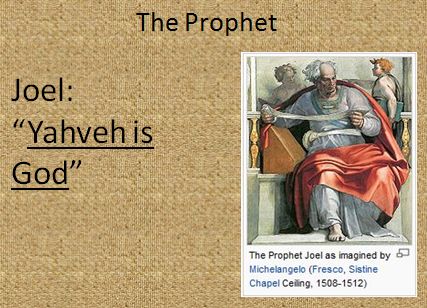
The name Joel means Jahveh is God. When Michelangelo painted his picture of Joel on the Sistine chapel, he had him looking at a small scroll. Someone has said that that represents his being inspired by God to say something new. Many of these new things that Joel said were repeated by the prophets who came after him. Joel’s message was very relevant to his local situation, but it looked way beyond that local situation to events that would take centuries to occur.

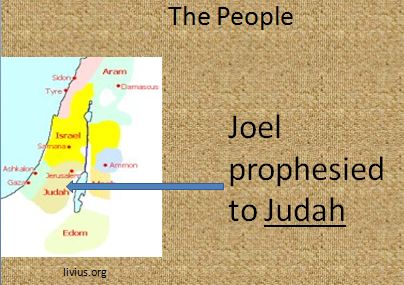
Joel prophesied to the nation of Judah after the kingdom had been divided. Yet, you may have noticed that Joel used the name “Israel” in his prophecy.

“You shall know that I am in the midst of Israel” (27).

That was no mistake. He looked so far into the future that by the time his prophecies would be fulfilled, Judah and Israel would be one nation again.

Judah had been hit by a major natural disaster: a series of locust plagues that wiped out the nation’s economy and led to system-wide depression and famine. It was hard to imagine things getting any worse. But Joel does not ride into town with his white horse and tell everybody “there, there, everything is going to get better now.” No, Joel’s message is more like “You ain’t seen nothing yet.” The plague of locusts which came from the north is going to be followed by swarms of armies coming from the same direction. We know from history that those armies came from Assyria, then Babylon, the Persia, then Greece, then Rome.

But Joel’s message is not all bad news. In verse 32 he says “there shall be those who escape.” He also says “among the survivors shall be those whom the LORD calls.” It was a message for Judah to hang on to their faith and God will bring them through all those bad times. Then, God is going to move.

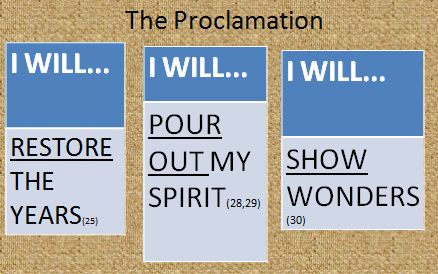
He’s going to do three things: He’s going to restore the years that that the locusts AND THE ARMIES have taken. He’s going to undo the damage. He’s also going to cause a spiritual revolution that will affect the whole nation, not just a few prophets here and there. And just before he does these things he will announce it with some miracles.

So the key to understanding Joel’s words here is that he is giving the predictions in reverse order. Look at verse 30. God is going to show wonders. That means he’s going to do a lot of miracles to let people know something significant is happening. Those wonders are going to be in the heavens and on the earth.

I think that Joel is pointing to Jesus’ life and ministry. The ultimate wonders that Joel mentions took place on the day of his crucifixion. He was being put to death at the same time the temple sacrifices were being prepared, and an eclipse took place that turned the sun to darkness.

Now look at verse 31. Notice the phrase “BEFORE the great and awesome day of the LORD comes.”

When you see “the day of the LORD” in the prophets, it is the same as saying “when God strikes.” So Joel is saying that he is going to cause a strong and significant spiritual revolution immediately after the death of Christ.

In Joel’s day, God poured out his Spirit on a few select prophets. If you wanted to know what God thinks, you would have to search out one of the prophets. But Joel predicts that when God strikes, EVERY believer will have his message. The Holy Spirit will gift and empower all believers regardless of gender, age, or social status.

In Acts 2:16-21 (At Pentecost Peter said) … “this is what was uttered through the prophet Joel” and then he quotes Joel 2:28-32. He recognized that this was the beginning of the spiritual revolution that God had predicted through Joel. That revolution is still going on. The Christian church which began in 30AD is part of God’s fulfillment of a prophecy Joel gave 800 years before that.

The Holy Spirit’s ministry through us is also the key to how God will choose to work beginning on that crucial day. In Joel 2:32, the prophet had predicted that this revolution would begin among the survivors in Jerusalem, but that it would be available to “EVERYONE WHO CALLS ON THE NAME OF THE LORD.”

Years later Paul would say in Romans 10:12-13 “For there is no distinction between Jew and Greek; the same Lord is Lord of all, bestowing his riches on all who call on him. For (and then he quotes Joel) “everyone who calls on the name of the Lord will be saved.” ”

Now, as I understand it, the first thing that Joel predicted will actually be the last thing fulfilled. ALREADY we have seen a time of great miracles BY CHRIST ending with the crucifixion OF CHRIST. ALREADY we have seen a time of great spiritual revolution beginning at Jerusalem but reaching out to all the cities and nations of the planet.

But Joel predicts that Jerusalem will experience a tremendous spiritual and material renewal. It will experience a time when the present famine and the future wars will all be in the past. Israel will know God, and worship him exclusively. In fact, God will be in the midst of Israel (27) and they will know it.

Joel’s message for you and me today is not to let the present spoil your vision of the future. It may take a long time before you actually see God at work in your life and family. But keep trusting in him. He has a plan, and he is going to fulfil his promises to you. When he begins to act, you will know it. Trust him during the locust swarms of your life. Trust him even during the cataclysmic invasions you will experience. He will never take anything away from you that he does not plan on restoring.
_________
LORD, help us to trust you during the trying times, and cooperate with your Holy Spirit ministering salvation to all we can reach. In Jesus’ name. Amen.

1. The Heart of Obadiah (1:11-15).

Obadiah 1:11-15 ESV
On the day that you stood aloof, on the day that strangers carried off his wealth and foreigners entered his gates and cast lots for Jerusalem, you were like one of them. 12 But do not gloat over the day of your brother in the day of his misfortune; do not rejoice over the people of Judah in the day of their ruin; do not boast in the day of distress. 13 Do not enter the gate of my people in the day of their calamity; do not gloat over his disaster in the day of his calamity; do not loot his wealth in the day of his calamity. 14 Do not stand at the crossroads to cut off his fugitives; do not hand over his survivors in the day of distress. 15 For the day of the LORD is near upon all the nations. As you have done, it shall be done to you; your deeds shall return on your own head.

Today we begin a new series of studies on the Old Testament prophets. For quite a while I have wanted to preach a series like this, because of all the types of literature in the Bible, I think the prophets get ignored the most. That is a shame, because the prophets were literally spokesmen for God. If you want to know what God is thinking, read the prophets.

I think one of the reasons we tend to ignore the prophets is that their messages were tied to events so far in the past that we find it hard to understand them. We are tempted to see them as outdated, irrelevant. But as we study the prophets over the next few months we are going to see that the messages they gave are just as applicable today as they were thousands of years ago. God’s word is never out of date.


But God’s word is dated. It was revealed in historical contexts, and sometimes is hard to understand unless we know something about those contexts. To simplify matters, I’m going to place each prophet we look at in one of four periods. Each period is an era of history. In the first period we will put those prophets who prophesied before the Northern kingdom fell to Assyria. In the second are those prophets who preached to Judah alone until Judah fell to Babylon. The third period is for those who prophesied during the exile. The fourth period is for those who prophesied when the Israelites began returning to rebuild the nation.

There is not a lot of consensus among bible scholars as to when Obadiah prophesied. I don’t want to be dogmatic about that issue then. But how one interprets the message has a lot to do with when one thinks it was given. I go along with those scholars who place Obadiah quite early. In fact, the reason I chose to preach about Obadiah first in this series is that I think he is actually the first of the canonical prophets. There were other prophets who came before him (like Elijah, Elisha, and Nathan), but I think it was Obadiah who first wrote a book containing his prophecies, and that book came to be named after him.

I place Obadiah’s prophecies during the reign of king Jehoram of Judah, which dates from 848-841 BC.

What do we know about Obadiah? Not a whole lot. His name means “servant of Yahveh” and it was a very popular name. In fact, the Arabic version of the name, “Abdullah” is still very popular today. In Old Testament times it was so popular that twelve other OT characters are called Obadiah, neither of which is the writer of this book.

We can say this about Obadiah: He saw God as being sovereign over time, and knew that God would eventually bring justice to Judah, but he wasn’t too concerned about that happening in his lifetime. Like the other canonical prophets who came after him, Obadiah saw into a future so distant that it would take centuries for his predictions to even begin to be fulfilled.

To really get the context of Obadiah, you have to go back all the way to Genesis. You will remember that Israel was born with the name of Jacob. His parents were Isaac and Rebekah. Rebekah gave birth to twins. Jacob’s twin brother was Esau. The Bible says that these two twins had been fighting each other even in their mother’s womb (Gen. 25:22).

Esau was the eldest, and, as such, stood to inherit a special blessing as Isaac’s firstborn. But (you remember the stories) he sold his birthright to Jacob for some stew. Jacob (fearing that Isaac would not honour that transaction) tricked his father into giving him the blessing.

The descendants of Jacob became the Israelites. In Obadiah’s time they inhabited Israel and Judah. The descendants of Esau became the Edomites. In Obadiah’s time they inhabited the area Southeast of Judah.

Verse 11 tells us what the problem was: “On the day that you stood aloof, on the day that strangers carried off his wealth and foreigners entered his gates and cast lots for Jerusalem, you were like one of them.”

What day is Obadiah talking about there? During the reign of Jehoram, Edom revolted against the rule of Judah, and set up their own king. (2 Kings 8:20-22). The LORD allowed that because he was punishing king Jehoram. He also sent a horrible bowel disease which inflicted no only the people of Judah, but even Jehoram himself. The third strike was that God allowed the Philistines and Arabians to attack Jerusalem, killing all but one of the king’s sons, and looting it of the royal treasures (2 Chron. 21:8-17).

The Lord blames Edom because it refused to help Judah during its time of distress.

The next three verses are so problematic that many translations do not render them literally. They are commands for Edom not to do certain things. The King James translated them as if God were saying “you should not have…” But some of the modern translations have gone back to translating these verses literally, and (in my opinion) rightly so. I think Obadiah is looking into the future to an event even more disastrous for Judah, and warning Edom not turn its back on his brother again. We know from history that Judah suffered its ultimate defeat under Nebuchadnezzar of Babylon. At that time, even the great temple of Solomon was destroyed.

Specifically, Obadiah warns Edom not to do three things.

No Bragging (12) “But do not gloat over the day of your brother in the day of his misfortune; do not rejoice over the people of Judah in the day of their ruin; do not boast in the day of distress.” When bad things happen, don’t say “I told you so.”

No Looting (13) “Do not enter the gate of my people in the day of their calamity; … do not loot his wealth in the day of his calamity.” When bad things happen, don’t make them worse by taking advantage of Judah when they are down.

No Bounty Hunting (14) “Do not stand at the crossroads to cut off his fugitives; do not hand over his survivors in the day of distress.” When bad things happen, don’t make them worse by exacting revenge on the fallen.

Verse 15 begins with the word “For” or “Because.” It is the ground for what Obadiah has prophesied.

15 “For the day of the LORD is near upon all the nations. As you have done, it shall be done to you; your deeds shall return on your own head.”

The heart of Obadiah’s message to Edom is a message for us all. Since Judgment Day is coming for everyone, we should not be too quick to assume that our enemies are just getting what they deserve. God expects us to love them, especially if bad things are happening to them.

The Message of Obadiah was foundational. It goes back to Leviticus 19:18, and is repeated by Jesus in Matthew 22:39.

The next time Judah was in serious trouble, the Edomites did the same thing. They helped the Babylonians ransack Jerusalem and helped capture and enslave Jews who were trying to escape. The Edomites no longer exist. They did not learn their lesson. God had sent his first missionary prophet to a people who were the enemies of the Jews. Obadiah’s message would go on to predict the utter destruction of Edom. He said “The house of Jacob shall be a fire, and the house of Joseph a flame, and the house of Esau stubble; they shall burn them and consume them, and there shall be no survivor for the house of Esau, for the LORD has spoken” (18).

There is a message for you and me coming from the heart of Obadiah today. That message is about the people we might tend to marginalize because they are different from us. They are the beggars, and people suffering from natural disasters, or people caught in the trap of drugs, or some alternative lifestyle that we see as wrong.

It may seem like God has given up on those people. But Obadiah tells us that God is watching us to see if we will chose to love them. We may say, “They made their bed, let them lie in it.” That is exactly the attitude Edom had.
God is calling us to love the unlovable. If we are going to be children of our heavenly Father, we will have to act like he does.

Remember, Repent, Return

Jesus commanded his followers to celebrate communion in remembrance of him – what he did for us on the cross.

“And he took bread, and when he had given thanks, he broke it and gave it to them, saying, “This is my body, which is given for you. Do this in remembrance of me” (Luke 22:19).

“and when he had given thanks, he broke it, and said, “This is my body which is for you. Do this in remembrance of me” (1 Corinthians 11:24).

It is a celebration of grace. As we remember God’s grace – we will naturally respond to that grace by loving him for what he has done.

That love will naturally produce works of love. Just as we have been learning from Paul in Galatians – grace does not produce laziness. It produces the Fruit of the Spirit in our lives.

The churches in Ephesus had experienced that reality. Paul talked about their faith in the Lord Jesus Christ and their love for all the saints (Eph. 1:15).

But just a few years later, something had happened in Ephesus. Jesus sent them this message:

“But I have this against you, that you have abandoned the love you had at first. Remember therefore from where you have fallen; repent, and do the works you did at first” (Revelation 2:4-5).

How could the Ephesians get back the zeal they had when they first came to Christ?

First, Jesus commanded them to remember from where they had fallen. There had been a time when God’s grace was so real to them that it made the world new – like when you get your first pair of glasses.

Secondly, Jesus commanded them to repent. Any life-change begins with a mind change. Most people who finally overcome an addiction or achieve significant weight loss remember a turning point – a time when their mind gets redirected toward health and wholeness. That’s what it means to repent. There may be battles ahead, but repentance is when you finally decide to enlist in the war.

Thirdly, Jesus commanded the Ephesians to return to the works they did at first. I think the order is very significant here.

If you don’t start by remembrance – by celebrating God’s grace – the works you try will be dead works. They won’t accomplish anything.

If you don’t personally repent, those sins you are hanging on to will keep dragging you down and you will not see victory.

Those of us who remember God’s grace and have repented of our sins are “God’s workmanship, created in Christ Jesus for good works, which God prepared beforehand, that we should walk in them” (Ephesians 2:10).

As we walk in those works we will find that old feeling creeping back into our hearts – that feeling of newness, joy, and love.

If you are here today, and you have not yet responded to God’s grace by giving your heart in repentance, make that decision as you partake of these symbols of that grace.

For those of us already in Christ, as we remember God’s grace, let us respond by determining to do the works we did at first.

October 2010 Newsletter from the Vanns in New Zealand

____________________[All photos are from Jachin Mandeno]

This is the Newsletter of Jeff and Penny Vann, missionaries with Advent Christian General Conference, currently serving in New Zealand as pastors-at-large with the Advent Christian Conference of New Zealand (ACCONZ). We serve as teaching pastors at Takanini Church of Christ, and Christian LIFE Church, Takanini, Auckland.

Decisions, Decisions. Jeff and I have had to make a number of decisions in the past couple of months. Jeff and I as of early February will be leaving the church here and New Zealand. We will also be resigning from the mission effective 3 months after we get back to the US. We have served the mission department for 14 years but we feel it is time. Our hearts still beat for the lost and for those who lack the opportunity for theological training. We are praying for ministry opportunities in the States as well as time and money to go on in our education. Hopefully getting our doctorates at sometime before Christ comes back. As to where in the States that we will be, we have not a clue. For those of you who have been praying for us all those years, you have helped us through victories and trials, thank-you. But, please don’t stop praying for us.

We are blessed to have Ernie Schache as part of our ministry team here in Takanini. He serves as an elder. Ernie has many years of experience with churches here, and a passion for missions. He presently serves as a Mission Manager for ACGC, overseeing the missions work being done by our partners in Myanmar, India, Thailand and Malaysia. You can find out more about Advent Christian Missions from the New Zealand ACMissionz website: http://www.acmissionz.org.nz/

I (Jeff) have been teaching a Greek class on Thursday nights to a small group of youth and adults. Penny and I have also been part of a Hebrew club that meets in a local seminary. We have been grateful to share with those who have a special interest in biblical languages. It is just one more way that we have found to be an encouragement to believers here.

Our church has lots of kids of all ages. This is something different for Penny and me. We are used to a college campus, where the only small kids were ours or those of the other faculty, or those who attend the campus preschool. It has been a joy to get to know this new generation of believers. It has also been challenging to adjust our teaching and preaching to meet their needs. The picture is of less than half of the children who come to church.

Penny will be teaching her Old Testament seminar again on October 31st in the city of Hamilton. Some of the attendees of the previous seminar asked her to teach it again at their church.

Penny also taught a very informative and enjoyable seminar on public speaking at Takanini Sunday afternoon, October 10th. That was designed to train those who have speaking parts in our worship services. Takanini Church integrates the young people into worship sessions by having them read the scriptures before the message. Other members take part by testimony, prayer, music and leading communion.

Some thoughts: The Bible speaks of God’s power “at work within us” (Eph. 3:20). We have noticed that God brings certain people into our lives to help us with a problem we did not anticipate. For instance while driving down the motorway (interstate) the car started to make a strange noise. So, we pulled off and exit and onto a side street to find we had a flat. Just as we started to get out the spare a teenager stopped his walk home from school to see if he could help. He stayed to help through the rain and hail getting soaked in the process, but definitely shortening the time it would have taken for Jeff to change it alone. We have also noticed that as we planned to teach or write on a certain topic, suddenly people come into our lives who illustrate the need for a biblical understanding on the same topic, affirming that we are right to study it. This is seen in that recently after finishing a lengthy study in Galatians Jeff met a man who was in bondage to the very things Galatians warns about. This shows us how sovereign God is in our lives. He is not just a transcendent God who is watching us “from a distance.” He is involved in our lives. He’s not just a supervisor. He’s a shepherd.

On the Internet:

Our Newsletters: http://vannnews.blogspot.com/

Jeff’s blog: http://jeffersonvann.blogspot.com/

Jeff’s theology book: http://anadventchristiansystematictheology.blogspot.com/

Advent Christian Conference of New Zealand: http://www.acconz.org.nz/

Takanini Church blog: http://takaninichurch.wordpress.com/

Jachin Mandeno’s photo site: http://mandenomoments.com/

Please Pray:

1) Penny and I will be returning to the United States and transitioning from mission work starting February, 2011. Please pray that we find jobs and that Jeff finds the right seminary to pursue his doctoral studies.

2) Pray as the Takanini Church looks for someone to serve in the teaching and preaching ministry after we leave.

3) Pray for Naomi as she continues to study at Columbia International University and is presently seeking a missions internship.

4) Pray for Elizabeth and Connie, that they continue to serve the Lord, and take care of their families.