The Gospel: A Reason to Boast (Gal. 6:11-18).

Galatians 6:11-18 ESV
See with what large letters I am writing to you with my own hand. 12 It is those who want to make a good showing in the flesh who would force you to be circumcised, and only in order that they may not be persecuted for the cross of Christ. 13 For even those who are circumcised do not themselves keep the law, but they desire to have you circumcised that they may boast in your flesh. 14 But far be it from me to boast except in the cross of our Lord Jesus Christ, by which the world has been crucified to me, and I to the world. 15 For neither circumcision counts for anything, nor uncircumcision, but a new creation. 16 And as for all who walk by this rule, peace and mercy be upon them, and upon the Israel of God. 17 From now on let no one cause me trouble, for I bear on my body the marks of Jesus. 18 The grace of our Lord Jesus Christ be with your spirit, brothers. Amen.

Our journey through the book of Galatians is coming to an end, and before we examine today’s text I want to do a little reflecting. Why is this letter in scripture? After all, it is letter from a person we have never met – the apostle Paul – to a group of people we have never known – the Galatian believers – in a place we probably will never visit.

God saw fit to make the letter to the Galatians part of canonical scripture. I think one of the reasons is that the Galatians had encountered a belief system that challenged the Gospel of Salvation by Grace that Paul had preached. By responding to that challenge, Paul articulated the Gospel of salvation by Grace. He also showed how easy it is for believers to get sidetracked if we are not careful.

The LORD allows us to learn the principles from his word at our own pace, which is a good thing. But we can also be lulled into a false sense of security. God does not send an army of angels to stop us from reading false teaching in a book, magazine or on the internet. We have the personal responsibility to evaluate what we read, hear and see on a screen. We have to compare it to the truth we have already learned in our walk with Christ.

The Galatians had not done that. The Judaizers from Jerusalem came into the Galatian churches and before long their version of the Gospel was the only one being preached. Because they lacked discernment, they had abandoned the gospel of grace for another gospel, and didn’t even realize it.

When you see someone doing something, do you ever stop to ask what motivates him to do that. Often a person’s motives for doing something are just as important as what he or she does. Paul concludes his letter to the Galatians by comparing his motivations with the motivations that the Judaizers had in spreading their version of the gospel.

Paul talks about boasting here. He is not talking about prideful boasting. He is comparing motivations. A reason to boast in that context is a reason to see yourself as completing the task you set out to accomplish. Paul is comparing two completely different sets of motivations in these final verses of his letter.

The Judaizers wanted the Galatians to be circumcised. It wasn’t that they wanted to obey God’s command or follow the Abrahamic covenant. Paul points out the wrong motivation behind their religious activity. They wanted to make a good showing. They would argue that appearances matter, and that is true. But if the only reason you want to do something is that it looks good, there’s something wrong.

The Judaizers wanted the Galatians to be circumcised because the Jews were actively persecuting converts to Christianity. Paul knew about that because he had been one of the persecutors. Before he came to Christ, he had used fear as a tool to keep people in line. Paul said that the Judaizers were doing what they were doing “in order that they may not be persecuted for the cross of Christ ” (Galatians 6:12).

Fear is a strong motivator but love is a better one. When believers are motivated by fear, the world sees only the fear. When believers are motivated by love, the world sees Christ.

The Judaizers wanted the Galatians to be circumcised because they wanted to boast in their flesh (13). They wanted to change these pagan Galatians into God-fearing Jews – but their motivation had nothing to do with God. It was human pride. They wanted to make their mark on these Gentiles. What better way than to force them to give up those things that identified them culturally as Gentiles.

The Judaizers did not want to redeem the Galatians, they wanted to alter them They insisted on the Galatians changing their identity. That’s why they only chose those aspects of Judaism that have to do with outward identity: diet, celebrations, circumcision, etc. They wanted to make a difference but it had nothing to do with inner change.

But Paul was motivated by what Christ did for the Galatians on the cross. He said “far be it from me to boast except in the cross of our Lord Jesus Christ, by which the world has been crucified to me, and I to the world” (Galatians 6:14). Paul had not preached to the Galatians because he wanted to change them, he preached to the Galatians because of what Jesus Christ did on the cross. The Gospel is not about how good we can become. It is about how good God is. God’s goodness sent his only begotten Son to the cross to die in our place. God’s goodness and grace as seen on the cross of Calvary leads not to our glorifying ourselves, but to glorifying Christ.

For Paul, “neither circumcision counts for anything, nor uncircumcision, but a new creation” (Galatians 6:15). He was talking about what Jesus said to Nicodemus. He said “unless one is born again he cannot see the kingdom of God” (John 3:3). Unless the change happens on the inside, then all the reforming and following orders you do is useless.

The Galatians had encountered a belief system that challenged the Gospel of Salvation by Grace that Paul had preached. By responding to that challenge, Paul articulated the Gospel of salvation by Grace. He also showed how easy it is for believers to get sidetracked if we are not careful.

I think that each of us is in danger of replacing our grace theology with some works theology. But Galatians is about more than that. It encourages us to hold on to Christ and what he did as the foundation for who we are. It also encourages us to live the freedom we have in Christ instead of giving into bondage. In Galatia, the bondage was primarily legalism. The bondage you and I may be tempted with could be something else. If we can shake free from the bondage that threatens us, we will have a reason to boast.

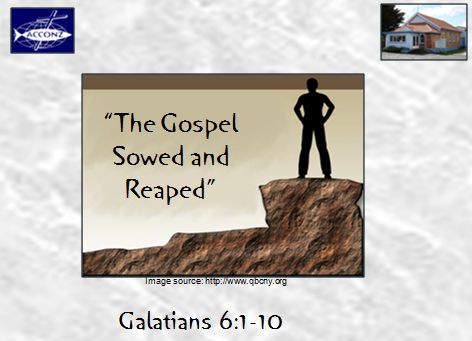
The Gospel Sowed and Reaped (Gal. 6:1-10).

Galatians 6:1-10 ESV
Brothers, if anyone is caught in any transgression, you who are spiritual should restore him in a spirit of gentleness. Keep watch on yourself, lest you too be tempted. 2 Bear one another’s burdens, and so fulfill the law of Christ. 3 For if anyone thinks he is something, when he is nothing, he deceives himself. 4 But let each one test his own work, and then his reason to boast will be in himself alone and not in his neighbor. 5 For each will have to bear his own load. 6 One who is taught the word must share all good things with the one who teaches. 7 Do not be deceived: God is not mocked, for whatever one sows, that will he also reap. 8 For the one who sows to his own flesh will from the flesh reap corruption, but the one who sows to the Spirit will from the Spirit reap eternal life. 9 And let us not grow weary of doing good, for in due season we will reap, if we do not give up. 10 So then, as we have opportunity, let us do good to everyone, and especially to those who are of the household of faith.

We now come to the final chapter in the book of Galatians. Every time I have sat down and studied one of these sections of the book, it has helped me to remember the context in which the words were written. Paul had planted and established the work in Galatia, then left it in the hands of its own leaders. He had every reason to believe that the Galatian churches would thrive as long as they stayed faithful to the LORD, and followed the principles he taught them.

But that is not what happened. Those “troublers” came from Jerusalem and brought an alternate gospel with them.

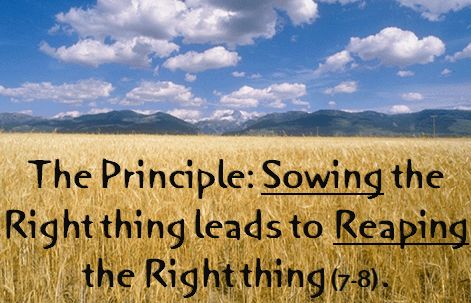
In this section, Paul appeals to a principle that explains what went wrong in Galatia. That principle is found in Galatians 6:7-8 “Do not be deceived: God is not mocked, for whatever one sows, that will he also reap. For the one who sows to his own flesh will from the flesh reap corruption, but the one who sows to the Spirit will from the Spirit reap eternal life.”
The Principle is: Sowing the Right thing leads to Reaping the Right thing. This is true for a person, and it is also true and a church.

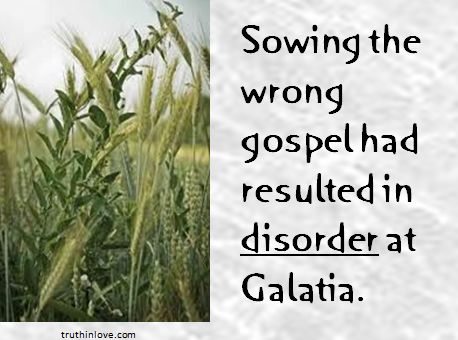
Jesus had told a parable about a farmer who planted wheat, but discovered that his enemy had secretly mixed in some weed seed (Matt. 13:25-30). The result was that the field grew both. That is what had happened in Galatia, and it didn’t look good. It was a disorderly mess. Paul’s letter was God’s way of helping the church to recover from that mess.

We 21st century churches can get a bit disordered at times too. We should follow Paul’s advice if we want to have a bountiful harvest for Christ. He teaches here how we can sow the true gospel in a church context.

Just like the farmer in Jesus’ parable, Paul advises against going into the Galatian churches and pulling up all the weeds. Instead, he tells us to turn the weeds into wheat. He says in verse 1: “if anyone is caught in any transgression, you who are spiritual should restore him in a spirit of gentleness.” That is wonderful pastor imagery.

Paul tells them in verse 2 to “Bear one another’s burdens, and so fulfill the law of Christ. ” That law was expressed in John 13:34, where Jesus says “A new commandment I give to you, that you love one another: just as I have loved you, you also are to love one another.”

Manifesting that love means restoring those who stray away from the gospel. In Romans 15:1, Paul says “We who are strong have an obligation to bear with the failings of the weak, and not to please ourselves.”

Paul goes on to say “For if anyone thinks he is something, when he is nothing, he deceives himself. But let each one test his own work, and then his reason to boast will be in himself alone and not in his neighbor. ” Galatians 6:3-4. To keep with the field analogy, Paul is saying, “make sure you have sowed the gospel in your own life first.” He had told the Corinthians to “Examine yourselves, to see whether you are in the faith. Test yourselves.” (2 Corinthians 13:5).

When the true gospel has been sowed in our lives, it will produce the right kind of works all by itself. So one way to test whether your theology is correct, is to examine your life to see if it is producing kingdom living and the fruit of the Spirit.

Paul says in verse 6, “One who is taught the word must share all good things with the one who teaches.” This takes some explanation. You see, before Paul had left the Galatian region, he had set up leaders who faithfully taught the gospel. When the troublers came in with their alternate gospel, they encouraged their followers to ignore these teachers.

Paul says in 1 Corinthians 9:14 “those who proclaim the gospel should get their living by the gospel.” God has established a way for the church to continue preaching the gospel, and that is through the professional ministry. What happened in Galatia is that those teaching the false gospel had supplanted those duly set up to teach in the church. So Paul is urging the Galatians to restore support to the rightful teachers.

In Galatians 6:9 Paul says “let us not grow weary of doing good, for in due season we will reap, if we do not give up.” He told the Corinthians something similar: “be steadfast, immovable, always abounding in the work of the Lord, knowing that in the Lord your labor is not in vain.” (1 Corinthians 15:58).

One of the reasons churches do not reap the harvest is that the people give up before the harvest comes. Galatians teaches us that we cannot be saved by works, but we are reading it wrongly if we think it is saying just trust the LORD and do nothing. The works that we will do will be the Holy Spirit’s works, not ours. They will be done because we are saved, not in order to get saved. But make no mistake: God’s people are expected to persevere in ministry until Christ comes.

So this section concludes with Paul saying “as we have opportunity, let us do good to everyone, and especially to those who are of the household of faith. ” (Galatians 6:10). The end result of the false gospel was that it led to the church biting and devouring one another. The end result of Paul’s gospel of salvation by grace is that the people in the church will invest themselves in each other’s lives.

The reason this kind of good works follows from the true gospel is that we have been set free from having to establish our own salvation, so now we have the opportunity to steer our good works toward others. That is how a church of saved people is supposed to operate.

LORD, we confess that all too often we have acted like the Galatians in our approach to ministry. We have sought to impress you by our obedience. We have worked hard to get on your good side. We repent of those kinds of works.

Help us LORD to trust in what Christ has done for us, so that we can be free to invest ourselves in others. Help us to sow the gospel of grace in this church, so that your Holy Spirit will be free to produce the fruit of the Spirit in our lives. In Jesus’ name. Amen.

The Gospel for the Crucified (Gal. 5:16-26).

Galatians 5:16-26 ESV
But I say, walk by the Spirit, and you will not gratify the desires of the flesh. 17 For the desires of the flesh are against the Spirit, and the desires of the Spirit are against the flesh, for these are opposed to each other, to keep you from doing the things you want to do. 18 But if you are led by the Spirit, you are not under the law. 19 Now the works of the flesh are evident: sexual immorality, impurity, sensuality, 20 idolatry, sorcery, enmity, strife, jealousy, fits of anger, rivalries, dissensions, divisions, 21 envy, drunkenness, orgies, and things like these. I warn you, as I warned you before, that those who do such things will not inherit the kingdom of God. 22 But the fruit of the Spirit is love, joy, peace, patience, kindness, goodness, faithfulness, 23 gentleness, self-control; against such things there is no law. 24 And those who belong to Christ Jesus have crucified the flesh with its passions and desires. 25 If we live by the Spirit, let us also walk by the Spirit. 26 Let us not become conceited, provoking one another, envying one another.

Today’s text is one of the most popular from the book of Galatians. Portions of it are probably read and preached more than any other in the book. But I am glad I did not decide just to jump into this text. I’m glad we have been hanging out in the whole book of Galatians for the past five months. Along the way we have discovered the historical and cultural context in which these words were first applied.

This context is going to help us see more clearly what Paul is saying, and to whom and how it applied in the first century. That knowledge will also help us put the text in practice here in the 21st century.

In summary, that context is this: Paul had been responsible for planting the churches of the Galatian region of the Roman province of Asia Minor. After he went on to plant more churches elsewhere, some false teachers came into those churches and promoted a new way of looking at Christianity. Paul called those false teachers “troublers” and that is exactly what they did – they caused trouble.

They taught that once you come to Christ by faith you then need to add something called “the works of the law” to that faith. Apparently the “works of the law” included circumcision, Jewish dietary restrictions, and strict obedience to the Mosaic laws as interpreted by these teachers.

So let me now venture a definition of the Galatian heresy based on what we have seen so far in Paul’s letter. It appears that the troublers were certain that anyone coming to Christ by faith were going to need some extra help living the life they have committed themselves to. So, they offer this advice: “if you want to live the Christian life, and please God, and succeed at being a believer, you need to add these “works of the law.” They are the secret ingredient that will help you produce the godly character you know God expects.

If you go to the average Christian bookstore you will find lots of books that claim to have the secret of living the Christian life. It is something we all want. That real desire in Christians is something the troublers were exploiting.
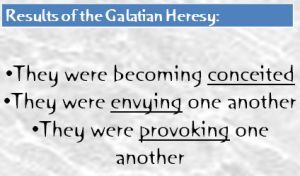
But there was a problem with that philosophy. It wasn’t working. It is apparent from verse 26 that the Galatian heresy was producing a bunch of people who could not even get along with each other, much less witness to their neighbours about Christ. The ones who seemed to be following the works of the law were becoming conceited about it. Proverbs 16:18 says “Pride goes before destruction, and a haughty spirit before a fall.”

The ones who didn’t have their act together envied those who looked like they did, and everybody was making everyone else miserable. You didn’t want to plan your next conference at Galatia. It was not the place anyone wanted to be.

So what went wrong: Paul had another word he used for the “works of the law” He calls them “the works of the flesh” (19). And he says in Galatians 5:17 “the desires of the flesh are against the Spirit, and the desires of the Spirit are against the flesh, for these are opposed to each other (NIV says they are in conflict with each other), to keep you from doing the things you want to do.”

So he was telling them that there was a war going on inside of them. Every time they decided to do something good in their own power, their sinful nature turned it into something evil. Every Christian has this war going on inside him.

So, no matter who you are, whether you are saved or not, whether you have been raised in a Christian home or not, whether you are home schooled or not, whether you went to Bible college or not… If you are trying to live the Christian life in your own strength you are going to produce the works of the flesh (19-21).

This is serious, because the only way the world is going to know that we Christians have found the Answer in Christ is that we manifest the fruit of the Spirit. If we are operating out of the flesh, we will produce what the flesh produces. That is not a good résumé.

The solution is what Paul commanded the Galatians to do here. If you remember from last week, Paul had told the Galatians that they were on self-destruct mode. He said “But if you bite and devour one another, watch out that you are not consumed by one another.” The NIV translates this well, because it picks up the continuous aspect: “If you keep on biting and devouring each other, watch out or you will be destroyed by each other.”

So Paul’s solution (in verse 16) is for them to walk by the Spirit. That means letting the Holy Spirit be the controlling power in their motivations, and the deciding influence in their actions. That is being led by the Spirit (18), which is passive.

It being passive makes it harder for us because it involves letting the Holy Spirit take control and do what God wants to do in our lives, not what we want to do, and it means doing what God wants to do in his way, not our way.

But that is the only way we are going to produce the Spirit’s fruit, instead of our own fruit. Jesus said “By this my Father is glorified, that you bear much fruit and so prove to be my disciples” (John 15:8). He also said “I am the vine; you are the branches. Whoever abides in me and I in him, he it is that bears much fruit, for apart from me you can do nothing” (15:5 ).

That reinforces the idea that Paul is getting across to the Galatians. Fruit bearing is passive: God wants to grow the fruit on us.

The zillion dollar question is “how?” How do we stop operating out of the flesh, and passively allow God to change us so that we manifest the fruit of the spirit instead of the works of the flesh? We have to understand that the Christian life is just that. It is a life, not just a decision. Lots of people make a decision to invite Christ into their lives and then never cultivate that life. They keep on living out of the flesh; they never walk by the Spirit. Those people are not saved, because their decision for Christ was not a repentance.

True repentance is what Paul described here, and the reason why the Galatians were having the problems that they were having is that they had missed true repentance. In verse 24 he says “those who belong to Christ Jesus have crucified the flesh with its passions and desires.”

Paul had experienced that true repentance. He said in Galatians 2:20 “I have been crucified with Christ. It is no longer I who live, but Christ who lives in me. And the life I now live in the flesh I live by faith in the Son of God, who loved me and gave himself for me.” That’s the kind of life he is calling on the Galatians to live.

But again, the question is “how?” Once we have truly repented of living life our way, and submitted to the Holy Spirit, how do we know that the desires and passions we now have are coming from the Holy Spirit, and not our flesh?

One clue is the question Paul asked in Galatians 3:5 “Does he who supplies the Spirit to you and works miracles among you do so by works of the law, or by hearing with faith?” Here Paul reveals how God chooses to work. Through his word he motivates us to do his will. But how is that different than what the Judaizers were saying? The difference is the one who initiates the change.

LORD, we want to know more about how to live the life where the Holy Spirit has control, and produces the fruit of the Spirit. Teach us how to live lives that have been crucified, surrendered completely to your will and your control. Teach us to hear your word and respond to it in faith. Forgive us for trying to live the Christian life in our own strength, under our own power, and by our own planning. Use us Oh Lord. Bear fruit from our branches. In the name of Jesus, who is the Vine. Amen

The Gospel for the Free (Gal. 5:1-15)

Galatians 5:1-15 ESV

For freedom Christ has set us free; stand firm therefore, and do not submit again to a yoke of slavery. 2 Look: I, Paul, say to you that if you accept circumcision, Christ will be of no advantage to you. 3 I testify again to every man who accepts circumcision that he is obligated to keep the whole law. 4 You are severed from Christ, you who would be justified by the law; you have fallen away from grace. 5 For through the Spirit, by faith, we ourselves eagerly wait for the hope of righteousness. 6 For in Christ Jesus neither circumcision nor uncircumcision counts for anything, but only faith working through love. 7 You were running well. Who hindered you from obeying the truth? 8 This persuasion is not from him who calls you. 9 A little leaven leavens the whole lump. 10 I have confidence in the Lord that you will take no other view than mine, and the one who is troubling you will bear the penalty, whoever he is. 11 But if I, brothers, still preach circumcision, why am I still being persecuted? In that case the offense of the cross has been removed. 12 I wish those who unsettle you would emasculate themselves! 13 For you were called to freedom, brothers. Only do not use your freedom as an opportunity for the flesh, but through love serve one another. 14 For the whole law is fulfilled in one word: “You shall love your neighbor as yourself.” 15 But if you bite and devour one another, watch out that you are not consumed by one another.

We have been examining the book of Galatians for several months now. Today we begin the fifth month, and the fifth chapter. Paul was very angry when he wrote Galatians. He was angry because he had planted the churches in the Galatian region by preaching the gospel of grace, and, after he left, some troublers came into those churches and started preaching a different gospel.

The troublers considered their teaching sort of a “gospel plus.” But Paul recognized that it was a “gospel minus.” They considered their teaching a way of taking Christianity to the next level, but Paul considered it a rejection of the gospel, and a return to a yoke of slavery.

Up until this point Paul has been expressing his exasperation with the Galatians for having been deceived and going along with this substitute gospel. And he has been arguing the case against the Judaizer heresy by showing that it opposes what he taught them, and it doesn’t fit with what the Bible says about salvation – Old Testament or New.

Up until this point Paul hasn’t been making many demands, but that changes here. In the space of one verse he gives two commands (a positive one and a negative one). It is as if he is saying, “alright now, it’s time for you to make your choice.” The Gospel forces us to make a choice.

But he doesn’t want to leave it at that, because he’s afraid that the Galatians would make the wrong choice. He has to convince them that if he is right, and salvation is by grace alone, then there is no other option. Choosing to go along with the Judaizers is choosing to be lost, not saved at all. There is no such thing as a legalistic Christian.

So what Paul does in this section of chapter 5 is put the two choices on the board, so to speak. He compares them so that the Galatians can actually see what they are choosing. In verse 1 he says it’s a choice between freedom and slavery. In verse 2 the choice is Christ or circumcision. In verse 4 the choice is grace or law.

In verse 7 he says it’s a choice between keeping on running and being hindered. False doctrine had created a stumbling block which prevented the Galatians from living the Christian life.

In verse 9 the choice is purity or contamination. Paul says some leaven has gotten into their lump, and it has contaminated the whole thing.

In verse 11 the choice has affected how they see the cross of Christ. If it is the only means of getting right with God, it is an honour. But if I can do something to gain merit for myself or redeem myself, the cross is an offense.

What is the means of sanctification? It is either the Holy Spirit (v.5), or the Flesh (v.13).

In verse 7 he says it’s a choice between keeping on running and being hindered. False doctrine had created a stumbling block which prevented the Galatians from living the Christian life.

In verse 9 the choice is purity or contamination. Paul says some leaven has gotten into their lump, and it has contaminated the whole thing.

In verse 11 the choice has affected how they see the cross of Christ. If it is the only means of getting right with God, it is an honour. But if I can do something to gain merit for myself or redeem myself, the cross is an offense.

What is the means of sanctification? It is either the Holy Spirit (v.5), or the Flesh (v.13).

What are the results of submitting to slavery. We can see that in what Paul said about the Galatians here.

First, slavery leads to disorder. Paul said that the troublers had unsettled the Galatians (12).

Second, slavery is defection. Paul said that the Galatians had fallen from grace (4). They had professed faith, but failed to persevere in it.

Third, slavery leads to disobedience. The Galatians were no longer obeying the truth (7). Ironically, when you choose to make obedience the basis of your “Christian” life, you can no longer obey God. The basis of the Christian life is faith.
Fourth, slavery leads to spiritual decapitation. Christ is the head of his body. Choosing slavery severs you from Christ (4).

Fifth, slavery makes Christ a disadvantage. What Christ has done for us is the only advantage a Christian has. To live by works is to make Christ’s death work against you! That’s why Paul told the Galatians that if they let themselves be circumcised, Christ would be no advantage to them (2).

Sixth, slavery is like taking your life on a spiritual detour. The Galatians were offered freedom, but then started using that freedom as an opportunity for the flesh (13).

Seventh, slavery creates enormous debt. Paul said that making that choice leads to an obligation to keep the whole law (3).

Finally, slavery leads to devouring. The Galatians had already begun biting and devouring one another (15). If you define yourself by what you do, you will compare yourself with others, and criticize and complain about them. It is not a pretty image, but it is accurate.

Now let’s look again at what Paul said in verse 1, and we will focus first on that positive command “stand firm.” Someone who is standing firm is ready for the storms of life, because she has a solid foundation under her. She does not have to rescue herself. All she has to do is put her faith in the foundation under her, and she will be alright.

So Paul is telling the Galatians, “Oh, foolish Galatians! I gave you the right foundation. Stand firm in it!”

What does standing in freedom look like? Paul had told the Corinthians “faith, hope, and love abide” (1 Corinthians 13:13). To abide is to remain, to stand firm. A person who is trusting in God and not himself for his salvation is going to manifest these three character traits.

We see that here in Galatians 5. Instead of by works the believer is to live by faith (5), he will produce works, but that will be faith working (6).
Instead of despairing because he cannot do it all himself, the believer eagerly waits for the hope of righteousness (5).

Instead of biting and devouring others, the believer serves others through love (13). Love is his means of demonstrating his faith (6). And love actually helps him do what his slave counterpart cannot do: fulfill the law (14).

LORD, we are challenged by what we have read and studied today. We confess to you that – all too often we have tried to live the Christian life on our own terms, to fulfill the law the best way we know how. We know that is wrong. Only one person could fulfill your law.

But we also know that he did. By his sinless life and sacrificial death Christ bought our freedom. We are free! We ask you today to help us to stand firm in that freedom. Help us not to get entangled in any kind of bondage. Enable us to live by faith, to wait eagerly for our hope, and to manifest our faith by serving one another through love. In Jesus’ name. Amen

A Call for Edifying Manifestations

1 Corinthians 14:6-12 ESV
“Now, brothers, if I come to you speaking in tongues, how will I benefit you unless I bring you some revelation or knowledge or prophecy or teaching? 7 If even lifeless instruments, such as the flute or the harp, do not give distinct notes, how will anyone know what is played? 8 And if the bugle gives an indistinct sound, who will get ready for battle? 9 So with yourselves, if with your tongue you utter speech that is not intelligible, how will anyone know what is said? For you will be speaking into the air. 10 There are doubtless many different languages in the world, and none is without meaning, 11 but if I do not know the meaning of the language, I will be a foreigner to the speaker and the speaker a foreigner to me. 12 So with yourselves, since you are eager for manifestations of the Spirit, strive to excel in building up the church.”

In this series I have been highlighting Paul’s commands to the churches that are of a particular structure. The structure is called continuous active imperative. These are commands for the church to (positively) keep doing what it is supposed to be doing, or (negatively) to stop doing what it is not supposed to be doing. The command in today’s text is in verse 12, where Paul encourages the Corinthians to keep striving to excel in building up the church.

The context of this command is chapters 12-14 of 1 Corinthians.

Let me try to summarize what Paul is saying in these three chapters.

Chapter 12 is about Spiritual Gifts. He says there are going to be all kinds of gifts manifested when we gather together, because the body of Christ is made up of many different members, with many different ministries assigned to them by the head (Christ) and empowered by the Holy Spirit. He does encourage the whole church to earnestly desire the higher gifts, which are the ones which build up the most members of the body.

Chapter 13 is the love chapter. Here Paul encourages all ministry to be done out of love, otherwise it counts for nothing.

In Chapter 14 Paul addresses some examples where it appears the Corinthians are not doing that, so spiritual gifts are becoming a problem. They were being abused, and the result was chaos rather than order.

Now I want to summarize chapter 14 with a little more detail. This is the chapter in which our text for today is found, so it is important to put as much flesh on it as possible.

All of the problems that Paul was dealing with in chapter 14 have to do with speaking in church, that is, with manifesting spiritual gifts which involve public speaking in the assembly. He identifies three specific problems:

1) too many people were “speaking in tongues” instead of prophesying;

2) too many people were speaking all at once, which was leading to confusion;

3) some of the women of the congregation were speaking, and, for some reason that too was causing disorder.

I want to comment on each of these problems, and I want to talk about the simplest problem first, then go to the ones that are more complex. The simplest problem Paul mentioned was that everybody was jumping up to speak all at once, and the result was chaos. People didn’t know who to listen to, and very little edification was getting done. It was a free-for-all, and probably resembled a competition to see who could gain the most listeners. The confusion was being caused by a good thing: the Corinthians were eager to share. Paul encouraged them to be considerate of one another and limit the number of people who speak, and have only one person speak at a time. Be considerate. Problem solved.

Another problem that Paul brought up in 1 Corinthian 14 is that some of the women of Corinth were speaking at the assemblies, and that was adding to the disorder. Some people believe that God has only ordained men to speak in church services, but I do not think that is the case. I have already shared how Gal. 3:28 shows that all Christians have the same status before God. Also, Joel 2:28-29 predicted a new era of the Holy Spirit’s ministry would include prophesying by both “sons and daughters.” That new era began at Pentecost.

So why is Paul preventing the women to speak here? Verses 34-35 hold the key.

First, I draw your attention to the last part of verse 25, where Paul says “it is shameful for a woman to speak in church.” Now, one problem is that Paul had already given instruction for the wives of the congregation in chapter 11. He tells them that they should cover their heads with a veil if they want to pray or prophecy. Praying and prophesying are kinds of speaking. Those kinds of speaking do not appear to be shameful. Perhaps what Paul meant was that the Corinthian society saw it as a shameful thing for its women to speak in public. He didn’t say it to the Thessalonians, Ephesians, or even the Romans. But apparently it was a problem in Corinth so Paul orders them not to have their women preach in public.

Paul says that the women are not permitted to speak, but should be in submission as the law also says. The problem is that there is absolutely no Old Testament commandment against women speaking. But there were plenty of laws in Corinth against women speaking. Paul seems to be saying that the women in Corinth should not speak in public because it is illegal.

In fact, history tells us that there was only one class of women who dared to speak in public in 1st century Corinth: the professional prostitutes. These were also the only Corinthian women of marriageable age who dared to appear in public without a veil.

The particular issue that appears to be the problem at Corinth is that wives are interrupting the worship to ask questions of their husbands. This is understandable, because in the first century women were not educated. There was apt to be a great deal of what was being said that the women did not understand. Their zeal to know was commendable, but it was causing confusion in the assembly, which is exactly the problem that Paul was addressing. Paul’s solution was “let them ask their husbands at home.”

As if I have not stirred up enough controversy, I want to go now to the problem that took up the most space in chapter 14: the problem of too many people “speaking in tongues.”

To understand Paul’s advice here we have to ask three questions. First, “What was “speaking in tongues?” I realize that there is a whole theological tradition that suggests that “speaking in tongues” is some kind of supernatural language that God gives believers to edify themselves with.

But I suggest that the problem in First Century Corinth was simply this: people were coming to worship services and giving their messages in languages that most of the other worshippers did not know.

Paul’s solution to the problem is found in verse 28 “But if there is no one to interpret, let each of them keep silent in church and speak to himself and to God.”
He tells the tongues speakers the same thing he told the women, and for the same reason. The wives questioning their husbands was causing distraction and not edifying anyone. The tongues speaking (without a translation) was doing the same thing. So Paul says “stop doing that.” The goal of all the manifestations of the Holy spirit is to edify the body of Christ. If what you are doing is not achieving that goal, you have no business doing it.

I want to conclude by going back to verse 12, where Paul encourages the Corinthians to keep striving to excel in building up the church. That is the BIG IDEA that Paul is trying to get across in chapters 12-14. May we never forget that. We need to constantly evaluate ourselves to see if the things we are doing when we meet together are actually building up the body. If First century Corinth could have problems – even after being founded by Paul himself – then we have no reason to assume that 21st century Takanini is immune.
_________
LORD, before we say anything in church, help us to ask ourselves “will this help the people who hear it?” If it will not help, give us the consideration and love to keep our mouths shut!” Amen.