a resurrection perspective

146


gift of life #22


a resurrection perspective


Paul David Tripp calls it “eternity amnesia.”  It is people living with no hope for the future. They live for today because they think today is all that we have. In his recent book, Forever, he outlines the symptoms of this problem: 


  1. Living with unrealistic expectations,
  2. Focusing too much on self,
  3. Asking too much of people,
  4. Being controlling or fearful,
  5. Questioning the goodness of God,
  6. Living more disappointed than thankful,
  7. Lacking motivation and hope,
  8. Living as if life doesn’t have consequences.

We can understand it when people who do not know Christ live this way. But all too often, those of us who claim to know Jesus live the same way. We are victims when we should be living in victory. The victory was already obtained by Christ. Because of what he did for us, we need never live as if these temporary lives are all that we have. We can see everything that happens now in the light of the glory that awaits us in eternity. We can tolerate pain and failure because we understand them to be temporary setbacks. We can better grasp the significance of success when we see it from the standard of eternity as well. We can look on every soul we encounter as another being who is potentially immortal and glorified, which might help us tolerate their present imperfections. We can have a better attitude about our own present failures to hit the mark.


Another Paul, the apostle Paul – said something about eternity amnesia too.  He said “And if our hope in Christ is only for this life, we are more to be pitied than anyone in the world.” (1 Corinthians 15:19). If you take away the resurrection, Christianity is an empty religion with no real hope, and believers are of all people most to be pitied. The reason is that all human beings are born mortal. We have a death sentence hanging over us because of Adam’s rebellion. We imitate Adam by being creatures who return to the dust. But the hope of the resurrection gives us a forever perspective.

People who live without the forever perspective can only hope to accomplish a limited number of things. No matter how happy or successful or significant their lives, that happiness, success and significance will be buried in the ground when they die. But people who have a resurrection perspective – a gospel perspective, can accomplish an unlimited number of things. We can make an eternal difference in other people’s lives by pointing them to the Saviour. We can get our minds off of the things which enslave others, because our focus is on serving Christ.  He was the first to be resurrected.  We are next.  Knowing our future can free us to truly live in the present.


The gospel’s victory is not a happy life today.  The gospel’s victory is an eternal happy life at the resurrection.  Here is how the apostle Paul explains it: “In a moment, in the twinkling of an eye, at the last trump: for the trumpet shall sound, and the dead shall be raised incorruptible, and we shall be changed. For this corruptible must put on incorruption, and this mortal must put on immortality. So when this corruptible shall have put on incorruption, and this mortal shall have put on immortality, then shall be brought to pass the saying that is written, Death is swallowed up in victory”” (1 Corinthians 15:52-54.) The resurrection is God’s victory, and ours. The gospel is the good news about that victory. It is the story of the crucial battle won on the cross, and demonstrated by Christ’s resurrection. It is the story of the final victory over sin and pain through the resurrection at Christ’s return. Coming to faith in Christ is entering into that story. We know how the story ends. That is why we can have a resurrection perspective.


If you have any questions about this teaching, you can ask me at jeffersonvann@yahoo.com.  Join me for this entire series as we search the scriptures to learn about the gift of life.


Listen to the audio at Afterlife.

wrong about hell

DSCF1426gift of life #21

wrong about hell

Today I want to respond to some of the criticisms we conditionalists get when we dare to assert that hell will eventually come to an end.

The universalists say we are wrong about hell because they believe hell’s purpose is destroying sins, not sinners. They agree with us that hell is a temporary event. They teach that it will end when the last sinner has paid for his sins, and has been restored.

But we conditionalists don’t see evidence of that restoration in scripture. Scripture says that God makes the wicked perish, blotting out their name forever (Psalm 9:5). Jesus taught that God can destroy both soul and body in Gehenna hell (Matthew 10:28). But neither the universalists nor the traditionalists think that this is really possible. Both of these groups believe that souls are indestructible. Conditionalists teach that human souls are created by God, and they can be destroyed by God.

Traditionalists say we are wrong about hell because we redefine the word forever. We respond by pointing out that most of the time in the Bible when the Hebrew word ‘olam or the Greek word aionios appears, neither refers to a perpetual process. Most of the time they simply mean permanent, or everlasting, and we certainly have no problems with those translations.

Here are some examples:

  • the permanent destruction the lost will face at Christ’s return (2 Thessalonians 1:9).
  • the permanent glory that accompanies salvation in Christ (2 Timothy 2:10).
  • The permanent salvation made possible by Jesus, our great high priest (Hebrews 5:9).
  • The permanent judgment that will take place after the resurrection of the dead (Hebrews 6:2).
  • the permanent covenant made possible by the shedding of the blood of Christ (Hebrews 13:20).
  • entrance into the permanent kingdom provided for all those who make their calling and election sure (2 Peter 1:10-11).

But, yes, we object to the word eternal because that English word conveys the idea of an on-going process. By definition, destruction cannot be a perpetual process. It has to end, or it cannot take place.

Traditionalists also say we are wrong about hell because God’s justice morally demands it. We agree with all other Bible-believing Christians that God’s justice requires a judgment day. We object to those who insist that day must continue forever. If the punishment for sins requires an eternity of suffering, then all of us are lost. Our Lord himself suffered punishment in our place on the cross, but his suffering came to an end when he died. How can we say that his death atoned for our sins? That’s what the Bible says. It says God sent his Son to be the atoning sacrifice for our sins (1 John 4:10). It says the wages of sin is death, not suffering eternally (Romans 6:23). It says that final punishment will be a lake of fire, resulting in the second death. That is what God’s justice demands.

So, no, we are not wrong about hell. We are a voice of reason, asking people to take another look at what the Bible really says about this important topic.

If you have any questions about this teaching, you can ask me at jeffersonvann@yahoo.com. Join me for this entire series as we search the scriptures to learn about the gift of life.

Listen to the audio file at Afterlife.

WE ARE … watching for his return

clip_image002

We have been exploring the ideas expressed in our church identity statement. We, as a church identify ourselves as “an open family of believers seeking to follow Jesus Christ and live out His teaching while we watch for his return.”

Identity statements like that are important for churches because they summarise ideas which we can band together behind. They also serve to help us decide the kinds of things we as a church should be doing, and what kinds of things we do not have to do.

I particularly appreciate the last phrase in our identity statement because it shows our expectation of what the scripture calls the blessed hope – the second coming of Jesus Christ.

Here is the day’s text:

3 Grace to you and peace from God our Father and the Lord Jesus Christ. 4 I give thanks to my God always for you because of the grace of God that has been given you in Christ Jesus, 5 for in every way you have been enriched in him, in speech and knowledge of every kind– 6 just as the testimony of Christ has been strengthened among you– 7 so that you are not lacking in any spiritual gift as you wait for the revealing of our Lord Jesus Christ. 8 He will also strengthen you to the end, so that you may be blameless on the day of our Lord Jesus Christ. 9 God is faithful; by him you were called into the fellowship of his Son, Jesus Christ our Lord (1 Corinthians 1:3-9).

I had a number of texts to choose from, because the New Testament has a lot to say about the promise of Christ’s return. But I chose this text, because it is one which is probably not used very much, but it definitely relates to the topic.

clip_image004

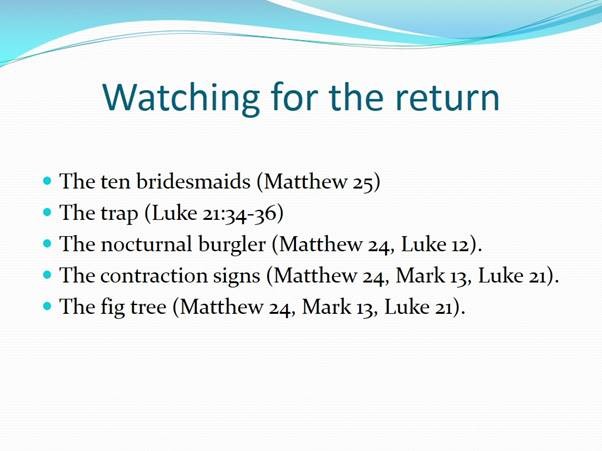
When we preach about the second coming, there are about five “usual suspects” that we round up.

The story of the ten bridesmaids is a helpful passage, because it shows that some people who think they are ready are not ready. It is a call to be authentic, and to be really prepared, not just to look prepared. You may recall that in the story all ten bridesmaids expected to be invited to the wedding, but five were not really prepared for the long wait before the bridegroom came.

I also like the warning that Jesus gave us when he described his second coming as a trap. He said “34 But be on your guard so that your hearts are not weighed down with dissipation and drunkenness and the worries of this life, and that day close down upon you suddenly like a trap. 35 For it will overtake all who live on the face of the whole earth. 36 But stay alert at all times, praying that you may have strength to escape all these things that must happen, and to stand before the Son of Man.” Luke 21:34-36 NET.

He also described his second coming like a burglar who comes at night. Back in Jesus’ day, people would bring their valuables (including their animals) into their homes at night. They would sleep up in a loft, or on the roof of their houses. Burglars would wait until the wee hours of the morning, burst into the homes and make off with the loot. Jesus used the story to express the same kind of warning as the previous passage: Don’t get caught unprepared for the second coming.

Another favourite passage for preaching about the return is the Olivet Discourse, also called the eschatological discourse, where Jesus answers three questions about his return. One of the questions that his disciples asked was how long it would be until the end of the age. Jesus told his disciples that a number of signs would occur over and over again, like contractions in a birth. His point was that those signs are not proof that his coming was soon, because the signs would keep coming over and over, like contractions during labour.

There was another set of signs that Jesus gave during the same discourse. These signs identified a more immediate group of events, particularly identifying the date of the return. So, while Jesus did say that no one would ever know the day or the hour, we would always be able to identify the season when Jesus could return. It would be just as obvious as when a fig tree spouts all its leaves. Anyone looking at world events today can clearly see that the season is right for Jesus’ return.

clip_image006

But I want us to focus today on the 1 Corinthians text today because it shows that there are some other reasons why believers should be watching for Christ’s return. Firstly, it talks about our being called into fellowship with Jesus. Now, what exactly does that mean?

In Tolkien’s The Fellowship of the Ring, a group of people were called together into a fellowship for the purpose of destroying a powerful ring. In spite of the differences in the people, it was the singular purpose of the fellowship that united them.

But there is something even more significant here. Paul is saying that every born-again believer is called into fellowship with Jesus Christ. We are called to be where Jesus is. But that does not happen yet. We are bound on this planet, and Jesus is with his Father in heaven. That poses a severe problem for fellowship. Some have suggested that when believers die, they go to be with the Lord in heaven. That would be a solution to the problem. But that is not the solution that the apostle Paul gave. He taught that Jesus is going to come back to earth – literally and physically. Then we can be a fellowship again.

His point in today’s text is that we are promised a permanent fellowship with Christ. So, he has to come back to fulfil that promise.

clip_image008

And there is yet another reason why Jesus has to come back. Paul notes the fact that the Corinthian Christians have been enriched by the grace of God. In other words, God has invested himself in the Corinthian Christians. The same is true for all Christians everywhere. God has begun an investment in us. It only makes sense for him to complete that investment.

Let me put it this way. Suppose (and I’m really going out on a limb here) I had invested a million dollars in a company. Do you think I would just walk away from that company, and let its leaders do whatever they want with the money I invested? Of course not. I would be making a nuisance of myself, always wanting to be involved in the company’s business because I am so heavily invested in the company. The future of the company would be my business.

Now, God has invested the life of his only Son in us. He has also given us the Holy Spirit who reveals his truth to us and empowers us for ministry. He’s not going to drop everything and go off and play in a distant galaxy for eternity. Jesus is coming back, and we know that because of what he has already done for us.

This is how Paul described this reality to the Ephesian Christians: “For he chose us in Christ before the foundation of the world that we may be holy and unblemished in his sight in love. 5 He did this by predestining us to adoption as his sons through Jesus Christ, according to the pleasure of his will– 6 to the praise of the glory of his grace that he has freely bestowed on us in his dearly loved Son. 7 In him we have redemption through his blood, the forgiveness of our trespasses, according to the riches of his grace 8 that he lavished on us in all wisdom and insight. 9 He did this when he revealed to us the secret of his will, according to his good pleasure that he set forth in Christ, 10 toward the administration of the fullness of the times, to head up all things in Christ–the things in heaven and the things on earth. 11 In Christ we too have been claimed as God’s own possession, since we were predestined according to the one purpose of him who accomplishes all things according to the counsel of his will.” Ephesians 1:4-11.

God had a purpose in mind when he called us to himself, and that purpose will not be fulfilled until Jesus returns.

clip_image010

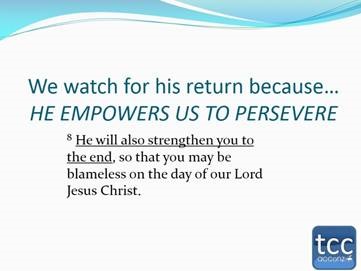
And finally, we can expect that investment by God to continue throughout our entire lives. The strength to persevere through the trials of life and keep proclaiming his word in spite of those trials will stay with us until Jesus returns.

clip_image012Are you watching for Christ’s return every day of your life? I think we often forget about the fact that his coming is coming. It is no wonder that sometimes we feel powerless to keep going. It is that blessed hope, that expectation of the return which can motivate our perseverance like nothing else.

LORD, help us to fix our eyes on Jesus, so that no matter how hard the race, we can run well, and finish well.

Listen to the audio at Takanini Community Church.

the purpose of hell

citrus-fruit-trees

Wheat Fied, Palouse, Washington State, USA


gift of life #20

the purpose of hell

I’m a little bit older now, and I’m glad for it. I enjoyed raising my three daughters, but I wouldn’t want to do it again. I am glad some aspects of parenthood are now over for me. Top of that list is punishing the kids. I did it when I had to, but I never enjoyed it, and I didn’t want it to last any longer than necessary.

In the last session, I introduced the concept of the wrath of God. Yes, God will have to punish his naughty kids, too. But people teach a lot of ideas about God’s wrath that just don’t add up. Listen to what John the Baptist taught about the wrath to come:

Luke 3:7 “So John said to the crowds that came out to be baptized by him, “You offspring of vipers! Who warned you to flee from the coming wrath?”

Luke 3:9 “Even now the ax is laid at the root of the trees, and every tree that does not produce good fruit will be cut down and thrown into the fire.”

Luke 3:17 “His winnowing fork is in his hand to clean out his threshing floor and to gather the wheat into his storehouse, but the chaff he will burn up with inextinguishable fire.”

This was the very first message about final punishment in the New Testament. It was preached by John the Baptist, to his own fellow Israelites. In it, he spoke of God as if he was an orchard owner, who is going to cut down all his unfruitful trees, and burn them up in a fire. He spoke of God as if he was a wheat farmer, who is going to gather up all his good wheat, and throw the chaff into a pile and burn it up, in a fire that no one can put out.

Now what does this message tell us about the purpose of hell. Well, consider what it does not say. It does not say that the orchard owner takes pleasure in torturing his unfruitful trees for eternity. It does not say that the wheat farmer will try to burn up the chaff, but he will not be able to, because for some reason the chaff will prove to be indestructible. You see, an inextinguishable fire still burns up chaff. It’s not the chaff that’s inextinguishable. It’s the fire which the wheat farmer uses to burn the chaff up.

As a parent, I did not want to punish my children. But when I had to do it, I did it, and got it over with. That’s what John the Baptist taught about final punishment. At the end of the day, there will only be fruitful trees, because the fire will serve its purpose, destroying the unfruitful trees. At the end of the day, there will only be good wheat, because the fire will serve its purpose, destroying the chaff. That’s what hell is for. That is the purpose of hell.

I know, you’ve been taught something else. You have been taught that God’s holiness requires that unbelievers be consciously tortured for eternity. But what this text teaches is that God’s holiness requires an eternity without unbelievers. That’s what hell is for. That is the purpose of hell.

If you have any questions about this teaching, you can ask me at jeffersonvann@yahoo.com. Join me for this entire series as we search the scriptures to learn about the gift of life.

Listen to the audio file at Afterlife.

God’s mouse

gift of lifegift of life #19

God’s mouse

It’s a story I heard many times while a missionary in the Philippines. It goes like this: There was a visiting preacher who did not understand the Cebuano language of Mindanao, so he had to have an interpreter with him when he preached. But the interpreter could not understand his English very well, since he had a heavy accent. One night while he was preaching, the preacher mentioned the wrath of God. But the interpreter did not quite hear him correctly. So, the interpreter confidently belted out the phrase ilaga sa dios. Laughter ensued, and the legend of God’s mouse was born!

While the story is funny, the reality of God’s wrath is not. It is a horrible reality. Jesus taught that everyone deserves that wrath, and that everyone will experience it except those who put their faith in him. He said “The one who believes in the Son has eternal life. The one who rejects the Son will not see life, but God’s wrath remains on him” John 3:36. So, according to scripture, the wrath of God is not a form of eternal life. It is the opposite. God’s wrath puts an end to life.

The apostle Paul said that those who refuse to obey the truth are actually storing up wrath which they will experience on judgment day. He said “because of your stubbornness and your unrepentant heart, you are storing up wrath for yourselves in the day of wrath, when God’s righteous judgment is revealed! He will reward each one according to his works: eternal life to those who by perseverance in good works seek glory and honor and immortality, but wrath and anger to those who live in selfish ambition and do not obey the truth but follow unrighteousness” Romans 2:5-8. So, according to scripture, the wrath of God is a sentence of judicial punishment which keeps getting worse and worse as long as you live in rebellion against God without repenting of that rebellion. Those who have repented are free to seek glory and honor and immortality, and the end result of that perseverance will be eternal life. Once again, the wrath of God as a punishment is contrasted with eternal life. The wrath is not a form of eternal life.

The Bible teaches that there will come a day when all of this wrath will be fully poured out on unbelievers. It says “And I saw the dead, the great and the small, standing before the throne. Then books were opened, and another book was opened–the book of life. So the dead were judged by what was written in the books, according to their deeds. The sea gave up the dead that were in it, and Death and Hades gave up the dead that were in them, and each one was judged according to his deeds. Then Death and Hades were thrown into the lake of fire. This is the second death–the lake of fire. If anyone’s name was not found written in the book of life, that person was thrown into the lake of fire” Revelation 20:12-15. So, according to scripture, the wrath of God is not experienced at death. It will be experienced on judgment day. It will not be a process of perpetual torment, but an event which will end in the second death, eternal death, from which there will be no resurrection.

No, it’s not funny. But it is a terrible reality. If you are an unbeliever, escape the coming wrath by repenting of your sins and trusting in Christ today!

If you have any questions about this teaching, you can ask me at jeffersonvann@yahoo.com. Join me for this entire series as we search the scriptures to learn about the gift of life.

(audio file available at Afterlife)