
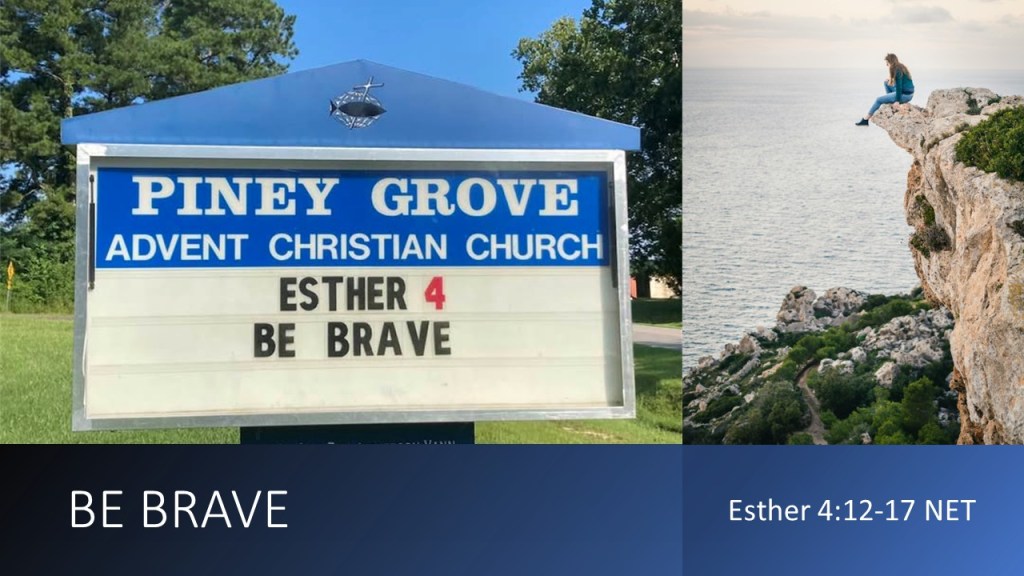
BE BRAVE

BE BRAVE

Esther 4:12-17 NET.

The stories in the Old Testament serve as lessons for us. They show the actions and behaviors that are expected of God’s people or reveal the opposite—the things believers should avoid. We need to pay close attention when reading because some Old Testament characters change their roles halfway through. They might start rebellious and then repent, or begin righteous and make a wrong turn or a terrible mistake. Therefore, reading these Old Testament narratives is not always easy.

We need to read the stories in the order we received them because that provides us with context. Context helps us understand what the characters are doing and why they are doing it. For example, today’s text is set during exile. This is the period when the Israelites are no longer in the land of Israel. They have been condemned by God for their lack of faithfulness and punished by exile. Exile is when people are taken from their land and brought to a new land by their conqueror.

Esther recounts the story of the Jews in Persia. The king had dismissed his queen, and he chose a new queen who happened to be Jewish. The villain of the story is an Agagite named Haman, who was violently anti-Semitic long before Hitler. Haman schemes to use the king’s power to eliminate the Jews.

Another key character in Esther is Mordecai, the cousin and guardian of Esther. Mordecai discovers a plot to destroy the Jews and appeals to Esther to intervene. When she learns of the plot, she wants to help save her people, but there is a problem. The protocol for appealing to the king is that he must first summon you. But Esther had not been called into the King’s presence in a month. Anyone who dares to enter the King’s presence without an invitation risks being executed. Esther understood the situation and chose to bravely enter the King’s presence to plead for her people’s lives.

If we look a little further back, we can see that another layer is at play in the story of Esther. There is a broader background as well as a more immediate one. In Esther, the sovereign God is protecting the people of Israel, from whom the Messiah will eventually come. That is another aspect we should recognize in these Old Testament stories. All of them reveal something about our Lord Jesus Christ. The Old Testament prepares the way for Christ’s first coming.

The book of Esther highlights one aspect of faith. It is a quality of biblical faith that isn’t often emphasized when we discuss what it means to have faith. In the New Testament book of Revelation, we find a list of all the people who will be excluded from eternal life and will be destroyed in the lake of fire. It states this: “But the cowards, faithless, detestable, murderers, sexually immoral, sorcerers, idolaters, and all liars, their share will be in the lake that burns with fire and sulfur, which is the second death” (Revelation 21:8).

I find it interesting that the first item on the list of those who will be destroyed in hell is cowards. Of all the things that the Bible describes as bad or evil, why put cowardice first?

I think there is a very good reason for this. Remember that the New Testament also tells us that our adversary, the devil, is prowling around looking for someone to devour. It does not ask us to hide from him. It does not tell us to run from him. It does not ask us to aim our rifles at him while he is far away and shoot him. It says that we are to resist him. Resistance requires contact. We must put ourselves in harm’s way and trust that God will accomplish his will. There’s no guarantee that we will always win.

There is no bravery without an obstacle.

We learned from Queen Esther not to let obstacles prevent us from standing up against enemies’ attacks. The obstacle Esther faced was that she had to enter the King’s presence to appeal to him on behalf of her people, but doing so could have cost her life.

Other biblical characters face the same challenge. Doing what is right could very likely cost them their lives. Daniel faced the lions in the den, his three companions faced the fire in the furnace, David faced Goliath, and Paul went to his death in Rome because he knew God wanted him to share the gospel with the emperor. One of the signs of faith in the Bible is that the people of God bravely set their sights on doing God’s will even when doing so is dangerous.

Another lesson we learned from Esther is that God is at work in every conflict, but we still must be brave.

I used to enjoy playing certain computer games where you faced dangerous challenges. I especially liked playing those games in what we called God Mode. If you set your settings to God Mode, then the bullets wouldn’t hurt you. The game remained challenging, but you had all the time you needed, and you could make all the mistakes possible without dying. Some people think that Christian life is like playing a game in God Mode. They believe they can face any challenge and don’t need to worry because their faith will protect them from losing. But that’s not what the Christian life is about. Esther is an example to follow, not because she was immune to danger, but because she wasn’t. She truly risked her life to do what was right. The world is full of cowards who aren’t willing to do the same.

God says that if we acknowledge Him before people, He will acknowledge us in the presence of His angels. But cowards hide behind their ignorance. They proclaim themselves as agnostics because they don’t want to offend anyone by claiming that Jesus Christ is Lord of Lords. They think they are saving themselves through their cowardice. But the fact is that refusing to bow the knee to Christ is like what Haman did. He built gallows, intending to hang Mordecai on them. However, he ended up being hanged from the very gallows he built.

The book we are reading today is called Esther because Esther showed faith to stand up and be counted to save her people. Esther had faith, and that faith was brave. But this is not just a story of one person’s faith. Before Esther went into the King’s presence, she told Mordecai to gather all the Israelites praying and fasting for her.

Not every Christian will face the kind of challenges she did, but we should all be ready to support those who do.

The New Testament encourages us all to pray and fast, but not solely for our preservation. Note these specific times when the apostle Paul asked others to pray for him.

  • He asked the Roman Christians to pray that he might be rescued from the unbelievers in Judea (Romans 15:31).
  • He asked the Ephesian Christians to stay alert and persevere in prayer for all the saints (Ephesians 6:18).
  • He also asked them to pray that he would stay bold in proclaiming the gospel even though he was in chains (Ephesians 6:20).
  • He asked the Colossian Christians to pray that God would give him and his team an opportunity to speak the mystery of Christ (Colossians 4:3).
  • He asked the Thessalonians to pray that as he and his team traveled to other places, the word of the Lord would spread quickly and be honored just as it was with them (2 Thessalonians 3:1).

Biblical faith is courageous faith. One reason we can be brave is that we know an army of prayer warriors is backing us up.

Communion Meditation

John 10:18

“No one takes it from me, but I lay it down, and I have the right to take it up again. I received this command from my father.”

We have discussed bravery as an aspect of faith. Esther demonstrated this bravery when she risked her life to save her people. She feared death, so she called for prayer and fasting on her behalf. Her bravery wasn’t the absence of fear; it was the courage to do what was right despite her fears.

Jesus is our example of that kind of courageous faith. He didn’t want to die, but he was brave enough to submit to God’s will and die in our place.

Today’s communion text tells us that God commanded both Christ’s crucifixion and resurrection. The father told the son to do it, and Jesus bravely did it. His one active obedience demonstrated both his compassion for us and his obedience to his father.


GEHAZI’S CHOICE

GEHAZI’S CHOICE

2 Kings 5:20-27 NET.

20 Gehazi, the prophet Elisha’s servant, thought, “Look, my master did not accept what this Syrian Naaman offered him. As certainly as the LORD lives, I will run after him and accept something from him.” 21 So Gehazi ran after Naaman. When Naaman saw someone running after him, he got down from his chariot to meet him and asked, “Is everything all right?” 22 He answered, “Everything is fine. My master sent me with this message, ‘Look, two servants of the prophets just arrived from the Ephraimite hill country. Please give them a talent of silver and two suits of clothes.” 23 Naaman said, “Please accept two talents of silver. He insisted and tied up two talents of silver in two bags, along with two suits of clothes. He gave them to two of his servants, and they carried them for Gehazi. 24 When he arrived at the hill, he took them from the servants and put them in the house. Then he sent the men on their way. 25 When he came and stood before his master, Elisha asked him, “Where have you been, Gehazi?” He answered, “Your servant hasn’t been anywhere.” 26 Elisha replied, “I was there in spirit when a man turned and got down from his chariot to meet you. This is not the proper time to accept silver or to accept clothes, olive groves, vineyards, sheep, cattle, and male and female servants. 27 Therefore, Naaman’s skin disease will afflict you and your descendants forever!” When Gehazi went out from his presence, his skin was as white as snow.

One of my favorite movies is Indiana Jones and the Last Crusade, where Indiana teams up with his father to track down the legendary holy grail. However, when they arrive at the spot where this treasure lies, their enemy, Walter Donovan, holds them at gunpoint and seeks the grail for himself. The ancient knight who has guarded the grail for centuries warns Donovan to choose wisely, but Donovan lunges for the shiniest gold chalice he can find. Confident that he has discovered the glorious treasure, he quickly fills it with water and drinks. For a moment, nothing seems to change. Then Donovan begins to age rapidly and violently, dying before everyone. That is when the ancient knight states without emotion, “He chose poorly.”

Last week, Penny preached about another man who made a poor choice. She spoke from 1 Kings 12 about Solomon’s son, Rehoboam. He was king over all Israel until he made one bad decision, resulting in most of his kingdom abandoning him. Life occasionally offers us choices. There is a song where the singer must decide whether to go right or left at Oak Street. It’s a simple choice, but the consequences will change everything. This theme of decision-making keeps appearing as we read about the kings of Israel and Judah. It isn’t just the kings who face choices; prophets, priests, and ordinary people do too.

On Wednesday, we read about Elijah on Mt. Carmel. The problem for the people in Elijah’s day was that they had a decision to make, but couldn’t come to a conclusion. Their decision involved which God they would serve. Yahveh, the God of Abraham, Isaac, and Jacob, rescued them, and they should have been serving Him. However, a new god had emerged. The Canaanites worshiped Baal, and the people wanted to follow the crowd. They didn’t want to be different. So, even though they had a history with Yahveh, they were tempted to serve Baal. Many new prophets had appeared—prophets of Baal—urging the people to make a change.

The problem was that the nation could not make a choice, so for a long time, the people remained divided. Elijah asked them, “How long are you going to be paralyzed by indecision? If the LORD is the true God, then follow him, but if Baal is, follow him!” But the people did not say a word.

Elijah summoned King Ahab to gather all of Israel on Mt. Carmel, where he constructed two altars. One altar was built for Yahveh, and the other for Baal. They waited to see which God would send down fire to consume the bull on the altar. At one altar stood Elijah, while at the other stood 450 prophets of Baal. From a numerical perspective, the odds favored the prophets of Baal. But Elijah understood that God is sovereign; He will never be outnumbered. Following Him is always the right choice.

You know the story: The prophets of Baal yelled, jumped around, prayed, and cut themselves with daggers and swords until they were a bloody mess. But Baal did not show up. All afternoon, they waited. When it was Elijah’s turn, he ordered the altar of Yahveh to be doused with water three times. At the time of the evening offering, Elijah prayed, “O Yahveh God of Abraham, Isaac, and Israel, prove today that you are God in Israel and that I am your servant and have done all these things at your command. Answer me, Yahveh, answer me, so these people will know that you, Yahveh, are the true God and that you are winning back their allegiance.” Then fire from Yahveh fell from the sky. It consumed the offering, the wood, the stones, and the dirt, and licked up the water in the trench. When all the people saw this, they threw themselves down with their faces to the ground and said, “Yahveh is the true God! Yahveh is the true God!”

Today’s passage is from 2 Kings, chapter 5. At that time, Elijah’s successor, Elisha, was the prophet of Yahveh. The story of this chapter revolves around three men who had to make a choice. I want to talk about those three men, the choices they made, and the consequences of their choices.

  • Who was Naaman?

In 2 Kings 5:1, Naaman is identified as the commander of the King of Syria’s army. As most of you know, I was in the military. One of the things we learned in basic training is the ranking system to identify those in command. Officers in the army fall into three categories. The lowest category is company-grade officers, which include Second Lieutenants, First Lieutenants, and Captains. The next higher category is field-grade officers, which consist of Majors, Lieutenant Colonels, and Colonels. The highest category is general officers, which are Brigadier Generals (one star), Major Generals (two stars), Lieutenant Generals (three stars), and four-star Generals. Naaman would have held the highest rank, equivalent to a four-star general. The Bible says he “was esteemed and respected by his master, for through him the LORD had given Syria military victories.

But Naaman faced a challenge. He suffered from a skin disease, and it was more than just a minor annoyance. In those times, people believed that skin ailments indicated that a person was cursed. Naaman likely exhausted all the resources at his disposal to free himself from that affliction. Yet, the disease persisted.

The Syrians were oppressing the Israelites in many ways during those days. One thing they would do was launch raiding parties that would invade Israelite territory and capture people to make them their slaves. Naaman’s wife had an Israelite slave—a young girl. One day, Naaman’s wife was speaking to her slave about her husband’s disease. The young slave girl said, “If only my master were in the presence of the prophet who is in Samaria! Then he would cure him of his skin disease.”

Naaman, the king’s general, not only traveled to Israel but was also given a letter from the king that provided him protection and made his visit an official state occasion. He also went to the King of Israel with that letter and a considerable amount of loot. However, the King of Israel thought it was a trap, believing that Naaman was provoking him. But Elisha heard about this and told the king to send Naaman his way.

  • Who was Elisha?

Elisha was a great prophet who had been anointed by the prophet Elijah and had asked for double the spirit of that great prophet. The Lord answered that prayer. The Bible records seven great miracles performed by Elijah and fourteen great miracles performed by Elisha. Naaman came with horses and chariots and stood at the door of Elisha’s house. Elisha sent out a messenger who told him, “Go and wash seven times in the Jordan; your skin will be restored and you will be healed.” Naaman went away angry, saying, “Look, I thought for sure he would come out, stand there, invoke the name of the LORD his God, wave his hand over the area, and cure the skin disease. The rivers of Damascus, the Abana and Pharpar, are better than any of the waters of Israel! Could I not wash in them and be healed?” So he turned around and went away angry. His servants approached and said to him, “O master, if the prophet had told you to do some difficult task, you would have been willing to do it. It seems you should be happy that he said, “Wash and you will be healed.” So, he went down and dipped in the Jordan seven times, as the prophet had instructed. His skin became as smooth as a young child’s, and he was healed.

Naaman had a choice. He could have healing from the Lord, but it had to be on the Lord’s terms. Naaman chose wisely.

Not only was Elisha empowered by the Lord, but he also possessed the Lord’s wisdom. When Naaman approached Elisha, ready to express his gratitude with a gift (similar to the one he had given the king), Elisha declined. He refused to accept anything. Had he received the gift, Naaman would have perceived it as payment for the blessing, leaving no room for grace. Furthermore, according to the customs of that time, accepting the gift would have obligated Elisha to Naaman in the future.

Elisha allowed Naaman to bring back some dirt from Israel. Naaman believed that if he sacrificed his offerings over that dirt, it would be counted as a sacrifice to Yahveh. Elisha may not have thought that such a compromise would actually work. His only reply to Naaman was “Go in Peace.”

Elisha had a choice. He could represent the God of grace or pretend to be the power behind his ministry himself. Elisha chose wisely.

  • Who was Gehazi?

The title of today’s message comes from what happened next. After Naaman left, Elisha’s servant Gehazi thought that his master was wrong to refuse a gift from Naaman. He caught up with Naaman and lied to him, suggesting that Elisha really could use a gift. Naaman happily gave Gehazi twice what he asked for. But when Gehazi got back to his master, Elisha revealed that he knew what he had done.

Gehazi had a choice. He could either represent the God of grace or seek to satisfy his greed. Gehazi chose poorly. The consequence of that poor choice was that the skin disease that had afflicted Naaman now plagued Gehazi and his family forever. He had aimed to gain from Naaman, and he did gain. He gained Naaman’s pain and shame. Now, the name Gehazi is synonymous with greed. We don’t know about anything else that Gehazi did. His one choice irreparably altered his life.

The truth implied in today’s text is summarized in one of God’s titles. He is Yahveh Yireh, which you may have heard pronounced Jehovah Jireh. It means that the Lord is the provider. Gehazi—a servant of Elisha—had likely witnessed many miracles. However, he trusted Naaman’s money to get what he desired. His actions were driven by more than greed; he failed to trust God. This is where this story connects with us. We trust in God’s grace for our eternal salvation. Will we trust Him with the daily decisions we make? The same God who saved us wants us to follow Him. He desires for us to depend on Him.

At some point in the future, you and I will face a choice. The way of the Lord will lie before us, but we will also encounter a shortcut. We will have to choose between staying on the path God has given us or taking the shortcut to achieve what we desire. Our Savior encountered the same choice. The devil offered him all the kingdoms of the world without requiring him to die on the cross. Jesus rejected that shortcut, and that rejection was a victory over Satan and his lies. Therefore, when we confront temptation, we should remember Christ and Gehazi, trust God, and continue following his way.

LISTENING TO THE HOLY SPIRIT

LISTENING TO THE HOLY SPIRIT

1 Samuel 25:32-38 NET.

32 Then David said to Abigail, “Praised be the LORD, the God of Israel, who has sent you this day to meet me! 33 Praised be your good judgment! May you yourself be rewarded for having prevented me this day from shedding blood and taking matters into my own hands! 34 Otherwise, as surely as the LORD, the God of Israel, lives — he who has prevented me from harming you — if you had not come so quickly to meet me, by morning’s light not even one male belonging to Nabal would have remained alive!” 35 Then David took from her hand what she had brought to him. He said to her, “Go back to your home in peace. Be assured that I have listened to you and responded favorably.” 36 When Abigail went back to Nabal, he was holding a banquet in his house like that of the king. Nabal was having a good time and was very intoxicated. She told him absolutely nothing until morning’s light. 37 In the morning, when Nabal was sober, his wife told him about these matters. He had a stroke and was paralyzed. 38 After about ten days the LORD struck Nabal down and he died.

We have committed to reading through the Bible, two chapters a day. Our calendars have brought us to today’s text, in which David responds to Abigail’s appeal to him not to attack and destroy her husband and his men, even though he had acted foolishly and provoked David. Abigail listened to the Holy Spirit and saved her husband and David from making a rash decision. I’m going to approach today’s text by first looking at the background that helps explain what is going on. Then, I’m going to explore Abigail’s character by asking what made her such a wise person. Finally, I’m going to walk us all through the process of applying today’s lesson to our own lives by outlining how we should follow Abigail’s example of listening to the Holy Spirit when we face trouble.

The background to the story

In last week’s sermon, we learned that Samuel was an older man who promised to instruct the people in living God’s way. However, they wanted a king, and Samuel was allowed by God to give them one. The king’s name was Saul. Despite starting well, Saul proved to be a disappointment, both to Samuel and to God. So, God promised that he would tear the kingdom away from Saul, just like Saul accidentally tore Samuel’s robe.

In today’s chapter, Saul is still king, but Samuel had already anointed David and was biding his time before God’s promise would be fulfilled. At the beginning of this chapter, we learned that Samuel had died, and all Israel assembled and mourned for him. Having just experienced the death and funeral for Pope Francis, we have some idea what that would have been like. After this period of mourning, David went with his men to the open country. It was there that he started planning for the coming holiday. He had remembered that his men had protected the property of a wealthy man named Nabal while they were in Carmel.

David sent ten of his men to request that Nabal provide what they needed to celebrate the coming feast. This was not an unreasonable request since David’s men had protected his property in the past. Also, Nabal had thousands of animals, so meeting the request would not have harmed him. But Nabal was in a mood. He absolutely refused the request and spoke harshly about David. When David’s men returned and told him what Nabal had said, David was incensed. David decided to visit Nabal himself – fully armed – with four hundred of his men (to-thirds of his army)!

In the meantime, one of Abigail’s slaves had witnessed Nabal’s bad behavior and rushed to tell Abigail. The slave knew that Nabal had done something both foolish and dangerous. The slave did not appeal to Nabal’s sense of propriety. Apparently, Nabal did not have any common sense, and the slave knew it. Instead, the slave went to the one person in the household who could make a difference: her mistress, Abigail.

When Abigail heard about her husband’s insult, she assumed David would respond in anger. She quickly gathered 200 loaves of bread, two skins of wine, five sheep, five seahs of grain, 100 clusters of raisins, and 200 fig cakes and loaded them onto donkeys. She determined to intervene to keep Nabal’s foolishness from destroying him. She took the gift and met David’s army on the road. She bowed to David and apologized, accepting all the responsibility and seeking to make reparation for the insult. What we read in today’s text is the result of that act of wisdom.

That day, Abigail saved two men who were acting on their emotions. Her actions demonstrated wisdom, and David rightly commended her for rescuing both her husband and David himself.

What made Abigail a wise person

Abigail showed that humility is wise. She was beautiful and intelligent, but she approached David with humility and wisdom, acknowledging his authority and the fact that he could rightly bring harm on her husband and his men. She used her intelligence not for pride but to discern the situation and act appropriately. Abigail’s story demonstrates that wisdom and humility are not weaknesses but powerful virtues that can be used to overcome adversity, bring peace, and ultimately glorify God.

Abigail gave the soft answer that the Bible says turns away wrath. All too often, we have been led to believe that the only way to fight fire is with fire. But ask a firefighter. A firefighter will tell you that the proper way to fight a fire is with water. It puts out the fire. Abigail teaches us that in a volatile situation, you don’t need to strap on your swords. Sometimes, what you need is to bring a present.

Abigail showed that peacemaking is wise. The first act of peacemaking was not to run to Nabal and explain to him how foolish he had been. Instead, she snuck out without going to Nabal because he had made a mess that had to be cleaned up. Later, there would be time to approach Nabal, not while he was still in a drunken rage.

Her gift to David and his men effectively diffused a potentially deadly situation by offering a peace offering and acknowledging her husband’s wrongdoings. Her words and actions prevented a bloody confrontation and spared her family and servants.

Later, Abigail showed constraint when she returned and found Nabal drunk. She waited until he was sober to reveal what she had done to save him and his men. Sometimes peacemaking means knowing when to wait for the right time to act.

Abigail showed that Intercession is wise. Some think that Abigail’s story prefigures Jesus’s sacrifice, as she placed herself between David and Nabal, just as Jesus placed himself between God and humanity.  Abigail showed wisdom by taking the blame for her husband’s actions and making reparation even though she knew he was wrong.

Even if Abigail’s story were not intended to teach about the coming Messiah, we can see him in her actions. He was a man of peace in a time of violence and anger. He taught his followers to be peacemakers. He came to die in our place to keep us all from receiving the punishment that we deserve.  

Abigail showed that following God’s will is wise. She could have told her slave to go away and mind her own business. She could have said that her husband was a fool and he deserved whatever would happen to him. But Abigail was wise enough to realize that what was happening was her prompt to get involved. God’s will would not work itself out without her involvement.

We need to realize that as well. God has a plan to make a difference in our community, our homes, and our church. But his plan requires that we get off our easy chairs and make things happen. The message came to Abigail, not somebody else. If Abigail had decided to pass the buck, the story would have ended badly for everyone.

Abigail’s actions are a powerful reminder of the importance of choosing righteousness and aligning oneself with God’s will, even when it’s difficult. She decided to align herself with David, the future king, and did not let her husband’s actions dictate her behavior.

How we can act as wise people.

We can take our debts seriously. Abigail realized that her family owed David for his protection. When she found out that her husband had offended David by not helping out his men, she took it on herself to pay that debt. Paying our debts is a spiritual matter. The Apostle Paul told the believers to owe nobody anything except the continuing debt of love. Wise people determine to live with integrity. That means never skipping one’s obligations.

We should never hide behind anyone else. Abigail could have left everything to her husband, but that was not the wise approach in this situation. Wise men know they sometimes make mistakes, and are grateful for wives who will not let those mistakes go uncorrected. We should be correctors of problems. Passing the buck and leaving the problems for others to fix is not wise.

We should think and act beyond ourselves. When she did what she did, Abigail undoubtedly acted outside the expectations of others. That does not make her a rebel; it makes her a hero. As a wise person, she looked outside the box when staying inside the box would have ended in disaster. She demonstrated insight when she was moved to action. She could not remain passive. She did not say, “It’s not my place.”

Abigail was the precursor to Queen Esther. Both women recognized that they were placed into their circumstances by God because God had a mission for them. If either of these women had not taken the initiative, innocent people would have died. Neither of them was a person of violence. But if they had not acted, violence would have been the result.

We don’t know whether Abigail was a mother, but she probably was. It would have made sense for her to intercede to try to prevent the deaths of some of her sons. Today happens to be Mother’s Day here in this country. Some of the most outstanding leaders the world has ever known owe their greatness to the wisdom they acquired by following their mothers. Those mothers might have had a reputation for being passive and unassuming. But watch out when their children are in trouble. As a hiker, I learned the most dangerous thing you can encounter on the trail is a mother bear with her cubs.

It will not be every day that you and I are called on to do such extraordinary things. When the time is right, we will know it. Then, it will be up to us to listen to the Holy Spirit and make the wise decision, like Abigail did. It will be a decision that we must make because God wants to use us to accomplish his will. When the people most capable of making peace choose to do nothing, that will be our prompt to do what must be done to make peace.

WHAT BOAZ SAW

WHAT BOAZ SAW

Ruth 2:4-17 NET.

4 Now at that very moment, Boaz arrived from Bethlehem and greeted the harvesters, “May the LORD be with you!” They replied, “May the LORD bless you!” 5 Boaz asked his servant in charge of the harvesters, “To whom does this young woman belong?” 6  The servant in charge of the harvesters replied, “She’s the young Moabite woman who came back with Naomi from the region of Moab. 7 She asked, ‘May I follow the harvesters and gather grain among the bundles?’ Since she arrived, she has been working hard from this morning until now — except for sitting in the resting hut a short time.” 8 So Boaz said to Ruth, “Listen carefully, my dear! Do not leave to gather grain in another field. You need not go beyond the limits of this field. You may go along beside my female workers. 9 Take note of the field where the men are harvesting and follow behind with the female workers. I will tell the men to leave you alone. When you are thirsty, you may go to the water jars and drink some of the water the servants draw.” 10 Ruth knelt before him with her forehead to the ground and said to him, “Why are you so kind and so attentive to me, even though I am a foreigner?” 11 Boaz replied to her, “I have been given a full report of all that you have done for your mother-in-law following the death of your husband — how you left your father and your mother, as well as your homeland, and came to live among people you did not know previously. 12 May the LORD reward your efforts! May your acts of kindness be repaid fully by the LORD God of Israel, from whom you have sought protection!” 13 She said, “You really are being kind to me, sir, for you have reassured and encouraged me, your servant, even though I am not one of your servants!” 14 Later, during the mealtime Boaz said to her, “Come here and have some food! Dip your bread in the vinegar!” So she sat down beside the harvesters. Then he handed her some roasted grain. She ate until she was full and saved the rest. 15 When she got up to gather grain, Boaz told his male servants, “Let her gather grain even among the bundles! Don’t chase her off! 16 Make sure you pull out ears of grain for her and drop them so she can gather them up. Don’t tell her not to!” 17 So she gathered grain in the field until evening. When she threshed what she had gathered, it came to about thirty pounds of barley!

We are continuing to read through the Bible, two chapters per day. Our reading has brought us to the period of the judges, and today’s text describes events that happened during that period. This was a time when the Israelites were not known for their loyalty to the LORD. There was no king, so people pretty much did whatever they wanted, with very little to prevent wickedness. It was a time and a culture much like that of our own. If you asked anyone whether what they were doing was right, they would say yes. But they were doing what was right in their own eyes. They had been given God’s law through Moses, but they paid very little attention to that law. If they wanted to do something, they did it. They did not stop to ask if what they were doing honored God. Most of the people during this time lived like that.

But there were exceptions. The life stories of some of those exceptional people are recorded in Scripture. The book of Ruth represents the islands of light in the sea of darkness. People like Ruth, Naomi, and Boaz were reminders that even during times of rampant wickedness, one can still choose to follow the Lord and be the light of the world. Many sermons have been preached that highlight the way Ruth and Naomi pierced the darkness by their faith and the actions brought about by that faith. For today’s message, I have chosen to look more closely at Boaz. The reason I want to focus on Boaz is that he had a character quality that very few in his time possessed. He had insight into the things that really mattered. He discerned how to make the right choices based on an awareness of what was significant and what was not.

I want to focus on how today’s text identifies Boaz’s insight. Each part of the passage introduces a new way of thinking that Boaz understood, but few around him did. He was set apart as an example of someone who could see opportunities where others only saw problems. He could see God at work where others only saw the mundane—the ordinary.

Boaz saw an opportunity to honor God in everything he did (4, 12).

The easiest facet of Boaz’s insight to recognize is what we see in these two verses. In verse 4, Boaz is greeting his harvesters. He does not begin by barking out orders, or even by requesting a report on the progress of the harvest. No, he starts with a formal greeting. It looks like this is a tradition with Boaz. We don’t see too many examples of this kind of greeting in Scripture, particularly not in this period. But Boaz is an exception. The first thing out of Boaz’s mouth is a blessing. He invokes God’s presence among his workers. He says, “May the LORD be with you.” They respond in turn, “May the LORD bless you.” They put the LORD first in their conversation. This is a clue that they have put the LORD first in their lives. They are harvesters, but they prioritize the LORD over their harvest. Boaz is the master of the harvest. He puts the LORD first over himself.

Jesus teaches that we should prioritize the LORD first. He taught us to pray, “Our Father… hallowed be thy name.” He taught us to seek first his kingdom and his righteousness. If we seek God’s kingdom first, then everything we do can be in his name. Boaz was not about making himself look great. He was not even about making Israel great. His priority was making the name of God great.

Later in the text, Boaz reflects the same insight when he asks the LORD to reward Ruth’s efforts (vs. 12). Boaz saw Ruth as someone who had taken refuge in the LORD. He asks God to repay her for seeking the LORD’s protection. She was not depending on Naomi or Boaz. She was showing dependence upon God himself, and Boaz praised her for it.

Boaz saw beyond national and ethnic prejudices (5-6).

He had asked his servants who Ruth was. Their answer seems to indicate that they had written Ruth off because she was not a natural-born citizen of Israel. They said, “She’s the young Moabite woman who came back with Naomi from the region of Moab. Their answer focuses on only one aspect of Ruth’s personality: her ethnic lineage. To them, the most important thing about Ruth was that she was one of them. Her ancestors were children of Lot, not children of Abraham.

The Moabites were very different from the Israelites. They claimed a different territory. They worshipped and served other gods. They sometimes clashed with and fought against the Israelites. But even beyond that, the Israelites often viewed the Moabites with suspicion because Lot’s daughters had gotten their father drunk and become impregnated by him to preserve his family line. So, when Naomi came back to Israel, tongues wagged because of that Moabite girl she brought with her.

Boaz had the spiritual insight to see beyond Ruth’s physical background and see Ruth for who she was on the inside. Of course, it helped Boaz that he himself came from a mixed family. His father was Salmon of the clan of Elimelech. But Salmon had married Rahab. Yes, the Rahab who had been a citizen of Jericho until she took a leap of faith and protected the Israelite scouts. After that, she became one of them. Before, she was one of them – the outsiders. Since Boaz probably grew up with tongues wagging all around him about his foreign mother, he was sensitive to what prejudice can do to a person.

Boaz saw potential where others saw a problem (8-9).

He invited Ruth to stay close to his workers and not to stray to other fields. He told his men to help her out and not to harass her. He did this because he recognized that she could be an asset, not a liability. Some property owners might have told their workers to shoo away the foreigners, but not Boaz. He looked beyond her background and responded only to her actions as a hard worker.

Boaz saw faith where others saw mere kindness (10-12).

When Ruth asked Boaz why he was being so kind to her, even though she was one of them, Boaz answered her. He said that he had been given a full report of all she had done for Naomi. Naomi had given both of her daughters-in-law permission to leave her and go back to their people. Orpah chose to do that. But Ruth chose to stay with Naomi. She decided to remain loyal to Naomi, even when that meant leaving her people and going to live among Naomi’s people.

Ruth’s loyalty to Naomi is so well-stated that it is often used to express marital fidelity even today. She was the one who first said, “Intreat me not to leave thee, or to return from following after thee: for whither thou goest, I will go; and where thou lodgest, I will lodge: thy people shall be my people, and thy God my God” (Ruth 1:16 KJV). Ruth was not just being kind to Naomi. She had decided to be all in. Boaz recognized that choice as an act of faith.

Boaz saw Ruth’s heart and sought to encourage her (13-17).

It was one thing for Boaz to appreciate Ruth for her loyalty to her mother-in-law. It was another to go beyond that and actively show deference to Ruth. Boaz was hooked. She had won his heart, and so he went out of his way to encourage hers. From that point on, it was Boaz who was going out of his way to pay attention to Ruth and bless her beyond what was expected.

When Ruth arrived home that night, she had about thirty pounds of barley with her. That was way more than your average yield for a day’s gleaning. Naomi knew right then that Ruth had caught Boaz’s attention.

We can learn from Boaz a thing or two about making a difference in the lives of those around us. He had been blessed, and he returned the blessing. This is more than just a love story. This is a story about a man who decided to live by the covenant that he had inherited from his family. Everything Boaz did was in obedience to the commands of God through Moses. We learned in our study of Deuteronomy that God expected his people to show deference to the poor, the foreign resident, and the widow. Ruth was all three of these. Boaz looked at this woman, and he saw more than a potential wife. Their courtship began because he chose to obey God’s word.

Jesus said that the second greatest commandment is to love our neighbors as we love ourselves. There is a reason God wants us to do that. He wants us to show that he loves the world and demonstrate that love. We demonstrate love by loving. We demonstrate that God cares by caring for people ourselves. There is a planet full of Ruths just waiting for someone to care. They are amazing people, but most of the world does not see their potential because they are different from us. Boaz challenges us to look at others with love in our hearts. The Good Samaritan challenges us to take the time to help the needy. Maybe the next Ruth is gleaning in our fields today. Will we dare to care for them?

MADE ALIVE

MADE ALIVE

1 Corinthians 15:20-26 NET.

20 But now Christ has been raised from the dead, the firstfruits of those who have fallen asleep.21 For since death came through a man, the resurrection of the dead also came through a man.22 For just as in Adam all die, so also in Christ all will be made alive.23 But each in his own order: Christ, the firstfruits; then when Christ comes, those who belong to him.24 Then comes the end, when he hands over the kingdom to God the Father, when he has brought to an end all rule and all authority and power.25 For he must reign until he has put all his enemies under his feet.26 The last enemy to be eliminated is death.

We are reading through the Bible – two chapters a day – and our Sunday morning messages have usually been based on one of the passages we have encountered in our reading. But we have been taking a short break from that practice these past two Sundays. Because last Sunday was Palm Sunday and today is Easter, we are taking a detailed look at what Paul says in 1 Corinthians 15, which is Paul’s presentation of the gospel message. For Paul, the gospel message is focused on the reality of Christ’s resurrection. That is what Easter is all about. When we take away all the cultural traditions and external wrapping, Easter is the holiday of the resurrection. But our holiday does not simply celebrate the hope of resurrection in general. As Paul makes it clear in this chapter, our hope of a future resurrection is forever linked to who Jesus is and the fact of his resurrection.

If we take Christ away from Easter, we will still have all the external celebrations and rituals, but they will have been robbed of their true meaning. That is why we need to focus first on what happened to Jesus on Easter Sunday morning. Before we jump to some other focus, we should be sure what the Bible says about that empty tomb as it relates to the man who was inside that tomb.

Christ is the first to be made alive (20).

The Scripture says that Christ has been raised from the dead. That tells us that he was not merely pretending to be dead, nor was he only partially dead. There is a category of human beings that we refer to as “the dead,” and for a brief period of days, Jesus Christ was in that category. All of us are familiar with the concept. We have enjoyed the company of friends and family members, but we have also lost some of them to the enemy dead. To use Paul’s analogy, death is reigning over us. Even if we are perfectly healthy and completely alive, the spectre of death hangs over us all like a dark cloud, predicting dark days and final defeat by that enemy.

But it is not all bad news. In today’s passage, the Apostle Paul describes the significance of Jesus’s resurrection by painting three different pictures. This first picture is that of a planting and a harvest. Death is compared to the planting of a seed. There is a natural similarity. When we plant seeds, we bury them in the ground. Later, the seeds germinate and sprout, eventually becoming a whole crop of new plants, alive and fruitful. Planting involves a period of dormancy. The seed is there in the ground, hidden from our eyes and sleeping. It is inactive.

Paul describes Christ as having experienced that period of dormancy. Before Easter Sunday morning, he was among the dead, asleep in Hades, but Scripture says that he was not abandoned there. He was among those who had fallen asleep in death. But then he was wakened to life again. He had been planted, but all was not lost. He was planted with a view of experiencing new life again. He did not immediately experience that new life. His death was not an illusion. It was a real death. But it did not end his life permanently. He has been raised from the dead.

The planting analogy continues as we examine the title Paul gives Jesus in these early verses: He is the firstfruits, the first harvest of all those planted. All the other dead continue sleeping in their graves, but not Jesus. It is not simply the fact that he has been resuscitated. Many die and are revived, either by a miracle (like Lazarus was) or but jump-starting their bodies again. But Jesus’s resurrection was different. He was revived, never to experience being planted again. The life he lives now is a different kind of life that the lives you and I live. We live with that dark cloud over us. Even on our best days, our mortality slips through and spoils our joy of living. But Jesus was raised never to die again. He is the only person who has ever experienced what the Bible calls the resurrection unto life.

The word “firstfruits ” offers hope. It speaks of a larger harvest yet to come. It says that Jesus is the first of a larger group of seeds, planted, dormant, and then sprouting to life. The life he is living now is the life we will inherit from him. Every Easter, we have the opportunity to look on our Savior as the first of a new category of human beings. Eternal, immortal, perfected human beings. Human beings free of our present imperfections and made anew into the image of Christ himself. He is the firsfruits, and there will be a later harvest. We can live in expectation not only of living again but of living his kind of life. As John the Baptist went before and prepared the world for Jesus, so Jesus went before us, tasting death for us, but also tasting the new life for us. That is something to celebrate! Jesus is our firstfruits!

Christ is the second Adam (22).

The Bible tells us all about the first Adam. He failed God, and because of his failure, all of us die. We die because when our first ancestors rebelled against God in the garden of Eden, that failure was passed on to everyone that their union would produce. All of their descendants die like they did. We are all born mortal and will all eventually die. That is what it means to be in Adam. We share the characteristics of our first parents. Many of us share characteristics of our immediate parents. We can see and hear the parents of our friends and family members in their children. We sometimes suffer ailments because we inherit deficiencies in our DNA. We are linked to those who have gone on before us through our bloodline. But what is true on that level is also true on the global, planetary level. We inherit things from Adam. He is the first, and we are next down the line. Mortality is one of those things we have inherited from Adam.

But Jesus is the second Adam. All of us belong to Adam, but verse 23 says that some of us also belong to Christ. Because we who have put our faith in Christ now belong to him, we will experience the same kind of resurrection that Christ did when he comes again. There is a resurrection unto life, and there is a resurrection unto condemnation that will end in the second death. Jesus was the second Adam because his resurrection was the first in the chain of resurrections unto life. Today’s text even gives us the order of the resurrections. Christ’s resurrection came first, and our resurrections unto life will happen when Christ comes. The second Adam is alive today in heaven. He wants all of us to experience the fantastic immortal life he is now living. He knows that will happen. But he also knows that it has to happen in the proper order. So, the Lord said that he is coming, and his reward is with him. He does not pass on that reward to people when they die. Death is not graduation day. His return is when all those in Christ will be made alive.

The phrase “second Adam” offers hope. We all know how fantastic it is to be part of the human race. We are amazed at the potential power, beauty, and wisdom that human beings are capable of. Even the lowest of us can think amazing thoughts and overwhelm others with our actions. An unassuming person comes to the auditorium, and the judges of the contest are introduced to the contestant. But for a brief moment, nobody knows what is coming next. Then, the contestant starts to sing or dance or do some acrobatic stunt. All of a sudden, people realize that this is no mere average human being. This is a star. This is a winner. This is exceptional among all us normals.

But the phrase “second Adam” tells us that God plans to create a new category of human beings. We are currently in the normal first-Adam generation. But we will inherit a world of stars, a world of winners, a world of people who are patterned after Christ himself. He is the next big thing, and we have the opportunity to be like him. That is why Paul said that he made it his aim to know Christ and to experience his resurrection. He was not satisfied with simply living out his first-Adam life. He wanted more. Easter reminds us that God wants more of us as well.

So, if you have ever asked yourself, “Is this all there is?” or “Is there nothing more?” you were getting at the question that Easter answers. God has much more in store for you and me than we can imagine. The second Adam has begun a revolution that will spread throughout the universe. We are invited to be part of that new thing.

 Christ will end the reign of death (25-26).

Another way of seeing the reality that Easter reveals is that God plans to undo all that is wrong with this reality. Paul teaches in today’s text that God will not be satisfied with simply collecting all the believers and transporting them to a good place. He plans to cleanse the impure things and make new the old things. He plans to make an end to all the things corrupted by sin. Those things are currently reigning over us. They dominate us. And the worst of all is the enemy death. Paul teaches here that Christ intends to put an end to all rule, authority, and power. Those are all the things in this life that dominate us and keep us from walking in freedom. Not only will Christ free us from the bondage of Hades, but he will also put all these other enemies under his feet. He will eliminate them from the universe. They are his enemies, and they are also our enemies.

The last and most potent of these enemies is death itself. Today, we have no choice but to welcome this enemy into our lives, our homes, and our families. But it will not be welcome in Christ’s new universe. Its reign has peppered our landscapes with monuments and memorial stones. But there will be no such thing on the Earth made new. The last battle will be fought, the last coffin emptied, the last flag rolled. The second death will be the last death. The lake of fire will be the last place of destruction.

Verse 22 says that everyone in Adam dies. We know that from experience. But the verse also says that everyone in Christ will be made alive. This is an easy text to misinterpret – especially as it reads in the NET. The clause “all will be made alive” only applies to the prepositional phrase “in Christ.” The promise of the resurrection unto eternal life only applies to those who are in Christ. Believers will live again never to die again. That is a promise worth living for. That is a hope worth celebrating.