everlasting

IMG_0368gift of life #18

everlasting

There are basically three views of final punishment debated among Christians. Two groups believe that God has created everyone with immortal souls. One group believes that in hell, God will keep punishing the souls of the lost forever because he cannot destroy them. This is what I call the traditionalist view. Another group says that God will destroy the sin, and eventually restore all the souls, so that no one will be lost forever. That is the view I call universalism. Traditionalists and universalists both agree on one thing: the immortality of the soul. They disagree over the meaning of hell itself. Traditionalists see hell as a perpetual process, while universalists see it as an event with everlasting results.

We conditionalists agree with universalists in that we see hell as an event with everlasting results, not a process which has to go on perpetually. We disagree with both groups in that we find no biblical justification for innate immortality. We believe that hell will involve real destruction, and that destruction will be everlasting.

The Greek adjective used to describe hell most in the New Testament is aionios, and that word is better translated everlasting, not eternal. It refers to the permanence of a result, rather than the continuous duration of a process.

Paul used this word aionios three times in his second letter to the Corinthians, and each use demonstrates that meaning.

  • In 4:17, he compared our present slight momentary affliction to our future everlasting weight of glory.
  • In the next verse, he compares the everlasting things to come that we cannot see now to the temporary things that we can see.
  • In 5:1, he compares our future everlasting body in the sky to our temporary tent of a body that we have now.

Now, the traditionalists look at that evidence and they say “see, hell is everlasting, so people will continue to suffer in it forever.”

No, when Paul used the word aionios to describe hell he said that the lost: “will be punished with everlasting destruction” (2 Thessalonians 1:9). That is not an on-going process. It is an event which has everlasting results.

So, when we conditionalists say that hell is everlasting, we affirm just what Paul did. It is God’s real solution to the problem of sin. Sinners will be destroyed, and that destruction will be everlasting.

If you have any questions about this teaching, you can ask me at jeffersonvann@yahoo.com. Join me for this entire series as we search the scriptures to learn about the gift of life.

Listen to the audio at Afterlife.
in good hands

menfac98gift of life #17

in good hands

Last session I mentioned that I had just come from a friend’s funeral, and the preacher watched his language and did not stray away from the Bible when he talked about my friend’s death. That’s not always the case. Sometimes, seeking to comfort the grieving, people say the most unbiblical things.

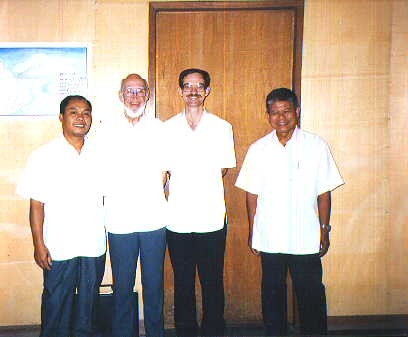
I am reminded of the funeral of another friend a few years ago. My friend and fellow professor at Oro Bible College in the Philippines, Rev. Rustom Marquiño, died after a long illness. Rustom was a great man of God, and one of those people who are full of life – the kind you like to be around. I hated to see him go, and I still miss him.

{The photo is of the male OBC faculty in 1998. Rustom Marquino, Dr. David Dean, myself (Jefferson Vann), and Graciano Villadolid.}

As is the custom in the Philippines, the family asked several different groups that Rustom was associated with to each take a nightly funeral service. As a result, one of the preachers (who probably didn’t know Rustom’s theology) said that Rustom had flown to heaven the moment he died This preacher based that assumption on Acts 7:59, where Stephen prays for the Lord to receive his spirit. The preacher said that Stephen did not go to sleep, he went to heaven. The next day, in class, I asked my students to go to Acts 7:59, and then read the next verse. It says “’And falling to his knees he cried out with a loud voice, “Lord, do not hold this sin against them.’ And when he had said this, he fell asleep.”

The whole point of what Stephen said is that he was trusting Jesus to take care of him until he comes again and raises him from the dead. Jesus said a similar thing at the cross. He was quoting from Psalm 31:5, where David says “Into your hands I commit my spirit; redeem me, O LORD, the God of truth.” David’s assurance was not that death was unreal. His assurance was that when a believer is dead, that believer is in good hands. Death is an end to life. But when God’s hands hold you, there is always hope for new, resurrected life.

Our comfort at the death of loved ones should not be based on fantasy. It should be based on reality. The reality is that death is real. Our only true hope in the fact of that grim reality is that God is true to his word. He will bring the dead back to life again. So, someone who has fallen asleep in Christ is in good hands.

Our trust is not in a theology of human nature. We do not deny the reality and severity of death. Our trust is in a God who is able to keep his promises.

If you have any questions about this teaching, you can ask me at jeffersonvann@yahoo.com. Join me for this entire series as we search the scriptures to learn about the gift of life.

Listen to the audio file at Afterlife.

watch your language

DSCF1938gift of life #16

watch your language

I said good bye to a friend today. And I heard a good solid biblical message at his funeral about the coming resurrection. The preacher said that my friend was asleep. That’s what Jesus said about Lazarus. He told his disciples “Our friend Lazarus has fallen asleep, but I go to awaken him” (John 11:11). Sleep is the most widely used metaphor for death in the Bible.

Some Christians do not watch their language very well at funerals. They talk about death using language that the Bible never uses, and Jesus never endorsed. They speak as if the dead person has travelled to a far-away place. The Christian hope is not going some place. The Christian hope is a someone coming back to us: Jesus himself.

Usually, the dead person has travelled to heaven, and has joined the angels, who are giving thanks to God. But, in the Bible, David said that no one gives God thanks in the realm of death (Hebrew Sheol). David’s plea was for God to keep him alive so that he could continue to send up songs of praise.

Some view death as a release from the prison of the body to enjoy freedom forever. But the Bible places the terminus of rescue and escape not at death, but at the coming of Christ. As tempting as it is to believe that death will bring rescue, the most that we can say biblically is that at death the suffering will end. The rescue comes when the rescuer comes.

Some people think that death is the gateway to the reward that Jesus promised those who are faithful to him. But Jesus says that those who do acts of kindness toward those who cannot repay them will be “repaid at the resurrection of the just” (Luke 14:14). That does not happen at death. It will happen when Jesus comes back to raise people from the dead.

Jesus came to the tomb of his friend Lazarus to give us all a visual demonstration of the resurrection at the last day. His friend had fallen asleep and he purposely waited until that happened. Jesus shouted his friend’s name. “Lazarus, come out.” He didn’t say “come down” because his friend had not gone anywhere. He had simply fallen asleep. The shout from Jesus is all it took to wake him. Someday, you and I will fall asleep. Do not fear. All it will take is a shout from our friend, Jesus, to wake us up again.

It would do us all well if we watched our language when talking about what happens at death. The world is listening, and they need to hear the truth.

If you have any questions about this teaching, you can ask me at jeffersonvann@yahoo.com. Join me for this entire series as we search the scriptures to learn about the gift of life.

Listen to the audio file at Afterlife.

the evolution of the afterlife

DSCF1273gift of life #15

the evolution of the afterlife

In his book, Life After Death: The Evidence, apologist Dinesh D’Souza claims that the Christian doctrine of the afterlife just kind of evolved. He said that at first, Jesus and Paul taught the same doctrine of the believer’s future that the Old Testament teaches: a future that depends on a resurrection. Then, along came some early Christian teachers with an alternative, and chief among them was Augustine. Augustine had been taught the philosophical doctrines of Plato, and so he adopted Plato’s view of human immortality and added it to the teachings of the Catholic Church. As a result, says D’Souza, “Christianity since Augustine does not espouse life ‘after’ death, but rather life ‘beyond’ death” (page 48).

For D’Souza, this is OK. He is apparently comfortable with the idea of theology evolving. Me, not so much. I have to believe that the whole Bible is consistent on the subject of life after death. And I don’t think it is responsible for anybody to teach something different than what is revealed in that Bible, and taught by Jesus and his apostles. That’s not really evolution. It’s syncretism.

I am a conditionalist when it comes to the afterlife. I believe there will be a future eternal life, but I reject what Plato taught. He taught that our future life automatically begins when we die. The Bible teaches that any future life is conditional. It cannot happen unless we are resurrected first. That is why Jesus and Paul only taught the resurrection and did not teach continued existence beyond death. They, too were conditionalists. Their hope was another life after death, not an automatic continuation of life beyond death.

The good news that the Bible proclaims is that through Jesus Christ those who believe in him can have resurrection life after their deaths, when Jesus comes again. One advantage of holding to this good news rather than accepting the counterfeit good news is that it is what D’Souza calls the “official teaching” of the Bible, rather than the popular “alternative, unofficial view.” We conditionalists need never resort to having to prove our view by practical reason and science alone, like D’Souza attempted to do in his book. We have God’s word on it. There will be a resurrection.

Another advantage of proclaiming life after death through the resurrection is that it is actually what people want. As much as a traditionalist might boast about his desire to go to heaven, he will spend his entire fortune to delay the trip. What people really want is to be alive – fully and functionally alive, and to enjoy God and the universe that he created for us. His plan for us is a new heaven and a new earth, restored to its holiness and spiritual vitality. That is our destiny, and it is a certainty for all who are in Christ. But that great event will not happen when we die. It will happen when death dies. It will happen after our Saviour returns. Come, Lord Jesus.

If you have any questions about this teaching, you can ask me at jeffersonvann@yahoo.com. Join me for this entire series as we search the scriptures to learn about the gift of life.

Listen to the audio at Afterlife.

you two point oh

10404313_10152719826176949_4738064153211655456_ngift of life #14

you two point oh

There’s going to be another you, a you after this you – a you two point oh. One of the fundamental truths that we Christians believe is that when Jesus returns, he’s going to raise us from the dead. Your resurrected you will be the same you, but with a very important upgrade. If you are a believer in Christ today, when he returns, he will make you perfect, sinless and immortal.

The apostle Paul explained the details of this you two point oh in 1 Corinthians 15. First, he taught that there is evidence now that our coming upgrade is going to happen. That evidence includes the fact that Jesus was raised from the dead. He’s the first to undergo the upgrade. Another evidence is the fact that the people who knew Christ the best (the apostles) gave their lives to preach the gospel. Another evidence is the change that takes place in peoples’ lives when they give those lives to Christ now. He makes a difference now; we expect him to make a difference then.

Paul even gave us a timetable for the future resurrection in 1 Corinthians 15. He talked about the order of the resurrection, describing it as a great harvest. Jesus was the firstfruits of the harvest, so his resurrection came first (verse 20). Then, when Christ returns, all the dead in Christ will be raised at once, and all the living in Christ will be caught up with them, and together we will all be with the Lord (verses 51-52). Then, there will be a time period in which Christ will reign and put all his enemies under his feet. I believe this time period is the millennial reign (verses 25-26). Finally, after that reign, the end of the harvest will come, the final resurrection of all the remaining dead (verse 24). Here’s why that timetable is important. Christ has promised us a resurrection. The fulfilment of the promise will happen not when we die, but when he returns.

Also in 1 Corinthians 15, Paul described the nature of this resurrection as well. The resurrection is not a re-creation, starting over with all-new materials (and hopefully getting it right this time). No, our upgrade will be the plant from the present seed. It will be a continuation of this life with which God originally intended to bless his universe forever. Sin entered your life and corrupted it, making it necessary for you to die. But God loves you too much to let that be the last note of your song. The resurrected you will be the same you, purged of all those things that cannot exist forever, and transformed into something extraordinary.

Finally, Paul described our present state: “of the dust of the earth” (46), perishable (50), mortal (53). God cannot endure that forever. He plans to purge his universe of the disease that humanity has become, so that it can once again be pronounced “very good.” Your upgrade state is imperishable and immortal. Your upgrade will be you as God intended you to be. Paul described his resurrection chapter as essentially the gospel message that he preached (1-2). It is right for believers to emphasise the benefits we already have because of the death of Christ: forgiveness of sins, permission to approach God in prayer, guidance from the indwelling Holy Spirit, etc. But let us never forget that the gospel is not complete if it stops there. You have not heard the whole gospel if the message you have heard fails to include the promise of the next upgrade.

If you have any questions about this teaching, you can ask me at jeffersonvann@yahoo.com. Join me for this entire series as we search the scriptures to learn about the gift of life.

listen to the audio in Afterlife