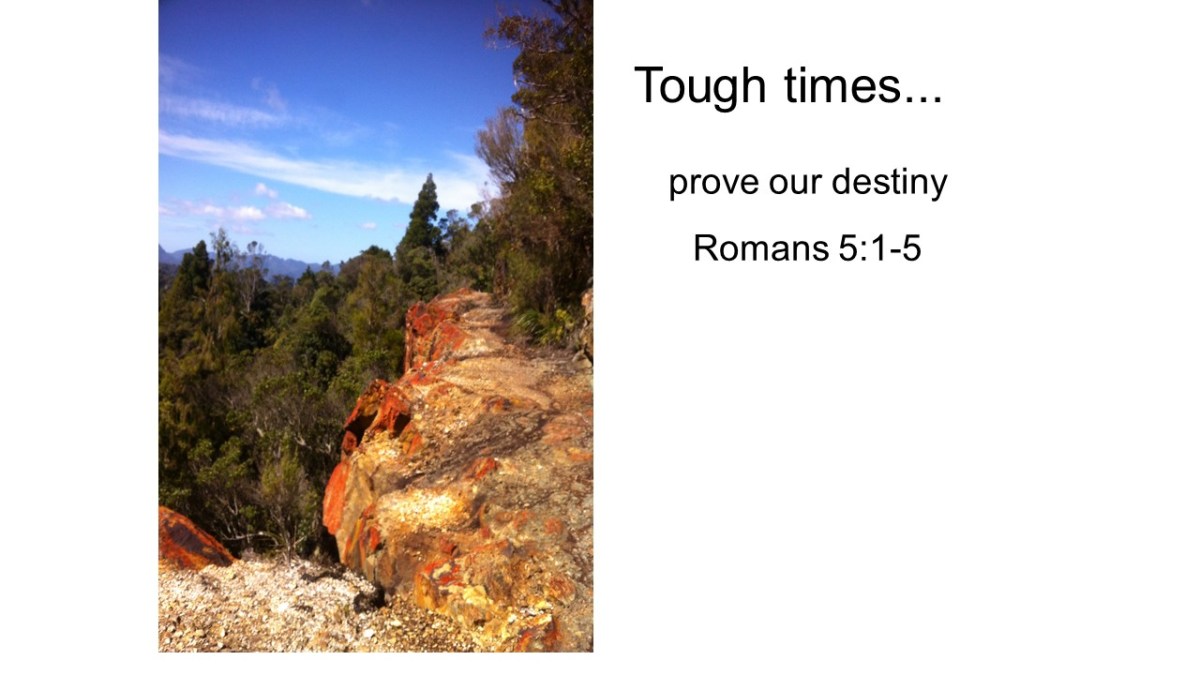
tough times prove our identity

tough-times-prove-our-identity-1

Matthew 13:18-23 (JDV)

18 “So listen to the parable of the planter:

19 When anyone hears the message about the coming kingdom and does not understand it, the evil one comes and snatches away what has been planted in his heart. This is what was planted along the path.

20 As for what was planted on rocky ground, this is the one who hears the message and immediately receives it with joy,

21 yet he has no internal root, so stays true for a while, but when troubles or opposition arise on account of the message, he falls away right then.

22 As for what was planted among thorns, this is the one who hears the message, but the worries of the age and the untrustworthiness of riches choke the message, and it becomes unfruitful.

23 As for what was planted on good soil, this is the one who hears the message and understands it. He really bears fruit and produces, in one case a hundred times as much, in another sixty, and in another thirty.”


Our church has experienced a series of unfortunate events in the past few months. Bad things have happened one after another, and it has caused many of us to rethink our situation. Some of us are wondering whether our church is going to survive, as domino after domino keeps toppling. I think it is appropriate for us to look into the Bible, and see what God has to say about when Christians go through tough times.

This passage is a good one to start with. It is the place where Jesus explains his parable of the soils. The parable itself was used by Jesus to show that there will always be different responses to the gospel when it is preached in the world. Jesus highlights four different responses using the allegory of four soils, and how they affect the seed planted in them.

The first soil he mentions is “the path” which doesn’t really receive the seed at all. The birds come and eat the seed before it has a chance to germinate and start growing. There is no life there. The truth comes and goes without any affect.

The last soil Jesus speaks of is the good soil which produces an abundant crop. This is the ideal.

I don’t want to focus on either one of these today.

In other sermons, I have talked about the four different kinds of response to the gospel, but that is not the direction I want to take today. Instead, I want to talk about the way Jesus describes tough times in this story.


tough-times-prove-our-identity-2

TOUGH TIMES COME TO CHALLENGE OUR FAITH, TO TEMPT US TO DEFECT.

“when troubles or opposition arise on account of the message, he falls away right then” (21).

This is when the tough times come into our lives for the express purpose of destroying our faith, and getting us to deny either God’s existence, or his relevance for our lives.

But I want you to notice the picture that Jesus has painted for us to look at. It is a picture of a crop that spouts up immediately. It is on rocky ground, so there is no internal root, but it looks just like the crop which had spouted on the good soil. When Jesus explains what the picture means, he says that it is people who receive the message of the kingdom immediately and joyfully.

I have seen so many people who appeared to have quickly and dramatically come to faith in Christ, but then just as quickly and dramatically lose all connection with the gospel and the church. That is what Jesus is talking about.

There are two causes for this phenomenon: an internal cause and an external cause. The external cause that Jesus refers to is when someone or something challenges the message of the gospel in your life. That is “when troubles or opposition arise on account of the message.” So, when the enemy of our faith notices that we are taking God’s word seriously, he will send direct challenges to the veracity of that word. But the parable does not say that Satan is directly responsible every time trouble comes into a person’s life. Trouble comes because trouble comes. Opposition arises because the message of the gospel is counter culture. Opposition is a natural thing in this world system. It should not surprise us when it happens.

But Jesus also mentioned the internal cause of defection. The defector “has no internal root, so stays true for a while” … but defects as soon as his beliefs are challenged. In other words, there is no faith there strong enough to overcome the effect of the troubles that Satan or the world sends to destroy it.

I worry sometimes that we tend to idolize people with the wrong kind of faith. Celebrities come along and appear to say something nice about Jesus, and we evangelicals fall all over ourselves to promote them. Then, when Jesus is no longer the flavour of the month for those celebrities any more, we look like idiots.

One thing we can learn from this portion of scripture is that true faith is long-haul faith. Troubles coming into our lives can actually help us to determine if we have that long-haul kind of faith. They can prove our identity as true Christians, because they reveal our roots. If our faith is real, it can withstand the challenges of the opposition.

tough-times-prove-our-identity-4

TOUGH TIMES COME TO CHOKE OUR FAITH, TO DIVERT OUR ATTENTION.

“the worries of the age and the untrustworthiness of riches choke the message, and it becomes unfruitful” (22).

The second way that Jesus describes tough times in this story is by painting a picture of a crop surrounded by thorns, briers, gorse.

This is when the tough times come into our lives for the express purpose of distracting us from the natural process of maturing and bearing fruit as disciples of Jesus Christ.

If the enemy cannot get you to defect, he is going to do all he can to distract you so that you are not productive in your faith.

The devil has two major tools that he uses to divert our attention away from productive Christianity: the worries of the age and the untrustworthiness of riches.

The “worries of the age” can be big things that affect the entire planet, or they can be things that affect us more directly. They can be global warming, or a high fever. They can be war in the middle east or not getting along with your spouse. They can be anxiety over the next political election, or even worrying about money.

The “untrustworthiness of riches” can be anything that is considered valuable that might serve as a substitute for the lordship of Christ and the pre-eminence of his kingdom. We have to seek his kingdom and his righteousness first. If we put anything else first, it becomes for us the “untrustworthiness of riches.” Even if it is a good thing… in fact, especially if it is a good thing.

  • Tolerance of other people’s world-views is a good thing. But if it keeps you from sharing the gospel with them, it has become your chief distraction.
  • Love of your family is a good thing. But if it keeps you from your commitment to your family of faith then it can become your chief distraction.
  • Desire to provide for your family is a good thing. But if it forces you to focus on making money instead of making disciples, then it becomes greed, and your chief distraction.

Those thorn bushes are going to be there. There is no secret weapon that will eliminate them from the patch of land we happen to be planted on. We have to overcome the distraction in order to be fruitful in our Christian lives.

tough-times-prove-our-identity-7

I titled today’s message “TOUGH TIMES PROVE OUR IDENTITY.”

But I do not want to give anyone the impression that I am teaching that having troubles is proof that you are not a Christian. Jesus said this to his followers on another occasion:

“Blessed are you who are poor, …

Blessed are you who are hungry …

Blessed are you who weep…

Blessed are you when people hate you and when they exclude you and revile you and spurn your name as evil…” (Luke 6:20-22 ESV).

That sounds like tough times, and it is actually proof that you are in the sky kingdom, not proof that you aren’t.

If you are a Christian, I want to tell you today that God knows your situation. He is not challenged by your challenges. He has things under control. He does not lack the power to change your circumstances. He may not choose to fix your problems today, and he has every right to make that choice.

But he is the one who planted the seed of the gospel in your life. He knows what you are going through, and he knows that the gospel message inside of you has the power to overcome the obstacles of the day. Those tough times that you are experiencing to not have to lead to defection or distraction. You can still thrive and grow as a Christian. And when you do, the one who planted the gospel in your life will be glorified by your perseverance.

who asked for that?

who asked for that

Who Asked for that?

Isaiah 1:7-15a

7 Your country is deserted, your cities have been burned up with fire; your land: aliens are devouring it in your presence, and it is desolate, as if devastated by foreigners.
8 And the daughter of Zion is left like a hut in a vineyard, like a shelter in a cucumber field, like a city that is besieged.
9 If Yahveh of armies had not left us survivor, we would have been as few as Sodom, we would have become like Gomorrah.
10 Hear the word of Yahveh, rulers of Sodom! Listen, the teaching of our God, people of Gomorrah!
11 What is that heap of your sacrifices to me? says Yahveh. I have had enough burnt offerings of rams and fat, fattened animals and I do not enjoy blood of bulls and ram-lambs and goats.
12 When you come to appear before me, who asked for this from your hand: you trampling my courts?
13 You must not keep bringing useless offerings, incense—which stinks to me; each new moon and Sabbath, each calling of a convocation– I cannot endure iniquity when you assemble.
14 Your new moons and your appointed festivals my soul hates; they have become to me like a burden I am not able to bear.
15 And when you stretch out your hands, I will hide my eyes from you; even though you make many a prayer, I am not listening. (Isa. 1:7-15a JDV)

Isaiah had just revealed to Judah that they were not as healthy as they thought they were. In the next few verses ISAIAH DESCRIBES THE CONDITION OF JUDAH in his time (7-10).

Slide3

a deserted country
burned cities
land devoured and desolate
left like a guard hut after harvest
like a besieged city
almost like Sodom & Gomorrah

This is a challenge from God for us to evaluate our true condition. We must stop deceiving ourselves by claiming normalcy. We need to see beyond the veneer, past the facade.

Secondly, ISAIAH CONDEMNS THE ORGANISED RELIGION OF JUDAH in his time (11-14)

Slide5He calls this religious people rulers of Sodom and people of Gomorrah, and indicates that their religious practices are negatives, rather than positives.

He has had enough offerings
He does not enjoy the blood
He calls it trampling his courts
He calls the offering useless
He says the incense stinks
He says the assemblies are for iniquity
He hates the festivals because they burden him

This is a challenge from God for us to evaluate what wev are doing and why we are doing it. We must stop pretending that if we just do the right thing, that our condition will somehow get better. We need to see beyond what we do.

I once visited a city and did a seminar there. I heard someone describe that city a being full of SEMINARians. In other words, all the church people did was go to seminars. They believed that the key to their success was doing the right thing more often than others. That is not how success is measured in the kingdom.

Thirdly, ISAIAH REVEALS WHAT GOD IS DOING as a result of Judah’s current approach to him through their organised religion (15a).
Slide7

  • He is hiding his eyes
  • He is not listening to their prayersThis is a challenge from God for us to stop doing business as usual. If we think God only responds to our prayers and worship, what happens when we discover that God is no longer listening to our prayers and watching our worship?

    There is nothing wrong with prayer and nothing wrong with worship. But both of these can become worse than useless when coming from the heart of the rebellious and unrepentant. So, Isaiah goes on to reveal the way for Judah to get back on God’s good side. We will explore this next section more in the next sermon in this series. But let me summarise verses 15b-17 here.

    15b Your hands are full of blood.
    16 Wash up! Make yourselves clean! Remove the evil of your actions from before my eyes! Stop doing evil!

    = REPENT

    To repent is to seek God’s cleansing by grace and resolve to stop rebelling against God’s moral law.

    17 Learn to do good! Seek justice! Rescue an oppressed one! Defend an orphan! Plead for a widow!

    = REFORM

    To reform is not to add more rituals to your worship, but to focus on meeting the needs of those around you, and so begin to act like your Father in heaven.

    Without true repentance and reformation, all the religion and prayers and worship in the world is worse than useless.

How is your health?

Slide1

This next series of sermons will focus on some questions we encounter when reading Isaiah chapter 1. The questions are designed to make us a bit uncomfortable, because they expose our reluctance to examine ourselves.
Isaiah 1:1-6

1 A vision from Isaiah son of Amoz, which he saw with reference to Judah and Jerusalem during the reigns of Uzziah, Jotham, Ahaz, and Hezekiah, kings of Judah. 2 Listen, sky, and discern, land, because Yahveh has spoken: I reared children and I brought them up, but they rebelled against me.3 An ox knows its owner and a donkey the trough of its master. Israel does not know; my people do not understand. 4 Wow, sinful nation, a people weighed down with iniquity, offspring of evildoers, children who deal corruptly. They have forsaken Yahveh; they have despised the holy one of Israel. They are estranged and perverted. 5 Why do you want to be beaten again? You continue rebelling. All of your head is sick, and all of your heart is weak.    6 From the sole of the foot and up to your head there is nothing healthy; your bruise and sore and bleeding wound has not been cleansed, and they have not been bound up and not treated with healing oil. (Isa. 1:1-6 JDV)

Slide2

Today’s question is “How is your health?” Are you really as spiritually healthy as you think you are?

Slide3

First Symptom: spiritual dementia (2-3)

2 Listen, sky, and discern, land, for Yahveh has spoken: I reared children and I brought them up, but they rebelled against me.
3 An ox knows its owner and a donkey the trough of its master. Israel does not know; my people do not understand.

Isaiah pictures Judah as having suffered a horrible debilitating disease. He describes the disease as a kind of spiritual dementia, because not only does it cause much physical suffering, it has also caused Judah to forget who she is, where she came from, who she belongs to. Consequentially, she is not aware of the relationship she has with Yahveh, a relationship which would offer her relief, treatment and recovery. The disease goes untreated, and is just getting worse.

Slide4

Second Symptom: psychological aberrations (4)

4 Wow, sinful nation, a people weighed down with iniquity, offspring of evildoers, children who deal corruptly. They have forsaken Yahveh; they have despised the holy one of Israel. They are estranged and perverted.

Yet, if you had asked the average citizen of Judah in Isaiah’s time how his spiritual health is, he would say he is healthy and normal. The first thing to go in them was their since of shame over their own sinfulness. Sin was something that the outsiders did. They saw themselves as a holy island in a sea of corruption. They were the holy nation. But look at how Isaiah described them.

Nowadays, our society is in denial, refusing to categorise anyone as abnormal. In fact, this generation defends anyone who insists he or she be treated just like everyone else, no matter how he or she acts. It is as if the category of psychological deviancy no longer exists. We are like the world that was described in the book of Judges, where everyone does what is right in his own eyes. The result of that kind of aberant behaviour in Judges, and here in Isaiah — is bondage.

Slide5

Third symptom: refusal of treatment (5-6)

5 Why do you want to be beaten again? You continue rebelling. All of your head is sick, and all of your heart is weak.
6 From the sole of the foot and up to your head there is nothing healthy; your bruise and sore and bleeding wound has not been cleansed, and they have not been bound up and not treated with healing oil.

So Isaiah puts his generation onto the scanner, and the results reveal a society that is totally sick, which has refused any treatment. Denying that there is anything wrong, the whole nation — sick in the head, sick in the heart, sick from the foot up to the head — continues to walk around pretending that everything is ok.

Such was the case with the scribes and Pharisees during Jesus’ day.

“When the scribes of the Pharisees saw that he is eating with the sinners and tax collectors, they were saying to his disciples, “Why is he eating and drinking with tax collectors and sinners?” So after hearing this, Jesus says to them, “It is not the ones who have strength who need a doctor, but the ones who are having something wrong with them; I did not come to call upright ones, but sinful ones.” (Mk. 2:16-17 JDV)

Such is the case with the world today as well. We deny that there is something wrong, and we have forgotten that there is a Great Physician who is ready to treat us. We go from bad to worse, refusing to acknowledge that God is ready to undo the damage.

So, here we are, the church of Christ, a hospital for the broken ones, a clinic for those who recognise that there is something wrong with us.

LORD, here we are, checking in to your hospital. Forgive us for denying that we have a health problem, for forgetting that you are the answer to our debilitating disease.

destroy this!

Slide1

John 2:13-22

Joh 2:13 And the Passover that the Jews celebrate was coming, so Jesus travelled to Jerusalem.
Joh 2:14 And He found in the temple the sellers of oxen and sheep and doves, and the moneychangers sitting.
Joh 2:15 And after he made a whip out of cords, he threw them all out of the temple, with the sheep and the oxen; and He poured out the coins of the moneychangers, and flipped their tables;
Joh 2:16 and he said to the dove sellers, “Take these away; stop making my Father’s house a market house.”
Joh 2:17 His disciples remembered that scripture says, “Zeal for your house will consume me.”
Joh 2:18 The Jews responding asked him, “What sign will you show to us, proving that you have the right to do these things?”
Joh 2:19 Jesus responded by telling them, “Destroy this temple, and in three days I will raise it back up.”
Joh 2:20 To that the Jews responded, “It took forty-six years to build this temple, and will You raise it back up in three days?”
Joh 2:21 But he had been referring to the temple which is his body.
Joh 2:22 So, after he had been raised from the dead, his disciples had remembered that He promised this; and they believed both the scripture, and the prediction which Jesus had made. (Joh 2:13-22 JDV)

What does the resurrection really prove? I mean, we Christians make some bold claims about our Jesus, being raised from the dead, and the eternal difference that his resurrection makes. Do we really have any basis for such claims? I want to examine that question this Easter morning, and I have brought along a text of scripture which I think is relevant to the question.

Let me set the stage for the drama we read about in today’s text. The events described in John 2:13-22 take place early in Jesus ministry. It can be a bit confusing, because there was a similar event where Jesus chased out the moneychangers just prior to his crucifixion. But today’s text records Jesus doing this years earlier, when he was still relatively unknown except to his disciples.

Behind the worship in the Jewish temple in Jesus’ day, there had been a long history of a kind of symbiotic relationship between the ministers who worked in the temple and the merchants who kept the system going by providing a means for people to purchase animals for sacrificing — at a tidy profit. The system had worked for a long time, and nobody wanted to change it — except Jesus.

An insult (2:16)

Slide2

Jesus saw the temple market system as an insult to his heavenly Father. The temple was supposed to be a place where people could go and find the glory of God, not the greed of humanity. It was supposed to be a place where God’s covenant loyalty could be seen clearly in spite of the sinfulness and and coveting of the people that he had chosen to save by his grace. Putting a market in the temple was an insult to the character of the God who had chosen to reside there.

Jesus felt that insult more than anyone else because he was the only begotten Son of the Father. He was offended by the audacity of these people and their blasphemous approach to worship. He could not stand there and just take it in. He had to respond, and his violent response was absolutely appropriate. It was appropriate not because violence is always appropriate. No, it was appropriate because of who God is, who Christ is, and what worship is supposed to be.

An insight (2:17)

Slide3.JPG

It was also appropriate because of the response it triggered in his disciples. It was a visual demonstration of Christ’s devotion to his Father’s house, and his Father’s plan. When the disciples saw their teacher flipping tables and chasing away the businessmen from the place they should not have been, they remembered scripture.

Particularly, they remembered this scripture: “Because for your sake I have been disgraced; Dishonour has covered my face. I have become estranged from my brothers, And I am like a foreigner to my mother’s sons. Because zeal for your house has consumed me, And the disgraceful acts of those who embarrass you have fallen on me. (Ps. 69:7-9 JDV)” These words were originally part of a psalm in which David admitted that he had sinned, and that his sin had embarrassed God. David repented, and his prayer in Psalm 69 was that his act of stupidity would not cause true believers to lose their faith in God. Notice the prayer in Psalm 69:6 “Do not let those who put their hope in You be disgraced because of me, Lord Yahweh of armies; do not let those who seek You be embarrassed because of me, God of Israel (Ps. 69:6 JDV). After repenting, David’s only purpose in life was to restore the reputation of his heavenly Father. Now, Jesus’ disciples see him as the coming Messiah David predicted, who would never sin, and whose only purpose in life is to ultimately restore the reputation of his heavenly Father.

Another insult (2:18)

Slide4

The self-proclaimed experts in scripture miss that insight entirely. Instead of seeing what Jesus had done as a fulfilment of scripture, they saw it as a challenge to their own authority. How dare this upstart young prophet come in here on our area of expertise and pretend to tell us what to do! They demand a miraculous sign to prove that Jesus is the Son of the Father he claims to be.

Before we criticise these Jews too much, I want us to be fully aware of what is happening here, because I think we are often guilty of the same thing. The difference is that except for the disciples, these Jews did not know who Jesus really was. They demanded a sign because only the Messiah would have had the authority to come into the temple and change the system.

What is our excuse? I am talking about those times in our lives when things are not going right with us, and we are tempted to just stop believing what we know is true about Jesus. We say he is the saviour of the world, but we often find ourselves coming to him in prayer and saying “just one more sign, Lord.”

Remember what Jesus said about his generation?

“An evil and adulterous generation is asking for a sign, but no sign will be given to it except the sign of the prophet Jonah. Because just as Jonah was three days and three nights in the belly of the sea monster, so will the Son of Man be three days and three nights in the heart of the ground. The men of Nineveh will rise up at the judgement with this generation and condemn it, because they repented when Jonah preached, and see, something much more than Jonah is here. The queen of the South will rise up at the judgement with this generation and condemn it, because she came from the ends of the land to hear the wisdom of Solomon, and see, something much more than Solomon is here” (Matt. 12:39-42 JDV).

I know how hard it is when you keep praying for something and you do not get your answer. But I also know that it is an insult to God to effectively say to Jesus “You died on the cross for me, but I will refuse to believe you until you fix my present problem.” It is better to pray,”Lord, since you died on the cross for me, I know you love me, and I will trust you to bring me through this problem too.”

Another insight (2:22)

Slide5

Jesus knew that the temple officials did not have that kind of trust in him. So he challenged them to “destroy this temple” — something he knew they had no intention to do. He said he could raise it back up in three days. They knew he could do no such thing. It was only years later that the disciples, reflecting on Jesus being raised back to life after three days dead –they finally got it. I can imagine them sitting around talking about the amazing revelations they had seen, and somebody said “Oh, and remember when he challenged the temple officials? He said destroy this temple. He was talking about his body then!

Today we celebrate Easter — the season when we remember that Jesus died on the cross, and then was miraculously raised to eternal life.

Destroy this!

Slide1

What does the resurrection really prove? I am asking again that question I started with. We make some bold claims about our Jesus, being raised from the dead, and the eternal difference that his resurrection makes. Do we really have any basis for such claims? Yes, we do. We have the scriptures. They testified for thousands of years that Jesus would appear, that he would die, and that he would be raised again. When people saw what Jesus did, they recognised him as the fulfilment of those scriptures.

But those scriptures go on to say that the one who was raised from the dead would return to this earth as its rightful king. We have every reason to believe and expect that this same Jesus whom the disciples saw ascend to heaven will return in the same way. After reflecting on the resurrection of Christ, the world is left with only two choices. We can either saw “Now we get it, come Lord Jesus” or we can stubbornly say “prove it again.” May God give us the wisdom to make the right choice.

how faith devotes us

Slide2

I am concluding my series based on the book of Titus today.  Titus is an epistle, and we have seen that its words were first written by Paul to Titus as a sort-of instruction manual for the missions assignment in Crete.  Titus was a younger missionary, and Crete was a hard place to plant the church, so Titus needed all the help and encouragement he could get.

In his epistle, Paul described what the church should be in that hostile environment.  He described church members who were disciplined so that they set the standard for the community around them, and devoted to Christ and the gospel, so that the Cretens would know where the difference came from.

Here is my translation of Titus 3:

1 Keep reminding them to be submissive to their rulers and authorities, to obey them, to be ready to do every good work, 2 to insult no one, to be a non-combatant, to be gentle, and to demonstrate consideration of all people. 3 Because we ourselves were once stupid, disobedient, led astray, slaves to our lusts and various pleasures, spending our lives by being mean and envious, hateful, hating one another. 4 But when the goodness and loving kindness appeared from our Saviour God, 5 it appeared, not because of works done by us in righteousness, but according to his own mercy, by the washing of regeneration and renewal of the Holy Spirit, 6 whom he poured out on us generously through Jesus Christ our Saviour, 7 so that having been declared not guilty by his grace we might become heirs, confident of inheriting eternal life. 8 The word is trustworthy, and I intend for you to insist on these things, so that those who have believed in God may be careful to devote themselves to good works. These things are good and profitable for people. 9 But avoid stupid controversies, genealogies, arguments, and fights about the law, because they are unprofitable and useless.  10 As for a person who causes division, after warning him once and twice, refuse to participate with him, 11 since we know that such a person has been warped and is being sinful; he is self-condemned. 12 When I send Artemas or Tychicus to you, put forth your best effort to come to me at Nicopolis, because I have decided to spend the winter there. 13 Put forth your best effort to support and send Zenas the lawyer and Apollos; so that neither of them lacks the resources to join me. 14 And let our people learn to devote themselves to good works, so they can bring relief in these urgent cases, and not be unproductive. 15 The ones who are with me send greetings to you. Greet our friends in the faith. Grace be with you all.   (Tit. 3:1-15 JDV)

Slide3Just as he did in chapter two, Paul sets the foundation for Titus’ ministry assignment in the gospel message itself.  Nothing that Paul instructs Titus to do is arbitrary.  Everything is based on what God had already done for us in Christ.  Notice the elements of the gospel message here. In theological terms, incarnation, justification, regeneration and sanctification are all works of grace and they are the foundation of the church’s ministry.

Slide4

Now, notice what Paul says the church in Crete should be doing because of what God in his grace had done for them.  The faith that was given by God’s grace should produce a change in inner character and outer relationships.

Even in an environment known for its abuse of authority, Titus was to teach the Cretan believers to submit to those very authorities and obey them.  The reason had nothing to do with the worthiness of the authorities.  It had to do with the task of the church: to demonstrate God’s grace among the unbelievers.  This was the reason that Christ submitted to the earthly authorities.

Also, in a world where you have to look out for number one or you will be stomped on, Titus was to teach the Cretan believers to be considerate and kind to others.  Just like Jesus, who went out of his way to minister to the poor and marginalized, the church was to demonstrate God’s grace by being considerate of and kind to the unbelievers.

When it came top their relationships with each other, the church in Crete was to avoid division and promote unity.  This was another way that they were to stand out among the various brawling groups in Crete.

We could all use a character makeover in the direction of mutual submission, consideration and unity.  But this is especially true for members of Christ’s church, because that is how we demonstrate God’s grace within our context.

Slide5

But let’s not forget the final words of Paul here in Titus.  I know we need to be careful not to read too much doctrine into the travel arrangements that Paul is making for his fellow missionaries.  But I see it as especially significant that Paul slipped so naturally into this subject while he was talking about demonstrating God’s grace as a church.

The missions mandate is present in every gospel presentation.  It is part of every believer’s job description.  The church is made up of those who serve as missionaries, those who send missionaries, and those who support the missionaries and missions work.

  • The servers particularly implied or listed in this chapter are Paul, Titus, Artemas, Tychicus, Zenas and Apollos.
  • The senders particularly implied or listed in this chapter are Paul and Titus.
  • The supporters are Titus and the Cretan believers, whom Paul calls “our people” (14) and “our friends in the faith” (15).

Our church has a long history of missions involvement. We have those who have served, senders, and supporters.  Jesus commissioned his apostles to make disciples of all nations, and we understand that commission as extending down to each disciple and each church.  Our faith directs us into a relationship with God, and also devotes us to reaching others with the gospel.

Slide2

So, there you have it.  The little book of Titus in the New Testament.  It turns out to be more significant that we might have thought.  It challenges us to confirm what we believe by living up to the gospel, and by sharing it with others.