The Gospel of Redemption (Gal. 3:10-14).

Galatians 3:10-14 (ESV)
For all who rely on works of the law are under a curse; for it is written, “Cursed be everyone who does not abide by all things written in the Book of the Law, and do them.” 11 Now it is evident that no one is justified before God by the law, for “The righteous shall live by faith.” 12 But the law is not of faith, rather “The one who does them shall live by them.” 13 Christ redeemed us from the curse of the law by becoming a curse for us- for it is written, “Cursed is everyone who is hanged on a tree”- 14 so that in Christ Jesus the blessing of Abraham might come to the Gentiles, so that we might receive the promised Spirit through faith.

One of the reasons I chose to study the Epistle to the Galatians is that the book clarifies what the gospel message is. It helps believers stay on target, because it explains how our faith in Christ should affect our daily lives.

Galatians introduces us to some theological terms which are very important because they help us to understand what God has done for us, and the difference it makes.

One of those terms is redemption

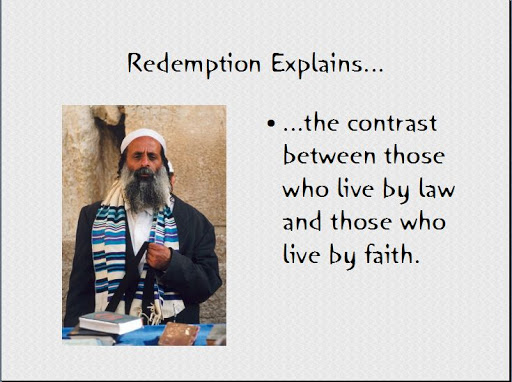
To live by law is to accept some human standard for your way of life, and then just keep plugging at it, and hope that God might accept your best effort.

There are three major flaws in this approach to life:
1) it is self-reliant, and therefore cursed according to Gal. 3:10;
2) it is ignorant of what God requires (the “all things” of vs. 10);
3) it is presumptuous. It presumes that God “grades on a curve.” when in fact God’s standard is his own holiness.

Paul quotes two scriptures in today’s text which lay out the two options everyone has. If we choose option A, we are saying “I can handle this.” It is the law option.

But if we choose option B, we are saying “there is no way I can do this.” We therefore are forced to trust in God’s mercy and put our faith in his works, not ours. That is what it means to live by faith.

What Paul is saying is that everyone – Jew and Gentile, actually choose option A at first. We all like sheep have gone astray. We all wander away from the fold and try to do things our way. even when we realize we are lost we just try harder and keep getting more and more lost.

The end result of our choice is the second death: destruction in Gehenna Hell.

Here again, Paul quotes two Old Testament scriptures to show that redemption frees us from the consequence of making the wrong choice.

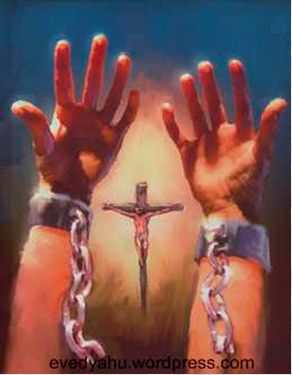
Our self-reliance has put us under a curse. But God chose to offer us all a second chance. If we choose to put our faith in Christ’s sacrificial death we can be redeemed from the curse put on us as lawbreakers.

God made Jesus to be the sin offering, so that by putting our faith in Jesus we might be redeemed and become the righteousness of God (2 Cor. 5:21).

Now we come to the last verse of today’s text, verse 14.

Remember that Paul is dealing with the challenge of a false teaching in Galatians. The “troublers” from Jerusalem have convinced the Gentile Galatians that they need to add obedience to the Mosaic law (as defined by Jewish tradition) to their faith in Christ in order to have the blessing of Abraham.

But Paul’s point is that the blessing of Abraham comes by faith in Christ’s atonement on the cross of Calvary. So one of the consequences of the cross is that the Gentiles are now included in God’s promises to Abraham when they put their faith in Christ.

That blessing includes forgiveness of sins and adoption as sons of God.

Another consequence of the cross is that the Holy Spirit is now available to everyone (Jew and Gentile). Fellowship with the Holy spirit brings power into our lives (Spiritual Gifts) and transforms us so that we manifest the Fruit of the Spirit (sanctified lives).

The Galatians were being tricked into rejecting Christ and going back to the old choice (self reliance) which only leads to sin and destruction.

What about you? Are you trusting in the blood of Christ for your salvation, or are you trying to be good enough for God to save you?

LORD, we hereby renounce the old way of self-reliance, and cling to the cross of Christ. We accept the redemption bought by his blood. We accept your forgiveness and adoption into your family. We accept transformation by your Holy Spirit. Amen

__________________

Communion Meditation: “Redeemed”

Fanny Crosby wrote:
“Redeemed How I Love to proclaim it,
Redeemed by the blood of the Lamb
Redeemed through his infinite mercy
His Child and forever I am.”

I grew up singing that hymn in church, so it has a special place in my heart. Wherever I am, it brings me back to my home church – the church where I came to Christ, and learned to preach.

But we have to be careful with these old songs. They are packed with meaning. This one makes me stop and think: Do I really love to proclaim that I am redeemed?

It means that I have been set free. All around me are folks that are living in bondage: this one to alcohol, that one to hate, this one lust, that one to greed, this one to false gods, that one to legalism.

But I have been set free. I know this because my Saviour, who was never in bondage to anything – paid the price for my freedom by dying on the cross of Calvary.

Back in those days if a person committed a crime he would be sent to prison. Outside his cell they would post a document called a certificate of debt. The certificate of debt had his name on it, the crime he committed, and the number of years, months and days of his sentence. Once he had finished his sentence, they would take that document to a judge. The judge would write on that document “TETELESTHAI” which meant that his sentence was paid in full. Then the inmate could be set free. If anybody questioned him, he could present the certificate of debt as proof that the debt was now paid.

I’m telling you this because Jesus Christ came to the cross in order to cancel our certificates of debt. We owed God far more than we could ever repay with our own works, even if we had a thousand lifetimes.

There he was on the cross, and the onlookers, the soldiers and the Father himself looking down from heaven as he draws his final breaths. He said something. Did you hear it? He said “It is finished.” In Greek: TETELESTHAI. “Paid in Full.”

“Redeemed How I Love to proclaim it,
Redeemed by the blood of the Lamb
Redeemed through his infinite mercy
His Child and forever I am.”

In Honour of David Burge 1968-2010

Funeral Service, Saturday, July 10, 2010

Welcome

Welcome everyone to this special service this morning. At the conclusion of this service you are warmly invited to join the Burge family for a cup of tea and something to eat in the church hall.

Introduction

We have come here today to thank the LORD for the life of David Burge. His was a remarkable life, and even in our grief, we don’t want to forget that he was a wonderful gift from God. We want to thank God for that gift.
We also want to show our support to Dave’s immediate family. We want to stand beside you and share this time with you. We who are here today are but a small percentage of those all around the world who are praying for you. We want you to know that we cared about him, and we care about you.

With any death there can be a sense of unfinished business, things we wish we had said – or hadn’t said. This is a special time and place to say some of the things which we might not want to leave unsaid. This morning is an opportunity for any who want to say some of those things to say them out loud. Some will feel more comfortable saying them before God in their hearts – and that’s OK too.
This is also a time and place for many of us to reaffirm our faith and trust in God. We have to admit that with David’s death that faith has been shaken. But God is our refuge, and by his strength our faith will outlast our grief. We believe in the one who said that he is the resurrection and the life. He proved what he said by being raised from the dead himself. We grieve today because the hurt is real, but we do not sorrow like those who have no hope. Our hope is in someone stronger than our hurt.

Opening Prayer

Heavenly Father, we want to thank you for the 42 years of life that you gave your servant, David Burge. At some point in our lives, we came to know this remarkable servant of yours, and our lives have been blessed forever because we did. He was one of those people that you could always count on for a word of encouragement. He had a down to earth wisdom about him, which was actually a great gift from heaven. He salted everything he said with a most delightful sense of humour. We are going to miss him terribly.

Father, forgive us if there have been times when we have failed David. Enable us by your grace to forgive anything that was hurtful to us. Set us free from our sins, grant us healing and wholeness. Speak to us now through the words we share with one another, and through the words of scripture, the source of David’s faith, that our own faith may be strengthened and renewed. We pray in Jesus’ name, Amen.

Scripture Reading

1 Corinthians 15:50-58 (NIV).
I declare to you, brothers, that flesh and blood cannot inherit the kingdom of God, nor does the perishable inherit the imperishable. Listen, I tell you a mystery: We will not all sleep, but we will all be changed– in a flash, in the twinkling of an eye, at the last trumpet. For the trumpet will sound, the dead will be raised imperishable, and we will be changed. For the perishable must clothe itself with the imperishable, and the mortal with immortality. When the perishable has been clothed with the imperishable, and the mortal with immortality, then the saying that is written will come true: “Death has been swallowed up in victory.” “Where, O death, is your victory? Where, O death, is your sting?” The sting of death is sin, and the power of sin is the law. But thanks be to God! He gives us the victory through our Lord Jesus Christ. Therefore, my dear brothers, stand firm. Let nothing move you. Always give yourselves fully to the work of the Lord, because you know that your labor in the Lord is not in vain.

Message

Some time ago David and Tarnya asked me to share this message. They wanted us to not only celebrate David’s life, but to rejoice in David’s hope – a literal resurrection when Christ returns to this earth.
1 Corinthians 15 was written by the apostle Paul to explain this hope of resurrection to the believers in first century Corinth, but it has a message for believers today as well. It reveals that the present you is only temporary. The real, permanent You is not the present you, but the next You. In 1 Corinthians 15, Paul invites you to look ahead into your future as a glorified saint. He encourages some imaginative personal eschatological thinking. His argument can be summarized as follows:

I. In 1 Corinthians 15, Paul argues that THE NEXT YOU IS GUARANTEED. IT IS BASED UPON HISTORICAL FACTS.
The evidence for the next you includes these verifiable facts:
1) Christ was raised from the dead, and when Paul wrote these words there were still many witness to that fact (3-8); The new Him is proof that there will be a new you.
2) Many have spent their lives preaching the gospel, and if there is no next you, all that preaching is useless (12-15);
3) Millions of Christians have believed in the next you throughout the ages and that faith has changed their lives (17-19);
4) Everyone who is baptised in the name of Christ has demonstrated faith in the next you (29);
5) Everyone who has suffered in ministry has demonstrated faith in the next you (30-32).
Paul’s argument is that every aspect of the Christian faith and life points toward the next you. Every breath you take in this life, every word you say, everything you do, is a precursor to that permanent expression of you-ness in the next life. Rather than implying that this life is meaningless compared to the next, Paul implies the opposite. This life is important because it sets the stage for the main event throughout eternity. The next you will validate the significance of the present you. The present you is an investment in the future you.

II. In 1 Corinthians 15, Paul argues that THE NEXT YOU IS INTENDED BY GOD, AND WILL HAPPEN ACCORDING TO HIS TIMETABLE.

Paul uses the analogy of a harvest to explain the chronological order of the resurrection. The sequence of God’s resurrection/harvest is:
1) Christ, the firstfruits of the harvest (20);
2) Those who belong to Christ (the dead in Christ are resurrected, then the living in Christ are transformed and raptured);
1 Corinthians 15:51-52 Listen, I tell you a mystery: We will not all sleep, but we will all be changed– in a flash, in the twinkling of an eye, at the last trumpet. For the trumpet will sound, the dead will be raised imperishable, and we will be changed.
3) The millennial reign (25-26) during which all of Christ’s enemies will be destroyed;

1 Corinthians 15:25-26 For he must reign until he has put all his enemies under his feet. The last enemy to be destroyed is death.

4) The end (of the harvest) which is the final resurrection of all the remaining dead (24) (see Rev. 20).

1 Corinthians 15:24 Then the end will come, when he hands over the kingdom to God the Father after he has destroyed all dominion, authority and power.
The resurrection, then, should not be just a minor blip on our theological radar screens. It belongs to those events by which God is shaping the destiny of his universe. In his providence, the next you is just as important as creation, the exodus, the incarnation, the cross, or Christ’s resurrection. Seen in that light, your existence today takes on new significance. You may think of yourself as caterpillar-like, but God has planned your butterfly-hood!

III. In 1 Corinthians 15, Paul argues that THE NEXT YOU IS NOT SIMPLY A RESUSCITATION OF YOUR BODY. YOU WILL BE THE SAME PERSON, BUT WITH A NEW GLORIOUS IMMORTAL NATURE.

Paul’s argument is that the next you will be the same you – only different. The seed and plant analogy assures that you will be the same person.
1 Corinthians 15:37 When you sow, you do not plant the body that will be, but just a seed, perhaps of wheat or of something else.

The resurrection is not a re-creation, starting over with all-new materials (and hopefully getting it right this time). No, the seed and plant analogy speaks of a continuation of a life with which God originally intended to bless his universe forever. Sin entered your life and corrupted it, making it necessary for you to die. But God loves you too much to let that be the last note of your song.
The resurrected you will be the same you, purged of all those things that cannot abide eternal existence, and transformed into something extraordinary. The different flesh/ splendour analogies assure that your nature will be different (39-41). The next you will be as different from the present you as humans are different from animals. The difference will be as pronounced as the difference between celestial and terrestrial bodies.

The Adam/Christ analogy explains the essence of that transformation.
1 Corinthians 15:49-50 And just as we have borne the likeness of the earthly man, so shall we bear the likeness of the man from heaven. I declare to you, brothers, that flesh and blood cannot inherit the kingdom of God, nor does the perishable inherit the imperishable.

Your new nature will “bear the likeness” of Jesus Christ! (49). All those inherited predispositions and character flaws and physical defects which identified you with your ancestors Adam and Eve will have been replaced. The stuff that the next you will be made of is described as “from heaven” (49) and “imperishable” (50).
IV. In 1 Corinthians 15, Paul argues that THE NEXT YOU IS NOT JUST AN ADDED BONUS TO YOUR SALVATION, IT IS ABSOLUTELY ESSENTIAL.

Paul describes your present state: “of the dust of the earth” (46), perishable (50), mortal (53). That is not what God wanted. Satan has intervened and tricked humanity into the rebellion that has resulted in the present mortal state. God cannot endure that forever. He plans to purge his universe of the disease that humanity has become, so that it can once again be pronounced “very good.”

Your future state is imperishable and immortal. The next you is more than just a revived you. The next you will be you as God intended you to be. By his death on Calvary’s cross, Christ won the battle which has made the next you possible, but you have not yet received all the spoils of the victory personally.
Paul described his resurrection chapter as essentially the gospel message that he preached (1-2). It is right for believers to emphasise the benefits we already have because of the death of Christ: forgiveness of sins, permission to approach God in prayer, guidance from the indwelling Holy Spirit, etc. But let us never forget that the gospel is not complete if it stops there. You have not heard the whole gospel if the message you have heard fails to include the next you.

The message is an encouragement for all of us, especially at a time like this, because it says that death is real, but it is not permanent. God’s answer to the tragedy that brought us together today is a glorious resurrection. We celebrate that truth today as we say goodbye to our friend David. But let us also remember that “goodbye” is shorthand for “God be with you until we meet again.”
Closing Prayer

Heavenly Father, we thank you for the privilege of having known your servant, David. We thank you for life’s lessons you have taught us through him. We thank you for the example he set for us as a son and grandson, as a husband, as a father, as a friend, and as a pastor. We thank you for the joy he brought us. We thank you for the wisdom he demonstrated.

We thank you most of all for his faith in Jesus Christ, and for the hope that he had that we will see him again one day because of the power and love of Jesus Christ.
We pray once again for all who mourn today. May they sense your arms around them. May they know your support and your healing. Give them assurance that you care for them all the time, and faith and courage for the days ahead. We ask this through Jesus Christ our Lord. Amen.

Committal and Benediction

We all know that David had a disease that he knew was likely to take him in the prime of his life. Before the leukaemia started taking up his time, he had the chance to step back from the busyness of life and concentrate on the things that were important to him. Obviously he spent much of that time with Tarnya and the kids. He also spent a good deal of time putting together some of his thoughts into writing. He has finished some books which will soon be all of ours to enjoy.
But even those months are not enough. It is unfair that we have to say goodbye to David at all. Our only consolation is that we are not saying goodbye for good. We are only saying goodbye for now.

Believing that Jesus is coming back to claim his own, we entrust David to the care of our ever loving God, in the sure and certain hope of the resurrection to eternal life. Our hope is in the Lord, who died, was buried, and who rose again for the forgiveness of the sins of all who believe. To God be the glory forever. Amen.

Responding To A Tragedy (Sunday Message, July 11th, 2010)

Matthew 14:12-14 ESV

And his disciples came and took the body and buried it, and they went and told Jesus. Now when Jesus heard this, he withdrew from there in a boat to a desolate place by himself. But when the crowds heard it, they followed him on foot from the towns. When he went ashore he saw a great crowd, and he had compassion on them and healed their sick.

A brother, a son, a grandson, a pastor, a fellow believer has fallen. David Burge, pastor of this church, has died. He is a victim of a disease, and a victim of the mortality which effects us all. His life in this age, which held such promise for the kingdom of God – is now cut short. How do we as believers respond to such a tragedy?

The enemy rejoices every time a godly man dies. Satan uses tragedies like this to convince people that there is no God – or that he, too is helpless to prevent evil.

Surely there is a better response… a truly Christian response. We cannot allow our shock at this event to blind us to our call. Jesus called us to be perfect just as our heavenly father is perfect. That means responding with faith.

That is what Jesus would do. In fact, that is what he did.
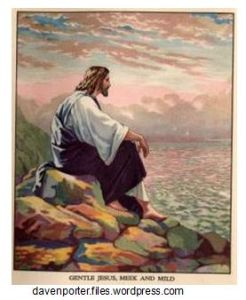
First he withdrew. The maker of all things needed to get away from it all. The Lord of all time needed some time to himself.

Surely we can understand that. John the Baptist was his friend. They shared a love for God and a call to the ministry. They were even related. And John died a death which served no purpose – except to accentuate the absolute futility that death represents. He was a great man – a true believer – a prophet of God. Yet he died because of jealousy and pride. He died because of the lust and foolishness of an irresponsible king.

Jesus knew all things. In his mind he did not have to ask “why?” But in his heart he did. Our Lord needed time to deal emotionally with this senseless tragedy in his life. We are here today because we also need to withdraw. Like the disciples, we need to withdraw with Jesus, not from him. We need to process this terrible event. It didn’t just happen to David, or to his wonderful family. It happened to all of us here. We are still in shock. It’s hard for us to even think about ordinary things. We can only think of the pain, the fear, the distress, the confusion. In a way, we are all still fighting for our lives.

Withdraw with me today. We will go privately to the solitude of our own hearts. And when we get there – we’ll have a little talk with God. Of course, we will not know what to say. Our hurt is too deep for words. But the precious Holy Spirit will be there – to communicate the sorrow we feel. And God will answer. He is there waiting in the church. He may not give an answer for the questions on our minds. But he does have answers for the questions on our hearts.

In his deep sorrow, our Lord looked around him. And what he saw was the crowds that had followed him. He couldn’t get away from it all – because people needed him. When he needed time for emotional healing – the crowds kept seeking him for physical healing. But he didn’t send them away. He had every right to. He was not obligated by any law of man or God to continue working that day.
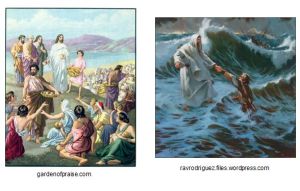
But he chose to continue. He put others’ needs above his own sorrow. He allowed compassion to change his course. That is our Savior. He came to serve, not to be served. Matthew tells us that two great miracles happened that day. Jesus fed the 5000, and he walked on water. But perhaps the greatest miracle of all was our Lord’s decision to do ministry even in his own grief.

David is a servant of Jesus Christ. He died while still working on ministry assignments. He cannot speak to us today. But if he could, he would probably tell us to live as he died. He would want us to never miss an opportunity to serve the Lord by serving others. Perhaps that is the best way for us to deal with our own sorrows.

Our Lord is going to return to this earth one day – probably very soon. When he does return, he wants to find us busy loving and serving and giving. That’s what he is all about. That’s what we are all about. There is a world right here on the shores of our Galilee that needs the compassionate ministry of Christ. When he returns, may he find us sacrificially serving, just as David did… just as Jesus did.

The Gospel Preached to Abraham Gal. 3 1-9

Galatians 3:1-9 ESV
O foolish Galatians! Who has bewitched you? It was before your eyes that Jesus Christ was publicly portrayed as crucified. 2 Let me ask you only this: Did you receive the Spirit by works of the law or by hearing with faith?
3 Are you so foolish? Having begun by the Spirit, are you now being perfected by the flesh? 4 Did you suffer so many things in vain- if indeed it was in vain? 5 Does he who supplies the Spirit to you and works miracles among you do so by works of the law, or by hearing with faith-
6 just as Abraham “believed God, and it was counted to him as righteousness”? 7 Know then that it is those of faith who are the sons of Abraham. 8 And the Scripture, foreseeing that God would justify the Gentiles by faith, preached the gospel beforehand to Abraham, saying, “In you shall all the nations be blessed.” 9 So then, those who are of faith are blessed along with Abraham, the man of faith.


We have been following Paul’s message to the Galatians. So far we have noticed that a key theme to the letter is the Gospel of Salvation by Grace.
In today’s passage we discover that the gospel of which Paul is speaking to the Gentile Galatians was revealed in the Old Testament to Abraham.
Here we see three elements of the New Testament gospel message first revealed to Abraham in the Old Testament.


I draw your attention to what Paul says in verse 1. He makes reference to Christ’s death by crucifixion. Why would he do that in this context?
The death of Jesus Christ was Gods PLAN A for the salvation of humanity. That’s why God revealed this element of the gospel message way back before the law was given through Moses.
He revealed it to Abraham when he commanded him to sacrifice Isaac on Mt. Moriah.


There are several parallels to the crucifixion story here:
1 Abraham was asked to sacrifice his only begotten son.
2 Isaac carried the wood on his back.
3 It was a three day walk to Mt. Moriah (Gen. 22:4).
4 The place where this happened was probably the exact spot where Jesus would be crucified.
5 The ram was provided as a substitute.
6 The place was called “The LORD will provide.” (Gen. 22:14).


Another Part of Paul’s argument to the Galatians is that God’s supernatural miraculous work in their lives is evidence that they have inherited the covenant with Abraham.
Abraham and Sarah were promised that they would have a son when they were both way past their “use by” date. The Bible records that both of them initially laughed at the idea.


Paul told the Galatians that the same God who brought unbelievable miracles into the lives of Abraham and Sarah also has supplied them with the Holy Spirit, and was working miracles among them.
Later in this chapter he says “Christ redeemed us from the curse of the law by becoming a curse for us- for it is written, “Cursed is everyone who is hanged on a tree”- so that in Christ Jesus the blessing of Abraham might come to the Gentiles, so that we might receive the promised Spirit through faith.” (3:13-14).


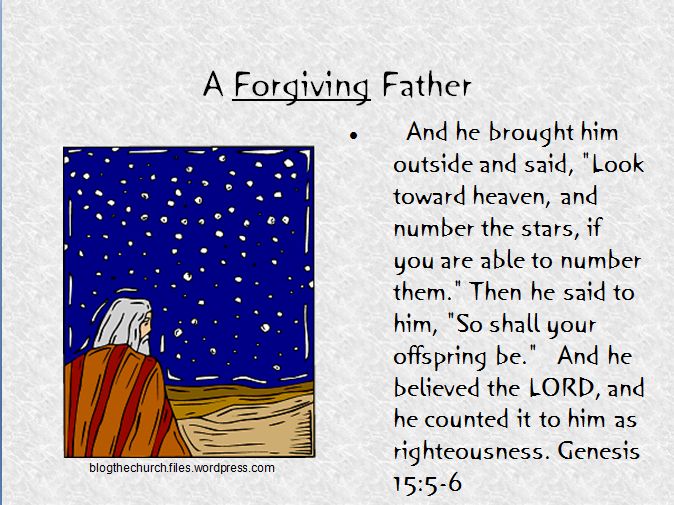
Abraham’s story was also a story of forgiveness… yes, I said forgiveness.
God had originally wanted the entire human race to be his representatives – his children. But sin marred God’s creation and made it impossible for any human being to be God’s child because we all lacked the righteousness necessary to represent him.
God in his grace responded to Abraham’s faith and counted it as righteousness. He forgave Abraham on the basis of the shed blood of Christ, his descendant.


Notice what Paul says about how we are counted children of Abraham:
1) It is through Christ.
Now the promises were made to Abraham and to his offspring. It does not say, “And to offsprings,” referring to many, but referring to one, “And to your offspring,” who is Christ. Galatians 3:16
2) We inherit what God promised Abraham.
For if the inheritance comes by the law, it no longer comes by promise; but God gave it to Abraham by a promise. Galatians 3:18
3) Only those in Christ will inherit what God promised Abraham!
And if you are Christ’s, then you are Abraham’s offspring, heirs according to promise. Galatians 3:29


The author of Hebrews implied that what identified those who had the faith of Abraham was their faith in what God promised him in spite of what their lives were like. They trusted in the One who promised, and died in faith, looking forward to the fulfillment.
The reason Paul brought up Abraham here in his message to the Galatians is that the troublers were trying to get the Galatian Christians to convert to Judaism in order to become heirs of Abraham. But by virtue of their faith in Christ, these Galatians were already heirs with him of all the blessings promised to Abraham.


LORD, help us to trust in you and you alone the way Abraham did.
Help us to trust in you in spite of what happens in this life because we are looking forward to your kingdom to come.
And help us to accept your payment for our sins, your miraculous Holy Spirit and your incredible forgiveness through Christ’s sacrifice.
Help us to hold fast to this gospel, once preached to Abraham, now available to us through Christ. Amen.

A Call for Comprehensive Discipline

1 Corinthians 9:19-27 ESV
For though I am free from all, I have made myself a servant to all, that I might win more of them. 20 To the Jews I became as a Jew, in order to win Jews. To those under the law I became as one under the law (though not being myself under the law) that I might win those under the law. 21 To those outside the law I became as one outside the law (not being outside the law of God but under the law of Christ) that I might win those outside the law. 22 To the weak I became weak, that I might win the weak. I have become all things to all people, that by all means I might save some. 23 I do it all for the sake of the gospel, that I may share with them in its blessings. 24 Do you not know that in a race all the runners compete, but only one receives the prize? So run that you may obtain it. 25 Every athlete exercises self-control in all things. They do it to receive a perishable wreath, but we an imperishable. 26 So I do not run aimlessly; I do not box as one beating the air. 27 But I discipline my body and keep it under control, lest after preaching to others I myself should be disqualified.

I have been studying the commands of Paul to the churches, particularly those that are of a certain structure that allows them to be translated as continuous active commands.

Today’s focus is found in verse 24, where Paul commands the Corinthian believers to KEEP ON RUNNING in order to someday obtain the prize.

In a general sense, Paul seems to be encouraging the Corinthians to live up to their commitment to Christ so that when Jesus returns they will have been found faithful to him, and will inherit eternal life, and a place in the kingdom he will set up on this earth. That is similar to what he told the Colossians when he encouraged them to KEEP ON WALKING (2:6).

I do not think that is all Paul is talking about here.

Notice that Paul has just spent five verses showing that what motivated him was not just getting saved, but bringing others into the kingdom.

His purpose was evangelism. I think that he was trying to motivate the Corinthians to have the same purpose. He wanted them to keep on running the race so that – along with being saved themselves — they could win others to Christ.

Running the race for Paul meant disciplining himself so that he could accomplish the task that he was called to by the LORD.

Now, here is where I think we often get off track as far as evangelism is concerned: We think our goal is to try to win the people within our sphere of influence to Christ. That is true. But we seldom try to expand our sphere of influence so that we can reach others.

From the moment of his conversion, Paul disciplined himself so that he could expand his sphere of influence to the whole Gentile world.

When he encouraged the Corinthians to KEEP ON RUNNING, it was in that context. He wanted them to adopt his attitude of self-discipline for the purpose of evangelism.

If we want to shake the world and gain a harvest for Christ’s coming kingdom we are going to have to be disciplined evangelists as Paul was.

Paul’s use of the command KEEP ON RUNNING suggests that being a disciplined evangelist is not going to be as easy as falling off a log.

For Paul, it means undergoing a transformation much like enduring miltary boot camp. By the time Paul was finished disciplining himself, he had become “servant to all” (19).

He prescribed the same boot camp experience to the Galatians when he told them not to use their freedom as an opportunity for the flesh, but to serve one another (Gal. 5:13). That goes against self-interest. It is hard work.

But the hard work is worth it – not just because you get to win people to Christ, but also because there is a reward at his coming.

Paul called it different things. Here, in verse 24, he called it the prize. He told the Philippians that he presses on toward the goal for the prize of the upward call in Christ Jesus (3:14).

In verse 25 here Paul calls it the imperishable wreath. Wreaths were the world cups of Paul’s day.

Paul also had this in mind when he told Timothy that he expected a crown of righteousness from the Lord when he comes (2 Tim. 4:8).

And Paul is not the only one to encourage believers by declaring that the disciplined Christian life is worth it.

James speaks of the crown of life. He says that God has promised to give that crown of life (which is eternal life itself) to those who love him. But he speaks of this crown in the context of the painful trials we must endure. The prize will come to those who have stood the test.

Peter talks about the unfading crown of glory. He was speaking about being a good leader in the church. If leaders shepherd the flock well, they can expect an unfading crown from the chief Shepherd when he appears.

What James, Peter and Paul knew was that although you can only enter God’s kingdom by grace, you haven’t entered at all unless you are willing to discipline yourself to keep Jesus’ commands.

Jesus said that a person is not fit for the kingdom if he puts his hand to the plow and then looks back (Luke 9:62). He likened his kingdom to a hard day plowing in a field.

Elsewhere he likened it to a narrow gate and a hard road to travel (Matt. 7:14), and a pearl that cost everything you have to possess (Matt. 13:46).

Paul had set his mind on buying that pearl of great price. Physical and mental conditioning and reconditioning was the price he was going to pay.

He endured that discipline regimen so that he remained fit to reach people for Christ .

I want you to notice two words especially as we reread 1 Cor. 9:27. The two words are the two options, if you will. For Paul, it was either discipline himself so that he would be the kind of person who brought others to Christ, or else he would be disqualified.

Paul encouraged the Corinthian Christians to discipline themselves like he did, so that they could gain the results he expected.
Let me now suggest five critical questions to think about as you try to apply this text to your own life and ministry.

1. What kind of person do I need to become to reach my peers for Christ?
2. How can I enlarge the scope of my friendships so that I can influence more people?
3. What aspects of my life are preventing people from getting close enough to me to see Jesus in me?
4. What activities am I willing to surrender to allow time for me to evangelize.
5. What are my gifts and abilities that I can utilize to influence others for Christ.

Previously we had seen Paul encouraging the church to KEEP ON WALKING (Col. 2:6). That command implied that we believers are expected to live according to their profession of faith. In today’s text he changed the metaphor to KEEP ON RUNNING. That metaphor implies that the Christian life is like a race that requires conditioning , self-discipline and endurance.
___________
LORD, help us to KEEP ON RUNNING the race that you have set before us. Help us to make ourselves servants to all so that we may win more people to you and your kingdom.

The Gospel of Faith in Christ

Galatians 2:15-21

“You and I are Jews by birth, not ‘sinners’ like the Gentiles. 16 Yet we know that a person is made right with God by faith in Jesus Christ, not by obeying the law. And we have believed in Christ Jesus, so that we might be made right with God because of our faith in Christ, not because we have obeyed the law. For no one will ever be made right with God by obeying the law.” 17 But suppose we seek to be made right with God through faith in Christ and then we are found guilty because we have abandoned the law. Would that mean Christ has led us into sin? Absolutely not! 18 Rather, I am a sinner if I rebuild the old system of law I already tore down. 19 For when I tried to keep the law, it condemned me. So I died to the law — I stopped trying to meet all its requirements — so that I might live for God. 20 My old self has been crucified with Christ. It is no longer I who live, but Christ lives in me. So I live in this earthly body by trusting in the Son of God, who loved me and gave himself for me. 21 I do not treat the grace of God as meaningless. For if keeping the law could make us right with God, then there was no need for Christ to die. (NLT)

I’d like to start by reviewing what we have seen so far in our study of Galatians.

In the first ten verses of chapter one, Paul sets the tone of the epistle by saying that he is shocked to hear that the Galatians are toying with a false teaching. He set them straight by proving that there is no other gospel.

He spends the rest of chapter one (11-24) explaining the supernatural way that God revealed the gospel message to him. Since the message did not come from man, man has no business changing it.

He begins chapter two (1-10) recounting his visit to Jerusalem fourteen years after his Damascus road experience. His point was that the Jerusalem leaders endorsed his ministry, and agreed that he had been entrusted with the same message.

Then (11-14) he tells about another visit – when Peter visited Antioch. He found that Peter had gotten out of step with the gospel, and rebuked him for it.

Now we come to today’s text, and the final verses of chapter two.

Scholars differ as to who is being addressed by Paul here. Is he continuing his quotation of his rebuke of Peter, or is he now addressing the Galatians? I think this is part of his public rebuke of Peter.

The point he is making to Peter is the reason he is bringing it to the Galatians. Faith in Christ is a choice. If you make that choice, you should live up to it.

You see, some of the Jews in Jerusalem had become syncretistic. That means that they had blended Christianity with their former Judaism beliefs. They thought that they could accept Christ AND trust in their own ability to save themselves by following the Jewish traditions (works of the law).

The Galatians were being fed the same stuff. But when you add anything to free grace it stops being free.

When we Christians declare our faith in Christ it is in Christ alone, not Christ AND.

When we declare that Christ gave himself for us on the cross we are saying that we were sinners, and that we were helpless to do anything to please God. BUT Jesus Christ was not a sinner. He could do something about our sin problem. He did it on Calvary’s cross. His sacrifice was enough to pay the price to set us free.

How tragic it is then, to have and proclaim this great gospel message, and then water it down by saying that God pays more attention to someone who doesn’t eat pork. Our trust is not in something we can do for God. Our trust is in something He did for us.

Dr. Albert Barnes summed up this aspect of the gospel well.

“It is the declared purpose of God to regard and treat those sinners who believe in the Lord Jesus Christ as if they had not sinned, on the ground of the merits of the Saviour.”

His quote does not say everything there is to say about the gospel. But it does cover the key issue that Paul was facing in Galatians.

The issue is how do we live out the truth of the good news of what God has done for us by sending Christ to die on the cross for our sins. People who have put their faith in Christ should trust God to deal with the sin problem his way.

I am NOT saying that believers are under no obligation to prove their faith. What I am saying is that since Christ’s death is the means of our justification, then Christ’s words should be our means of proving our faith.

We should endeavor to live according to the commands of Christ.

Our hope should be based on the promises of Christ.

Paul saw that the Galatians had a serious problem. they had put their faith in Christ, but now they were in danger because someone was trying to convince them to alter that faith. The troublers wanted the Galatians to trust in Christ AND…

But God did not send his only Son to die in our place so that we could trust him AND ourselves.
___________________

LORD, help us to put our faith in Christ alone, and keep our faith in Christ alone.