In Step With The Gospel

Galatians 2:11-14 ESV

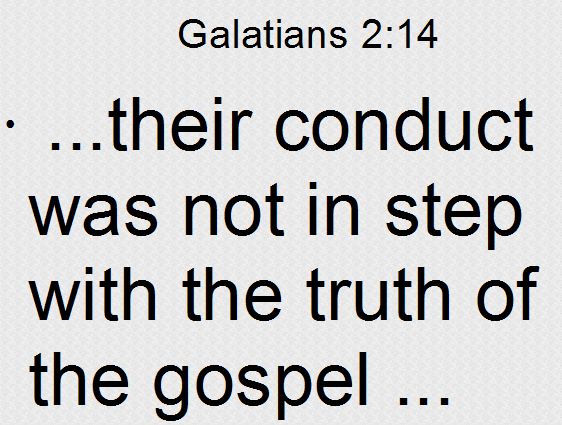
11 But when Cephas came to Antioch, I opposed him to his face, because he stood condemned. 12 For before certain men came from James, he was eating with the Gentiles; but when they came he drew back and separated himself, fearing the circumcision party. 13 And the rest of the Jews acted hypocritically along with him, so that even Barnabas was led astray by their hypocrisy. 14 But when I saw that their conduct was not in step with the truth of the gospel, I said to Cephas before them all, “If you, though a Jew, live like a Gentile and not like a Jew, how can you force the Gentiles to live like Jews?”

In Gal. 2:1-10 Paul explained that the leaders of the Jerusalem Church had approved of his message to the Gentiles, and affirmed that he had been entrusted with the same gospel message as they were.

This week we look at verses 11-14. Here we see Peter taking a trip to the Church at Antioch, a Gentile church which had served as Paul’s launching point.

A problem had developed at Antioch during Peter’s visit. It involved the Jewish believers, whose conduct was suddenly not in step with the gospel.

Things had actually started out very well in Antioch for Peter. He was “going with the flow.”

It was quite different than Jerusalem because this church was predominently Gentile believers.

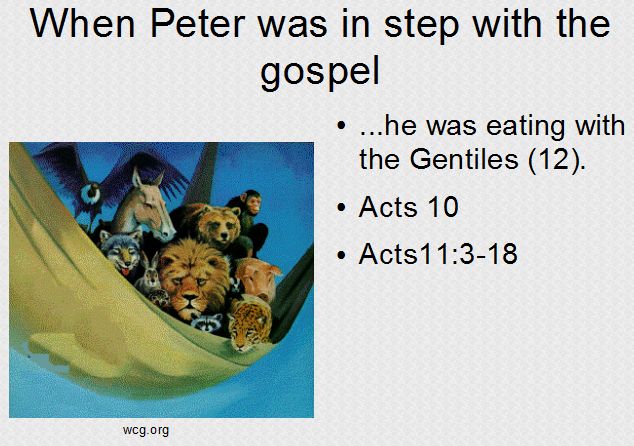
But Peter had already learned God’s lesson that he should not consider unclean what God accepts. God showed him that truth through visions in Acts 10-11.

So Peter fellowshipped freely with the Gentile and Jewish believers alike.

But then the troublers came. These appear to be the same kind of troublers that are threatening Galatia, and that’s why Paul brings up this story.

As soon as the troublers came, they insisted on dividing up the church into the acceptable and unacceptable.

Peter had a choice to make. He could continue fellowshipping freely based on what God had shown him, or he could cave in to the peer pressure.

He made the wrong choice. He drew back and separated himself.

Remember, Peter was a respected leader in the Christian church. As such, his choice was not just an individual choice. It was a leadership choice.

Sure enough, the rest of the Jews acted hypocritically along with him.

Even Paul’s good friend and co-worker Barnabus was led astray by Peter’s actions.

Now it was Paul’s turn to respond. He could have done the same thing Peter did, claiming Peter’s authority. That would have been the easy thing to do.

But there was a lot at stake here. It was not just the traditions of men, whether Jewish or Gentile. The truth of the gospel was at stake.

So Paul publically opposed Peter.

Paul was being a good friend here. All of us are able to make wrong choices which deny what we profess. If that happens, may God give us a friend like Paul, who cares enough to confront us.

This story is included in Galatians because the Galatian believers were being threatened with the same false teaching that the “certain men from James” had with them when they visited Antioch.

The Galatians would have to make the same choice that Peter did. They would have to repent and get back in step with the gospel that they profess.

This story suggests a few principles for living like a Christian in any age.

When you and I gave our lives to Jesus Christ, we accepted the gospel of the kingdom, and agreed to live by its principles.

Are we still living by those principles? Have we taken on any new habits and practices since then?

__________________________________
LORD, help us to examine ourselves to see if we are still living by the gospel that we accepted when we first came to you.

Entrusted With The Gospel

Galatians 2:1-10 ESV
Then after fourteen years I went up again to Jerusalem with Barnabas, taking Titus along with me. 2 I went up because of a revelation and set before them (though privately before those who seemed influential) the gospel that I proclaim among the Gentiles, in order to make sure I was not running or had not run in vain. 3 But even Titus, who was with me, was not forced to be circumcised, though he was a Greek. 4 Yet because of false brothers secretly brought in- who slipped in to spy out our freedom that we have in Christ Jesus, so that they might bring us into slavery- 5 to them we did not yield in submission even for a moment, so that the truth of the gospel might be preserved for you. 6 And from those who seemed to be influential (what they were makes no difference to me; God shows no partiality)- those, I say, who seemed influential added nothing to me. 7 On the contrary, when they saw that I had been entrusted with the gospel to the uncircumcised, just as Peter had been entrusted with the gospel to the circumcised 8 (for he who worked through Peter for his apostolic ministry to the circumcised worked also through me for mine to the Gentiles), 9 and when James and Cephas and John, who seemed to be pillars, perceived the grace that was given to me, they gave the right hand of fellowship to Barnabas and me, that we should go to the Gentiles and they to the circumcised. 10 Only, they asked us to remember the poor, the very thing I was eager to do.

We have seen how Galatians focuses on the gospel message. In 2:7, Paul says that he has been “entrusted with the gospel.”

The same is true of you and me. We have been entrusted with the gospel message.

The challenge for us is to keep faithfully proclaiming the gospel as Paul did.

The reason Paul could keep proclaiming the gospel is that he was not ashamed of it. He believed that it is God’s power for salvation (Rom. 1:16).

Of course, God does not want us proclaiming his truth if we do not back it up by living right.

Paul tells the Philippians “…let your manner of life be worthy of the gospel of Christ” (Philippians 1:27).

Sometimes the things that we do speak so loudly that people can’t hear the words that we say.

The answer is not to stop proclaiming the gospel, but to proclaim it faithfully. Otherwise we will have been running in vain.

Paul asked the Ephesians to pray for him that “words may be given to (him) in opening (his) mouth boldly to proclaim the mystery of the gospel” (Ephesians 6:19).

If Paul needed that, then surely you and I do as well. In fact, this should be a part of our regular prayers for each others.

Instead of just praying “God bless so and so” let’s pray that God give so and so opportunities to share his faith.

For Paul, being entrusted with the gospel also meant that he had to speak out against the troublers that he had referred to in 1:7.

These troublers were not just people with a different theological point-of-view. They were espousing an entirely different kind of salvation.

We need discernment so that we don’t get hung up on petty theological differences. If we do that, noone will listen when we seek to defend the gospel.

The fact is – there are a lot of people out there who just do not understand the gospel message.

Paul says that “the god of this world {Satan} has blinded the minds of the unbelievers, to keep them from seeing the light of the gospel of the glory of Christ, who is the image of God. ” (2 Corinthians 4:4).

There were some unbelievers in Jerusalem who were more concerned with the fact that Titus was uncircumcised that the fact that he believed in Christ. Paul refused to give in to their blindness because the integrity of the gospel was at stake.

For Paul, being entrusted with the gospel meant that he had to use the methods that worked best to minister the gospel.

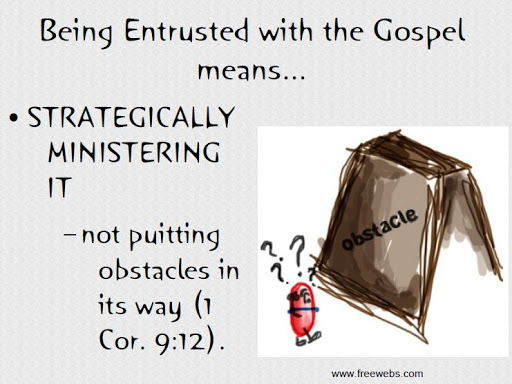
In 1 Cor. 9, he argued that he and Barnabus had the right to be paid for their missionary work, but that they waived that right and supported themselves because they would “endure anything rather than put an obstacle in the way of the gospel of Christ.” (1 Corinthians 9:12).

We need to stop and ask ourselves if what we are doing is accoplishing the task that we want done. If it is not, then we need to have the courage to change. Otherwise, our traditions might be keeping people out of the kingdom.

Paul had a strategy. He would plant churches wherever he went, and leave one of the missionaries who were with him to continue establishing those churches, and he would continue to stay in touch by e-mail (that is Epistle-mail).

For example, he told the Thessalonians that he “sent Timothy, our brother and God’s coworker in the gospel of Christ, to establish and exhort you in your faith” (1 Thessalonians 3:2). He had also sent Timothy to Ephesus for the same purpose. My point is that Paul’s strategy worked for spreading the gospel.

When he was encouraging the Ephesians to have an active prayer ministry, he reminded them that they should also be “wearing for shoes on (their) feet the eagerness to spread the gospel of peace” (Eph. 6:15 NJB).

A strategy is only as good as the willingness of all involved to operate according to the strategy. Paul’s method for reaching the Gentiles with the gospel depended on every believer being eager to spread the gospel, not just every missionary or every minister.

Each of us have been entrusted with the gospel.

Each of us has a sphere of influence to whom we have been called to share the gospel.

No one can reach your sphere of influence like you can. Not your pastors, not your elder, …only you.

____________________________________

LORD, give us all the courage to faithfully proclaim the gospel you have entrusted us with. Give us the strength to defend it against attack. Give us the wisdom to minister it with methods that work, because eternal lives are at stake.

June 2010 Newsletter from the Vanns in New Zealand

You have reached the Newsletter of Jeff and Penny Vann, missionaries with Advent Christian General Conference, currently serving in New Zealand as pastors-at-large with the Advent Christian Conference of New Zealand (ACCONZ). We serve as teaching pastors at Takanini Church of Christ, and Christian LIFE Church, Takanini, Auckland.


photo by Jachin Mandeno

Our friend and fellow pastor David Burge continues to struggle with Leukemia, and is in the hospital for treatments often. He is no longer a candidate for bone marrow transplant, and his doctors are now merely trying to prolong his life. Please continue to pray for a miracle -his complete recovery.

Since Jeff and Penny have been here to take on the preaching and teaching duties at David’s church, he has been busy enjoying life with his wife and children. He is also completing a number of writing projects in which he has invested a great deal of time. Jeff is also serving as editor on some of those projects, and enjoying that task emensely.

You can follow David’s progress at this site: http://davidburge.wordpress.com/


photo by Jachin Mandeno

Jeff has been preaching two concurrent series on Sunday mornings. Galatians: The Gospel of Salvation by Grace is taking the Takanini congregation through the book of Galatians (a chapter a month). Keep On is a series of sermons based on Paul’s commands encouraging the churches to persevere in doing the right thing. Presentation slides,notes and .pdf files of these sermons are available at Jeff’s current web log: http://jeffersonvann.blogspot.com/

This month Jeff begins a new course on New Testament Greek which meets every Thursday night at the church lounge. The course is being scaled back to meet the needs of home-schoolers, but is available for anyone who would like to study God’s word in one of its original languages.

So what has Penny been doing? She handles communion almost every week. She is also getting ready to teach a seminar on the Old Testament.

Our Kids:

Naomi, our youngest, is staying the summer with Liz. She is planning on getting a Summer job there but as of this writing has not been able to. Please pray she can find one.

Connie: Is expecting a baby, so we will have another grandchild soon.

Liz: Just finished teaching another year of school.


We plan a short trip to the South Island June 29th-July 2nd to visit some friends we met while Jeff was at Gordon-Conwell seminary. We’ll probably see snow there.

Please Pray:

1)For Penny as she is rarely busy. After so many years of teaching full time,the down time is very hard.
2)The Takanini church as they adjust to two Americans on their pastoral team.
3)David Burge’s recovery.
4)Our safety as we visit our friends on the South Island.

A Call for A Consistent Walk

Ephesians 5:15-17 ESV

15 Look carefully then how you walk, not as unwise but as wise, 16 making the best use of the time, because the days are evil. 17 Therefore do not be foolish, but understand what the will of the Lord is.

Today’s text is just three verses in Ephesians in which the apostle Paul encourages the believers in Ephesus to take a long and careful look at what kind of life they were living.

A very literal translation of the first few words in the text would read “Look carefully how you are walking.” Those words bring two images to my mind.

First, I see a foolish walk. That’s a walk that pays no attention to the obstacles in the path, and therefore is constantly stumbling,.

Second, the wise walk isstraight, careful, and safe.

Paul told the Ephesian believers that before they came to Christ they “… were spiritually dead because of (their) disobedience and sins. At that time (they) followed the world’s evil way; (they) obeyed the ruler of the spiritual powers in space, the spirit who now controls the people who disobey God” (2:1-2).

Their lives had been characterized by sin, conformity to the world, and lack of self-control, because Satan was in control. The world calls it walking in freedom. God calls it walking in foolishness.

Paul had warned the Ephesians not to walk as the Gentiles did, “in the futility of their minds.”

In other words, the Gentiles were following a path, but not giving any thought to where that path would lead. Their feet were moving, but their minds were not there.

When you do that, the least that can happen is that you get lost. To be lost means more than the fact that you are not yet saved. If you stay lost, something dangerous is likely to happen.

Paul said that unsaved are “darkened in their understanding.” This is true regardless of their academic status: they can be doctors or deadbeats.
Their darkened minds do not show up in an IQ test. What reveals a darkened mind is failure to consider God and his ways. That explains how a person can have a brilliant mind and still live an ungodly life. His mind is not disciplined in the right direction. It’s like a spiritual autism. The mechanics are still there, but the relationship is missing.

Paul said that unbelievers are “alienated from the life of God.” Some important connections are missing, and so the life does not work right.

We were not created to act independent of our creator. Genesis tells us that in the garden of Eden, God made regular visits with Adam and Eve. They received guidance and support from him during those visits. After they sinned, God not only banished them from the garden, he also ceased to regularly visit them. The alienation began there.

This alienation is both the cause and the result of ignorance due to hardened hearts.

Now we come to the other option. Paul was encouraging the Ephesians to walk the wise walk. He said that Christians “are his masterpiece, created in Christ Jesus for good works that God prepared long ago to be our way of life” (2:10 ISV).

The wise walk is what we were born again for. It is the first stage of our eternal inheritance – the stage we can take advantage of now. Through this walk, the church is now manifesting God’s wisdom to “…the principalities and powers in heavenly places” (3:10 KJV).

The wise walk is also the way to keep peace in the fellowship. If there is one thing that will destroy a church faster than a fire it is disunity in the fellowship. Paul encouraged the Ephesians to adopt attitudes toward each other that would maintain unity amid a diverse body. That is the secret. It is not developing a doctrine that everyone can support. It is making the unity itself the thing that the church is eager to defend.

Paul encouraged the Ephesians to walk in love as Christ loved us. The love walk that Christ walked took him from heaven to a manger in Bethlehem.

It was a walk in which he “made himself nothing” so that we could become something.
We must be willing to humble ourselves so that God can use that witness to reach someone who needs him.

The wise walk is also centered on God’s will. But in the Bible, the concept of God’s will can mean two things:

It can mean God’s divine sovereign plan. This is the will of God that is going to happen in the future. It is sure because God has planned it, and he cannot fail in any of his plans. But we usually do not know this will.

The will of God that we can know is his desire: what he wants to happen. The Bible reveals this will of God, so we can know it. More importantly, it is this will of God that we are to walk according to.

“Look carefully how you are walking” Paul tells the Ephesians. That’s our challenge as well. We need to be walking the wise walk, not the foolish walk.

_____
Father, give us the courage to walk the wise walk, and KEEP ON walking it consistently – so that the world may know that we are following Christ. May they follow us all the way to Him.

A Call for Continuous Action

Colossians 2:1-7 ESV
“For I want you to know how great a struggle I have for you and for those at Laodicea and for all who have not seen me face to face, 2 that their hearts may be encouraged, being knit together in love, to reach all the riches of full assurance of understanding and the knowledge of God’s mystery, which is Christ, 3 in whom are hidden all the treasures of wisdom and knowledge. 4 I say this in order that no one may delude you with plausible arguments. 5 For though I am absent in body, yet I am with you in spirit, rejoicing to see your good order and the firmness of your faith in Christ. 6 Therefore, as you received Christ Jesus the Lord, so walk in him, 7 rooted and built up in him and established in the faith, just as you were taught, abounding in thanksgiving.”

Christ saved Paul by grace on the Damascus road also called him to a life of continuous activity.

Paul became one of those early Christians whose constant effort led to overturning the known world.

When we turn to the epistles (letters written by Paul to the churches he planted and coworkers he sent) we find Paul constantly encouraging believers to work just as hard as he did.

The casual reader of an English translation of the New Testament can often miss when Paul is emphasizing this fact. This is due to the fact that English translations do not accurately translate a particular grammatical structure that is found throughout Paul’s writings. It is called a Present Active Imperative, and translates as a call to continuous action.

Walking is a metaphor for how we live your lives. Here Paul is saying that it is not enough just to accept Jesus as our Savior. We have to live our lives according to the reality that we are now saved by Him.
This command was important for the Colossians because false teaching was beginning to spread throughout the churches. That false teaching implied that getting saved was OK, but in order to really impress God with your spirituality, to get on God’s good side, and to open the door for supernatural power, believers needed to add something else besides faith in God’s grace.

Having grown up as a legalist, Paul recognized that these prohibitions were not from God. The gospel is supposed to set us free. Paul is telling them not to get sidetracked by legalism.

The first century Colossians are not the only ones who are tempted to replace the gospel of grace with a law code. Whenever we as Christians today define our Christianity by what we do not do, we are in danger of doing the same thing. I think that the reason much of the modern world has rejected Christianity is that we have fallen into the same trap.

Paul wanted the hearts of the Colossians to be encouraged. One of the first signs of depression is that you stop doing things that you are used to doing. Paul wanted to spur the Colossians on to keep on living the life of children of God. It is easy to give up when you fail to see regular signs that what you are doing is accomplishing something.

Now, here is a key to this whole idea of continuous activity. Keep obeying God, and he will eventually bless what you are doing. Stop obeying God and the power flow will eventually cease. When the power flow ceases, discouragement is the result.

That is where the Colossians were at. They were discouraged because they had rested on the fact that they were saved, and failed to keep on living that salvation.

I cannot help but believe that many in our churches today are in the same place. The solution is to live our lives by faith in the same grace that saved us. People who live those kinds of lives are obedient to Christ. This may sound like a contradiction but it is not. Grace and obedience are not opposites. A life lived by grace is one of continuous activity!

I keep hearing the same complaint from many churches: “we are not united.” Paul gave this command in order that the Colossians might be “drawn together in love” (2).

This tells me that we are not going to be unified if we only try to come together doctrinally. There are always going to be differences in how we understand God’s truth – even if we all agree that that truth comes from the Bible. Unity is going to happen when we all start obeying the same truth.

Notice how Jesus prayed to the Father for the Church’s unity:

John 17:23 “I in them and you in me, that they may become perfectly one, so that the world may know that you sent me and loved them even as you loved me.”

How are we going to demonstrate that God loves us in the same way as He loves Christ? We will do this when we live the life that Jesus lived. Our unity needs to be one of action, not just words.

How can we be sure that our activity is the right kind of activity?

First, everything we do must be something Christ would do. Our actions must be rooted and built up in him. A good way of insuring that we stay in him is intentionally learning his specific commands.

Second, must must not do anything that contradicts what we profess. Our actions need to be established in the faith. When the Bible talks about “the faith” it is referring to what we believe and teach. That’s why Paul adds the phrase “just as you were taught.”

Third, Paul adds that we should abound in thanksgiving. He didn’t say that we had to be successful in everything we try to do. He didn’t even say that it has to cost a lot of money. He just reminds us that it doesn’t hurt to be grateful, to thank the Lord while we keep on walking.

God has planned for Christ to live his life through us. When we do nothing, we fail to demonstrate Christ’s life.

As we keep on walking in Christ, what God has revealed about him is going to become more and more real to us. Paul likens it to a treasure storehouse. The more we walk through the storehouse, the more treasures we see.

I believe the way this process works is this: God has revealed what he wants us to do by his new covenant commands found in the New Testament. To the extent that we continuously obey those commands, God is going to keep giving us glimpses of his plan for our lives.

Obedience to the commands that we know can guard us against being deceived about those matters in which we do not know.

Satan has a number of weapons that he uses against believers, and one of them is deception. Paul said that he “disguises himself as an angel of light” (2 Corinthians 11:14). If he showed up like in the cartoons, with the red pajamas and pitchfork, we would always know it was him. But he enters into our conversations around the dinner table. He inserts himself into a television news broadcast.

How can we keep ourselves from being deceived by Satan’s “false arguments?” First, stay in the word of God. Regular Bible reading can keep you from counterfeit doctrine just like being familiar with real money can keep you from accepting counterfeit cash.

But another way of avoiding deception is staying busy doing what you know for sure is God’s will. When the believer stays continuously active, living the life of Christ, he has no time for doctrines of demons.

What we need in this world today is Christians who dare to live like Christians, and keep on living like Christians until they change their communities, counties, states, and nations.
________________
LORD, help us to learn how to keep on walking in you, so that you can use us to transform the places where we walk. In Jesus’ name. Amen