everlasting

IMG_0368gift of life #18

everlasting

There are basically three views of final punishment debated among Christians. Two groups believe that God has created everyone with immortal souls. One group believes that in hell, God will keep punishing the souls of the lost forever because he cannot destroy them. This is what I call the traditionalist view. Another group says that God will destroy the sin, and eventually restore all the souls, so that no one will be lost forever. That is the view I call universalism. Traditionalists and universalists both agree on one thing: the immortality of the soul. They disagree over the meaning of hell itself. Traditionalists see hell as a perpetual process, while universalists see it as an event with everlasting results.

We conditionalists agree with universalists in that we see hell as an event with everlasting results, not a process which has to go on perpetually. We disagree with both groups in that we find no biblical justification for innate immortality. We believe that hell will involve real destruction, and that destruction will be everlasting.

The Greek adjective used to describe hell most in the New Testament is aionios, and that word is better translated everlasting, not eternal. It refers to the permanence of a result, rather than the continuous duration of a process.

Paul used this word aionios three times in his second letter to the Corinthians, and each use demonstrates that meaning.

  • In 4:17, he compared our present slight momentary affliction to our future everlasting weight of glory.
  • In the next verse, he compares the everlasting things to come that we cannot see now to the temporary things that we can see.
  • In 5:1, he compares our future everlasting body in the sky to our temporary tent of a body that we have now.

Now, the traditionalists look at that evidence and they say “see, hell is everlasting, so people will continue to suffer in it forever.”

No, when Paul used the word aionios to describe hell he said that the lost: “will be punished with everlasting destruction” (2 Thessalonians 1:9). That is not an on-going process. It is an event which has everlasting results.

So, when we conditionalists say that hell is everlasting, we affirm just what Paul did. It is God’s real solution to the problem of sin. Sinners will be destroyed, and that destruction will be everlasting.

If you have any questions about this teaching, you can ask me at jeffersonvann@yahoo.com. Join me for this entire series as we search the scriptures to learn about the gift of life.

Listen to the audio at Afterlife.

in good hands

menfac98gift of life #17

in good hands

Last session I mentioned that I had just come from a friend’s funeral, and the preacher watched his language and did not stray away from the Bible when he talked about my friend’s death. That’s not always the case. Sometimes, seeking to comfort the grieving, people say the most unbiblical things.

I am reminded of the funeral of another friend a few years ago. My friend and fellow professor at Oro Bible College in the Philippines, Rev. Rustom Marquiño, died after a long illness. Rustom was a great man of God, and one of those people who are full of life – the kind you like to be around. I hated to see him go, and I still miss him.

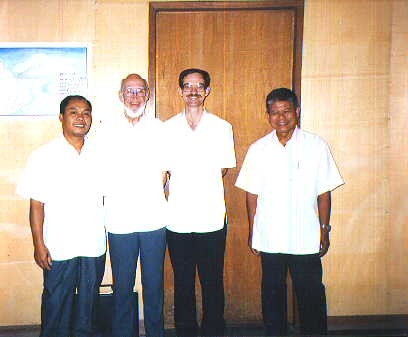
{The photo is of the male OBC faculty in 1998. Rustom Marquino, Dr. David Dean, myself (Jefferson Vann), and Graciano Villadolid.}

As is the custom in the Philippines, the family asked several different groups that Rustom was associated with to each take a nightly funeral service. As a result, one of the preachers (who probably didn’t know Rustom’s theology) said that Rustom had flown to heaven the moment he died This preacher based that assumption on Acts 7:59, where Stephen prays for the Lord to receive his spirit. The preacher said that Stephen did not go to sleep, he went to heaven. The next day, in class, I asked my students to go to Acts 7:59, and then read the next verse. It says “’And falling to his knees he cried out with a loud voice, “Lord, do not hold this sin against them.’ And when he had said this, he fell asleep.”

The whole point of what Stephen said is that he was trusting Jesus to take care of him until he comes again and raises him from the dead. Jesus said a similar thing at the cross. He was quoting from Psalm 31:5, where David says “Into your hands I commit my spirit; redeem me, O LORD, the God of truth.” David’s assurance was not that death was unreal. His assurance was that when a believer is dead, that believer is in good hands. Death is an end to life. But when God’s hands hold you, there is always hope for new, resurrected life.

Our comfort at the death of loved ones should not be based on fantasy. It should be based on reality. The reality is that death is real. Our only true hope in the fact of that grim reality is that God is true to his word. He will bring the dead back to life again. So, someone who has fallen asleep in Christ is in good hands.

Our trust is not in a theology of human nature. We do not deny the reality and severity of death. Our trust is in a God who is able to keep his promises.

If you have any questions about this teaching, you can ask me at jeffersonvann@yahoo.com. Join me for this entire series as we search the scriptures to learn about the gift of life.

Listen to the audio file at Afterlife.

the message is ministry

IMG_0203The word gospel is usually translated “good news.” It can also be translated “excellent message.” I like that translation because it helps me to realise how important sharing the message about Christ is. There are any number of good things I can do for others as part of my ministry.  But the most important thing is to get this excellent message to them.

Mark started his Gospel with the words “This is the beginning of that excellent message about Jesus Christ (1:1).” From then on, any biography of Jesus was called a Gospel. But Mark was not using the word to indicate a new literary genre.[1] He was talking about the unique message about Jesus that John the Baptist started preaching, and he was essentially saying “now here’s my take on that excellent message.” It is like Mark was also challenging me to write a Gospel according to Jefferson Vann. Of course, I was not there to write the beginning of the message, but that message has impacted me, so I get to help pass it on.

Jesus himself preached that excellent message, and commanded others to believe it (1:14-15). To believe the message is to believe in Christ himself. You haven’t really repented unless you do. To believe that message is to take up your cross and have your soul put to death for it (8:34-35). It is worth leaving your family behind for (10:29). It’s worth more than simply liking it when someone posts it on a social network. It’s worth giving everything for.

The mission of reaching the nations with this message is so important that Jesus promises not to come back to earth until it is done (13:10). All those stories in the New Testament will be told to the whole world (14:9; 16:15) as a witness to everyone of the impact that Jesus had when he came to visit this little planet. The message includes what Jesus did and what he taught his followers to do. So, each generation needs to ask whether we are doing things that spread the message or stifle it.

Each church needs to ask a similar question. Lots of things are being done, and money spent on “missions” projects that have little to do with giving the excellent message to those who have not heard it. We used to invest lots of money in these strange animals that we called missionaries. The missionaries would leave their home country and invest themselves in the lives of people in another culture in order to get the message into that culture, and establish proclamation posts (churches) in that target culture. I know that still can happen. I am a missionary myself. But the club is not a very popular one in this generation.

Now, I know I’m being simplistic. Ministry in the name of Jesus is more than just sharing the message about Jesus. When the world looks at a church which just preaches, they see a museum exhibit with a caption underneath “archaic and soon to be extinct.” We owe it to our neighbours to love them as we love ourselves, which will mean feeding them when they are hungry, and helping them heal when they are broken. There is a lot of ministry that we can do, and we should do in the name of Christ. I think the pendulum has begun to swing back in the direction of serving others in this generation, and that is a good thing. But we should not lose sight of the message completely as we minister. The message is ministry.


[1] R.T. France, The Gospel of Mark: A Commentary on the Greek Text. (Grand Rapids: Wm B. Eerdmans Publishing, 2002), 4.

watch your language

DSCF1938gift of life #16

watch your language

I said good bye to a friend today. And I heard a good solid biblical message at his funeral about the coming resurrection. The preacher said that my friend was asleep. That’s what Jesus said about Lazarus. He told his disciples “Our friend Lazarus has fallen asleep, but I go to awaken him” (John 11:11). Sleep is the most widely used metaphor for death in the Bible.

Some Christians do not watch their language very well at funerals. They talk about death using language that the Bible never uses, and Jesus never endorsed. They speak as if the dead person has travelled to a far-away place. The Christian hope is not going some place. The Christian hope is a someone coming back to us: Jesus himself.

Usually, the dead person has travelled to heaven, and has joined the angels, who are giving thanks to God. But, in the Bible, David said that no one gives God thanks in the realm of death (Hebrew Sheol). David’s plea was for God to keep him alive so that he could continue to send up songs of praise.

Some view death as a release from the prison of the body to enjoy freedom forever. But the Bible places the terminus of rescue and escape not at death, but at the coming of Christ. As tempting as it is to believe that death will bring rescue, the most that we can say biblically is that at death the suffering will end. The rescue comes when the rescuer comes.

Some people think that death is the gateway to the reward that Jesus promised those who are faithful to him. But Jesus says that those who do acts of kindness toward those who cannot repay them will be “repaid at the resurrection of the just” (Luke 14:14). That does not happen at death. It will happen when Jesus comes back to raise people from the dead.

Jesus came to the tomb of his friend Lazarus to give us all a visual demonstration of the resurrection at the last day. His friend had fallen asleep and he purposely waited until that happened. Jesus shouted his friend’s name. “Lazarus, come out.” He didn’t say “come down” because his friend had not gone anywhere. He had simply fallen asleep. The shout from Jesus is all it took to wake him. Someday, you and I will fall asleep. Do not fear. All it will take is a shout from our friend, Jesus, to wake us up again.

It would do us all well if we watched our language when talking about what happens at death. The world is listening, and they need to hear the truth.

If you have any questions about this teaching, you can ask me at jeffersonvann@yahoo.com. Join me for this entire series as we search the scriptures to learn about the gift of life.

Listen to the audio file at Afterlife.

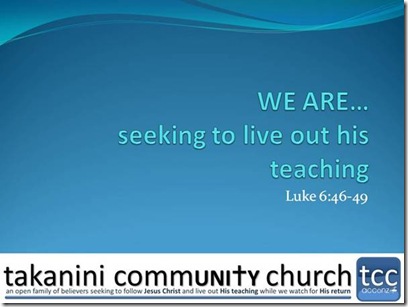
We are… seeking to live out his teaching

clip_image002

We have been exploring some biblical texts that line up with our vision and mission statement as a church. Here at Takanini Community Church we describe ourselves as “an open family of believers seeking to follow Jesus Christ and live out His teaching while we watch for his return.”

Today’s text helps to clarify what we mean when we talk about living out Christ’s teachings. It is found in Luke’s Gospel, chapter 6 and verses 46-49.

46 “So why do you keep calling me ‘Lord, Lord!’ when you don’t do what I say? 47 I will show you what it’s like when someone comes to me, listens to my teaching, and then follows it. 48 It is like a person building a house who digs deep and lays the foundation on solid rock. When the floodwaters rise and break against the house, it stands firm because it is well built. 49 But anyone who hears and doesn’t obey is like a person who builds a house without a foundation. When the floods sweep down against that house, it will collapse into a heap of ruins.”

In the last text we looked at in this series, we saw what it meant to be a follower of Jesus Christ. We saw four men on a beach being challenged to let Jesus change them into fishers of men. We saw a large crowd bringing all the broken people they could find to Jesus, so that he could heal them.

We can naturally pick up from those images, and see another aspect of the gospel message in today’s text. Reading the larger context, we see that Jesus had prayed all night on a mountain. When he came down to a level place, he then called the twelve whom he was training as missionaries. Joining them was a large crowd of other disciples, and an even larger crowd of people from all over the surrounding regions, and they had brought all the people with something wrong with them for Jesus to fix. So, there were four groups in all, interacting with Jesus: the twelve apostles, the larger group of disciples, the even larger crowds watching, and the people being helped. The message Jesus taught was directed to all four groups. It was a message about being authentic in one’s Christian walk.

Now, consider this: of all the people in all the groups I just mentioned, no one doubted that Jesus was real. They brought crippled people to him, and he healed them. They brought people attacked by demons and after Jesus did his thing, those people left with their lives back under control. Jesus was the evidence of his own genuineness. But, what about the Christians? What was to be the evidence of their authenticity?

Here is where you will find some differences in answers depending on who you ask. Some Christians come from a background that teaches them to expect God to always heal the sick and do other supernatural things as the sign that their faith is real. I do not doubt God’s power to heal at all. Neither do I doubt that the Holy Spirit gifts certain Christians with supernatural healing gifts, or manifests his power through some other kind of miracle. But I’m not one of those Christians who comes from a background where we always expect God to do that. When I look carefully at this text, I see Jesus authenticating who he is by his miracles. But he teaches the apostles and disciples to authenticate who they are some other way. We Christians authenticate ourselves by living out his teaching – by doing what he commanded us to do.
clip_image004

Jesus had noticed that there were many who had professed faith in him, and even owned him as their Lord, but their confession had not produced any obedience. There are some groups that emphasize God’s election so much that it sometimes seems like they are saying what you do does not matter. But what you do does matter. It matters to Jesus. Those he chooses choose to obey him. Simply claiming that Jesus is your Lord puts you in the latter two groups, not in the former two groups. Those in the latter two groups have had some awareness of who Jesus is and what he can do. They may even have had some experience of him. He may have even healed them or delivered them from demons. But simple awareness or even a simple experience is not enough. The question Jesus asked challenged them to seal their commitment by becoming part of group two: the larger group of disciples. He had given a number of commands in his gospel sermons. He expected those who were really sincere about calling him Lord to start obeying those commands.

The message for us today is that professing faith is still not enough. We can say we are Christians all we want. We can even attend Christian services, listen to Christian music, back Christian political candidates, and put a fish sticker on our car’s back bumper. Still not enough. So, what is enough? That’s what Jesus teaches here. A life of obedience demonstrates authentic Christianity.
clip_image006

Jesus describes that life of obedience by comparing our lives to a house built on the solid foundation of a rock. He talks about floodwaters rising and breaking against that house and – nothing happens. In the simile that Jesus is using here, you can tell an authentic Christian life because the trials and troubles which destroy the lives of others cause no destruction in the true Christian’s life. The evidence is … nothing. No cracks, no leaks, no landslides, no roof caving in, no disintegration. The evidence is a lack of negative evidence.

But do not forget the reality that we saw first. Simply professing Christ as your Lord is not the same thing as building your life of the rock. There is only one way to build a Christian life. It is not having good Christian parents. It is not having a good Christian education. It is not learning a solid Christian theology. All of these are good things, but neither is the thing that Jesus identified as building one’s house on a rock. Building my life on the rock is learning and obeying the teachings of Jesus.

The apostles who wrote the epistles of the New Testament picked up on this same building analogy to teach their churches how to live authentically as Christians.

  • — “let us aim for harmony in the church and try to build each other up” (Romans 14:19).
  • — “We should help others do what is right and build them up in the Lord” (Romans 15:2).
  • — “ (Equipping ministers’ ) responsibility is to equip God’s people to do his work and build up the church, the body of Christ” (Ephesians 4:12).
  • — “So encourage each other and build each other up, just as you are already doing” (1 Thessalonians 5:11).
  • — “But you, dear friends, must build each other up in your most holy faith” (Jude 1:20).

What I find most significant about the way the New Testament epistles read Jesus’ teaching about building our lives is that they all describe the process that Christians do for each other. We’re not used to thinking of it quite like that. I think of building my own life on the rock, and I tend to think of obeying Christ’s teachings personally, remaining pure, not being hypocritical, staying personally devoted to the Bible, etc. But the apostles understood that Jesus actually gave very few commands that his followers can obey individually. In fact, it is in the laboratory of community living that we will find the most challenges to our desire to live out his teachings. So, that is one reason why Christ taught his disciples to form churches. It is in the context of church, family, society where we can build our lives into something stable that will outlast whatever destruction comes our way.
clip_image008Of course, there is a cosmic, future, ultimate sense in which Jesus’ illustration applies as well. The ultimate challenge that we all face is our own mortality. The ultimate floods that sweep down on the house are age and disease, accident or violence. If the atheists are right, and there is no God, we all just die. But if Jesus was right, and God exists, there is a solution to the death problem. Jesus taught in many different ways that there is hope for a second life, an eternal life. How do we guarantee that we will make it into the right side of the judgment? Answer: the same thing we do to authenticate our Christian profession: living out his teachings.


clip_image009

We have committed ourselves as a church to learning Jesus’ teachings, and applying them to our lives as individuals and as a Christian community. We want to build each other up into a building that will survive the disasters of this life, and make it into the future life. You are invited to join us. We are an open family: there’s always room for more. But if you are serious about joining us, you have to know that we do not compromise the teachings of Jesus. Living out those teachings is the building process itself.


Jefferson Vann

Takanini Community Church

Auckland, New Zealand