The Gospel of Faith in Christ

Galatians 2:15-21

“You and I are Jews by birth, not ‘sinners’ like the Gentiles. 16 Yet we know that a person is made right with God by faith in Jesus Christ, not by obeying the law. And we have believed in Christ Jesus, so that we might be made right with God because of our faith in Christ, not because we have obeyed the law. For no one will ever be made right with God by obeying the law.” 17 But suppose we seek to be made right with God through faith in Christ and then we are found guilty because we have abandoned the law. Would that mean Christ has led us into sin? Absolutely not! 18 Rather, I am a sinner if I rebuild the old system of law I already tore down. 19 For when I tried to keep the law, it condemned me. So I died to the law — I stopped trying to meet all its requirements — so that I might live for God. 20 My old self has been crucified with Christ. It is no longer I who live, but Christ lives in me. So I live in this earthly body by trusting in the Son of God, who loved me and gave himself for me. 21 I do not treat the grace of God as meaningless. For if keeping the law could make us right with God, then there was no need for Christ to die. (NLT)

I’d like to start by reviewing what we have seen so far in our study of Galatians.
In the first ten verses of chapter one, Paul sets the tone of the epistle by saying that he is shocked to hear that the Galatians are toying with a false teaching. He set them straight by proving that there is no other gospel.
He spends the rest of chapter one (11-24) explaining the supernatural way that God revealed the gospel message to him. Since the message did not come from man, man has no business changing it.
He begins chapter two (1-10) recounting his visit to Jerusalem fourteen years after his Damascus road experience. His point was that the Jerusalem leaders endorsed his ministry, and agreed that he had been entrusted with the same message.

Then (11-14) he tells about another visit – when Peter visited Antioch. He found that Peter had gotten out of step with the gospel, and rebuked him for it.
Now we come to today’s text, and the final verses of chapter two.

Scholars differ as to who is being addressed by Paul here. Is he continuing his quotation of his rebuke of Peter, or is he now addressing the Galatians? I think this is part of his public rebuke of Peter.

The point he is making to Peter is the reason he is bringing it to the Galatians. Faith in Christ is a choice. If you make that choice, you should live up to it.

You see, some of the Jews in Jerusalem had become syncretistic. That means that they had blended Christianity with their former Judaism beliefs. They thought that they could accept Christ AND trust in their own ability to save themselves by following the Jewish traditions (works of the law).

The Galatians were being fed the same stuff. But when you add anything to free grace it stops being free.

When we Christians declare our faith in Christ it is in Christ alone, not Christ AND.

When we declare that Christ gave himself for us on the cross we are saying that we were sinners, and that we were helpless to do anything to please God. BUT Jesus Christ was not a sinner. He could do something about our sin problem. He did it on Calvary’s cross. His sacrifice was enough to pay the price to set us free.

How tragic it is then, to have and proclaim this great gospel message, and then water it down by saying that God pays more attention to someone who doesn’t eat pork. Our trust is not in something we can do for God. Our trust is in something He did for us.

Dr. Albert Barnes summed up this aspect of the gospel well.

“It is the declared purpose of God to regard and treat those sinners who believe in the Lord Jesus Christ as if they had not sinned, on the ground of the merits of the Saviour.”

His quote does not say everything there is to say about the gospel. But it does cover the key issue that Paul was facing in Galatians.

The issue is how do we live out the truth of the good news of what God has done for us by sending Christ to die on the cross for our sins. People who have put their faith in Christ should trust God to deal with the sin problem his way.

I am NOT saying that believers are under no obligation to prove their faith. What I am saying is that since Christ’s death is the means of our justification, then Christ’s words should be our means of proving our faith.

We should endeavor to live according to the commands of Christ.

Our hope should be based on the promises of Christ.

Paul saw that the Galatians had a serious problem. they had put their faith in Christ, but now they were in danger because someone was trying to convince them to alter that faith. The troublers wanted the Galatians to trust in Christ AND…

But God did not send his only Son to die in our place so that we could trust him AND ourselves.
___________________

LORD, help us to put our faith in Christ alone, and keep our faith in Christ alone.
ACST 14. The Immutable One

James said that with God “there is no variation or shadow due to change” (James 1:17). He was drawing attention to another attribute of God: immutability. When we affirm that God is immutable, we are affirming (positively) that he is consistent; he acts and responds the same way that he always has. James made this affirmation about God to dissuade his readers from thinking that God was bringing trials upon them to do evil. Instead, he wanted them to realize that temptations come from within us, but remaining steadfast (imitating God’s immutability) will lead to “the crown of life” (James 1:12).

Although God acts and moves through history, making his mark upon the lives of all his creatures, he still remains transcendent. His essential nature and attributes do not change. By his grace he changes us, but we do not change him. If he were changeable, it would mean destruction for God’s people (Mal. 3:6). But he is consistent with himself. He can be trusted when no one else can.

It was this consistent nature that set God apart from all the other gods of the ancients. For the Canaanite, for example, a sure harvest this season might cost an extra goat from his flocks this season, or it might cost the life of his child. His gods were fickle; he could not depend on them. For the Israelite, what God wants is clear: it is codified in the law of Moses for everyone to know. It was not left to the whim of the latest shaman to reinterpret. This fact was mean to bring stability into the Israelite’s life.

This stability came with a price. Since God cannot be changed, neither can he be manipulated. He cannot be bought off by a bigger offering, or enticed by a louder chant. He does not respond to magic words, or magic charms. He is in control, and remains in control. He does nor relinquish that control to even those who have faith in him. He remains omnipotent. The ancient Canaanite could never accept such a God.

The modern world is filled with people who have the same disposition. They do not mind religion as long as they get to set the standards. They want a God that they can trust to be good when they want good done, but who looks the other way when they do evil to others. They are happy to sing about God the savior, but want nothing to do with God, the judge. They want a god who can tell them that they are the fairest of them all, and that everyone else is too.

The God of the Bible offers salvation and judgment. He can save believers precisely because it is his judgment from which we need salvation. His attributes are consistent, which is another difference between him and his creatures.
One distinction between man’s attributes and God’s attributes is that, whereas man has characteristics added or subtracted from Him, God does not. A man can be joyful as a child and sorrowful as an adult. A man can be faithful as an employee and unfaithful as a husband. God, on the other hand, never loses or gains any attribute of His person.1

This consistency serves as a rock of refuge for believers. As we face the difficulties associated with living life this side of eternity, we are assured that the rules of the game do not change. Life is determined not by blind chance, but by an immutable Person.

Although this attribute of God is encouraging, it also suggests some questions that the thinking Christian should consider. Even if they pose no serious problem to our faith, dealing with them may help us to answer objections from nonbelievers, who might question the reality of God. There are three such questions:
1) If God is unchanging, how can he affect history?

Some have suggested that God’s transcendence means that, although he exists, he chooses not to have an impact upon the world that he created. Since he does not change, he limits the affect his presence might have on the cosmos by remaining at a distance, and simply observing. This view reverses the import of transcendence, since it emphasizes the unchanging nature of creation, rather than the creator. It is popular among those who resist the concept of miracles, because their worldview can get along without them.

Immutability speaks to the power of God, and does not limit his ability to affect his creation. It suggests that God interacts with the universe, but that, in the final analysis, that interaction does not alter anything he does or anything that he is. He can affect the course of history, or the course of my life, or yours, because he is sovereign over all things. If he chooses to have mercy on a sinner, it is because he is compassionate and merciful by nature – the transaction has not changed his essential nature. If he chooses to raise up one nation and put down another, he is acting within the parameters of his omnipotence. He never encounters a situation that forces him to act outside his nature.

His nature, however, is one of consistent intervention. The world is what it is because he keeps stepping into the mix and muddying his hands, so to speak. What appears to some to be a well-oiled simple machine that requires little maintenance, is actually a complex group of inter-acting systems that require constant tweaking and intervention.

2) If God is unchanging, why offer salvation to all?

If some see a problem with an unchanging God who changes history, others see a problem with an unchanging God who changes personal destiny. They suggest that it is unfair for God to offer salvation to all when he knows who will respond to that offer, and who will not. He therefore knows that some (indeed many) will never take advantage of his grace, will never repent and display faith in the atoning sacrifice of Christ. Yet he insists on proclaiming “whoever will” even though he knows only the elect will.

For those who see a disconnect here, one way to resolve the problem is for God to make a divine exception to his own nature: he must limit his sovereignty in the area of personal salvation. This will enable anyone who desires to be saved to accept Christ. W. E. Best sees this as an application of deism in the realm of soteriology.2 It seeks to solve the sovereignty/free will debate by assuming that God makes the concession to human sovereignty in just this one particular area.

Yet, when we look at what the Bible says about salvation, we see that God has not abdicated his role in this process. He does more than just set up an option, sit back and wish as people get close, then fall away. He sends his Holy Spirit and causes people to be born again into his kingdom (John 3:3,5). It is an intervention. It is another one of those maintenance miracles that God does so often, we are tempted to think of them as normal.

We live in a world in which God is active, and constantly seeking the lost, and transforming them by the power of his Holy Spirit. This is the kind of God we have. It is not a God who is at the mercy of his creatures. He is immutable. He does not surrender his attributes even to accomplish what he wants.

3) If God is unchanging, is there hope for those who have not heard the gospel?

A third challenge, related to the second, is the notion that God would be unfair to provide only one chance for people to respond to his grace. There are some who see history as a series of dispensations, in which God acts differently, and expects different things from those who belong to him. To some, believing that God is changing helps to soften the impact of a world who largely neglects him. There is always the possibility that God has a “plan b” that will include those who are not responding well to this plan.

The problem is that such thinking has (once again) reduced God to an observer, when the Bible implies that he is the prime mover. For the sake of a “wider hope” the view requires that we reject the present hope. Our present (and only) hope is in the grace of God, who sovereignly brings the lost to himself through his Son. The fact that he is immutable should lead us to use all our resources to bring the dying world to Christ, because only he is the answer. When the next age dawns, it will be Christ’s age. The changes we will see will not reflect a change in who God is. Instead, they will reflect a more clear revelation of the immutable God we worship today.
_______________

1 Jeremy Cagle, Just The Simple Truth: The Attributes of God. (www.justthesimpletruth.com/pdfs/03-theattributesofGod.pdf).

2 W. E. Best, The Impeccable Christ. (Lafayette, IN: Sovereign Grace Publishers, Inc., 1971), 69.

In Step With The Gospel

Galatians 2:11-14 ESV

11 But when Cephas came to Antioch, I opposed him to his face, because he stood condemned. 12 For before certain men came from James, he was eating with the Gentiles; but when they came he drew back and separated himself, fearing the circumcision party. 13 And the rest of the Jews acted hypocritically along with him, so that even Barnabas was led astray by their hypocrisy. 14 But when I saw that their conduct was not in step with the truth of the gospel, I said to Cephas before them all, “If you, though a Jew, live like a Gentile and not like a Jew, how can you force the Gentiles to live like Jews?”

In Gal. 2:1-10 Paul explained that the leaders of the Jerusalem Church had approved of his message to the Gentiles, and affirmed that he had been entrusted with the same gospel message as they were.

This week we look at verses 11-14. Here we see Peter taking a trip to the Church at Antioch, a Gentile church which had served as Paul’s launching point.

A problem had developed at Antioch during Peter’s visit. It involved the Jewish believers, whose conduct was suddenly not in step with the gospel.

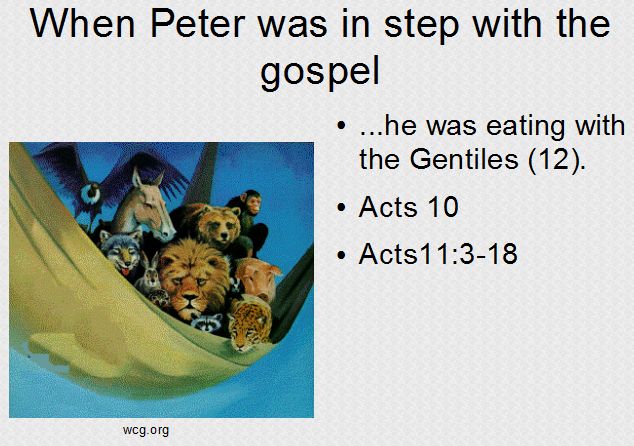
Things had actually started out very well in Antioch for Peter. He was “going with the flow.”

It was quite different than Jerusalem because this church was predominently Gentile believers.

But Peter had already learned God’s lesson that he should not consider unclean what God accepts. God showed him that truth through visions in Acts 10-11.

So Peter fellowshipped freely with the Gentile and Jewish believers alike.

But then the troublers came. These appear to be the same kind of troublers that are threatening Galatia, and that’s why Paul brings up this story.

As soon as the troublers came, they insisted on dividing up the church into the acceptable and unacceptable.

Peter had a choice to make. He could continue fellowshipping freely based on what God had shown him, or he could cave in to the peer pressure.

He made the wrong choice. He drew back and separated himself.

Remember, Peter was a respected leader in the Christian church. As such, his choice was not just an individual choice. It was a leadership choice.

Sure enough, the rest of the Jews acted hypocritically along with him.

Even Paul’s good friend and co-worker Barnabus was led astray by Peter’s actions.

Now it was Paul’s turn to respond. He could have done the same thing Peter did, claiming Peter’s authority. That would have been the easy thing to do.

But there was a lot at stake here. It was not just the traditions of men, whether Jewish or Gentile. The truth of the gospel was at stake.

So Paul publically opposed Peter.

Paul was being a good friend here. All of us are able to make wrong choices which deny what we profess. If that happens, may God give us a friend like Paul, who cares enough to confront us.

This story is included in Galatians because the Galatian believers were being threatened with the same false teaching that the “certain men from James” had with them when they visited Antioch.

The Galatians would have to make the same choice that Peter did. They would have to repent and get back in step with the gospel that they profess.

This story suggests a few principles for living like a Christian in any age.

When you and I gave our lives to Jesus Christ, we accepted the gospel of the kingdom, and agreed to live by its principles.

Are we still living by those principles? Have we taken on any new habits and practices since then?

__________________________________
LORD, help us to examine ourselves to see if we are still living by the gospel that we accepted when we first came to you.

Entrusted With The Gospel

Galatians 2:1-10 ESV
Then after fourteen years I went up again to Jerusalem with Barnabas, taking Titus along with me. 2 I went up because of a revelation and set before them (though privately before those who seemed influential) the gospel that I proclaim among the Gentiles, in order to make sure I was not running or had not run in vain. 3 But even Titus, who was with me, was not forced to be circumcised, though he was a Greek. 4 Yet because of false brothers secretly brought in- who slipped in to spy out our freedom that we have in Christ Jesus, so that they might bring us into slavery- 5 to them we did not yield in submission even for a moment, so that the truth of the gospel might be preserved for you. 6 And from those who seemed to be influential (what they were makes no difference to me; God shows no partiality)- those, I say, who seemed influential added nothing to me. 7 On the contrary, when they saw that I had been entrusted with the gospel to the uncircumcised, just as Peter had been entrusted with the gospel to the circumcised 8 (for he who worked through Peter for his apostolic ministry to the circumcised worked also through me for mine to the Gentiles), 9 and when James and Cephas and John, who seemed to be pillars, perceived the grace that was given to me, they gave the right hand of fellowship to Barnabas and me, that we should go to the Gentiles and they to the circumcised. 10 Only, they asked us to remember the poor, the very thing I was eager to do.

We have seen how Galatians focuses on the gospel message. In 2:7, Paul says that he has been “entrusted with the gospel.”

The same is true of you and me. We have been entrusted with the gospel message.

The challenge for us is to keep faithfully proclaiming the gospel as Paul did.

The reason Paul could keep proclaiming the gospel is that he was not ashamed of it. He believed that it is God’s power for salvation (Rom. 1:16).

Of course, God does not want us proclaiming his truth if we do not back it up by living right.

Paul tells the Philippians “…let your manner of life be worthy of the gospel of Christ” (Philippians 1:27).

Sometimes the things that we do speak so loudly that people can’t hear the words that we say.

The answer is not to stop proclaiming the gospel, but to proclaim it faithfully. Otherwise we will have been running in vain.

Paul asked the Ephesians to pray for him that “words may be given to (him) in opening (his) mouth boldly to proclaim the mystery of the gospel” (Ephesians 6:19).

If Paul needed that, then surely you and I do as well. In fact, this should be a part of our regular prayers for each others.

Instead of just praying “God bless so and so” let’s pray that God give so and so opportunities to share his faith.

For Paul, being entrusted with the gospel also meant that he had to speak out against the troublers that he had referred to in 1:7.

These troublers were not just people with a different theological point-of-view. They were espousing an entirely different kind of salvation.

We need discernment so that we don’t get hung up on petty theological differences. If we do that, noone will listen when we seek to defend the gospel.

The fact is – there are a lot of people out there who just do not understand the gospel message.

Paul says that “the god of this world {Satan} has blinded the minds of the unbelievers, to keep them from seeing the light of the gospel of the glory of Christ, who is the image of God. ” (2 Corinthians 4:4).

There were some unbelievers in Jerusalem who were more concerned with the fact that Titus was uncircumcised that the fact that he believed in Christ. Paul refused to give in to their blindness because the integrity of the gospel was at stake.

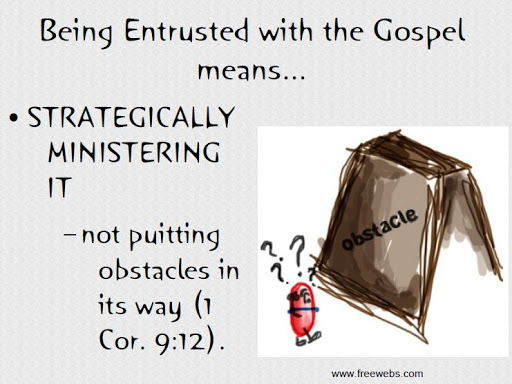
For Paul, being entrusted with the gospel meant that he had to use the methods that worked best to minister the gospel.

In 1 Cor. 9, he argued that he and Barnabus had the right to be paid for their missionary work, but that they waived that right and supported themselves because they would “endure anything rather than put an obstacle in the way of the gospel of Christ.” (1 Corinthians 9:12).

We need to stop and ask ourselves if what we are doing is accoplishing the task that we want done. If it is not, then we need to have the courage to change. Otherwise, our traditions might be keeping people out of the kingdom.

Paul had a strategy. He would plant churches wherever he went, and leave one of the missionaries who were with him to continue establishing those churches, and he would continue to stay in touch by e-mail (that is Epistle-mail).

For example, he told the Thessalonians that he “sent Timothy, our brother and God’s coworker in the gospel of Christ, to establish and exhort you in your faith” (1 Thessalonians 3:2). He had also sent Timothy to Ephesus for the same purpose. My point is that Paul’s strategy worked for spreading the gospel.

When he was encouraging the Ephesians to have an active prayer ministry, he reminded them that they should also be “wearing for shoes on (their) feet the eagerness to spread the gospel of peace” (Eph. 6:15 NJB).

A strategy is only as good as the willingness of all involved to operate according to the strategy. Paul’s method for reaching the Gentiles with the gospel depended on every believer being eager to spread the gospel, not just every missionary or every minister.

Each of us have been entrusted with the gospel.

Each of us has a sphere of influence to whom we have been called to share the gospel.

No one can reach your sphere of influence like you can. Not your pastors, not your elder, …only you.

____________________________________

LORD, give us all the courage to faithfully proclaim the gospel you have entrusted us with. Give us the strength to defend it against attack. Give us the wisdom to minister it with methods that work, because eternal lives are at stake.

June 2010 Newsletter from the Vanns in New Zealand

You have reached the Newsletter of Jeff and Penny Vann, missionaries with Advent Christian General Conference, currently serving in New Zealand as pastors-at-large with the Advent Christian Conference of New Zealand (ACCONZ). We serve as teaching pastors at Takanini Church of Christ, and Christian LIFE Church, Takanini, Auckland.


photo by Jachin Mandeno

Our friend and fellow pastor David Burge continues to struggle with Leukemia, and is in the hospital for treatments often. He is no longer a candidate for bone marrow transplant, and his doctors are now merely trying to prolong his life. Please continue to pray for a miracle -his complete recovery.

Since Jeff and Penny have been here to take on the preaching and teaching duties at David’s church, he has been busy enjoying life with his wife and children. He is also completing a number of writing projects in which he has invested a great deal of time. Jeff is also serving as editor on some of those projects, and enjoying that task emensely.

You can follow David’s progress at this site: http://davidburge.wordpress.com/


photo by Jachin Mandeno

Jeff has been preaching two concurrent series on Sunday mornings. Galatians: The Gospel of Salvation by Grace is taking the Takanini congregation through the book of Galatians (a chapter a month). Keep On is a series of sermons based on Paul’s commands encouraging the churches to persevere in doing the right thing. Presentation slides,notes and .pdf files of these sermons are available at Jeff’s current web log: http://jeffersonvann.blogspot.com/

This month Jeff begins a new course on New Testament Greek which meets every Thursday night at the church lounge. The course is being scaled back to meet the needs of home-schoolers, but is available for anyone who would like to study God’s word in one of its original languages.

So what has Penny been doing? She handles communion almost every week. She is also getting ready to teach a seminar on the Old Testament.

Our Kids:

Naomi, our youngest, is staying the summer with Liz. She is planning on getting a Summer job there but as of this writing has not been able to. Please pray she can find one.

Connie: Is expecting a baby, so we will have another grandchild soon.

Liz: Just finished teaching another year of school.


We plan a short trip to the South Island June 29th-July 2nd to visit some friends we met while Jeff was at Gordon-Conwell seminary. We’ll probably see snow there.

Please Pray:

1)For Penny as she is rarely busy. After so many years of teaching full time,the down time is very hard.
2)The Takanini church as they adjust to two Americans on their pastoral team.
3)David Burge’s recovery.
4)Our safety as we visit our friends on the South Island.