The Gospel for the Free (Gal. 5:1-15)

Galatians 5:1-15 ESV

For freedom Christ has set us free; stand firm therefore, and do not submit again to a yoke of slavery. 2 Look: I, Paul, say to you that if you accept circumcision, Christ will be of no advantage to you. 3 I testify again to every man who accepts circumcision that he is obligated to keep the whole law. 4 You are severed from Christ, you who would be justified by the law; you have fallen away from grace. 5 For through the Spirit, by faith, we ourselves eagerly wait for the hope of righteousness. 6 For in Christ Jesus neither circumcision nor uncircumcision counts for anything, but only faith working through love. 7 You were running well. Who hindered you from obeying the truth? 8 This persuasion is not from him who calls you. 9 A little leaven leavens the whole lump. 10 I have confidence in the Lord that you will take no other view than mine, and the one who is troubling you will bear the penalty, whoever he is. 11 But if I, brothers, still preach circumcision, why am I still being persecuted? In that case the offense of the cross has been removed. 12 I wish those who unsettle you would emasculate themselves! 13 For you were called to freedom, brothers. Only do not use your freedom as an opportunity for the flesh, but through love serve one another. 14 For the whole law is fulfilled in one word: “You shall love your neighbor as yourself.” 15 But if you bite and devour one another, watch out that you are not consumed by one another.

We have been examining the book of Galatians for several months now. Today we begin the fifth month, and the fifth chapter. Paul was very angry when he wrote Galatians. He was angry because he had planted the churches in the Galatian region by preaching the gospel of grace, and, after he left, some troublers came into those churches and started preaching a different gospel.

The troublers considered their teaching sort of a “gospel plus.” But Paul recognized that it was a “gospel minus.” They considered their teaching a way of taking Christianity to the next level, but Paul considered it a rejection of the gospel, and a return to a yoke of slavery.

Up until this point Paul has been expressing his exasperation with the Galatians for having been deceived and going along with this substitute gospel. And he has been arguing the case against the Judaizer heresy by showing that it opposes what he taught them, and it doesn’t fit with what the Bible says about salvation – Old Testament or New.

Up until this point Paul hasn’t been making many demands, but that changes here. In the space of one verse he gives two commands (a positive one and a negative one). It is as if he is saying, “alright now, it’s time for you to make your choice.” The Gospel forces us to make a choice.

But he doesn’t want to leave it at that, because he’s afraid that the Galatians would make the wrong choice. He has to convince them that if he is right, and salvation is by grace alone, then there is no other option. Choosing to go along with the Judaizers is choosing to be lost, not saved at all. There is no such thing as a legalistic Christian.

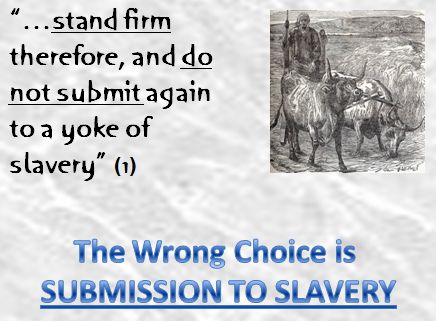
So what Paul does in this section of chapter 5 is put the two choices on the board, so to speak. He compares them so that the Galatians can actually see what they are choosing. In verse 1 he says it’s a choice between freedom and slavery. In verse 2 the choice is Christ or circumcision. In verse 4 the choice is grace or law.

In verse 7 he says it’s a choice between keeping on running and being hindered. False doctrine had created a stumbling block which prevented the Galatians from living the Christian life.

In verse 9 the choice is purity or contamination. Paul says some leaven has gotten into their lump, and it has contaminated the whole thing.

In verse 11 the choice has affected how they see the cross of Christ. If it is the only means of getting right with God, it is an honour. But if I can do something to gain merit for myself or redeem myself, the cross is an offense.

What is the means of sanctification? It is either the Holy Spirit (v.5), or the Flesh (v.13).
In verse 7 he says it’s a choice between keeping on running and being hindered. False doctrine had created a stumbling block which prevented the Galatians from living the Christian life.

In verse 9 the choice is purity or contamination. Paul says some leaven has gotten into their lump, and it has contaminated the whole thing.

In verse 11 the choice has affected how they see the cross of Christ. If it is the only means of getting right with God, it is an honour. But if I can do something to gain merit for myself or redeem myself, the cross is an offense.

What is the means of sanctification? It is either the Holy Spirit (v.5), or the Flesh (v.13).
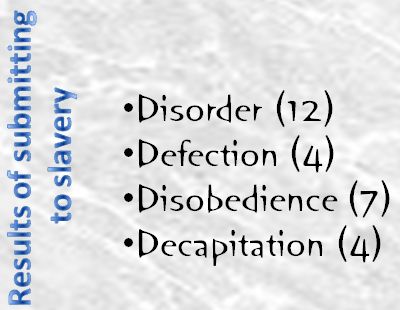
What are the results of submitting to slavery. We can see that in what Paul said about the Galatians here.

First, slavery leads to disorder. Paul said that the troublers had unsettled the Galatians (12).

Second, slavery is defection. Paul said that the Galatians had fallen from grace (4). They had professed faith, but failed to persevere in it.

Third, slavery leads to disobedience. The Galatians were no longer obeying the truth (7). Ironically, when you choose to make obedience the basis of your “Christian” life, you can no longer obey God. The basis of the Christian life is faith.
Fourth, slavery leads to spiritual decapitation. Christ is the head of his body. Choosing slavery severs you from Christ (4).

Fifth, slavery makes Christ a disadvantage. What Christ has done for us is the only advantage a Christian has. To live by works is to make Christ’s death work against you! That’s why Paul told the Galatians that if they let themselves be circumcised, Christ would be no advantage to them (2).

Sixth, slavery is like taking your life on a spiritual detour. The Galatians were offered freedom, but then started using that freedom as an opportunity for the flesh (13).

Seventh, slavery creates enormous debt. Paul said that making that choice leads to an obligation to keep the whole law (3).

Finally, slavery leads to devouring. The Galatians had already begun biting and devouring one another (15). If you define yourself by what you do, you will compare yourself with others, and criticize and complain about them. It is not a pretty image, but it is accurate.

Now let’s look again at what Paul said in verse 1, and we will focus first on that positive command “stand firm.” Someone who is standing firm is ready for the storms of life, because she has a solid foundation under her. She does not have to rescue herself. All she has to do is put her faith in the foundation under her, and she will be alright.

So Paul is telling the Galatians, “Oh, foolish Galatians! I gave you the right foundation. Stand firm in it!”

What does standing in freedom look like? Paul had told the Corinthians “faith, hope, and love abide” (1 Corinthians 13:13). To abide is to remain, to stand firm. A person who is trusting in God and not himself for his salvation is going to manifest these three character traits.

We see that here in Galatians 5. Instead of by works the believer is to live by faith (5), he will produce works, but that will be faith working (6).
Instead of despairing because he cannot do it all himself, the believer eagerly waits for the hope of righteousness (5).

Instead of biting and devouring others, the believer serves others through love (13). Love is his means of demonstrating his faith (6). And love actually helps him do what his slave counterpart cannot do: fulfill the law (14).
LORD, we are challenged by what we have read and studied today. We confess to you that – all too often we have tried to live the Christian life on our own terms, to fulfill the law the best way we know how. We know that is wrong. Only one person could fulfill your law.

But we also know that he did. By his sinless life and sacrificial death Christ bought our freedom. We are free! We ask you today to help us to stand firm in that freedom. Help us not to get entangled in any kind of bondage. Enable us to live by faith, to wait eagerly for our hope, and to manifest our faith by serving one another through love. In Jesus’ name. Amen

ACST 19. The Created Being

From the sovereign LORD of the universe we move our consideration to the being created in his image – humanity. Whereas God can best be described as “The Independent One,” humans are first described in such a way as to highlight their dependence upon him. In his account of man’s creation, Moses said “then the LORD God formed the man of dust from the ground and breathed into his nostrils the breath of life, and the man became a living creature” (Genesis 2:7).

The pagan creation myths tended to focus on violent conflict. Moses speaks of creation as a benevolent, artistic act. God takes the elements with which he has molded the other parts of his universe, and he carefully produces just one more work of art. Then the creator of all life breathes life into his ultimate creation. We can only truly understand who we are by beginning with the reality of our total dependence upon God for life and existence.

Formed From Dust

There are three statements in Genesis 2:7 that, together, make up a pretty good summary of this dependence we have on God. First, Adam was made up of the dust from the ground. It does not say simply that Adam’s body was made from the dust. There is no dualism here. God did not create two things: Adam’s body and his spirit.

“The Bible teaches us to view the nature of man as a unity, and not
as a duality, consisting of two different elements, each of which move
along parallel lines but do not really unite to form a single organism. …
it is not the soul but man that sins; it is not the body but man that dies;
and it is not merely the soul, but man, body and soul, that is redeemed
by Christ.”1

The being created was Adam before he was ever animated by the breath from God’s nostrils. After his sin, God reminded Adam that “By the sweat of your face you shall eat bread, till you return to the ground, for out of it you were taken; for you are dust, and to dust you shall return” (Genesis 3:19). God did not say “your body is dust, but you are something else.” He did not say, “your body will return to the dust, but you will go somewhere else.”

The very name “Adam” spoke of the dependence human beings have on the elements from which this planet is made. He is (‘adam), and he was taken out of the (‘adamah— ground). Later in Genesis we will learn that humans have the potential to be something more, but even that is a miracle of God’s grace. Eternal life was never an entitlement. As first created, humans were just as dependent upon God for life as any of the other creatures God made.

In fact it was also “out of the ground (‘adamah) the LORD God formed every beast of the field and every bird of the heavens” (Genesis 2:19). Both “man and all creatures of the earth were equally formed out of the dust of the ground … (so) … he and all the creatures of the earth have been regarded by God as mortal beings composed of dust of the ground and the breath of life.”2

Awareness of this fact of dependence upon the divine for life leads to a certain humility. Abraham, for example, could say “Behold, I have undertaken to speak to the Lord, I who am but dust and ashes” (Genesis 18:27). He did not flatter himself by imagining that he was something in God’s eyes. He admitted his utter dependence upon the sovereign Lord.

Job appeals to God on the basis of his dependence on Him: “Remember that you have made me like clay; and will you return me to the dust?” (Job 10:9). Job pleads for his life, and at the same time acknowledging that God is the one who gave this life to him – so God is capable of undoing it. Job recognized that he had no innate quality that would prevent God from ending his existence.

Solomon philosophized over this fact that we are just as dependent upon God as all the other creatures as well.

For what happens to the children of man and what happens to the beasts is the same; as one dies, so dies the other. They all have the same breath, and man has no advantage over the beasts, for all is vanity. 20 All go to one place. All are from the dust, and to dust all return (Ecclesiastes 3:19-20).

His point was that it made no sense for a man to waste his life on hard work if in the end it would make no eternal difference. Only in a world where God holds out a promise does anything matter. Without him, life is meaningless. We are just like the animals.

That would be a rather bleak idea if we knew nothing more than Genesis 2:7. Indeed, our complete dependence upon God is a scary truth. But it is a truth that is foundational. We have to understand our “in Adam” identity before we can grasp with gratitude our “in Christ” hope.

The first man was from the earth, a man of dust; the second man is from heaven. As was the man of dust, so also are those who are of the dust, and as is the man of heaven, so also are those who are of heaven. Just as we have borne the image of the man of dust, we shall also bear the image of the man of heaven. (1 Corinthians 15:47-49)

The gospel promises that human beings who are in Christ will one day bear his image. That includes immortality. However, that promise is conditional. It only applies to those who are “in Christ.” Also, it will only be experienced after his return, and the resurrection of the righteous.

There have always been those who insist that, in spite of Genesis 2:7 and 1 Corinthians 15, we already have immortality. To do so blurs the distinction which Paul saw so clearly between the creation and the restoration. It also ignores the fact that we are made of mortal, perishable, corruptible dust.

Given Life by God

The second major statement about the nature of humanity in Genesis 2:7 is the fact that God breathed into Adam’s nostrils, the breath of life. As previously stated, Adam was already Adam when God formed him from the dust. Whatever the breath of life was, it did not impart Adam’s personality or personhood. It was not some separate “soul” which took up residence in the body, but could have easily done without it. The phrase nishmat chayim is rendered literally “a breath of lives.” It refers to the animation of something that is at first lifeless. That same phrase is found in Genesis 7:22 referring to the animals and men who died in Noah’s flood: “Everything on the dry land in whose nostrils was the breath of life died.”

So, the phrase itself does not imply any kind of “immortal soul” that would survive death. Instead, it implies the same thing that the dust did: humans are dependent upon God for life. The breath remains God’s breath, and he can take it back whenever he wishes.

Life is a gift from God. It was true of the animals. It is true of human beings as well. There is a difference between Adam and the animals he named, but that difference is not that Adam has some kind of “get out of death free card.” The first lesson we learn about ourselves is a humbling one: we depend upon God for life.

That breath that God gave Adam that day was simply the ability to breathe. This is seen in uses of the term neshamah elsewhere in scripture. Moses told the Israelites when they conquer the promised land to save alive nothing that breathes (Deut. 20:16). In other words, no survivors. Joshua obeyed and “devoted to destruction all that breathed” (Joshua 10:40; 11:11,14). If neshamah implied some kind of immortal soul, those statements would be contradictions.

The prophet tells us to “Stop regarding man in whose nostrils is breath, for of what account is he?”3 It is much more important to regard the Independent One from whom the breath came. Human beings may be mighty or wise, but remove their breath, and they are again reduced to dust. They have great potential for advancement, but they are still dependent upon their creator for their next breath.

The process by which God gave breath to Adam on the day of his creation continues to be carried on by God for human beings today. God is the one who “created the heavens and stretched them out, who spread out the earth and what comes from it, who gives breath to the people on it and spirit to those who walk in it.”4 He continues to give life, we continue to receive it.

Spirit (ruach) is just another name for that life-breath. It too, is the same animating breath that gives life to the animals.5 As for the animals, when God takes “away their breath, they die and return to their dust” (Psalm 104:29). As for humanity, “When his breath departs he returns to the earth; on that very day his plans perish” (Psalm 146:4). This all important gift from God — without which we could not exist — is a reminder that we are completely dependent on him.
The good news that we will pursue in later chapters is that God plans to resurrect those who are destined for eternal life. But until that day of resurrection at Christ’s second coming, our fate at death is the same as that of the lost. The most common description of this fate in the Bible is sleep. This metaphor “suggests an instructive parallel in which death is likened to falling asleep at night, the intermediate state to the hours of unconscious rest, and the resurrection to the experience of awakening to a new day.”6

A Composite Unity

The result of this creation process described in Genesis 2:7 is a being who is made up of the stuff of earth, infused with life from heaven. The Bible does not place the accent on one or the other of these facts, but insists on both. The result of creation is a composite unity. As Moses put it, “then the LORD God formed the man of dust from the ground and breathed into his nostrils the breath of life, and the man became a living creature.” Adam was not given a “soul,” he became one.

“Notice that the Bible presents man as a unitary being. While
discussing man’s spirit, soul, and body, the Scripture places
the emphasis upon man as a complete person. It is man –
the complete being – who was created, who fell into sin, who
can be saved, who dies, who will be raised again, and who will
be judged.”7

This composite unity must remain together in order to be alive. The real human being is not one or the other, but “a combination of body and soul or spirit.”8 If you separate the dust from the life, you no longer have a living creature. This also is a gentle reminder of our ultimate dependence upon God for life. Since sin came into God’s creation, mortality has been everyone’s condition, and death has ended every life. If not for the promise of a redeemer, and a future resurrection, that would be the end of our story.

Human beings are created beings, and, as such, we have an affinity with all other creatures, and the rest of the cosmos that God created. Realizing this should instill in us a desire to preserve and protect the environment, and guard the universe from abuse. This is the most fundamental fact about ourselves in scripture (that we are created beings). From this fact flows the second most fundamental fact (that we are responsible to creation). We explore that responsibility in the next chapter.

_________________________
1 Louis Berkhof, Systematic Theology (London: The Banner of Truth Trust, 1949), 192. quoted in Freeman Barton, Heaven, Hell and Hades (Lenox Mass:Henceforth … Publications, 1990), 16.

2 George Wisbrock, Mortal By Design. (Chicago Ridge IL: by author, 2003), 13.

3 Isaiah 2:22.

4 Isaiah 42:5.

5 Genesis 7:22 speaks of the breath of the spirit of life (nishmat-ruach chayim) referring to the animating breath in all the men and animals that died in the flood.

6 Clarence H. Hewitt, Faith For Today. (Boston: The Warren Press, 1941), 106.

7 David A. Dean, Resurrection Hope. (Charlotte: ACGC, 1992), 40.

8 James A Nichols, Jr., Christian Doctrines (Nutley NJ: Craig Press, 1970, 119.

ACST 18. The Independent One

Chapter 14 introduced the idea that God is transcendent.1 The term implies that God is not a part of the universe, but is separate from it. In the words of the Julie Gold song, made popular by Bette Midler, “God is watching us from a distance.” J. Gresham Machen insisted that this attribute of God is “absolutely fundamental in the Bible” and “absolutely necessary in order to render intelligible all the rest.”2 One of the reasons that God must be seen as separate from his creation is that the creation has been adversely affected by sin, but God has not.

The Old Testament fiercely preserves and protects the
transcendence of God, precisely because it fiercely preserves
and protects the holiness of God. Angels, particularly the
mysterious Angel of the Lord, seem to appear in the narrative
of the Hebrew scriptures for this very purpose – to allow
divine interaction with the corruptible world of created
beings, while at the same time preserving the distance between
God and all that is corruptible.3

Chapter 14 also introduced the theological flipside to the issue of transcendence. God is not only separate from his creation, but he remains active within it, intervening whenever and wherever he pleases.4 This concept is included in the doctrine of the immanence of God, defined as “God’s intimacy and closeness to all creatures.” He is immanent without losing his transcendence, or without “ceasing to be the free and sovereign Lord of all.”5

Putting both of these biblical concepts together reveals a God who is both sovereign over creation and independent from it. Yet it poses a problem: if God is independent from the universe which he created, how can we prove his existence?
The short answer is that we cannot. His transcendence makes it impossible for us to point to God and tell the world “there he is.”

Yet his immanence makes it entirely possible that we can point to God’s work as evidence that he exists. He has left footsteps in the sand to show that he has been here among us, and that evidence keeps reoccurring to show us that he still walks among us. The majority of the world still believes in a deity of some kind because of this evidence, but most suppress this truth. For that reason, simply recounting examples of this evidence may not achieve much. Nevertheless, it will not hurt to try!

Evidence from Creation

For most of human history, the sciences have come to the aid of theology in providing evidence for God’s existence because they examined the universe, both on a macro (telescope) and micro (microscope) level. The evidence science has catalogued indicated that “the universe manifests order and purpose that can only be the result of a conscious intelligence.”6 We see this order in the patterns that repeat themselves in creation: the petals on a flower, or the rotation of the planets in a solar system.

In the past century, as technology has continued to improve, science has become more and more capable of presenting this type of evidence, but, ironically has been distracted from that task. Science has been held captive by a philosophical belief system which refuses to acknowledge the possibility of anything supernatural about nature itself, especially its origin. This has resulted in the disenchantment of nature itself, and has been partially responsible for the exploitation of the environment that has left the planet with a number of ecological problems.7 We do not have to deify nature in order to solve the ecological crisis. We merely need to rediscover how important nature is as a means of connecting us to its Creator.

The psalmist tells us that nature is constantly communicating both the existence and majesty of God.8 It does this by presenting to us evidence that demands us to consider its design and thus postulate the existence of its designer. Even if we are not ready to speculate on the nature of that designer, logic demands that we imagine at least that there is one.

Many of us may not fully grasp the purpose of Stonehenge,
but we immediately recognize that it is the result of
intelligent design and not natural processes. This is
because Stonehenge contains a complex arrangement of
stones that match a pattern. We may know very
little about the purposes, beliefs, or identity of the
designers of Stonehenge, but we know it was designed.9

Like Stonehenge, nature gives us clues to its creator. We see in both the microcosm and the macrocosm an almost infinite number of recognizable patterns, complex machine-like systems working on the basis of complex encoded data. To suggest that all of what is there “just happened” defies logic, and requires a faith in chance that goes way beyond the faith required of any god in any religion.

Evidence from Philosophy

Some of Christianity’s earliest theologians were philosophers as well, and sought to bring their philosophical disciplines to bear on the subject of God’s existence as well. One of the first, and most effective of these was Thomas Aquinas. His five ways that nature evidences God’s existence show how the human mind keeps stumbling over the fact of God’s existence when simply thinking about the nature of what is.10

1. The fact that the entire universe is in motion leads us to suspect an unmoved mover as its creator.

2. The fact that everything that exists appears to have a cause leads us to suspect that it was all created by an uncaused cause capable of bringing everything into existence.

3. The fact that the universe exists leads us to surmise an uncreated creator, because nothing happens without a reason. If there was ever a time when nothing (or no one) existed, there could have been nothing (or no one) to bring the universe into existence.

4. The fact that we can appreciate excellence in the universe leads to the suggestion that a being exists who is the standard by which all else is compared. Since the universe contains degrees of complexity from inanimate objects to complex beings, it follows that an even more complex being than humanity is possible.

5. The fact that the universe manifests order and direction suggests a conscious intelligence directing it, and building order into its structure.

Arguments like these are constantly debated among philosophers, and rarely yield agreement. Even Aquinas did not come to faith in God by virtue of his appreciation of God’s evidence in nature. It was the other way around: after finding God through Christ, Aquinas was able to see the evidence for God’s existence in nature. Faith became a lens by which Aquinas was able to see creation more clearly, and thus detect the marks which God, the creator had left upon it.

However, Aquinas’ faith does not negate his logic. A witness’s testimony is not negated when she is able to give a more accurate story since she was wearing corrective lenses when she saw the incident. Her testimony is actually deemed more reliable. In the same way, believers who approach the question of God from the book of creation are not out of bounds and in error simply because they have access to the supplemental revelation of faith or scripture.

In fact, there are a number of thinkers in this planet who come to accept the fact of God’s existence without those corrective lenses. They are theists, but not believers in any particular god. They see sufficient evidence in nature and elsewhere for the assumption of a deity, while remaining agnostic as to his, her, or it’s identity. This fact lends credence to arguments like Aquinas’s five ways. It suggests that such arguments are not merely reflections of religious bias, tainting pure science. Like the citizens of Athens, they knew enough about God to know that he existed, but not enough to know who he was.11

Evidence from Human Nature

A particularly revealing chapter in the book of nature is the book of human nature. The thoughts and feelings within the human heart show an impression upon us that cannot be explained by merely blaming the environment or our past history. One example of these thoughts and feelings is the tendency all humans have of assessing the acts of other humans, or societies with the categories of justice or injustice. All human beings are not in agreement on what is fair and what is unfair. Neither has there been consistent agreement throughout time as to which actions are just, and which are unjust. Nevertheless, it is true that throughout time all human beings of whatever race, culture or creed have retained the concept of justice.

One question to ponder, then, is where did this concept of justice come from? It is too simplistic to say that such concepts are merely taught by parents and reinforced by society. Many, because of conscience, are led to reject the teaching of their parents, or rebel against their governments.

It is also too simplistic to assume that such ideas are programmed into us by the processes of evolution. To suggest that our moral consciences are merely throwbacks to the decisions our prehistoric ancestors had to make to survive does not account for the justice decisions people make all the time which are clearly not in the interest of personal or corporate survival. If there is a justice gene embedded in human DNA, then why is it that humans and nations are consistently inconsistent on what justice is?

From whence, then, do these ideas and policies come which seek fairness for all? Christians have an answer. We blame God for wiring all humans in such a way that we see actions as potentially right or wrong, fair or unfair, just or unjust. In fact, we often go beyond the concept of justice, and ask “what would be the caring or loving thing to do.” We seek reconciliation rather than retribution. Christians argue that these concepts did not emerge through a gradual process from the primordial ooze. They have been with humanity since creation, and are inherited from a loving God who wishes his creatures to imitate his character.

The Difference Christ Made

As good as the above arguments are, each of them is inadequate. Although they can lead some to be theists, they are not sufficient to dispel the agnosticism of Athens. It takes revelation to do that. So, Paul at Athens said…
The times of ignorance God overlooked, but now he commands all people everywhere to repent, because he has fixed a day on which he will judge the world in righteousness by a man whom he has appointed; and of this he has given assurance to all by raising him from the dead.” (Acts 17:30-31 ESV)

This man is Jesus. His resurrection was the evidence, or assurance (pistis) that God offered to humanity still in ignorance (agnoia) of his existence. The resurrection of Jesus is all the proof the world will ever need that everything said in the Bible is true. As evidence supplied by God himself, it covers the issue of origins, the issue of our responsibility to God as his creatures, and everything in between. Thus it was on the basis of the resurrection of Christ that Paul commanded the Athenians to repent, and warned them of coming judgment.

Now that Christ has been raised from the dead, no human being will be able to stand before God and excuse her failure to pay attention to his word. The gospel message redirects a world that has ignored God’s message back to it. Once we return to God’s word, the gaps in our knowledge of him are filled in by it.

Evidence from the Bible

The Bible tells us that God exists, and progressively reveals more and more of his character and identity as it tells his story. Without this essential piece to the puzzle, crucial elements of the story of the universe and the story of humanity would remain a mystery. This explains why cultures who deny God’s existence are apt to bring harm to their environment and themselves. Conversely, those people and societies who care enough to seek God through the Bible find that the resulting relationship leads to a proper stewardship of the earth’s resources, and a better care for society as a whole. Knowing God makes a difference.

We saw in previous chapters that the Bible reveals a God who cannot be defined in the terms which we use to define everything else in the universe. He is immeasurable. That makes him independent of the universe which he created. Although he can affect change upon the universe, he cannot be changed by it. He is immutable. All around the universe change is happening, including the ultimate change of death, but God is not capable of such change. He alone has immortality.

Although analogies from nature (such as the shamrock, or water) have been used to illustrate the Trinity, nature is really insufficient to teach the doctrine. The Bible, however, has no such limitation. From the beginning of Genesis, where we see a God who is both a “he” and an “us,” the triune nature of God comes through. The holiness of God is also best seen in his relationship with man and nations, which is brought out best through the history given in divine revelation.

What we see as the evidence from scripture piles up around us is that God is not the same as the universe he created. He is the Independent One. His sovereign acts within history and his words revealing himself and his plan are just ways that he has chosen to connect with his creatures. They are adequate to give us glimpses of his existence and attributes, and that is all that faith truly needs. Skepticism and doubt are free to ignore that evidence, but that ignorance is a choice, not an excuse.12

Human beings have every capacity to recognize the clues to God’s existence in nature, thought, human nature and the Bible, but some choose not to do so. The reasons why this is so are found not in the nature of God, but in human nature, particularly that nature as it currently presents itself, marred by original sin. Thus logically we proceed to a study of those issues.

_____________________________
1 cf. page 98.

2 J. Gresham Machen, Christianity and Liberalism. (Grand Rapids: Wm B. Eerdmans, 2009), 54. “From beginning to end the Bible is concerned to set forth the awful gulf that separates the creature from the creator.”

3 Kevin W. Mannoia and Don Thorsen, The Holiness Manifesto. (Grand Rapids: Wm B. Eerdmans, 2008), 47.

4 cf. page 100.

5 Daniel L. Migliore, Faith Seeking Understanding. (Grand Rapids: Wm. B. Eerdmans, 2004), 413.

6 Douglas J. Soccio, Archetypes of Wisdom. (Belmont, CA: Wadsworth, 2009), 226.

7 cf. Alister McGrath, The Re-enchantment of Nature. (London: Hodder & Stoughton, 2002).

8 Psalm 19:1-6.

9 H. Wayne House, Intelligent Design 101. (Grand Rapids: Kregel Publications, 2008), 241.

10 My summary of Aquinas is based on Patrick J. Clarke, Questions about God. (Gloucestershire, UK: Nelson Thornes, 2001), 30-31, and Soccio, 226-230.

11 Acts 17:23.

12 Romans 1:20.

ACST 17. The Holy One

If the concept of a triune God seems rationally incomprehensible for some, the concept of holiness may seem absolutely alien for most. Perhaps in a previous era theologians could have easily spoken of the holiness of God and gained a sympathetic audience, but those days are gone now. To most of the world, the concept of holiness is an outdated, archaic, almost prehistoric idea. In fact, aside from being used as a mild intensive (holy smoke!), the term is rarely used anymore. So, before we can speak of God’s holiness in today’s context, the term will need some careful definition.

The term holy in Hebrew is kadesh, which originally connoted something or someone that was unique. In the ancient Near East, the term holy came to be associated with the gods of the various tribes, and with things, animals, times or places or people related to the worship of these gods. This explains why the Hebrews used the term kadesh for pagan male cult prostitutes and kedeshah for female cult prostitutes. The term implied that these individuals were unique (in that they had sexual relations as part of their cult rituals, and not as part of a normal married life. They would also be seen as exclusively devoted to the deity they represented while performing those cult rituals.

The God of the Bible is represented as unique – kadesh as well. He told the Hebrews to consecrate themselves and be holy because he is holy (Lev. 11:44). Through the prophet Isaiah he asked his people “to whom then will you compare me, that I should be like him? says the Holy One.” Of all the “gods” of the nations, none can compare to him. The New Testament represents him as light, with no darkness at all. In fact, the Bible represents God as exclusively holy. To emphasize this point, he is described as “Holy, Holy, Holy.” Without redemption, humanity does not even have access to God.

But the God of the Bible is not just holy because he is different. His holiness is his goodness. Although goodness is an attribute that is communicable (that is, we can imitate God by being good) there is a purity which we cannot attain. His righteousness makes ours look like filthy rags in comparison. His holiness is a mixture of moral attributes that set him apart from all his creation.

A good summary of those moral attributes is found in God’s revelation of himself to Moses in Exodus 34.

The LORD passed before him and proclaimed, “The LORD,
the LORD, a God merciful and gracious, slow to anger, and
abounding in steadfast love and faithfulness, keeping
steadfast love for thousands, forgiving iniquity and
transgression and sin, but who will by no means clear the
guilty, visiting the iniquity of the fathers on the children
and the children’s children, to the third and the fourth
generation.”
Exodus 34:6-7 ESV

The LORD is Merciful.

His mercy keeps him from administering swift justice because he has compassion on sinners. It does not keep him from seeing when sin has been committed. In fact, his merciful nature is made that more astounding because he does see everything that happens. He is more aware of our sin than we are. Yet he has chosen within the depths of his own goodness to forego punishing us as we deserve because he wants the best for us. Any parent knows this dilemma: there are times when you know that your child has done something wrong yet something within you yearns to let it be, to let this one go. Perhaps that parental yearning comes close to manifesting God’s attribute of compassionate mercy.

The LORD is Gracious.

The same God, who withholds punishment out of compassionate mercy, gives constant blessing and undeserved favor out of his supply of graciousness. Anyone who has ever stopped to count their blessings knows that no matter how bad things get, the scale is always overbalanced in their favor. Knowing that we do not deserve anything but swift, immediate destruction from God, we are overwhelmed to think of all the blessings we have received.

When horrible things happen to us or the ones we love, we are tempted to tell God that he is not being fair. But those are the words of a spoiled child. They are a reflection of a life so filled with enjoyment and blessing that one is shocked when something does not go as he expected it to. They are the words of someone to whom blessing is normal. We expect blessing normally because our God is gracious.

The LORD is Slow to Anger.

This attribute parallels that of mercy, but communicates something extra by how it is said. The Hebrew idiom actually says that God is long of the nostrils. The idiom does not mean that God physically has a long nose, but it suggests that God takes a long deep breath before reacting emotionally. Anger management suggests that we stop and count to ten before reacting to something that we object to. This text implies that God does the same thing. It tells us that God has the capacity to be angered by the wrongs so often manifested in this rebellious world, but that his anger is under control.

The LORD Abounds in Steadfast Love.

The NET translates this attribute as “loyal love.” It is the stubborn, relentless devotion to his own people that led God to powerfully rescue them from bondage in Egypt. Moses depended upon God’s steadfast love to guide the children of Israel to the Promised Land. He also appealed to God to forgive his people based on the same attribute. This attribute parallels that of graciousness, but adds to it the concept of covenant loyalty.

The LORD is Faithful.

Whereas steadfast love implies that God is faithful to his people, faithfulness implies that he is true to himself. He is a firm and solid rock because he never wavers from one position to another. What is true about him remains true about him. In theological terms, he is immutable. In practical terms, he can be trusted. Abraham’s servant found that God could be trusted to lead him to a wife for Isaac. Jacob found he could be trusted to bring him prosperity. David found that God’s rules could be trusted to keep him on the right path.

In the animistic culture of the ancient near east from which the Old Testament emerged, gods were not trustworthy. A sacrifice to one’s favourite idol might bring one a good crop this year, but might not be enough to avert famine the next. If one god refuses to answer the plea for help, there were always others you might try. The gods of the nations were fickle. One could not expect consistency. The God of the Hebrews was different. Not only was he true to himself, he could be trusted to be true to his promises. He was (and is) faithful.

The LORD Keeps His Covenant Love for Generations

There is comfort for the parent and grandparent here. It tells them that their God has a vested interest in their descendants. It is not a guarantee that their children will be believers, since they will have the same freedom their ancestors did (to accept or reject God’s grace). But it is God’s assurance that he will love them just as much. He will remain faithful to his covenant because that is who he is.

The LORD Forgives Iniquity, Transgression and Sin.

There are three words for sin here, and each highlights a different way a person can offend his Maker. He can offend God by willfully harboring an unholy thought or unrighteous word or deed. That is to commit iniquity. He can offend God by breaking his Law. That is transgression, whether it is done through rebellion of simple carelessness. He can also offend God by not measuring up to his standard. That is sin, even if it is done in error.

The good news is that God has them all covered. He offers forgiveness for each of these types of offense. The gods of the nations usually only offer the opportunity for sinners to make up for their sins by means of gifts, rituals, or acts of penance. The LORD actively bears the punishment for the sins himself. That is forgiveness. He can offer such lavish grace because he has already paid for the price of all the sins of humanity by the death of Christ on Calvary’s cross.
The LORD Sends Consequences upon Sinners.

The holiness of God is both sweet and sharp. God promises his goodness, grace, love and mercy because his nature is holy and you can expect these good things from a holy God. But God’s holiness also demands that he actively deal with sins that are not confessed. He is a God who is “a righteous judge, and a God who feels indignation every day” (Psalm 7:11). If a sin is not covered by the blood of Jesus (through personal confession and forgiveness) it causes God to be angered.

The results of God’s anger are two-fold. Ultimately all unconfessed sins will be dealt with at the lake of fire, called Gehenna, on the judgment day. But God loves sinners too much to simply wait until they get the punishment they deserve. So he sends consequences of sinful behavior. These consequences may even last long enough to affect the lives of the sinner’s great-grandchildren.
The purpose of these consequences is also two-fold. First, they vindicate God’s holiness by sending punishment upon offenders. However, their primary purpose is not specifically to punish the sins. Their purpose is to get the sinners’ attention so that they can repent. Even the sharpness of the consequences of sin is caused by the sweetness of his love for the sinner. They can be compared to a parent’s discipline, which is not administered to cause the pain, but to prevent a greater pain.

Practical Applications

The first practical application to these truths about God’s holiness is not hard to detect: God’s unique goodness should lead his people to worship him. In fact, that was Moses’ reaction after God revealed these moral attributes to him. The scripture says that “Moses quickly bowed his head toward the earth and worshiped”. It is only right that we human beings who aspire to be morally correct would feel compelled to show appreciation for our creator, who always has been holy.

A second application also suggests itself. Seeing the holiness of God manifest itself in the way he deals with his creatures, it is only right for us to attempt to imitate these moral attributes. We should do so for several reasons: 1) the author of Hebrews instructs us to “strive for peace with everyone, and for the holiness without which no one will see the Lord”; 2) God encourages his people to be holy because he is holy; 3) the Apostle Paul encouraged believers to “be imitators of God, as beloved children”. If we dare to be more holy as we relate to the world around us, perhaps that world will dare to believe that the holy God of whom we speak is real after all.

A Call for Edifying Manifestations

1 Corinthians 14:6-12 ESV
“Now, brothers, if I come to you speaking in tongues, how will I benefit you unless I bring you some revelation or knowledge or prophecy or teaching? 7 If even lifeless instruments, such as the flute or the harp, do not give distinct notes, how will anyone know what is played? 8 And if the bugle gives an indistinct sound, who will get ready for battle? 9 So with yourselves, if with your tongue you utter speech that is not intelligible, how will anyone know what is said? For you will be speaking into the air. 10 There are doubtless many different languages in the world, and none is without meaning, 11 but if I do not know the meaning of the language, I will be a foreigner to the speaker and the speaker a foreigner to me. 12 So with yourselves, since you are eager for manifestations of the Spirit, strive to excel in building up the church.”

In this series I have been highlighting Paul’s commands to the churches that are of a particular structure. The structure is called continuous active imperative. These are commands for the church to (positively) keep doing what it is supposed to be doing, or (negatively) to stop doing what it is not supposed to be doing. The command in today’s text is in verse 12, where Paul encourages the Corinthians to keep striving to excel in building up the church.

The context of this command is chapters 12-14 of 1 Corinthians.

Let me try to summarize what Paul is saying in these three chapters.

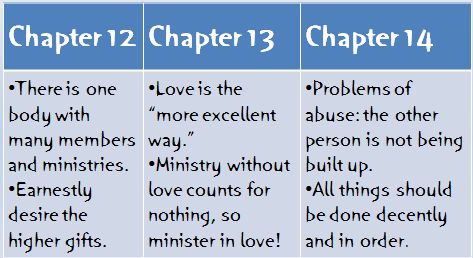
Chapter 12 is about Spiritual Gifts. He says there are going to be all kinds of gifts manifested when we gather together, because the body of Christ is made up of many different members, with many different ministries assigned to them by the head (Christ) and empowered by the Holy Spirit. He does encourage the whole church to earnestly desire the higher gifts, which are the ones which build up the most members of the body.

Chapter 13 is the love chapter. Here Paul encourages all ministry to be done out of love, otherwise it counts for nothing.

In Chapter 14 Paul addresses some examples where it appears the Corinthians are not doing that, so spiritual gifts are becoming a problem. They were being abused, and the result was chaos rather than order.

Now I want to summarize chapter 14 with a little more detail. This is the chapter in which our text for today is found, so it is important to put as much flesh on it as possible.

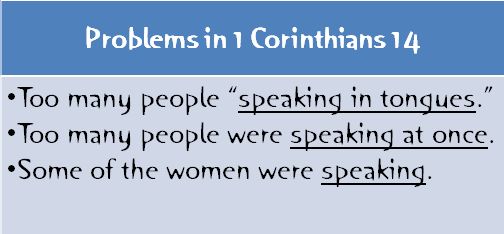
All of the problems that Paul was dealing with in chapter 14 have to do with speaking in church, that is, with manifesting spiritual gifts which involve public speaking in the assembly. He identifies three specific problems:

1) too many people were “speaking in tongues” instead of prophesying;

2) too many people were speaking all at once, which was leading to confusion;

3) some of the women of the congregation were speaking, and, for some reason that too was causing disorder.

I want to comment on each of these problems, and I want to talk about the simplest problem first, then go to the ones that are more complex. The simplest problem Paul mentioned was that everybody was jumping up to speak all at once, and the result was chaos. People didn’t know who to listen to, and very little edification was getting done. It was a free-for-all, and probably resembled a competition to see who could gain the most listeners. The confusion was being caused by a good thing: the Corinthians were eager to share. Paul encouraged them to be considerate of one another and limit the number of people who speak, and have only one person speak at a time. Be considerate. Problem solved.

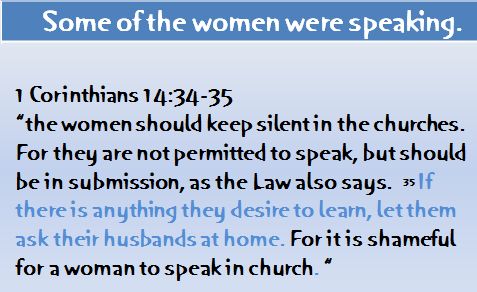
Another problem that Paul brought up in 1 Corinthian 14 is that some of the women of Corinth were speaking at the assemblies, and that was adding to the disorder. Some people believe that God has only ordained men to speak in church services, but I do not think that is the case. I have already shared how Gal. 3:28 shows that all Christians have the same status before God. Also, Joel 2:28-29 predicted a new era of the Holy Spirit’s ministry would include prophesying by both “sons and daughters.” That new era began at Pentecost.

So why is Paul preventing the women to speak here? Verses 34-35 hold the key.

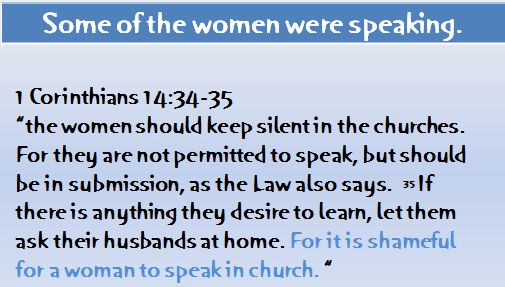
First, I draw your attention to the last part of verse 25, where Paul says “it is shameful for a woman to speak in church.” Now, one problem is that Paul had already given instruction for the wives of the congregation in chapter 11. He tells them that they should cover their heads with a veil if they want to pray or prophecy. Praying and prophesying are kinds of speaking. Those kinds of speaking do not appear to be shameful. Perhaps what Paul meant was that the Corinthian society saw it as a shameful thing for its women to speak in public. He didn’t say it to the Thessalonians, Ephesians, or even the Romans. But apparently it was a problem in Corinth so Paul orders them not to have their women preach in public.

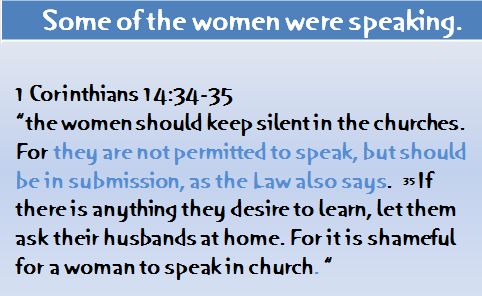
Paul says that the women are not permitted to speak, but should be in submission as the law also says. The problem is that there is absolutely no Old Testament commandment against women speaking. But there were plenty of laws in Corinth against women speaking. Paul seems to be saying that the women in Corinth should not speak in public because it is illegal.

In fact, history tells us that there was only one class of women who dared to speak in public in 1st century Corinth: the professional prostitutes. These were also the only Corinthian women of marriageable age who dared to appear in public without a veil.

The particular issue that appears to be the problem at Corinth is that wives are interrupting the worship to ask questions of their husbands. This is understandable, because in the first century women were not educated. There was apt to be a great deal of what was being said that the women did not understand. Their zeal to know was commendable, but it was causing confusion in the assembly, which is exactly the problem that Paul was addressing. Paul’s solution was “let them ask their husbands at home.”

As if I have not stirred up enough controversy, I want to go now to the problem that took up the most space in chapter 14: the problem of too many people “speaking in tongues.”

To understand Paul’s advice here we have to ask three questions. First, “What was “speaking in tongues?” I realize that there is a whole theological tradition that suggests that “speaking in tongues” is some kind of supernatural language that God gives believers to edify themselves with.

But I suggest that the problem in First Century Corinth was simply this: people were coming to worship services and giving their messages in languages that most of the other worshippers did not know.

Paul’s solution to the problem is found in verse 28 “But if there is no one to interpret, let each of them keep silent in church and speak to himself and to God.”
He tells the tongues speakers the same thing he told the women, and for the same reason. The wives questioning their husbands was causing distraction and not edifying anyone. The tongues speaking (without a translation) was doing the same thing. So Paul says “stop doing that.” The goal of all the manifestations of the Holy spirit is to edify the body of Christ. If what you are doing is not achieving that goal, you have no business doing it.

I want to conclude by going back to verse 12, where Paul encourages the Corinthians to keep striving to excel in building up the church. That is the BIG IDEA that Paul is trying to get across in chapters 12-14. May we never forget that. We need to constantly evaluate ourselves to see if the things we are doing when we meet together are actually building up the body. If First century Corinth could have problems – even after being founded by Paul himself – then we have no reason to assume that 21st century Takanini is immune.
_________
LORD, before we say anything in church, help us to ask ourselves “will this help the people who hear it?” If it will not help, give us the consideration and love to keep our mouths shut!” Amen.