
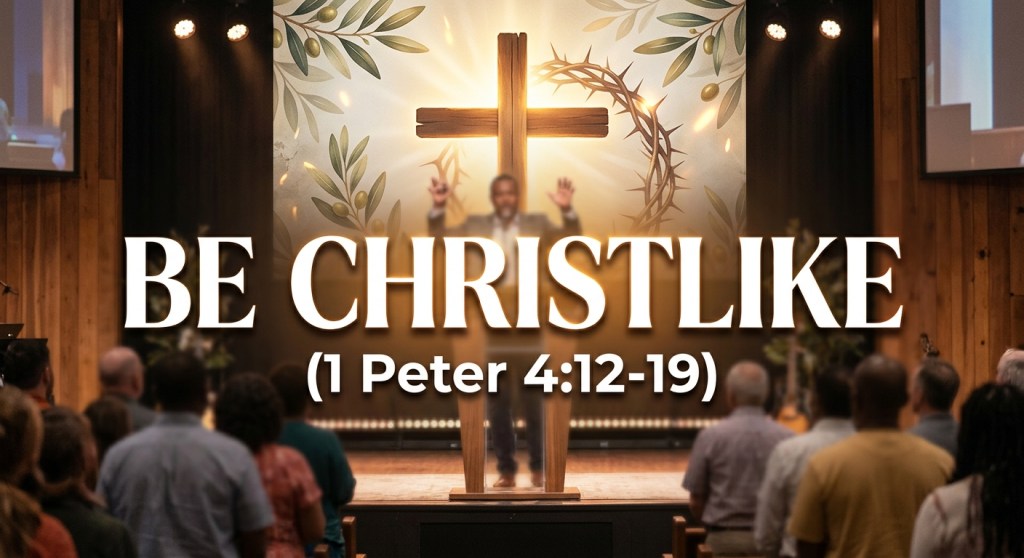

BE CHRISTLIKE

BE CHRISTLIKE                               

1 Peter 4:12-19 (LSB)

12 Beloved, do not be surprised at the fiery trial among you, which comes upon you for your testing, as though some strange thing were happening to you. 13 But to the degree you are sharing the sufferings of Christ, keep on rejoicing, so that also at the revelation of His glory you may rejoice with exultation. 14 If you are insulted for the name of Christ, you are blessed, because the Spirit of glory and of God rests on you. 15 Make sure that none of you suffers as a murderer, or thief, or evildoer, or a troublesome meddler; 16 but if anyone suffers as a Christian, he is not to be put to shame, but is to glorify God in this name. 17 For it is time for judgment to begin with the house of God; and if it begins with us first, what will be the outcome for those who do not obey the gospel of God? 18 And if it is with difficulty that the righteous is saved, what will become of the godless man and the sinner? 19 Therefore, those also who suffer according to the will of God must entrust their souls to a faithful Creator in doing good.

Introduction

Jesus lived every day with a clear awareness of the suffering He was called to endure. He spoke of it openly. He walked toward it willingly. He embraced it faithfully. He never treated suffering as a surprise, a mistake, or a sign that something had gone wrong in His Father’s plan.

Three times He told His disciples plainly that He must go to Jerusalem and suffer many things, and be killed, and be raised on the third day. He set His face toward the city. When Peter tried to talk Him out of it, He answered with the sharpest rebuke in the Gospels. When the hour came, He did not run. He did not negotiate. He did not ask for a different assignment.

But believers often do.

We tend to see suffering as a problem to escape, not a calling to embrace. We assume hardship means God is displeased, distant, or disinterested. We imagine that if we were more faithful, more prayerful, or more obedient, suffering would disappear.

We quietly assume that comfort is the normal Christian life, and that pain is an interruption of it.

Peter writes to correct that misunderstanding. He teaches us that suffering is not an interruption of the Christian life—it is part of the Christian life. It is not a detour from God’s will—it is often the very path God has appointed for us.

Peter knew what he was talking about. He had already been arrested, beaten, and threatened by the Sanhedrin. He had gone on his way from their presence “rejoicing that they had been considered worthy to suffer shame for the Name” (Acts 5:41). Now, writing to believers scattered across Pontus, Galatia, Cappadocia, Asia, and Bithynia, he prepares them for something harder.

Within a generation, a Roman governor named Pliny the Younger would write to the emperor Trajan about Christians in Bithynia. He described interrogating them, asking three times whether they were Christians, and executing those who would not deny the name. He recorded that they met before dawn and sang a hymn to Christ as to a god. The trial Peter described was not a metaphor. It was coming.

In this passage, Peter gives six exhortations that shape how believers suffer faithfully in a hostile world.

1. Suffer in Confidence (v. 12)

“Beloved, do not be surprised at the fiery trial among you… as though some strange thing were happening to you.”

Peter begins with a word of affection: “Beloved.” He wants them to hear this not as a rebuke but as a pastoral reminder. The word is agapētoi, the same word he uses to open the letter and to address them again later. Before he tells them anything hard, he tells them they are loved.

He says, “Do not be surprised.”

The verb is xenizesthe, built on xenos, which means a stranger or a foreigner. It means to be startled by something as though it were alien to you, to treat it as foreign to your experience. Peter uses the same word family back in verse four, where he says that unbelievers “are surprised that you do not run with them into the same excesses of dissipation.” The irony is sharp. The world is shocked that we will not sin with them. We are shocked that they hate us for refusing. One of those two reactions is irrational, and it is not theirs.

Suffering for Christ is not strange. It is not accidental. It is not random. It is not a sign that God has lost control.

It is the normal experience of those who follow a crucified Savior.

Jesus said it plainly: “If the world hates you, know that it has hated Me before it hated you” (John 15:18). Paul told Timothy, “Indeed, all who desire to live godly in Christ Jesus will be persecuted” (2 Timothy 3:12). That is not a maybe. It is a promise.

Peter calls it a “fiery trial.” The Greek word is pyrōsis, a burning. It is the word for the fire that melts ore so the metal can be separated from the slag. It is not the fire of a destroyer. It is the fire of a refiner.

Scripture uses that image again and again. “The refining pot is for silver and the furnace for gold, But Yahweh tests hearts” (Proverbs 17:3). “He will sit as a smelter and purifier of silver, and He will purify the sons of Levi and refine them like gold and silver” (Malachi 3:3). “I will bring the third part through the fire And refine them as silver is refined And test them as gold is tested” (Zechariah 13:9). “Behold, I have refined you, but not as silver; I have tested you in the furnace of affliction” (Isaiah 48:10).

Peter already said it once in this letter. Our faith, “being more precious than gold which is perishable, even though tested by fire,” will “be found to result in praise and glory and honor at the revelation of Jesus Christ” (1 Peter 1:7).

Gold is not destroyed by fire. Gold is proved by it. And so is genuine faith.

The three young men in Babylon understood this. They told Nebuchadnezzar that God was able to deliver them from the furnace, and then they added, “But if not, let it be known to you, O king, that we are not going to serve your gods” (Daniel 3:18). God did not keep them out of the fire. He met them in it. When they came out, the fire had “no power over the bodies of these men, nor was the hair of their head singed, nor were their trousers damaged, nor had the smell of fire even come upon them” (Daniel 3:27). Only their bonds burned.

That is what a refining fire does. It burns what holds you and leaves you.

So Peter says: Do not panic. Do not assume God has abandoned you. Do not treat suffering as an unexpected intruder.

Suffer with confidence, knowing God is at work.

2. Suffer with Joy (v. 13)

“But to the degree that you share the sufferings of Christ, keep on rejoicing…”

This is one of the most counterintuitive commands in Scripture: Rejoice in suffering.

Not because pain is pleasant. Not because trials are enjoyable. But because suffering for Christ means we are walking the same path He walked.

Peter says we “share the sufferings of Christ.” The verb is koinōneite, from koinōnia, fellowship. It means partnership, a shared stake in something common. Paul used the same idea when he wrote that he wanted “the fellowship of His sufferings, being conformed to His death” (Philippians 3:10). Suffering for Christ is not an interruption of our union with Him. It is one of the ways that union becomes visible.

Not His atoning suffering; that is His alone. No one shares the cross that bore the sin of the world. Peter says Christ “Himself bore our sins in His body on the tree” (1 Peter 2:24). That work is finished, and it is not repeatable. But we do share in the world’s hostility toward Him. When the world struck the Shepherd, it did not stop being hostile when the Shepherd left. The flock stands where He stood.

That is why Jesus met Saul of Tarsus on the Damascus road and asked, “Saul, Saul, why are you persecuting Me?” Saul had never touched Jesus. He had been dragging His people to prison. But Jesus takes the treatment of His people personally.

And Peter says this joy now prepares us for greater joy later: “…so that also at the revelation of His glory you may rejoice with exultation.”

There are two joy words in that sentence. The first is chairō, to rejoice. The second is agalliaō, to exult, to leap with gladness. Peter stacks them. It is as if he cannot say it strongly enough. Rejoicing now leads to exulting then. The joy we practice in the fire is a rehearsal for the joy we will have when the fire is out, and the glory appears.

Suffering now. Glory later. This is the pattern of Christ, and the pattern of all who belong to Him.

“For I consider that the sufferings of this present time are not worthy to be compared with the glory that is to be revealed to us” (Romans 8:18). Paul called his affliction “momentary, light” and said it was “working out for us an eternal weight of glory far beyond all comparison” (2 Corinthians 4:17). He was not minimizing pain. He was measuring it against something larger.

Joy in suffering is not denial. It is hope. It is the confidence that the story ends in glory.

James said, “Consider it all joy, my brothers, when you encounter various trials, knowing that the testing of your faith brings about perseverance” (James 1:2-3). He did not say feel joyful. He said consider it. Count it. Do the arithmetic. Put the trial on one side of the ledger and the outcome on the other, and see which one is heavier.

That is not stoicism. Stoicism clenches its teeth and refuses to feel. Christian joy opens its hands and refuses to despair.

3. Receive Insults as Blessings (v. 14)

“If you are insulted for the name of Christ, you are blessed…”

Insults sting. Mockery wounds. Rejection hurts.

Peter does not pretend otherwise. He does not tell us to develop a thick skin. He tells us to reinterpret what is happening.

The word he uses is oneidizō, to reproach, to heap scorn on someone. It is the word used of the crowds who mocked Jesus on the cross. It is the word behind Hebrews 11:26, where Moses is described as “regarding the reproach of Christ greater riches than the treasures of Egypt.” Moses did the same arithmetic. He weighed reproach against treasure and chose reproach.

But Peter says that when insults come because of Christ, they are not curses; they are blessings.

The word is makarioi, blessed. It is the word Jesus used to open the Sermon on the Mount. It does not describe a warm feeling. It describes a verdict. It is God’s own assessment of your condition, announced from the throne. The world has rendered its verdict, and the world’s verdict is that you are contemptible. God has rendered His verdict, and His verdict is that you are blessed. Only one of those verdicts is binding.

Why? “…because the Spirit of glory and of God rests on you.”

The verb is anapauetai, to rest, to settle down, to cease from labor. It is the picture of a dove lighting and staying. It is the word used in Isaiah 11:2 of the Messiah: “The Spirit of Yahweh will rest on Him.” Peter is telling insulted believers that the same Spirit who rested on Jesus rests on them.

That is why the insult is not the whole story. In the very moment the world pushes you away, the Spirit settles on you.

When the world rejects you for Christ, God affirms you. When the world dishonors you, God honors you. When the world pushes you away, God draws near.

The insult of the world becomes the evidence of the Spirit’s presence.

This is why believers can endure ridicule without bitterness, slander without retaliation, and rejection without despair.

Peter already told us what that looks like. Christ, “who being reviled, was not reviling in return; while suffering, He was uttering no threats, but kept entrusting Himself to Him who judges righteously” (1 Peter 2:23). He did not answer insult with insult, because He knew who was watching and who would judge.

The world’s insults become God’s reminders: “You belong to Me.”

4. Glorify God by Suffering for Your Faith (vv. 15–16)

“Make sure that none of you suffers as a murderer, or thief, or evildoer, or troublesome meddler…”

Peter is clear: Not all suffering is noble. Not all hardship is persecution. Some suffering is simply the consequence of sin.

That is a bracing word, and we need it. It is possible to suffer and to be wrong. It is possible to call our pain persecution when it is really the harvest of our own foolishness. Peter names four categories.

A murderer, a thief, an evildoer. Those are obvious. And then he adds one that surprises us: a “troublesome meddler.” The Greek is allotriepiskopos, and it appears nowhere else in the New Testament. It is built from allotrios, “belonging to another,” and episkopos, “overseer.” The LSB footnote reads “Lit. one who oversees others’ affairs.” It is a person who appoints himself bishop of somebody else’s business.

Peter puts that in the same list as murder and theft. That should make us sit up. Meddling is not a minor social flaw. It is the kind of sin that brings deserved suffering and dishonors the name it claims.

But if suffering comes because you bear the name of Christ, Peter says: “He is not to be ashamed, but is to glorify God in this name.”

The word for “Christian” is Christianos, and it appears only three times in the whole New Testament. The disciples were first called Christians in Antioch (Acts 11:26). Agrippa said to Paul, “In such short time are you persuading me to become a Christian?” (Acts 26:28). And here. It was probably a nickname invented by outsiders, formed the way the Jews formed the name Herodianoi for the partisans of Herod. It meant “the people of that one.” It was not a compliment. It became a badge.

Do not be ashamed. Do not hide your faith. Do not shrink back.

Instead, glorify God by suffering faithfully:

with integrity,

with humility,

with steadfastness,

with visible allegiance to Christ.

The world may shame you for Christ, but God calls you to honor Him through your suffering.

Notice the bookends of this chapter. In verse 11, Peter says, “so that in all things God may be glorified through Jesus Christ, to whom belongs the glory and might forever and ever. Amen.” In verse 16 he says, “but is to glorify God in this name.” The whole chapter has one aim. Whether you are speaking or serving or suffering, the aim is the same: that God would be glorified. Suffering is not an exception to that rule. It is one more arena where it can happen.

5. Realize the Time We Are In (vv. 17–18)

“For it is time for judgment to begin with the house of God…”

Peter shifts the perspective. Suffering is not merely about the world’s hostility. It is about God’s refining work.

The word for “time” is kairos, a season, an appointed moment. It is the same word Peter used a few verses earlier: “The end of all things is at hand” (1 Peter 4:7). He is not describing a distant possibility. He is describing the era the church is already living in.

And the word for judgment is krima, the verdict and the sentence that follows it. Judgment begins with God’s people. Not condemnation, but purification.

That distinction matters. There is “now no condemnation for those who are in Christ Jesus” (Romans 8:1). But there is discipline, and discipline is a form of judgment. “Those whom I love, I reprove and discipline” (Revelation 3:19). “For those whom the Lord loves He disciplines, and He flogs every son whom He receives” (Hebrews 12:6). The writer goes on to say that “all discipline for the moment seems not to be joyful, but sorrowful, but to those who have been trained by it, afterward it yields the peaceful fruit of righteousness” (Hebrews 12:11).

God is preparing His church for glory by cleansing it through trials. He is stripping away idols, exposing hypocrisy, strengthening faith, and producing holiness.

The image of the refiner returns. Malachi saw the refiner sitting. He does not wander away from the crucible. He sits over it and watches the metal until the dross is gone and He can see His own reflection in the silver.

Peter points to the house of God, the church. The LSB cross-references here are suggestive. Jeremiah 25:29 speaks of judgment beginning with the city called by God’s name. Ezekiel 9:6 has the executioners beginning at the sanctuary. Amos 3:2 says, “You only have I known among all the families of the earth; Therefore I will punish you for all your iniquities.” Nearness to God does not exempt a people from judgment. It raises the standard. That is what an attentive Father does. Judgment begins at home.

If the righteous are saved “with difficulty,” meaning through many trials, what will become of those who reject the gospel?

The word is molis, “barely,” “with difficulty,” “sparingly.” It does not mean that God is reluctant, or that salvation is uncertain, or that we are saved by the skin of our teeth because the scale nearly tipped. It means the road is hard. It means the righteous are saved through a narrow and costly way. Paul and Barnabas went through the churches “strengthening the souls of the disciples, encouraging them to continue in the faith, and saying, ‘Through many afflictions we must enter the kingdom of God’” (Acts 14:22). Jesus said the gate is narrow and the way is constricted (Matthew 7:14).

Peter is quoting from Proverbs 11:31, where the LSB reads, “If the righteous will be repaid in the earth, how much more the wicked and the sinner!” The argument runs from the lesser to the greater. If even the beloved children of God must pass through the fire, what awaits those who refuse the gospel altogether?

That question deserves an answer, and Peter does not soften it. Their end is real. The LSB cross-reference at verse 17 points to 2 Thessalonians 1:8, where Christ comes “executing vengeance on those who do not know God and to those who do not obey the gospel of our Lord Jesus.”

Scripture describes that end in the plainest terms. “Do not fear those who kill the body but are unable to kill the soul; but rather fear Him who is able to destroy both soul and body in hell” (Matthew 10:28). “For the wages of sin is death, but the gracious gift of God is eternal life in Christ Jesus our Lord” (Romans 6:23). “But for the cowardly and unbelieving and abominable and murderers and sexually immoral persons and sorcerers and idolaters and all liars, their part will be in the lake that burns with fire and brimstone, which is the second death” (Revelation 21:8). The godless man and the sinner come to an end, not to an endless existence in misery. The One “who alone has immortality” is God (1 Timothy 6:16), and immortality is something Christ “brought to life” through the gospel (2 Timothy 1:10). It is a gift, not a birthright. “For God so loved the world, that He gave His only begotten Son, that whoever believes in Him shall not perish, but have eternal life” (John 3:16). To perish is to be lost, not to be kept alive forever in torment.

That is why the question Peter asks is so urgent. He is not trying to frighten the church. He is trying to steady it. He wants believers to see suffering in light of eternity. This is not the time for comfort. This is the time for refinement. This is the time for steadfastness.

The contrast is sharp. The one who hears Christ’s word and believes “has eternal life, and does not come into judgment, but has passed out of death into life” (John 5:24). The one who refuses the gospel remains in death. “He who believes in the Son has eternal life; but he who does not obey the Son will not see life, but the wrath of God abides on him” (John 3:36).

We are living in the days when God is purifying His people for the return of Christ. For the world, it is a warning. For the church, it is a promise. The fire that proves us is the same fire that will consume what refuses to be refined.

6. Trust in God’s Faithfulness (v. 19)

“Therefore, those also who suffer according to the will of God shall entrust their souls to a faithful Creator in doing good.”

This is Peter’s final word: Entrust your soul to God.

Not to circumstances. Not to your own strength. Not to the approval of others.

The word is paratithesthai, from paratithēmi, which means to place something alongside someone, to deposit it with them for safekeeping. It is a banking word. It is what you do with something valuable when you must go on a journey and cannot carry it with you. You do not hide it in the ground. You do not leave it in the street. You hand it to someone you trust.

Jesus used the same word on the cross. “Father, into Your hands I commit My spirit” (Luke 23:46). Luke chose paratithēmi deliberately. In the moment of His greatest weakness, Jesus made a deposit.

Peter used it too, two chapters earlier, when he described Christ, “who while suffering, He was uttering no threats, but kept entrusting Himself to Him who judges righteously” (1 Peter 2:23). Now he tells us to do what Christ did.

Paul used it of his own life. “I know whom I have believed and I am convinced that He is able to guard what I have entrusted to Him until that day” (2 Timothy 1:12). Deposit, then trust the depository.

Entrust your soul to the faithful Creator, the One who made you, sustains you, and governs all things.

Peter could have said, faithful Father or faithful Redeemer. Instead, he says faithful Creator. The word ktistēs appears only a handful of times in the New Testament. It reminds us of two things at once. The One you are trusting has the power to keep you, because He made everything. And He has the right to dispose of what He made, because it is His. Both of those truths are a comfort when the world is deciding what to do with you.

“According to the will of God” is the qualifier. Not all suffering is God’s will. Suffering we bring on ourselves by sin is not. But there is a suffering that comes because it is God’s will that we honor Him in a hostile world. When that is the kind of suffering you are in, you are exactly where He wants you, and you can trust Him there.

And while you suffer, Peter says, “keep doing good.”

The phrase is en agathopoiia, “in doing good.” It is the last word of the paragraph, and it is the shape faith takes when it trusts. Trusting is not passive. It does not sit down and wait. It keeps its hands busy with the next good thing.

Do not withdraw. Do not retaliate. Do not grow bitter. Do not give up.

Keep doing good because God is faithful. Keep doing good because suffering is temporary. Keep doing good because glory is coming.

Peter has already said this twice in the letter. “For what credit is there if, when you sin and are harshly treated, you endure? But if when you do good and suffer for it, you endure, this finds favor with God” (1 Peter 2:20). “For it is better, if God should will it so, that you suffer for doing good rather than for doing wrong” (1 Peter 3:17). And now a third time. Doing good is not the price of God’s faithfulness. It is the response to it.

Conclusion

Jesus lived with a constant awareness of the suffering He was called to. He embraced it for the joy set before Him. He endured it for the glory of His Father. He walked through it trusting the One who judges righteously.

Peter calls us to follow Him.

So, beloved:

Suffer in confidence.

Suffer with joy.

Receive insults as blessings.

Glorify God in your suffering.

Understand the time we are in.

Entrust your soul to your faithful Creator.

And when the fire has done its work, the God of all grace, “who called you to His eternal glory in Christ, will Himself restore, strengthen, confirm, and ground you” (1 Peter 5:10).

This is not a strange path. It is the path of Christ. And it leads to glory.

Amen.
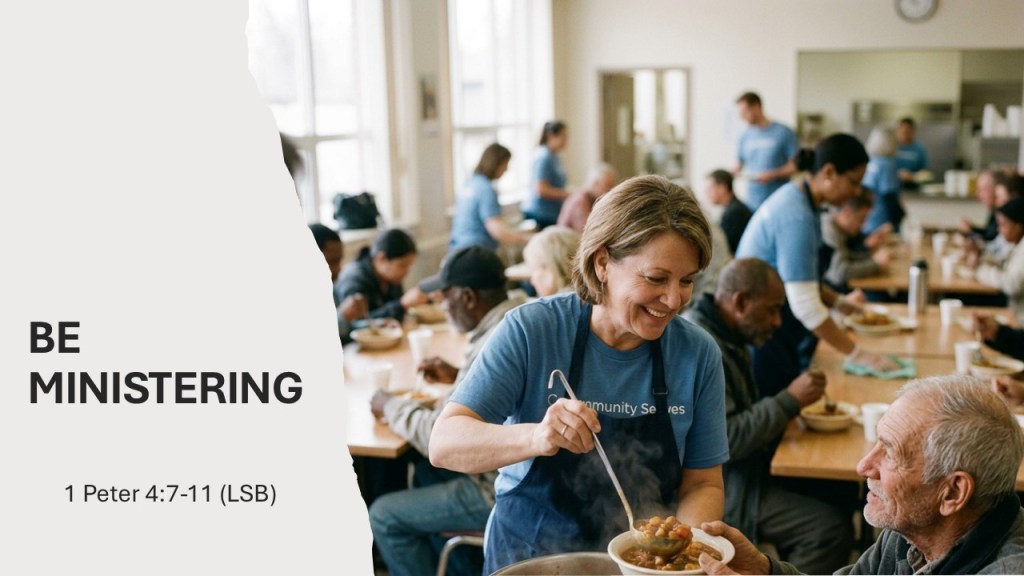
BE MINISTERING

BE MINISTERING

1 Peter 4:7-11 (LSB)

7 The end of all things is at hand; therefore, be of sound thinking and sober spirit for the purpose of prayer. 8 Above all, keep fervent in your love for one another, because love covers a multitude of sins. 9 Be hospitable to one another without grumbling. 10 As each one has received a gift, employ it in serving one another as good stewards of the manifold grace of God— 11 whoever speaks, as one speaking the oracles of God; whoever serves, as one serving by the strength which God supplies; so that in all things God may be glorified through Jesus Christ, to whom belongs the glory and might forever and ever. Amen.

Introduction

During the catastrophic Ebola outbreak across West Africa from 2014 to 2016, physicians, nurses, ambulance drivers, burial teams, and international aid workers encountered an unimaginable level of physical, mental, and spiritual pressure. Every single morning, these individuals voluntarily stepped directly into environments where lethal infection was an omnipresent, invisible threat. Many watched their direct colleagues become infected and perish. Countless healthcare workers buried their own family members before returning to their shifts, enduring the overwhelming, crushing strain of fear, quarantine, and societal panic.

Yet, amidst this horrific escalation, thousands of these dedicated workers repeatedly chose to show up. They did not abandon their posts. They continued treating patients in overcrowded wards, comforting the agonizing and dying, educating fearful rural communities, and administering essential medical relief to those in the most desperate human need. While the surrounding pressure rapidly intensified and society threatened to collapse into chaos, they resolutely refused to withdraw from their profound responsibilities. Instead, they deepened their resolve, actively ministering to humanity right in the absolute thick of the crisis.

The Apostle Peter writes his first epistle to first-century believers who were facing a uniquely severe, exhausting type of pressure. These early Christians dwelt as scattered exiles within an intensely hostile Roman culture that fundamentally misunderstood their beliefs, routinely slandered their lifestyle, politically marginalized their communities, and increasingly subjected them to social ostracism and state-sanctioned persecution because of their unyielding allegiance to Jesus Christ.

Yet, in addressing this beleaguered flock, Peter surprisingly does not instruct them to construct a holy fortress, retreat into isolated monasticism, disengage from a decaying society, or passively hunker down in self-preservation until Christ returns to rescue them. Instead, under the inspiration of the Holy Spirit, Peter calls them directly into active, sacrificial, outward-facing ministry.

For the early church—and for the contemporary church today—the divine truth that the historical curtain is rapidly drawing toward the ultimate culmination of God’s redemptive plan was never intended to serve as a justification for spiritual panic, existential dread, or self-indulgent passivity. Rather, the imminent consummation of all things stands as the ultimate catalyst to pray with unshakeable spiritual clarity, to love one another with relentless fervor, to open homes and lives with radical hospitality, and to deploy God-given spiritual gifts with uncompromising diligence.

In 1 Peter 4:7-11, the apostle provides a remarkably concise, deeply profound, and enduring blueprint of precisely what the redeemed community of God must look like under intense cultural and eschatological pressure. When the surrounding world grows increasingly chaotic, dark, and hostile toward divine truth, the church of Jesus Christ is not commissioned to scale back its ministering presence. It is summoned to intensify it.

The church is called by God to function as a vibrant, holy, ministering counter-community. In these five short verses, Peter articulates a compact yet immensely powerful vision of a healthy, Spirit-formed, Christ-centered church operating effectively in the last days. It is a church that actively ministers to the saints and a dying world through vigilant prayer, through self-sacrificing love, through open-hearted fellowship, and through the intentional stewardship of diverse spiritual gifts—all directed toward the supreme end of magnifying the glory of God.

1. Be Ministering Through Prayer (v. 7)

“The end of all things is at hand; therefore, be of sound thinking and sober spirit for the purpose of prayer.”

Peter initiates this seminal directive by establishing an inescapable theological reality that dictates all Christian ethics: “The end of all things is at hand.” In the biblical worldview, the incarnation, sinless life, substitutionary death, victorious resurrection, and ascension of Jesus Christ inaugurated the final era of human history—the “last days.” The decisive battles of redemption have been fought and won at Calvary and the empty tomb; all that remains is the final, imminent return of the King to consummate His glorious kingdom.

When Peter writes that this ultimate conclusion is “at hand,” he is not inviting frantic speculative calculations, apocalyptic panic, or wild predictions regarding dates and times. Rather, he is establishing a profound spiritual perspective. He is re-orienting the mind of the Christian away from the temporal, passing illusions of this present evil age and fixing it upon the absolute certainty of Christ’s ultimate victory. Perspective, not panic, is the mandatory foundation of eschatological living.

Because the end of all human history is imminent and eternity hangs in the balance, believers cannot afford to drift along in spiritual lethargy or emotional instability. Therefore, Peter commands two distinct mindsets necessary for effective spiritual ministry:

  • Be of sound thinking (Clear-minded): Believers must cultivate a mind governed by divine truth, sound doctrine, and emotional restraint. To be clear-minded means refusing to be swept away by the prevailing cultural hysteria, political outrage, economic anxiety, or sudden waves of personal fear. It means evaluating all earthly circumstances through the immovable lens of God’s sovereign Word rather than the volatile swings of public sentiment.
  • Be of sober spirit (Sober-spirited): Believers must maintain rigorous spiritual alertness, discipline, and self-control. Spiritual sobriety stands in direct contrast to spiritual drunkenness, apathy, or distraction. Just as a physical guard on the perimeter of a city must remain alert, clear-headed, and vigilant against incoming danger, the Christian must be spiritually awake, guarded against the seductive influences and numbing entertainments of a fallen world.

Notice the divine sequence and purposeful end of Peter’s exhortation: we are commanded to maintain sound thinking and a sober spirit “for the purpose of prayer.” Clear thinking and spiritual alertness are not isolated intellectual achievements; they are the essential prerequisites for a disciplined, effective prayer life.

When the human mind is consumed by earthly anxieties, irrational fear, unbridled anger, or worldly distractions, prayer becomes distorted, selfish, chaotic, or completely abandoned. Spiritual clarity feeds purposeful prayer, and purposeful prayer sustains spiritual clarity.

Prayer, within the framework of Peter’s theology, is far more than a spiritual emergency exit or a last resort when human efforts fail. Prayer is the indispensable, frontline ministry of the local church.

  • Prayer is not passive; it is active service. It is the hard work of kneeling before the throne of grace on behalf of a suffering world and a struggling church.
  • Prayer is not an escape from reality; it is strategic engagement with the supreme God who actively rules, overrules, and directs the grand course of human history.

In a world that appears to be unraveling at every seam—where moral boundaries are erased, societies fracture, and persecution mounts—the church’s premier ministry to its members and its culture is to pray. We are called to pray not with confused minds, but with scriptural clarity; not with unstable panic, but with holy stability; not with cynical despair, but with unshakable confidence in the promises of God.

A praying church is, by definition, a ministering church. Conversely, a prayerless church—no matter how impressive its programs, facilities, or worldly influence may seem—is a functionally powerless church. Peter firmly summons every believer to step onto the spiritual battlefield by lifting their eyes to the Almighty God, interceding passionately for one another, and constantly pleading for divine strength to execute the holy mission Christ has entrusted to His bride.

2. Be Ministering by Caring for One Another (v. 8)

“Above all, keep fervent in your love for one another, because love covers a multitude of sins.”

Transitioning from our fundamental vertical orientation toward God in prayer, Peter immediately turns to our horizontal relationships within the body of Christ. He introduces this section with an emphatic priority: “Above all.” These are Peter’s explicit words under the inspiration of the Spirit, not a human opinion. Amidst all the complex duties, theological debates, organizational structures, and practical challenges facing a church living under intense societal pressure, the absolute highest, non-negotiable priority is the cultivation and exercise of genuine Christian love. In the final days of human history, the most critical, foundational ministry the church offers to itself is supernatural, self-sacrificing love.

However, Peter does not call us to a vague, sentimentally warm, or superficial emotion. He does not mandate a polite, superficial friendliness that avoids true vulnerability. Instead, Peter commands: “keep fervent in your love for one another.” The Greek term translated as “fervent” (ektenēs) is a vivid athletic metaphor. It pictures an athlete straining with every fiber of their muscle, stretching to the absolute physical limit to cross the finish line or reach a mark.

This is not easy, convenient, or effortless affection. This is:

  • Love that strains against natural human selfishness, pride, and personal preference.
  • Love that stretches beyond comfort zones, social boundaries, and personal offenses.
  • Love that keeps going even when it is costly, unappreciated, exhausting, or emotionally painful.

Why does Peter assign such paramount urgency to this caliber of straining love? He provides the explicit biblical reason: “because love covers a multitude of sins.”

In declaring this, Peter is echoing the timeless wisdom of Proverbs 10:12 (“Hatred stirs up strife, but love covers all transgressions”). It is crucial to understand what Peter does not mean by this statement. He does not mean that human love somehow atones for guilt or purchases forgiveness before God; only the precious, shed blood of Jesus Christ can wash away sin. Nor does Peter mean that church leaders should ignore gross immorality, sweep severe abuse under the rug, or refuse to exercise wise, biblical church discipline when unrepentant sin threatens the purity and safety of the flock.

Rather, Peter means that fervent, Spirit-led love chooses not to magnify, weaponize, or broadcast the daily offenses, slights, shortcomings, and missteps that inevitably occur when sinful human beings live together in community. In a fallen world, brothers and sisters in Christ will periodically displease, misunderstand, irritate, and hurt one another. Where love is cold or absent, minor offenses are instantly seized upon, brooded over, endlessly discussed through gossip, exaggerated, and transformed into destructive fires of church conflict and schism. But where fervent love reigns, grace creates a protective canopy over human frailty.

Fervent Christian love:

  • Absorbs offenses graciously without harboring secret ledgers of wrongdoing.
  • Forgives quickly and completely, releasing resentment before it can poison the soul.
  • Refuses bitterness by choosing to extend the same lavish grace we have received at the cross.
  • Protects unity by shutting down divisive gossip, malicious slander, and unfair assumptions.
  • Restores relationships through patient, gentle, and merciful reconciliation.

When a local gathering of believers actively ministers through this brand of fervent, sin-covering love, it transforms into an indestructible spiritual sanctuary—a true city set on a hill, providing light and safety in a dark, vindictive world. Conversely, a church that lacks this self-sacrificing love becomes nothing more than a religious echo of the surrounding culture: an institution marked by outrage, tribalism, factionalism, and harsh judgment. Fervent love is the undeniable hallmark of authentic Christian discipleship.

3. Be Ministering by Fellowship (v. 9)

“Be hospitable to one another without grumbling.”

From the internal posture of fervent love, Peter seamlessly moves to its concrete, practical expression: biblical hospitality and true fellowship. In the modern context, “hospitality” is frequently confused with entertaining—inviting close friends or family members into a beautifully decorated home for an elaborate meal to impress them or enjoy easy social conversation. While sharing meals is delightful, the biblical concept of hospitality (philoxenia, which literally translates as “love of strangers”) is far deeper, far more radical, and significantly more demanding.

Authentic biblical hospitality is not merely having people over for dinner; it is the intentional opening of your life, your living space, your time, your financial resources, and your heart to others within the household of faith.

In the first-century Roman Empire, hospitality was not a luxury; it was an absolute necessity for the survival and expansion of the early church:

  • Traveling believers, itinerant evangelists, and missionaries had no safe commercial lodging; ancient inns were notoriously corrupt, immoral, dangerous, and expensive. They depended entirely on local Christians opening their doors.
  • Persecuted believers who had lost their homes, jobs, or family connections due to their testimony for Jesus Christ desperately needed physical refuge, shelter, and material assistance.
  • Lonely, isolated believers whose pagan families and social circles had cast them out needed a new spiritual family to surround them with warmth, belonging, and emotional support.

Because the early church met primarily in private homes, the open door was literally the foundation of corporate worship, discipleship, and evangelism. Without radical hospitality, the early Christian movement would have ground to a halt.

Recognizing the heavy demands that true hospitality places upon human patience and resources, Peter attaches a crucial, heart-exposing qualification to this command: “without grumbling.”

The word “grumbling” (gongysmos) refers to low, muttered complaints, secret resentment, or whispering under one’s breath. Peter understands human nature: it is entirely possible to perform the outward act of hospitality while inwardly harboring deep irritation over lost personal privacy, ruined schedules, spent money, or messy carpets. We can open our front doors while keeping our hearts tightly locked.

Peter exposes this hypocrisy because God evaluates not merely the external action, but the internal motivation:

  • Hospitality is not genuine ministry if it is accompanied by secret resentment.
  • It is not true Christian fellowship if it is coerced, forced, or performed out of cold obligation.
  • It is not authentic love if it is offered reluctantly, leaving the recipient feeling like an inconvenient burden rather than a prized brother or sister in Christ.

True, Spirit-empowered fellowship is joyful, sacrificial, and wholehearted. It is the practical ministry of making room for others—deliberately opening space in our busy calendars, expanding our budgets, adjusting our personal comforts, and softening our hearts to embrace those who are hurting, needy, or simply different from us.

When a local congregation becomes renowned for practicing cheerful, uncomplaining hospitality, it displays a radiant, living advertisement of the gospel. It reflects the very character of God, who opened His heavenly home to us when we were alienated strangers, inviting us to feast at His table as redeemed sons and daughters through the sacrifice of His Son.

4. Be Ministering with Your Spiritual Gifts (vv. 10–11a)

“As each one has received a gift, employ it in serving one another as good stewards of the manifold grace of God—whoever speaks, as one speaking the oracles of God; whoever serves, as one serving by the strength which God supplies;”

In this crucial section, Peter transitions to the corporate functioning of the church through the mobilization of spiritual gifts. He begins by making a foundational theological assertion that dismantles the pervasive, erroneous divide between “clergy” and “laity”: “As each one has received a gift…”

Peter explicitly assumes what many modern believers mistakenly doubt or overlook. Every single genuinely born-again Christian has been sovereignly endowed by the Holy Spirit with at least one spiritual gift designed for corporate ministry.

  • Not just some believers are gifted; every single member of the body has a divine role.
  • Not the ordained leadership only possess spiritual equipment for ministry.
  • Not merely the exceptionally “talented,” articulate, or prominent personalities are called to minister.
  • Every believer without exception has received a unique spiritual capability from God.

Peter then commands what must be done with this divine endowment: “employ it in serving one another.” Your spiritual gift is not a personal trophy awarded for your spiritual performance; it is a spiritual tool forged for corporate labor. It is not intended for self-aggrandizement, public display, or individual ambition; it is given strictly for the practical service, encouragement, and edification of the local church.

Peter clarifies our identity regarding these gifts by calling us “good stewards of the manifold grace of God.” A steward in the ancient world was a servant entrusted with managing, distributing, and overseeing their master’s household assets. The steward owned nothing; they merely administered the owner’s wealth according to the owner’s explicit directions.

God’s grace is “manifold”—meaning multi-faceted, infinitely varied, richly diverse, and multi-colored. No single Christian possesses all spiritual gifts or reflects the fullness of God’s grace alone. Instead, God distributes His grace in diverse measure across the entire body, so that we remain mutually dependent upon one another. Your spiritual gift is a dynamic portion of God’s manifold grace entrusted to you for the direct benefit of your brothers and sisters. To withhold your gift is to deprive the church of the specific manifestation of grace God designed you to dispense.

To simplify the vast array of spiritual gifts, Peter organizes them into two primary, comprehensive functional categories:

A. Speaking Gifts

“Whoever speaks, as one speaking the utterances of God;”

This category encompasses all gifts that primarily utilize verbal proclamation: preaching, formal teaching, public exhortation, personal counseling, biblical encouragement, and wise spiritual direction.

Peter establishes an extraordinarily high standard for anyone who exercises a speaking gift: they must do so “as one speaking the utterances [oracles] of God.” This does not mean the speaker’s words are infallible scripture, but rather that the speaker must hold a deep, reverent awe for God’s divine Word.

Teachers and speakers in the church must not use their platform to promote personal political agendas, human philosophies, entertaining stories, speculative opinions, or clever worldly wisdom. When a believer steps forward to speak in Christ’s church, they must speak as a faithful herald of the King, accurately bringing the absolute, binding authority of Holy Scripture to bear upon the hearts and minds of the listeners.

B. Serving Gifts

“Whoever serves, as one serving by the strength which God supplies;”

This category encompasses all gifts that primarily manifest through practical, action-oriented support: administration, practical help, mercy ministry, physical maintenance, financial giving, hospitality leadership, and invisible acts of service.

Just as Peter set a standard for speaking, he sets a vital standard for serving: it must be performed “by the strength which God supplies.” The Greek word for “supplies” (chorēgeō) historically referred to a wealthy patron who lavishly funded and fully supplied a grand choir or theatrical production. God is our grand patron who abundantly, infinitely, and perpetually supplies every ounce of energy required for Christian ministry.

Serving in the church is never meant to be fueled by finite human energy, natural willpower, fleshly ambition, or self-reliant stamina. When we attempt to serve in our own strength, we inevitably burn out, grow bitter, become cynical, and demand human recognition. But when we serve in continuous reliance upon the Holy Spirit, we tap into an inexhaustible reservoir of divine power—literally “the strength that God keeps on lavishly supplying.”

Whether your unique spiritual gift is prominent or unseen, public or private, vocal or practical, highly visible or quietly supportive, it is a holy channel through which God’s multifaceted grace flows to build up the church. A local church where every single member actively discovers, develops, and deploys their spiritual gift in reliance upon God is a church vibrant with supernatural vitality, spiritual maturity, and divine power.

Conclusion: Minister to God’s Glory (v. 11b)

“…so that in all things God may be glorified through Jesus Christ, to whom belongs the glory and might forever and ever. Amen.”

In the grand climax of this passage, Peter unveils the ultimate, overarching purpose behind every aspect of Christian life and church ministry: “so that in all things God may be glorified through Jesus Christ.”

This is the supreme, non-negotiable end of all true Christian existence. This grand objective must dictate every sermon preached, every prayer offered, every act of hospitality extended, every sin covered in love, every dollar given, and every invisible act of service rendered within the church:

  • Not our personal recognition, applause, or human praise.
  • Not our personal comfort, ease, or worldly advancement.
  • Not our numerical success, institutional growth, or impressive facilities.
  • Not our church’s earthly reputation or cultural standing.

The ultimate goal of all faithful ministry is the explicit magnification of the transcendent glory of God through the person and work of Jesus Christ.

When believers pray with clear-minded spiritual sobriety, love each other with earnest, sin-covering fervor, open their homes with joyful hospitality, and faithfully exercise their spiritual gifts in divine strength, something miraculous happens: the world and the church are forced to look past the human instruments and behold the heavenly Master. The church transforms into a living, breathing doxology—a holy community whose total lifestyle perpetually points upward, declaring the boundless worth, grace, and majesty of the God who redeemed them out of darkness into His marvelous light.

Overwhelmed by the majesty of this divine vision, Peter naturally bursts into an outburst of spontaneous praise and adoration: “to whom belongs the glory and might forever and ever. Amen.”

  • Glory belongs to Him—all honor, reverence, beauty, and praise are His eternal right.
  • Might belongs to Him—all sovereign power, authority, dominion, and strength belong to Him alone.
  • Forever and ever—His glorious reign is unshakeable, unending, and impervious to the rise and fall of earthly empires or societal decay.

This doxology is not a mere formal, liturgical closing to a letter. It is the very heartbeat of all genuine Christian ministry. It is the defining purpose of the local church. It is the glorious, eternal destiny of all God’s redeemed people.

Final Exhortation

Beloved brothers and sisters, the end of all things is truly at hand. The return of our Lord Jesus Christ is closer today than it has ever been in human history.

God gives the reality of His imminent coming:

  • Not to frighten us into existential panic or spiritual anxiety,
  • Not to paralyze us into passive, fearful self-preservation,
  • Not to isolate us behind closed doors while the world burns,

…but to intensely focus our minds on eternal realities, and to powerfully mobilize our lives for gospel ministry.

Therefore, while daylight remains and the night approaches, let us rise and be ministering:

  • Through prayer that is clear-minded, sober, and unceasing;
  • Through love that is fervent, deep, and quick to cover sin;
  • Through fellowship that is hospitable, warm, and free from grumbling;
  • Through spiritual gifts deployed faithfully as good stewards of God’s manifold grace—

…so that in all things, in every detail of our life together, God may be supreme, Christ may be exalted, and His church may radiate His matchless light until He comes again in power and great glory.

Amen.