The Gospel Choice (Gal. 4:21-31).

Galatians 4:21-31 Tell me, you who desire to be under the law, do you not listen to the law? 22 For it is written that Abraham had two sons, one by a slave woman and one by a free woman. 23 But the son of the slave was born according to the flesh, while the son of the free woman was born through promise. 24 Now this may be interpreted allegorically: these women are two covenants. One is from Mount Sinai, bearing children for slavery; she is Hagar. 25 Now Hagar is Mount Sinai in Arabia; she corresponds to the present Jerusalem, for she is in slavery with her children. 26 But the Jerusalem above is free, and she is our mother. 27 For it is written, “Rejoice, O barren one who does not bear; break forth and cry aloud, you who are not in labor! For the children of the desolate one will be more than those of the one who has a husband.” 28 Now you, brothers, like Isaac, are children of promise. 29 But just as at that time he who was born according to the flesh persecuted him who was born according to the Spirit, so also it is now. 30 But what does the Scripture say? “Cast out the slave woman and her son, for the son of the slave woman shall not inherit with the son of the free woman.” 31 So, brothers, we are not children of the slave but of the free woman.

We have been meditating on Paul’s letter to the Galatians for the past few months. Paul was dealing with a problem that had developed not only in the Galatian region, but in many places where new Gentile churches had been established. A group of people from Jerusalem had infiltrated these Gentile churches and suggested an alternative to the Gospel of salvation by grace that Paul preached. Their alternative involved trusting in Jesus for their salvation, AND following the Jewish customs and traditions.
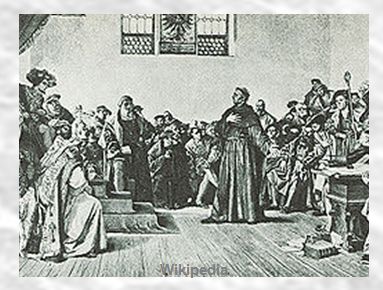
This problem was not unique to the first century AD. For two thousand years the Church of Jesus Christ has had to constantly re-evaluate and reform itself because human traditions keep crowding themselves into its doctrines and practices.
We have depended upon the Bible as God’s standard for what it means to be the Church. Each successive generation has had to re-look at the Bible to see if we have added some new human traditions and crowded out the simple truth of the gospel.

Fortunately today the Bible is not hidden from us. We no longer have to depend on professional clergy to tell us what the Bible says, or to interpret its message for us. Those of us who speak English have dozens of well-prepared Bible translations available for us to read. We even have access to the original languages in which the Bible was written. Nothing keeps us from getting a clear message from God, and responding to that message in faith.
Nothing, that is, except laziness or presuming that we already understand the Bible!

Today’s text offers us an opportunity not just to re-examine the Bible, but to re-examine ourselves, and the choice that we have made that puts us in this church building today. Paul was writing to people who claimed to be true Christians, but he argued that they had substituted the true faith that they had received for a false faith, a faith in both Christ and themselves.
As we examine Paul’s argument in Galatians 4:21-31, we need to be asking ourselves what choice we have made as well.

Here is the story that Paul was alluding to in today’s text. In Genesis 15 God had promised Abraham that he would be the father of many nations, but he was childless.
Genesis 16:2 And Sarai said to Abram, “Behold now, the LORD has prevented me from bearing children. Go in to my servant; it may be that I shall obtain children by her.” And Abram listened to the voice of Sarai.
Genesis 16:15 And Hagar bore Abram a son, and Abram called the name of his son, whom Hagar bore, Ishmael.

Now let us pick up the story 14 years later:
Genesis 17:15-19 And God said to Abraham, “As for Sarai your wife, you shall not call her name Sarai, but Sarah shall be her name. 16 I will bless her, and moreover, I will give you a son by her. I will bless her, and she shall become nations; kings of peoples shall come from her.” 17 Then Abraham fell on his face and laughed and said to himself, “Shall a child be born to a man who is a hundred years old? Shall Sarah, who is ninety years old, bear a child?” 18 And Abraham said to God, “Oh that Ishmael might live before you!” 19 God said, “No, but Sarah your wife shall bear you a son, and you shall call his name Isaac. I will establish my covenant with him as an everlasting covenant for his offspring after him.
It turns out that Abraham was wrong to go behind God’s back and do his miracle for him. I think this is the point that Paul is making: We are in danger of asking God to bless us with salvation, then taking the task back on ourselves.

God offers us something supernatural – something only he can do. He has an Isaac in store for us. We assess our situation, and, like Abraham and Sarah, we decide God needs a little help. After all, God helps those who help themselves, right?
Actually, that’s one of those statements that lots of people quote, but it is not in the Bible. The truth is, God can only help those who realize that they cannot help themselves. Having Ishmael was the wrong choice. It was, in biblical terms, “of the flesh.”
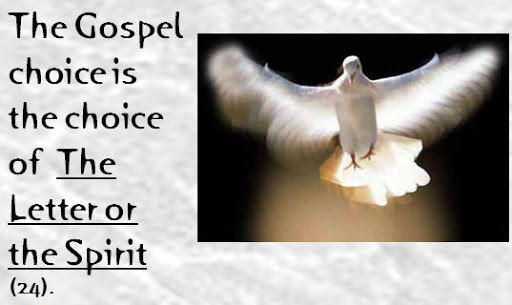
Having introduced faith to the Gentile Galatians, he also introduced to them the power that would enable them to live out their salvation. Paul asks them in Gal. 3:3 “Having begun by the Spirit, are you now being perfected by the flesh?” And that is exactly what the Judaisers wanted. They wanted to replace the Holy Spirit with the Mosaic Law as the means of sanctification.
But it doesn’t work that way. Paul says in Galatians 3:21-22 “… if a law had been given that could give life, then righteousness would indeed be by the law. But the Scripture imprisoned everything under sin, so that the promise by faith in Jesus Christ might be given to those who believe.”

Paul asks the Galatians to think of two places: Mt. Sinai in Arabia or the heavenly Jerusalem. He is trying to get them to see for themselves that only one choice leads to true freedom.

The people at Sinai had the same choice.

Exodus 24:3 Moses came and told the people all the words of the LORD and all the rules. And all the people answered with one voice and said, “All the words that the LORD has spoken we will do.”

They should have said, “We cannot follow the rules, we put ourselves at your mercy and trust in your grace.”

If freedom is going to come to us, it is going to be the work of heaven, not our work.

So Paul quotes Genesis 21:10 where God orders Abraham to expel Hagar because Ishmael will not share in Isaac’s inheritance. Hagar is called “the slave woman.”
Paul has been using this allegory to point out that the Galatians have a simple choice. If they want to inherit the blessings of Abraham they will have to make the choice Abraham did. They have to take God on his terms, not their terms.

Now, you and I have to make the same choice. We can decide to do our best, and hope that God accepts it. That is the choice of Hagar, of Ishmael, of the letter, of Sinai, it is a choice to enslave ourselves.
Or, we can take God on his terms. We can say, God, I cannot do it myself. I trust in Christ and his finished work on the cross. I trust in your Holy Spirit to guide me in the Christian walk. And I trust in You, heavenly Father, to bring me into the inheritance you have planned for me.

The Gospel Received and Abandoned (Gal. 4:8-20).

Galatians 4:8-20 ESV
Formerly, when you did not know God, you were enslaved to those that by nature are not gods. 9 But now that you have come to know God, or rather to be known by God, how can you turn back again to the weak and worthless elementary principles of the world, whose slaves you want to be once more? 10 You observe days and months and seasons and years! 11 I am afraid I may have labored over you in vain. 12 Brothers, I entreat you, become as I am, for I also have become as you are. You did me no wrong. 13 You know it was because of a bodily ailment that I preached the gospel to you at first, 14 and though my condition was a trial to you, you did not scorn or despise me, but received me as an angel of God, as Christ Jesus. 15 What then has become of the blessing you felt? For I testify to you that, if possible, you would have gouged out your eyes and given them to me. 16 Have I then become your enemy by telling you the truth? 17 They make much of you, but for no good purpose. They want to shut you out, that you may make much of them. 18 It is always good to be made much of for a good purpose, and not only when I am present with you, 19 my little children, for whom I am again in the anguish of childbirth until Christ is formed in you! 20 I wish I could be present with you now and change my tone, for I am perplexed about you.

We have been studying Paul’s epistle to the Galatians. We have seen that the Galatians had been deceived by some false teachers. They were being tempted to identify themselves with Jewish traditions, with the assumption that in so doing they might enjoy God’s favour and the blessings associated with Abraham.

Paul has been arguing that going to Judaism is going backwards, not forwards.

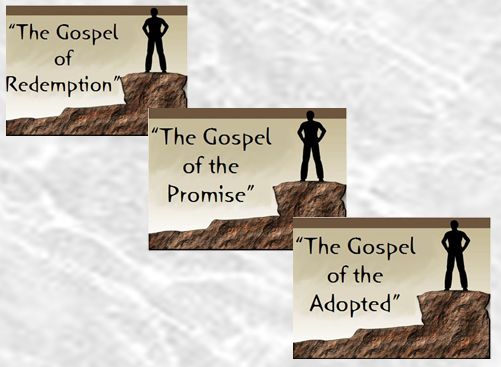
In 3:10-14 he argued that Gentile Christians are already redeemed by what Christ did.

In 3:15-29 he argued that Gentile Christians are already recipients of God’s promise to Abraham.

In 4:1-7 he argued that all Christians are adopted equally into the family of God.

In today’s text Paul goes back to what the Galatians were like before they heard the gospel. He says that they were all enslaved to demons. The Galatians did not need proof of the existence of demons. They had been under demonic bondage until they found freedom by responding to the gospel in faith.

In this culture demons are not taken seriously, but the New Testament takes demons very seriously.

One of Jesus’ ministries when he walked this earth was casting out demons. He actually presented his work of casting out demons as evidence that the kingdom of God had arrived. If demons were a fairy tale, Jesus would have exposed it. Instead, he spent much of his valuable time delivering people from their control. He took them seriously, and so should we.

Paul told the Corinthians that demons were behind pagan idolatry. Those gods of wood and stone had enslaved people because there were real spirit beings using them for that very purpose. For that reason he warned the Corinthians not to have anything to do with the idols – not because the idols are powerful, but because the demons behind them are real.

In fact, Paul told the Ephesians that in our Christian life our real battle is not with human enemies, but with these demons. We wrestle against the spiritual forces of evil. These forces are real, even though normally we can’t see them. They work in four ways: they tempt us to sin, they deceive us in our thinking, they accuse us in order to render us powerless through guilt, and (if all else fails) they intimidate us by manifesting.

James takes the devil and his demons seriously as well. He tells us to resist the devil. Resist is a defensive word. It suggests that the devil is on the attack. If we don’t take him and his demons seriously, we will be sitting ducks.

So Peter tells us to be on the watch, because just because you chose to ignore the spirit world does not mean that you cannot become a victim of it. Satan is real, and he is looking for his lunch. Peter says “be watchful.” Don’t become lion lunch.

So Paul continues his chronological argument by reminding the Galatians that when the gospel came, they accepted it gladly. Even though Paul had some kind of sickness when he came to their area, they still flocked to him. He had the answer to their problem. By trusting in Jesus Christ as their Saviour and Lord, these Galatians found freedom from their bondage to demons. They were set free. They found out that they did not have live in fear of these spirit beings anymore. That is good news.

So what happened? What turned these victors in to victims? It was pride. Yes, that’s right… pride. In verse 17, Paul says “They make much of you, but for no good purpose. They want to shut you out, that you may make much of them.” The “they” are the troublers, the Judaizers. They came to Galatia as “super-Christians.” They said to the Galatians “Hey, you overcame your bondage to demons. That’s good. But now it’s time for you take the next step. Become super-Christians like us.

But Paul knew what was really going on. He realised that the temptation to pride was coming from the same place that the demonic bondage had come from. The Galatians were being enticed to go forward when in fact they would really be going backward.

This was the very thing that kept many Jews from receiving the gospel in the first place. They wanted praise from others, and were not willing to humble themselves and put their trust in God alone.

But God chooses to save those who cannot say “I can handle this.” He chooses the low and despised in the world. There are no self-made men in the kingdom of God.

By grace. Through faith. Not your own doing.

This is why the message of Galatians is so important: Anyone who hears the gospel is at risk of abandoning it – while still remaining outwardly Christian.

God has a righteousness available, but those who seek to establish their own will never submit to it. It is an either-or choice. God will not tolerate someone giving their life to him, and then taking it back.

So Paul told the Galatians to turn around because they had gotten turned around. They were going the wrong way. They had abandoned the gospel that they had received. In order to reach them for Christ, Paul had become like them. Now he was asking them to become like him: a person who lives by faith (12).

Paul had given birth to them by bringing them to Christ. Now he is in labour again so that the life of Christ can be formed in them (19).

He wants them to be crucified with Christ. He wants it to no longer be the Galatians who live, but Christ living in them. He wants them to follow his example of living by faith.

John Piper describes that life this way: “Faith is the assurance that what God will make of you, as Christ is formed in your life, is vastly to be preferred over what you can make of yourself. Faith is the confidence that the demonstration of Christ’s work in your life is more wonderful than all the praise you could get for yourself by being a self-made man—or woman. Faith is a happy resting in the all-sufficiency of what Christ did on the cross, what he is doing now in our heart, and what he promises to do for us for ever.”

Now this message applies to us today. It is possible to remain in the church while abandoning the gospel. It is possible to escape one form of demonic deception and then fall for another form. The Galatians had abandoned their idols, but now they were tuning to pride and self-reliance.
———–
LORD, help us to live by faith in the Son of God who died for us. Help us to rest in the all-sufficiency of what Christ did for us on the cross, what he is doing now in our hearts, and what he promises to do for us for ever. In Jesus’ name, Amen.