living ready

bcard


This post contains the manuscript I was attempting to follow yesterday as I preached at Relevant Church in Williamsburg, Virginia.


Matthew 25:1-13

1 “At that time the kingdom from the sky will be like ten virgins who took their lamps and went to meet the bridegroom. 2 Five of them were thoughtless, and five were intelligent. 3 Because when the thoughtless took their lamps, they took no oil for them, 4 but the intelligent took flasks of oil for their lamps. 5 Since the bridegroom was overdue, they all became sleepy and dozed off. 6 But at midnight there was a cry, ‘Here is the bridegroom! Come out to meet him.’ 7 Then all those virgins got up and trimmed their lamps. 8 And the thoughtless said to the wise, ‘Give us some of your oil, because our lamps are going out.’ 9 But the intelligent answered, saying, ‘Since there will not be enough for us and for you, go instead to the dealers and buy for yourselves.’ 10 And while they were going to buy, the bridegroom came, and those who were ready went in with him to the marriage feast, and the door was shut. 11 Afterward the other virgins came also, saying, ‘Lord, lord, open to us.’ 12 But he answered, ‘Honestly I am telling you, I do not know you.’ 13 So keep alert, because you know neither the day nor the hour.”

The elders here at Relevant Church have been sharing a series of sermons based on the story parables taught by Jesus as recorded in the Gospels.

FIRST, I WANT TO EXPLAIN WHY JESUS USED PARABLES LIKE THIS.

THEN, I WANT TO SUMMARIZE WHAT JESUS HAD ALREADY TAUGHT ABOUT HIS SECOND COMING.

THEN, I WANT TO SHOW HOW THIS PARABLE EXPLAINED WHAT IT MEANS TO LIVE READY.

FINALLY, I WANT TO GIVE SOME PRACTICAL SUGGESTIONS FOR LIVING READY TODAY.

WHY JESUS USED PARABLES LIKE THIS.

· Parables are not a topic themselves. They were used to illustrate and explain something that had already been taught. John mentioned this when he introduced the series a few weeks ago.

· The word parable means something placed alongside to explain. It is based on the combination of the Greek verb ballō, which means to place or through something, and the preposition para, which means alongside.

· When I was in Africa, I used a photo of my family as a parable. I showed my students the photo, and then shared how the quality of my family has served to testify of the authenticity of my ministry. Some of the men said that their wives and families were actually opposed to their ministry, so we all surrounded them and prayed that God would change that.

WHAT JESUS HAD ALREADY TAUGHT ABOUT HIS SECOND COMING.

· He had taught that his coming would bring judgment on some, rescue for others. He said “The harvest is the conclusion of the age, and the harvesters are angels. Just as the weeds are gathered and burned up with fire, so will it be at the conclusion of the age. … The angels will come out and separate the evil from the righteous.” (Matthew 13:39-40, 49). This judgment is real, and we don’t do anyone a favor if we fail to warn them. But the good news is that the rescue we look forward to is real too.

· He had commanded his disciples to be ready for his coming. He commanded them (and us) to “stay alert, because you do not know on what day your Lord is coming. But be aware of this, that if the master of the house had known in what part of the night the thief was coming, he would have stayed alert and would not have let his house be broken into. Therefore you also must be ready, because the Son of Man is coming at an hour you do not expect” (Matthew 24:42-44).

· He had answered his disciples’ three questions in detail about the timing of his coming (Matthew 24:3).

o They asked when the Jerusalem temple would be destroyed. Jesus had told them that the temple would be destroyed, and that not one stone would be left upon another. The disciples could not imagine that happening. They asked him when these things would happen. He told them exactly when. He said they would happen within one generation. This could mean within the lifetimes of those who were listening to him, or it could be more specific – a 40 year period. Jesus predicted that in AD 30, and the Roman attack under General Titus began in 66 AD, and the temple was destroyed in 70 AD: exactly 40 years from Jesus’ prediction. Prophecy fulfilled.

o They asked what his second coming would be like. They asked him what the sign of his coming would be. He didn’t avoid that question either. He told them his coming would not be gradual, or symbolic. It would be sudden and unmistakable. It would be like lightning flashing across the sky. Nobody misses lightning. He also used buzzards as an illustration. I was riding my bike on the Colonial Parkway this week, and I noticed a group of about seven buzzards in the woods just on the side of the road. I didn’t see a dead animal, but I knew it was there. The buzzards were visible signs. Sun darkened, stars shaking, Christ appearing in the sky, some people taken, others left – it will be obvious. He said it would be like Noah’s flood. Nobody is going to sleep through that.

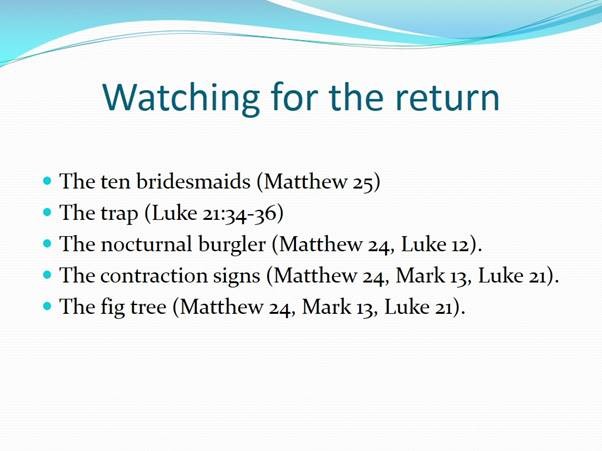
o They also asked how long the age would last between his first and second comings. Jesus did not give them a specific answer to that question. Instead, he explained that there would be a lot of signs to show people that they are still in that age between the advents. He called these the birth pangs. Birth pangs are signs that the baby is on his way, but they can last a long time. That was the point. Here is a list of birth pang signs taken from Matthew 24, Mark 13 and Luke 21:

      • False messiahs.
      • Wars, revolutions, and international strife.
      • Famines, earthquakes, pestilences.
      • Fearful events, great signs from heaven.
      • Apostasy and schism.
      • Persecution, false prophets.
      • Martyrdom.
      • Increased wickedness, Love growing cold, family betrayal.
      • Gospel preached to all nations.

Not one of these is a sign of the immediate end of the age. Instead all the signs show that we are still living in that age. Jesus wanted his disciples – and we are also living in that age – to live ready for its end.

HOW THIS PARABLE EXPLAINED WHAT IT MEANS TO LIVE READY.

· Not everyone is as ready as she thinks she is (2). All of the young ladies thought that they were ready for the big party, but only some of them were. For parties, that does not really matter. But for the second coming, it matters. We cannot afford to be unprepared for that.

· The real difference is not the oil, but the relationship (12). Some people get hung up on the symbol. I’ve been taught all my life that the oil was a symbol of the Holy Spirit, and it was. But in this parable, the oil stands for the preparation itself. When the bridegroom explain why he was denying them entrance, he didn’t blame it on their lack of oil. He said he didn’t know them. The question we should be asking is not what we can bring to the party. The question is will the host recognize us?

· The thoughtless had lamps, but they started going out (8). Some people are trusting in their ministries to get them into the party. Jesus had told his disciples that they are the light of the world. The lamps seem to speak to that reality. But sharing God’s glory by influencing the world around us is not our qualification. Nobody does enough for their works to count toward their eternal destiny.

· Those who were ready went in, and the door was shut (10). This tells me that the grace that the LORD offers us today to come to him is a limited time offer. If we fail to respond to his invitation today, we will not get a second chance on the coming day.

· The Christian life is a marathon, not a short sprint (5). We all know people who make great starts in their attempts to live the Christian life, but then get sidetracked by some failure. The intelligent virgins in Jesus’ story were ready to wait for as long as it took. They did not have a plan B. The thoughtless virgins were OK with waiting for a while, but if the party were delayed too long, they would think of other options. Like Sarah, in the Old Testament, when the promised baby did not come, she introduced her maid, Hagar, into the picture. Bad choice. We need to stick with plan A, no matter how long it takes.

SOME PRACTICAL SUGGESTIONS FOR LIVING READY TODAY.

· Invest yourself in the coming kingdom . Jesus gave another parable – that of the talents — to encourage us to invest ourselves in the kingdom that will appear when the king does.

o We invest in the kingdom by getting into the word of God, which describes it.

o We invest in the kingdom by fellowshipping with the King.

o We invest in the kingdom by fellowshipping with other kingdom citizens.

· Serve Christ by serving others. Both the parable of the talents, and that of the sheep & goats encourage us to serve others and meet other people’s needs. That is one way to prepare for eternity. The light shining from our lamps is light that helps other to see the God we belong to.

· Resist shortcuts to righteousness. The intelligent virgins were willing to pay the full price of admission. They knew that they would only have one chance of joining the party, so they invested in the extra oil that they would need in order to be ready when the bridegroom made his appearance.

· Eliminate distractions. Jesus had taught in the parable of the soils that some people would make a good start in the kingdom, but then would be sidetracked by other desires and worries. The intelligent virgins stayed on target.

· Be real. The parable of the sheep & goats shows us that not everyone who looks and sounds like an authentic Christian is really an authentic Christian. In fact, there was a long period of time when all ten virgins appeared to be ready for the party.

Sometimes the words of Jesus are designed to comfort the troubled, and sometimes they are designed to trouble the comfortable. I hope you have been troubled this morning; I know I have. I’ve asked some of our church leaders to come forward and be available to you if you feel like this message has challenged you in your Christian walk. Let’s take advantage of this time to recommit ourselves to living ready for our Lord’s return.

LORD, we are in this for as long as it takes. We commit ourselves to living ready today and every day until you burst through the clouds. Show us how to make ourselves ready for your coming kingdom.

Jefferson Vann

From Glory to Glory

clip_image004Psalm 19:1-14 NLT 1 The heavens proclaim the glory of God. The skies display his craftsmanship. 2 Day after day they continue to speak; night after night they make him known. 3 They speak without a sound or word; their voice is never heard. 4 Yet their message has gone throughout the earth, and their words to all the world. God has made a home in the heavens for the sun. 5 It bursts forth like a radiant bridegroom after his wedding. It rejoices like a great athlete eager to run the race. 6 The sun rises at one end of the heavens and follows its course to the other end. Nothing can hide from its heat. 7 The instructions of the LORD are perfect, reviving the soul. The decrees of the LORD are trustworthy, making wise the simple. 8 The commandments of the LORD are right, bringing joy to the heart. The commands of the LORD are clear, giving insight for living. 9 Reverence for the LORD is pure, lasting forever. The laws of the LORD are true; each one is fair. 10 They are more desirable than gold, even the finest gold. They are sweeter than honey, even honey dripping from the comb. 11 They are a warning to your servant, a great reward for those who obey them. 12 How can I know all the sins lurking in my heart? Cleanse me from these hidden faults. 13 Keep your servant from deliberate sins! Don’t let them control me. Then I will be free of guilt and innocent of great sin. 14 May the words of my mouth and the meditation of my heart be pleasing to you, O LORD, my rock and my redeemer. For the choir director: A psalm of David.

clip_image002We are continuing our series on the psalms. Last week we talked about the process that you can use to study a text so that you make sure that you are getting the same thing out of it that the original hearers did. This discovery process requires that we ask certain questions.

The BACKGROUND question is a little trickery than for Psalm 3 because the only things the superscription tells us is that David wrote it, and dedicated it to the choir director. This actually tells us a lot, though. It suggests David finished the final version of this song while he was king. I think he started it while a shepherd, based on the nature imagery of verses 1-6.

The WORD STUDY question also reveals some interesting progression. The names he uses for God keep getting more and more personal.

The THEOLOGICAL FOCUS of the psalm is on the doctrine of revelation, that is, how God reveals himself to us.

The STRUCTURE question puts these elements together and you can see a progression of ways that God revealed himself to David, and how David chose to respond to those revelations.

clip_image006This first part was probably written early in David’s life, perhaps while he served as a shepherd. You can picture David out on a clear day, clouds floating by, and he just takes in the glory of creation. What David sees is the craftsmanship of a divine artist, communicating through the canvass of creation itself. He discovers a great deal about God from staring at that canvass. He also comes to the conclusion that this is what God wants. He wants his creatures to look at the majesty and glory of creation and say “My God did that.” The message is that God is glorious, and that message goes out to the whole planet.

Penny and I just got back from a hiking trip on the Appalachian Trail. We climbed Catawba Mountain, and enjoyed the view from McAfee’s Knob. It was so stunning that we actually came back for seconds on the same day. Our God is awesome, and you can see how awesome he is by looking at what he has created.

clip_image008Next, David goes from the general to the specific. He highlights the glory of one part of this glorious creation: the sun. He describes it as a radiant bridegroom, bursting forth from his wedding canopy. Then, he changes the simile, and says the sun is like a great athlete, eager to run the race and show everybody what he’s got in him. I can imagine young David, sitting under a shade tree, watching his sheep, and following the sun’s course as it rises at one end of the sky, and, over the day, burns its way to the other end.

The sun’s daily course speaks of incredible power under control. The one controlling this great power is the one who created it. Scientists tell us that the earth’s relationship to the sun is incredible. We live in what they call the Goldilocks zone: 93 million miles from the sun’s surface. If we were 92 million miles away, life could not exist on earth. If we were 94 million miles away, life could not exist on earth. But God puts us right where we need to be in relation to this glorious sun.

clip_image010At verse 7, we see our first major structural transition. David is no longer talking about the natural creation, and starts talking about a supernatural one: the Bible. God is still revealing himself to David, but he has added a new form of revelation. I imagine that at some point in David’s life, he was so overwhelmed by the glory of God that he saw in creation, that he started seeking more. That is what the Bible is for. God’s word brings us from recognition of God (Elohim, vs. 1), to revival of the soul through a covenant with the LORD (Yahveh, vss.7,8,9).

Some people never get to this stage. They know that God exists, but they will not accept the Bible. David did accept the Bible as God’s word, and it made a tremendous difference in his life. Look at what he says about the Bible here. Because of God’s revealed word, David says his soul was revived, he was made wise, his heart found joy, he had insight for living, and found truth that was pure, true, fair, , true, fair, desirable, sweet, and rewarding. That is what the Bible can do for us.

clip_image012But, wait, don’t pay yet. There’s more. Another transition is found in this next section. I’m pretty sure that this last part of Psalm 19 was written by David after his great sin with Bathsheba and Uriah. Once again, David uses an even more personal title for God. In this section, the LORD is “my rock and my redeemer.” This speaks of the glory of a personal relationship with God. David knows God as the one who forgives his sins and sustains his spiritual life. He recognizes that although he recognized God in creation, and honored his word, that was not enough. God wants to be more to him, and sanctify and cleanse him, so that they could walk together.

God wants to reveal himself to us in the same way. He wants to change us so that the words of our mouths and the meditations of our hearts are pleasing to Him.

clip_image014The apostle Paul knew about this too. In Romans 12:2, he said “Don’t copy the behavior and customs of this world, but let God transform you into a new person by changing the way you think. Then you will learn to know God’s will for you, which is good and pleasing and perfect. ” He told the Roman Christians that the real payout to being a Christian was more than just knowing that God exists and created the world. It was even more than knowing that God gave us the Bible as instructions to follow. There’s even more to God’s will than that. We really know God when we are doing that which is good and pleasing and perfect. The good news is, that (according to Romans 1-11) Jesus’ death on the cross makes that possible. Listen to Romans 5:10-11 “For since our friendship with God was restored by the death of his Son while we were still his enemies, we will certainly be saved through the life of his Son. 11 So now we can rejoice in our wonderful new relationship with God because our Lord Jesus Christ has made us friends of God.

clip_image016So, now we are ready for the big idea: THE MORE WE KNOW ABOUT GOD, THE MORE HE CHANGES US. The process begins when we recognize the handiwork of God in the world around us. That awareness of his presence and power drives some us to seek a covenant with him to follow the perfect instruction in his word. But that very word convicts us all of sin, and forces us to seek forgiveness outside of ourselves. We find that forgiveness in Christ. We also find a relationship with God powerful enough to transform us so that we can please him in our daily walk. It is one thing for me to know that God exists. It is another for that God of all creation to be my rock and redeemer. It is one thing to know what God wants, as he reveals it in his word. It is another thing for me to walk with God and prove his will for me by doing it. That kind of change takes a lifetime, but that is what he wants for us.

bcard

Deliver me, my God!

Slide1


Psalm 3:1-8 NET

1 A psalm of David, written when he fled from his son Absalom. LORD, how numerous are my enemies! Many attack me. 2 Many say about me, “God will not deliver him.” (Selah) 3 But you, LORD, are a shield that protects me; you grant me honor and give me renewed strength. 4 To the LORD I cried out, and he answered me from his holy hill. (Selah) 5 I rested and slept; I awoke, for the LORD protects me. 6 I am not afraid of the multitude of people who attack me from all directions. 7 Rise up, LORD! Deliver me, my God! Yes, you will strike all my enemies on the jaw; you will break the teeth of the wicked. 8 The LORD delivers; you show favor to your people. (Selah)

Slide2The Bible is the most relevant literature that you and I will ever read. God speaks to us through it, because it is his word. But we sometimes have problems hearing what God is saying. Expository sermons can help. We are beginning a series of expository sermons on the Psalms today. Each Sunday, we are going to take you on a tour of a psalm. We want to serve as reading assistants. We will walk you through the process of discovering what is there.

Today I’m going to try to help you discover what is in Psalm 3. I will also be talking about the discovery process a lot, because you will find that it can help you in your own study of the Bible.

Why do I start at Psalm 3? If you look at Psalm 1, it is — more or less– instructional. It’s an example of what the scholars call a Torah psalm. It instructs us on the right way to live. Psalm 2 would be classified a royal psalm. It focuses on praise for the king, and predicts something about the Messiah. Psalm 3 is an individual lament. That’s where I want to start because I want to show how our praise can flow from our present problems.

When I’m studying a text, one of the first questions that I ask is the BACKGROUND question. What things do I need to know so that I can hear the words of this psalm just like the original hearers heard it.

That’s an important question because there a lot of barriers that keep me from understanding this psalm. Time has gone by. I live in a different culture that the psalmist and his original audience. We live different lives and have different experiences.

The more I know about the background and history of the words, the better I can understand them.

Psalm 3 gives us some help with the background question. It tells us that the author is David, and that he wrote it “when he fled from his son Absalom.” For the full story, read 2 Samuel, chapters 13-19. The short story is this: Absalom decided he would be a better king than his father, and organized a civil war. He succeeded in forcing David to flee Jerusalem. While regrouping, David wrote this psalm.

I think this feeling of betrayal that David expressed here is also the reason for this psalm being placed in book one. You might have noticed that the Psalms are divided into five books. These books correspond to the first five books of the Bible, so Psalm 3 is placed in the Genesis section. That section highlights the fact that we are God’s creatures, and we need him.

Now that we have a little bit of background, let’s proceed to the WORD STUDY question. Are there any words in the text that are unusual words that we might need to clarify their meaning?

Yeah, here’s one: What is a psalm? A psalm is a formal song. The psalms were the songs sung in the temple worship, and later in the formal religious ceremonies of the Jewish families and in the synagogues. Some of the psalms did not begin as liturgy. Psalm 3 began as the heart cry of David after his son betrayed him, and thousands were trying to kill him. The message of the psalm goes back to that original context, so anyone singing or praying it after that needs to make sure that they stay true to David’s meaning.

Like Psalm 2, many of the psalms also contained allusions to a future Messiah. Because of this, Psalms is one of the most quoted books in the NT. So we can also find Jesus in the psalms.

There are verbal clues to the STRUCTURE of this psalm. We do find “selahs” at the end of verses 1,3, and 8, but I think they are serving more for musical purposes. There are four shifts in subject: from the enemies (1-2) to the LORD (3-5), to David (6), then back to the LORD (7-8).

So, now we are ready to summarize the message of this psalm.

Slide3FIRST, we see David’s PROBLEMS).

1 A psalm of David, written when he fled from his son Absalom. LORD, how numerous are my enemies! Many attack me. 2 Many say about me, “God will not deliver him.” (Selah)


David had been betrayed, and was in danger of being destroyed. He was overwhelmed with his problems and his own insufficiency to solve them. Have you ever felt that way? I have. Some people think that God keeps us from having problems. That was not the way it was for David. Not for us either. Our problems serve as a gate through which we enter his presence for worship.

Slide4SECOND, we see David’s PROVISION(3-5).

3 But you, LORD, are a shield that protects me; you grant me honor and give me renewed strength. 4 To the LORD I cried out, and he answered me from his holy hill. (Selah) 5 I rested and slept; I awoke, for the LORD protects me.

David gets his eyes off his problems, and turns them on his deliverer. He sees God as his battle shield, who protects him as he fights. He remembers how he has found times of rest when he faced struggles in the past (Goliath, the Philistines, Saul). So he decides to trust God for protection, honor and strength now.

Slide5THIRD, we see David’s POSITION (6).

6 I am not afraid of the multitude of people who attack me from all directions.

Here is a lesson for all of us – a lesson in courage. True courage is not channeling our inner Chuck Norris, and saying “bring it on, I can handle this.” True courage is looking squarely into our impossible situation and saying “I am not afraid because God is with me.”

Please note that David’s situation had not changed. He was still being attacked by “a multitude of people” who were coming “from all directions.”

Slide6FINALLY, we see David’s PRAYER (7-8).

7 Rise up, LORD! Deliver me, my God! Yes, you will strike all my enemies on the jaw; you will break the teeth of the wicked. 8 The LORD delivers; you show favor to your people. (Selah)

This psalm does not end in a resolution, it ends with a petition. The psalm is not all about the problem, it is about David getting his eyes off his problem, and back on to God. I cannot promise you that prayer is going to solve your problems. I can promise you that prayer can help you to refocus on your deliverer.

We are not reading Psalm 3 today because David found a way to overcome a civil war and won back his throne. We are reading Psalm 3 today because it was a prayer that God answered.

The apostle Peter gives us the New Testament corollary to this psalm:

“Humble yourselves, therefore, under God’s mighty hand, that he may lift you up in due time. 7 Cast all your anxiety on him because he cares for you.” 1 Peter 5:6-7 NIV

Now we are ready for the big idea:

OVERWHELMING PROBLEMS ARE OPPORTUNITIES TO TRUST GOD TO DELIVER US.

I don’t know what your overwhelming problems are. But if you are experiencing them right now, I can assure you that God wants to be your shield and strength. Let the rest of us pray for you.

Father, we want to intercede for those in our fellowship today who are experiencing overwhelming problems. LORD, they are being attacked, and we want to stand with them. But we also want them to know that You are standing with them, and you are going to provide all the help they need. These problems are opportunities for them to trust you for deliverance. Be very real to them right now, and make your presence known to them. Help them to stay close to you as they wait for your deliverance.

Maybe you do not feel overwhelmed by problems right now. That’s OK too. But this psalm speaks to you too. The reason David could trust God in troubled times is that he never forgot where his victorious times came from. Cultivate your relationship with him now, so that when the attacks are coming from every direction, you can draw strength from that relationship.

LORD, we thank you for our brothers and sisters who are experiencing your strength and deliverance right now. Help them to cultivate their relationship with you, so that they can stand in faith and confidence in you when the trying times come.

I have one more prayer. But first, let me explain why we need it. God has a purpose for everything that happens to us. His ultimate purpose is to bring us into a relationship with him, because he wants us to be his adopted children for eternity. He actually gives us difficulties as a gift, because they can lead us to him – to that relationship. Maybe you are here today, and you are not really sure that you have a relationship with God. You can come to him at any time. You do not need to feel anything special, and you do not need any miraculous signs. All you need to do is recognize that you need God in your life permanently. You can get that relationship for free; all you have to do is ask.

But just because you can get it for free does not mean that it comes cheap. For any human being to have an eternal relationship with God is absolutely impossible, because we are all born sinners. Our ancestors rebelled against God and plunged us all into a depravity that we cannot change. All our righteousness is as filthy rags to God. So, what we could not do because of our sin, Jesus did for us. He came as one of us, lived a sinless life, and died a sacrificial death on the cross. That death was God’s judgment on our sin. When we celebrate the Lord’s Supper, we celebrate God’s grace in accepting Christ’s death instead of our own.

If you are here this morning, and you are without Christ in your life, I invite you to accept him into your life by taking of the symbols of his death. The bread symbolizing his broken body, and the cup symbolizing his shed blood. Do this as an act of faith. All you need to know is that his death was for you. The rest of us do it for the same reason. We are celebrating God’s grace.

LORD, for all of those who do not really know if you are there to deliver them or not, I pray that this day is the day they find Christ. You want to deliver them from their present problems, and you want to give them eternal life. Come into their lives as their ultimate deliverer today. May they celebrate your grace today.

bcard

a church led by the Holy Spirit

IMG_0531

It is a thrill to be back here at Maranatha Bible Church. Pastor Jessie invited me to speak this morning. The Lord has put 1 Corinthians 12:1-13 in my heart to share with you. These words are particularly important for churches to keep in mind, because, like the Corinthian church in Paul’s day, it is very easy for us to be led by the flesh, and not by the Holy Spirit.

1Brothers I do not want you to be misled about spiritual gifts. 2 You know that when you were pagans whenever someone led you, they were leading you off the path, and making you follow voiceless and useless idols. 3 That is why I want you to understand that no one speaking by the Spirit of God ever says “Jesus is accursed!” and no one is able to say “Jesus is Lord” except by the Holy Spirit.

A CHURCH LED BY THE HOLY SPIRIT STAYS ON THE RIGHT PATH

Paul tells the Corinthians that they were formerly led off the right path. When he brought the gospel to them, it gave the chance to get back on the right path. But he warns them that even a church who thinks it is obeying the Spirit can be operating in the flesh. The difference is the focus on Jesus.

4 Now there are different kinds of gifts, but the same Spirit gives each kind. 5 There are different ministry gifts, but the same Lord; 6 and there are different manifestation gifts, but it is the same God who activates them all in everyone.

IMG_0536

A CHURCH LED BY THE HOLY SPIRIT DEMONSTRATES UNITY

The unity of the church is designed to come from the top down. When we seek unity of the flesh, that is uniformity, and it does not work. It comes from the wrong source. Legalism destroys churches as well as people. Our unity must come from God. It is not rule by democracy, and it is not rule by tyranny of the most powerful or most popular.

7 In each believer the Spirit manifests for the good of everyone. 8 To one the Spirit gives something insightful to say, and to another the same Spirit gives something intelligent to say, 9 to another the same Spirit gives extraordinary faith, to another the one Spirit gives power to heal, 10 to another he enables the working of miracles, to another prophecy, to another the ability to distinguish between spirits, to another the ability to speak various kinds of languages, to another the explanation of things said in other languages. 11 All these are empowered by one and the same Spirit, who gives to each one individually exactly the gift he wants him to have.

A CHURCH LED BY THE HOLY SPIRIT DEMONSTRATES DIVERSITY AT THE SAME TIME

One of the reasons flesh unity does not work is that the Holy Spirit works within us in different ways, so we are automatically going to be different from each other. God wants to reach the community through all of us, and our diversity is his means of doing that.

When the flesh leads, either insight or intelligence will prevail. But when the Holy Spirit leads, both insightful and intelligent words are spoken.

When the flesh leads, someone’s individual ministry becomes the measure of the church’s success. But when the Holy Spirit leads, everyone’s ministry is given its proper place, and the Lord of the church is glorified instead of one of his servants.

In 2 Corinthians we discover that a group of leaders within the Corinthian church had hijacked it, and were teaching another Christ, a different spirit, and a different gospel![1] The LORD gave us these epistles because we are susceptible to idolizing others, which can lead to apostasy as well.

12 Because just as the body is one and has many members, and all the members of the body, though many, are one body, so it is with Christ. 13 Because one Spirit immersed us all into one body- Jews or Greeks, slaves or free- and all of us were given a drink of that one Spirit.

IMG_0539

A CHURCH LED BY THE HOLY SPIRIT DEMONSTRATES EQUALITY

Paul emphasizes the fact that the Corinthian church is made up of a diverse lot of people. Some of those people were Jews, and some of them were Greeks. Some of them were slaves and some of them were free – in fact some of them employed slaves who were also Christians.

But from the standpoint of the who they were in Christ, they were one body. In a body, every member has the same status as every other member. The Corinthians were all equal, not because it was a democracy, but because it was a church.

The Corinthians had taken this truth and distorted it, because they were being led by the flesh. So they began to build authority pyramids, to determine who the top dogs were. Paul wrote them to explain that in the church, there are no top dogs. The Corinthian fellowships were dysfunctional because they were seeking to establish a hierarchy.

Hierarchies destroy churches because churches were designed to function like bodies. In a body, each member is equal in worth, because the body can only function properly when each member does its work.

Our challenge today is to stop being led by the flesh. It will mean that we have to humbly accept that God is going to do some things without getting permission from our church leadership. It will mean that we are going to have to trust each other to be what God says we all are. The temptation is to stay within our comfort zones, and we can do that. But the price that we pay for doing that is that some of the things that God’s Holy Spirit wants to do will not be done. As a result, some of the people within the church will stay hurting, and some outside the church will stay unreached.

Being led by the Spirit may mean launching out into a new ministry. It may mean that God will call on you to say something that you know others are going to oppose. It may mean doing something that others will criticize. Real church ministry is a messy thing. I cannot promise you that your new ministry will be accepted. I cannot even promise that you will always have success. 

All I am saying is that we often get it wrong, and our Lord wants us to get it right.  Following Christ is not the same thing as playing “follow the leader.”

LORD, give us courage to follow you into the right path. We know you want to speak and act through us. Show us how to follow your leading, to accomplish your will, to be your church.


[1] 2 Corinthians 11:4-5.

the deity of the Holy Spirit

Slide1

Travis introduced this sermon series to us – the elder team – a few months ago. I agreed to speak on the deity of the Holy Spirit. What first came to my mind was that there never has been a challenge to the deity of the Holy Spirit – at least not directly.

The real challenges doctrinally come from those who refuse to believe that the Holy Spirit is a person, the same way that the Father and Jesus are real persons. They tend to describe the Holy Spirit as a kind of energy or influence from God. They think of the Holy Spirit as an “it” rather than a “him” — something like the force in Star Wars.

Christian churches debated this subject a long, long time ago, and they determined that according to the Bible, the Holy Spirit is more than that. He is a person, just like the other two members of the trinity. They found that the Bible describes the Christian God as three persons in one God.

Slide2

It does not make sense really, but that should not surprise us. After all, we are talking about the nature of our creator. I don’t know why people think that they should be able to understand his nature. I studied the trinity for my theology book, and wrote an entire chapter on the issue, but it just scratched the surface. Anyway, if you want to know more about the trinity, we will be posting some resources for you to read and study on the Relevant Church website.

The problem with denying that the Holy Spirit is a person is that it steals from him all the aspects of deity that are essential to what the Bible teaches that he does. That’s what I want to talk to you about. You see, just saying “I believe in the Holy Spirit.” may be a true confession, but it is just about useless. It is a profession without a purpose, which runs the risk of being irrelevant.

When we say, “I believe in the Father” – there is a lot of implied purpose in that statement. It is saying, “I believe that there is a being who purposefully brought the universe into existence by his own will, he loves the world, and has determined to purposefully rescue the universe from the evil that happened as a result of rebellion and sin.”

When we say, “I believe in the Son” — implied in that statement is the fact that Jesus Christ pre-existed his birth as God the Son, and purposefully came to this earth to fulfill the Father’s will by becoming the sacrifice for our sins. That is why he was born one of us, and that is why he died on a cross.


Slide3

What is the implied purpose to our statement “I believe in the Holy Spirit”? I wrote six chapters about that! This morning I want to focus on just one thing that Jesus taught about what the Holy Spirit does.

“If you love me, obey my commandments. And I will ask the Father, and he will give you another Advocate, who will never leave you. He is the Holy Spirit, who leads into all truth. The world cannot receive him, because it isn’t looking for him and doesn’t recognize him. But you know him, because he lives with you now and later will be in you.” (John 14:15-17 NLT).

This is one of several passages in Scripture which shows all three members of the trinity at the same time. Jesus, the Son, promises his disciples that he will pray to the Father, and that the Father will give the disciples another Advocate. Jesus affirms the existence of all three members of the trinity here. But what I want to focus on is what Jesus affirms about the Holy Spirit.

Slide4

First, let me tell you that Pentecost was the answer to Jesus’ prayer. That means that from that time on, the Holy Spirit is more than just God with us. He is God in us!

You see, the Holy Spirit was present with the disciples and empowered them for ministry. They performed miracles and led people to Christ and his kingdom by that empowerment. This was before Pentecost. After Pentecost, they had the same power, but it never left them because the source of the power was now inside them. That source is not a thing. He is a person: The Holy Spirit. What makes this doctrine even more relevant is the fact that when the Holy Spirit came to the disciples at Pentecost, he stayed – not only in them, but in everyone they led to Christ. That includes you and me.

Slide5

A major purpose of the Holy Spirit in our lives is to continue the discipling ministry of Jesus Christ.

Look carefully at that word “another” in verse 14. The Greeks had two words for the English “another.” The word heteros meant another of a different kind. Our word heterosexual contains the idea behind heteros. A heterosexual chooses a partner of a different gender, as opposed to a homosexual who chooses a partner of the same gender.

But the word for “another” in verse 14 is not heteros. It is allos. This word means another of the same kind. So, Jesus was saying that the Holy Spirit would be another person just like Jesus is a person. The Holy Spirit would also be deity just like Jesus is deity. Whatever Jesus was for those disciples, the Holy Spirit would also be. Whatever Jesus did for those disciples, the Holy Spirit would also do.

The title that Jesus used to describe his ministry that the Holy Spirit would take over is – in this translation — Advocate. The translators have struggled trying to come up with a suitable English word to translate this Greek word. The Greek word means someone who is called alongside. Some translate it Comforter, others, Helper; others, Counselor. I think the word that best captures Jesus’ meaning here is Discipler. A major purpose of the Holy Spirit in our lives is to continue the discipling ministry of Jesus Christ. Just as Jesus came alongside his disciples to disciple them, so the Holy Spirit will disciple us.

We experience this in four ways.

1.Guidance into all truth by illumination.

2.Gifting with spiritual gifts for edification.

3.Going where he wants us to go for evangelization.

4.Glorifying Christ through sanctification.

Slide6

The Holy Spirit inspired the authors of the Bible to give us a faithful and accurate revelation directly from God. But that is only part of what Jesus promised. He said that the Holy Spirit would lead us into all truth. So, he not only gave us the Bible, he also helps us to interpret it correctly. He gives spiritual gifts to teachers and writers and preachers and worship leaders. He is in us, so he uses us to disciple us.

He also gives other spiritual gifts to each member of the body – the church. The gifts he gives us allow us to back up what we teach and what we believe. His power is at work within us to confirm what he is teaching us. He is in us, so he uses us to disciple us.

He also empowers us to back up what we believe and teach by means of authentic Christian living. I think one of the most important truths taught in verse 17 is not clear in English, because English does not have a separate 2nd person plural. To really understand it, you have to translate it to Southernese: “But y’all know him, because he lives with y’all now and later will be in y’all.” The truth about the Holy Spirit is not that he is God in me, but that he is God in us – all of us.

Incredible diversity in churches is God’s idea. The Holy Spirit speaks through a diverse lot of different people.

He comes into our lives and speaks to us from within our unique experiences. He is then free to use us in our uniqueness and diversity. That’s why it is a sin and a crime when churches set up false standards of commonness. When we all look alike and sound alike, we are telling people that if they want Jesus, they have to become like us. No way! Jesus didn’t die for you so that he could make you into someone else. He loved you, and he still does.

Slide7

The Holy Spirit wants to be in us to use us to disciple us. By saying yes, we affirm the deity of the Holy Spirit. It is a theological statement, but it is also very practical. It frees me to be me, and you to be you, but insists that we both are loved by the same Father, and were saved by the same Son, and are empowered by the same Holy Spirit.

LORD, your Holy Spirit came into our lives the moment we put our faith in Christ. But, we confess, we have all failed to give him free reign in our lives to disciple us. We confess that we have been suspicious of the differences of some other believers, so we have kept them at a comfortable distance. Forgive us. Make us people who affirm the deity of the Holy Spirit by accepting his ministry within us, and through all of us. In Jesus name, Amen

429128_10150854435803452_59590858451_12611200_1772072460_n

This sermon was preached at Relevant Church in Williamsburg, Virginia, USA on Sunday, February 16th.

Jeff serves at Relevant as an elder.