A Call for Edifying Manifestations

1 Corinthians 14:6-12 ESV
“Now, brothers, if I come to you speaking in tongues, how will I benefit you unless I bring you some revelation or knowledge or prophecy or teaching? 7 If even lifeless instruments, such as the flute or the harp, do not give distinct notes, how will anyone know what is played? 8 And if the bugle gives an indistinct sound, who will get ready for battle? 9 So with yourselves, if with your tongue you utter speech that is not intelligible, how will anyone know what is said? For you will be speaking into the air. 10 There are doubtless many different languages in the world, and none is without meaning, 11 but if I do not know the meaning of the language, I will be a foreigner to the speaker and the speaker a foreigner to me. 12 So with yourselves, since you are eager for manifestations of the Spirit, strive to excel in building up the church.”

In this series I have been highlighting Paul’s commands to the churches that are of a particular structure. The structure is called continuous active imperative. These are commands for the church to (positively) keep doing what it is supposed to be doing, or (negatively) to stop doing what it is not supposed to be doing. The command in today’s text is in verse 12, where Paul encourages the Corinthians to keep striving to excel in building up the church.

The context of this command is chapters 12-14 of 1 Corinthians.
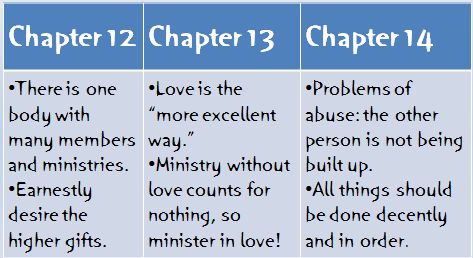
Let me try to summarize what Paul is saying in these three chapters.

Chapter 12 is about Spiritual Gifts. He says there are going to be all kinds of gifts manifested when we gather together, because the body of Christ is made up of many different members, with many different ministries assigned to them by the head (Christ) and empowered by the Holy Spirit. He does encourage the whole church to earnestly desire the higher gifts, which are the ones which build up the most members of the body.

Chapter 13 is the love chapter. Here Paul encourages all ministry to be done out of love, otherwise it counts for nothing.

In Chapter 14 Paul addresses some examples where it appears the Corinthians are not doing that, so spiritual gifts are becoming a problem. They were being abused, and the result was chaos rather than order.
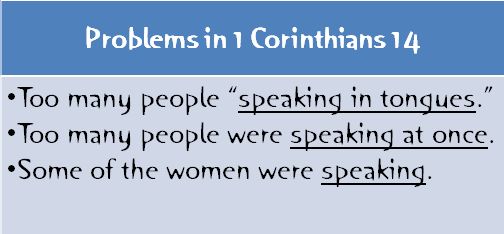
Now I want to summarize chapter 14 with a little more detail. This is the chapter in which our text for today is found, so it is important to put as much flesh on it as possible.

All of the problems that Paul was dealing with in chapter 14 have to do with speaking in church, that is, with manifesting spiritual gifts which involve public speaking in the assembly. He identifies three specific problems:

1) too many people were “speaking in tongues” instead of prophesying;

2) too many people were speaking all at once, which was leading to confusion;

3) some of the women of the congregation were speaking, and, for some reason that too was causing disorder.

I want to comment on each of these problems, and I want to talk about the simplest problem first, then go to the ones that are more complex. The simplest problem Paul mentioned was that everybody was jumping up to speak all at once, and the result was chaos. People didn’t know who to listen to, and very little edification was getting done. It was a free-for-all, and probably resembled a competition to see who could gain the most listeners. The confusion was being caused by a good thing: the Corinthians were eager to share. Paul encouraged them to be considerate of one another and limit the number of people who speak, and have only one person speak at a time. Be considerate. Problem solved.

Another problem that Paul brought up in 1 Corinthian 14 is that some of the women of Corinth were speaking at the assemblies, and that was adding to the disorder. Some people believe that God has only ordained men to speak in church services, but I do not think that is the case. I have already shared how Gal. 3:28 shows that all Christians have the same status before God. Also, Joel 2:28-29 predicted a new era of the Holy Spirit’s ministry would include prophesying by both “sons and daughters.” That new era began at Pentecost.

So why is Paul preventing the women to speak here? Verses 34-35 hold the key.
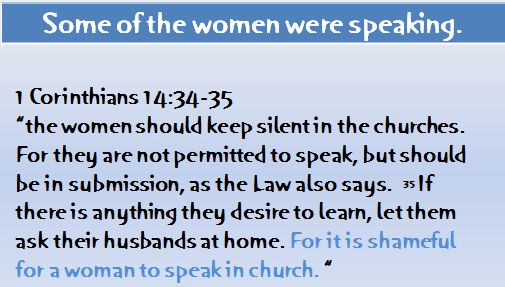
First, I draw your attention to the last part of verse 25, where Paul says “it is shameful for a woman to speak in church.” Now, one problem is that Paul had already given instruction for the wives of the congregation in chapter 11. He tells them that they should cover their heads with a veil if they want to pray or prophecy. Praying and prophesying are kinds of speaking. Those kinds of speaking do not appear to be shameful. Perhaps what Paul meant was that the Corinthian society saw it as a shameful thing for its women to speak in public. He didn’t say it to the Thessalonians, Ephesians, or even the Romans. But apparently it was a problem in Corinth so Paul orders them not to have their women preach in public.
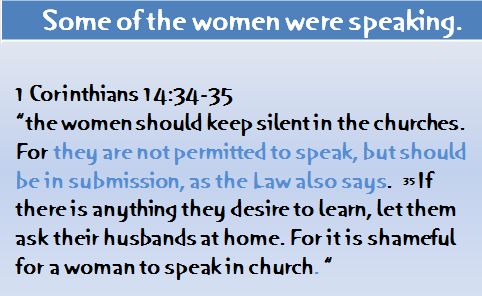
Paul says that the women are not permitted to speak, but should be in submission as the law also says. The problem is that there is absolutely no Old Testament commandment against women speaking. But there were plenty of laws in Corinth against women speaking. Paul seems to be saying that the women in Corinth should not speak in public because it is illegal.

In fact, history tells us that there was only one class of women who dared to speak in public in 1st century Corinth: the professional prostitutes. These were also the only Corinthian women of marriageable age who dared to appear in public without a veil.
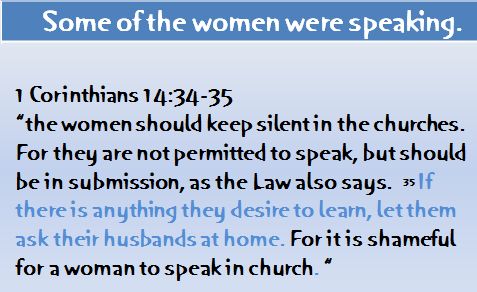
The particular issue that appears to be the problem at Corinth is that wives are interrupting the worship to ask questions of their husbands. This is understandable, because in the first century women were not educated. There was apt to be a great deal of what was being said that the women did not understand. Their zeal to know was commendable, but it was causing confusion in the assembly, which is exactly the problem that Paul was addressing. Paul’s solution was “let them ask their husbands at home.”

As if I have not stirred up enough controversy, I want to go now to the problem that took up the most space in chapter 14: the problem of too many people “speaking in tongues.”

To understand Paul’s advice here we have to ask three questions. First, “What was “speaking in tongues?” I realize that there is a whole theological tradition that suggests that “speaking in tongues” is some kind of supernatural language that God gives believers to edify themselves with.

But I suggest that the problem in First Century Corinth was simply this: people were coming to worship services and giving their messages in languages that most of the other worshippers did not know.

Paul’s solution to the problem is found in verse 28 “But if there is no one to interpret, let each of them keep silent in church and speak to himself and to God.”
He tells the tongues speakers the same thing he told the women, and for the same reason. The wives questioning their husbands was causing distraction and not edifying anyone. The tongues speaking (without a translation) was doing the same thing. So Paul says “stop doing that.” The goal of all the manifestations of the Holy spirit is to edify the body of Christ. If what you are doing is not achieving that goal, you have no business doing it.
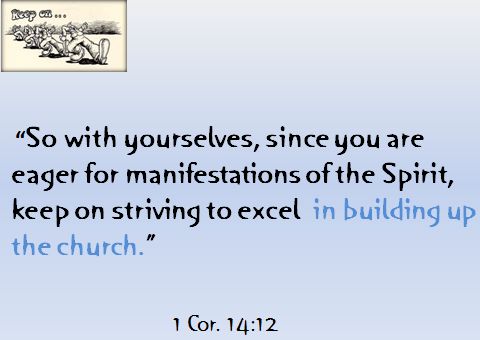
I want to conclude by going back to verse 12, where Paul encourages the Corinthians to keep striving to excel in building up the church. That is the BIG IDEA that Paul is trying to get across in chapters 12-14. May we never forget that. We need to constantly evaluate ourselves to see if the things we are doing when we meet together are actually building up the body. If First century Corinth could have problems – even after being founded by Paul himself – then we have no reason to assume that 21st century Takanini is immune.
_________
LORD, before we say anything in church, help us to ask ourselves “will this help the people who hear it?” If it will not help, give us the consideration and love to keep our mouths shut!” Amen.

ACST 16. The Triune One

Evangelical Christians have inherited a rather bizarre sounding doctrine of God. Many believers take this doctrine for granted, but would be hard pressed to explain it to anyone. Some openly reject the doctrine as unbiblical. This is the doctrine of The Trinity. It teaches that the God of the Bible is a complex being consisting of three equally divine persons, but that these three persons comprise one divine essence, not three gods. The Father, Son, and Holy Spirit are not each 1/3 God, but each is fully God, while each is distinct from the other persons.

This trinitarian formula has been passed down to Christianity from its earliest days, and is the result of hashing over the biblical data in search of what it systematically tells regarding the question of the nature of the Father God, the nature of Christ, and the Holy Spirit, and their relationship to each other.

Unfortunately, most of that hashing over of the biblical data took place a long time ago. As a result, many sincere Christians fail to see the connection between the doctrine as it is expressed today, and the texts it developed from. The formula as it stands today is not substantially altered from that expressed by the creed of the Council of Nicaea, in 325 AD.

Challenges

Alternate theories have developed. This chapter will seek to address some of those theories by identifying the points where they depart from trinitarianism, and their reasoning for doing so. Usually these objections to trinitarian language are trying to protect some other aspect of orthodox theology. For that reason, these arguments should be welcomed in academic theological study, even if at the end their premises are rejected.

The Biblical Data

The first place to turn, however, is not to the theories, but to the word of God. A survey of the Bible’s teaching about the nature of God reveals that the authors of the trinitarian formula were trying to summarize the biblical data when they developed the formula.

The very first verse in the Bible contains a grammatical contradiction. In Genesis 1:1 the verb bara’ is properly translated “he created.” But the subject of that verb – God, the one who created – is called ‘Elohim, which in form is masculine plural. The Jews developed many explanations for this apparent contradiction, but at least it suggested that the God who created the universe could not easily be defined. In the same chapter, God says “let us make man in our image” (1:26) which suggests again that God’s nature is a plurality of some sort. There is nothing in the context that suggests that God was talking to anyone else but himself. The occasional use in the Old Testament of plural pronouns when God is referring to himself,1 and plural verbs when referring to God’s activities2 and times when the titles “God” or “LORD” seem to refer to two persons at the same time3 seem to suggests that a raw Unitarianism does not capture God’s nature.

The contradiction is more than a grammatical one, because basic to Judaism is the concept of monotheism. The Bible affirms that monotheism in a number of places. In Deut. 6:4 the LORD is proclaimed to be one. In the face of pagan nations who claim that other beings are equally divine, God tells the Israelites that he alone deserves the title deity. This is more than simply a protest against idolatry. It is a fundamental testimony to the nature of God. But Moses, who wrote Deut. 6:4, is the same author who penned Genesis 1. Either he is contradicting himself, or he is suggesting a fundamental monotheistic deity who (in some sense) is also a plurality.

In the New Testament, this fundamental monotheism of Deut. 6:4 is retained in statements of essential theology. James takes it as a standard of orthodoxy to believe that “there is one God” (2:19). Paul repeats these words numerous times (1 Cor. 8:6; Eph. 4:6; 1 Tim. 2:5). Yet when Jesus commands baptism in the name of this one God, he tells the church to baptize believers in the name of “The Father and of the Son and of the Holy Spirit” (Matt. 28:19). Notice that there is only one name mentioned. “The Father” is not a name, it is a title. “The Son” is likewise a title. “The Holy Spirit” is a title as well. If Jesus had in mind a name here, it could only be the name which, in our English Bibles is translated LORD. The name in Hebrew is YHVH. Thus the term which the Bible uses most for God applies equally to all three members of the Trinity.

The monotheism that the Bible proclaims is preserved by the trinitarian formula because each of the three persons of the trinity is called by the same name, identifying each with the same being, the same God. God is one “what” and three “whos” at the same time. There is no trickery here. If the data that the Bible presents allowed some other explanation, then the trinitarian formula should be renounced.

But the trinity is often rejected for another reason: it does not make sense. The reason is does not make sense is that it is an attempt to describe God’s nature. His nature is difficult to describe because there is no one else to compare it to. The Bible constantly affirms that there is no one else like God.4 We have already seen in the previous chapters that some aspects of God’s nature are exclusive to him alone. We should not expect to fully understand or relate to those attributes which are exclusive to God. God’s triune nature is one of those attributes.

Each of the persons of the Trinity is revealed in the Old Testament, and his existence and purpose is clarified in the New Testament. Psalm 2:7 records a conversation between God the Father and someone else. The Father is speaking to someone else who is in heaven with himself, and proclaims to that person “”You are my Son; today I have begotten you.” That other person was not an angel, as is made clear by the author of Hebrews (1:5). The New Testament affirmation is that this statement was made to Jesus Christ before he was born (Acts 13:33; Hebrews 5:5).
So trinitarian thought affirms that Jesus (in addition to being fully human) is also fully God, so preexisted his own incarnation.

Jesus constantly spoke of the Father sending his Son into the world.5 It was clear that he was not sent in the same way that the prophets were sent, because behind each of these references is that incarnational appointment as high priest under the new covenant (Hebrews 5:5). He was not sent just to be a messenger to the world, but he was sent to be its Savior, as Paul6 and John7 would proclaim in their epistles. A prophet could come from earth, and be a sinner just like us. But a Savior had to come from heaven,8 — from above9 –and be sinless, like God.

So, when Jesus did finally make his appearance in the flesh among the human race, God the Father declared that he was unique, because of his special relationship with him. Other people were God’s children by virtue of creation and subsequent procreation. Jesus was God the Father’s only begotten Son in whom the Father is well-pleased, and upon whom the Holy Spirit dwells and remains without limitation.10 He is uniquely the Son of God,11 therefore he knows the Father like no one else, and is equally known by the Father.12

Jesus also infuriated the Jewish leaders by claiming that special relationship. They correctly understood that Jesus was making himself to be equal with God. They were right in accusing him of blasphemy if his statements were not true.

John 10:22-33 ESV
At that time the Feast of Dedication took place at Jerusalem.
It was winter, and Jesus was walking in the temple, in the
colonnade of Solomon. So the Jews gathered around him and
said to him, “How long will you keep us in suspense? If you are
the Christ, tell us plainly.” Jesus answered them, “I told you,
and you do not believe. The works that I do in my Father’s
name bear witness about me, but you do not believe because
you are not part of my flock. My sheep hear my voice, and
I know them, and they follow me. I give them eternal life,
and they will never perish, and no one will snatch them out
of my hand. My Father, who has given them to me, is greater
than all, and no one is able to snatch them out of the Father’s
hand. I and the Father are one.” The Jews picked up stones
again to stone him. Jesus answered them, “I have shown you
many good works from the Father; for which of them are you
going to stone me?” The Jews answered him, “It is not for a
good work that we are going to stone you but for blasphemy,
because you, being a man, make yourself God.”

It was a serious thing to reject what Jesus was saying about himself here. Those who refused to listen to his voice were not part of his flock. He was not claiming to be the Father, but he was claiming to be one (that is, equal) with his Father. He was claiming full deity just as the Father has full deity.

Another factor that leads to trinitarian thought is how the biblical record treats the Holy Spirit. The language used of him is personal, and, when taken seriously, prevents the assumption that the Holy Spirit is just another name for the Father, or some influence or power sent from the Father. Although the title “Spirit” is neuter in Greek, the New Testament authors do not treat the Holy Spirit as a mere influence. They insist on using masculine pronouns when referring to him. He is a “he,” not an “it.”13 The actions he is said to perform are actions of a person who can communicate and whose words can be rejected, and even blasphemed against.14 The “he” in question is not the Father. The Son was sent from the Father. The Spirit was also from the Father but was sent by the Son (John 15:26).

Like the Son, the Spirit will have a mission, and carry out that mission on earth. In fact, the Holy Spirit would take on the same mission as Christ did, so far as the discipling of Christ’s followers is concerned. This is what Jesus meant when he said that the Holy Spirit would be another Helper. In John 14:16 Jesus predicts that the Father (one person) will answer his (another person’s) prayer and send another Helper (third person) who would be with the disciples forever. By using the term “another” here, Jesus implies that he (Jesus) was the first helper.

The term “another” is also significant because the Greeks used two words that can be translated into English as “another.” The term heteros means another of a different kind. We see that word in our English word heterosexual. A heterosexual has sexual relations with another person of a different gender. The opposite is a homosexual, who prefers relations with a person of the same (homos) gender. The point is, if the Holy Spirit were merely an influence from God, an impersonal power, then the Greek word John would have used in John 14:16 would naturally be heteros but it was not. Instead, John used allelos. This word also translates into English as “another” but it means another of the same kind. If Jesus, as a person, came as a helper for his disciples, then he would send the Holy Spirit, who is also a person to pick up the slack in his physical absence. For God so loved the world that he sent his Son. For Jesus so loved the world that he also sent another person: the Holy Spirit.

Father, Son and Holy Spirit had made a noticeable appearance together at the baptism of Christ.15 It was not until after the Holy Spirit appeared and began manifesting himself in the early Church that believers began putting one plus one plus one together and coming up with a God who is three persons. By the time the epistles were written, this had become so clear that invocations for blessings to God were now written not just to the Father, but to both the Father and the Son.16 And references to God’s work in believers’ lives would include all three persons.17

Objections

Not all evangelical believers see the data above as conclusive proof for the doctrine of the trinity. Some objectors, like the Arians and modern day Unitarians18 seek to preserve the monotheism by down-grading the Son to a lesser “god” with a small “g,” (which they would then argue is not God at all), and down-grading the Spirit to God in action (denying his distinct person-hood). Others seek to preserve the unity by merging all three persons into one, like the Oneness Pentecostals19 do when they insist on “Jesus Only.” They apparently see the examples of God’s plurality in speech or action as merely a plurality of manifestation of the one monotheistic God of the Bible.

Sometimes opponents of the Trinity object to it ad hominem because they believe the doctrine came from Catholicism, and thus must necessarily be wrong. While it is true that the first believers in the Trinity were Catholics, it is also true that the first believers in justification by faith and sola scriptura and the priesthood of all believers (as those doctrines came to be expressed by the reformers) were also Catholics. The fact is, the doctrines that reveal the apostate nature of Roman Catholicism had not yet fully developed when the doctrine of the Trinity was approved by the Council of Nicaea. Its creed represents a Church seeking to conform to the Bible and present the Bible’s theology.

The trinity is a touchy subject for most of us. It has even been a matter upon which evangelicals have chosen to deny membership or fellowship to those who hold different opinions. While we evangelicals are sometimes quite liberal in our acceptance of those with differing theological views, this subject often seems too sensitive for that. After all, the nature of God himself seems too essential, too basic to allow much wiggle room.

There is also a practical reason that this doctrine is held with such fervor. To lose the triune nature of God is to miss out on a God to whom relationships are part of his essential being. Both Unitarians and Oneness Pentecostals proclaim a God who is categorically one person. Trinitarians proclaim, worship and serve a God whose unity has always been a manifestation of a unique eternal relationship between Father, Son, and Holy Spirit. Trinitarians like to think that knowing the Triune God teaches us something about true unity in relationships.

Sincere Advent Christians have promulgated both the Unitarian and Trinitarian positions, but the debate has not always been as irenic as it could have been. The clashes in the past were partly due to the sensitive and important nature of the debate. But some of them (to our shame) have resulted from failure to treat each other with respect. May God forgive us.

________________________
1 Gen. 3:22; 11:7; Isaiah 6:8.
2 Gen. 20:13; 35:7.
3 Psalm 45:6-7; 110:1; Hosea 1:7.
4 Deut. 4:35,39; 1 Kings 8:60; 1 Sam. 42:8; Isaiah 45: 5,6, 18,21,22; 46:9; Mark 12:32.
5 John 4:34; 5:24,30,36,37; 6:38,39,44,57; 7:16,28,29,33; 8:16,18,26,29,42; 9:4; 11:42; 12:44,45,49; 13:20; 14:24; 15:21; 16:5; 17:8,18,21,23,25; 20:21.
6 Gal. 4:4,6.
7 1 John 4:9,10,14.
8 1 Cor. 15:47; 1 Thess. 1:10; 4:16; 2 Thess. 1:7; Heb. 12:25.
9 John 3:31; 8:23.
10 Matt. 11:27; 24:36; Mark 13:32; Luke 10:22.
11 Matt. 4:6; 8:29; 14:33; 27:40,43,44; Mark 3:11; 12:6-8; 15:39; Luke 4:41; 22:70; compare John 1:34,49; 9:35; 11:27.
12 Matt. 11:27; Luke 10:22.
13 John 14:17, 26; 15:26; 16:13.
14 Mark 3:29; Luke 12:10.

August 2010


photo by Jachin Mandeno

You have reached the Newsletter of Jeff and Penny Vann, missionaries with Advent Christian General Conference, currently serving in New Zealand as pastors-at-large with the Advent Christian Conference of New Zealand (ACCONZ). We serve as teaching pastors at Takanini Church of Christ, and Christian LIFE Church, Takanini, Auckland.

Our friend and fellow pastor David Burge fell asleep in Christ on July 4th. David had a disease that he knew was likely to take him in the prime of his life. Before the leukaemia started taking up his time, he had the chance to step back from the busyness of life and concentrate on the things that were important to him. But even those months he had, are not enough. It is unfair that we have to say goodbye to David at all. Our only consolation is that we are not saying goodbye for good. We are only saying goodbye for now.

Dave’s funeral was held on Saturday, July 10 at a local Baptist Church. Hundreds joined us as we gave tribute to this man of God. The message Jeff shared focused on the resurrection of believers, and is available on his web log: http://jeffersonvann.blogspot.com/2010/07/in-honour-of-david-burge-1968-2010.html

photo by Jachin Mandeno

God’s timing is so awesome. While preparing for Dave’s funeral, I (Penny)had a sudden thought that I had better resend my cell phone numbers to my sister so in case something happened Stateside she could contact me. For whatever reason the email was delayed a couple of days. She got the numbers one morning and had to use them THAT afternoon to tell me of my dad’s heart attack. She called back an hour later to tell me he had died. It was 12:30pm here when the call came and I was at the airport ticket in hand 4 hours later. I flew back to Connecticut for his funeral. But, while in the States, I was able to visit Connie in Massachusetts, and be there for the birth of our newest grandson.

Simon Dean Shaw was born on July 22nd, 7lb. 5oz, and 22 in. He and his parents (Steve and Connie) are doing fine.

3 days after returning to New Zealand, Penny taught a one-day seminar on the Old Testament. The insights she shared helped us all to see the big picture of God working through thousands of years of history to bring about his purpose of calling the nations to himself.


photo by Jachin Mandeno

Our short trip to the South Island took place August 10-13. We visited some friends we met while Jeff was in seminary. One of the highlights was a trip to a lamb farm, where we saw thousands of newly born lambs.

See a video of the lambs: http://docs.google.com/leaf?id=0B8QUBWMDoi-tNjBhODg1ODEtYzljZi00OGFkLWJkZWEtZDY1ZWI4OTE3ZjQz&hl=en

Life in New Zealand (A Yankee’s perspective). It has been winter here. Winter in Auckland is NOT like winter in New England. The grass is still green and I have not seen one flake of snow. It mostly rains and is rather a raw cold. So we go to coffee shops
to chase the dampness away. Coffee shops act as the local social hang out. The other thing one notices here is most Kiwi’s don’t have central heating in their homes. They rely more on space heaters or wood/coal stoves for their heat. The reasoning is, “why heat a room you are not in?” They also keep the rooms cooler than most American homes. The idea is if your cold put on a jumper (sweater). It is actually not a bad idea, and one I grew up with in the 70’s during the oil embargo.
I often feel like I am trying to speak two dialects at the same time. I (Penny), being from New England, don’t have to try as hard as Jeff does having the “eh?” and “wicked” already down and being used to people dropping their “R”s. There are still differences, like a jumper-sweater, a pinafore-jumper, supper-night-time snack, while tea or dinner-supper, you get the picture. This with idiomatic differences is enough to keep us on our toes.

Please Pray:

1) For Penny’s family as they face the loss of her father.
2) For David Burge’s family as they adjust to life without him.
3) For The Takanini church that they make wise plans for present and future ministry.
4) For Penny and Jeff, that they continue to serve the LORD in New Zealand.

The Gospel Choice (Gal. 4:21-31).

Galatians 4:21-31 Tell me, you who desire to be under the law, do you not listen to the law? 22 For it is written that Abraham had two sons, one by a slave woman and one by a free woman. 23 But the son of the slave was born according to the flesh, while the son of the free woman was born through promise. 24 Now this may be interpreted allegorically: these women are two covenants. One is from Mount Sinai, bearing children for slavery; she is Hagar. 25 Now Hagar is Mount Sinai in Arabia; she corresponds to the present Jerusalem, for she is in slavery with her children. 26 But the Jerusalem above is free, and she is our mother. 27 For it is written, “Rejoice, O barren one who does not bear; break forth and cry aloud, you who are not in labor! For the children of the desolate one will be more than those of the one who has a husband.” 28 Now you, brothers, like Isaac, are children of promise. 29 But just as at that time he who was born according to the flesh persecuted him who was born according to the Spirit, so also it is now. 30 But what does the Scripture say? “Cast out the slave woman and her son, for the son of the slave woman shall not inherit with the son of the free woman.” 31 So, brothers, we are not children of the slave but of the free woman.

We have been meditating on Paul’s letter to the Galatians for the past few months. Paul was dealing with a problem that had developed not only in the Galatian region, but in many places where new Gentile churches had been established. A group of people from Jerusalem had infiltrated these Gentile churches and suggested an alternative to the Gospel of salvation by grace that Paul preached. Their alternative involved trusting in Jesus for their salvation, AND following the Jewish customs and traditions.

This problem was not unique to the first century AD. For two thousand years the Church of Jesus Christ has had to constantly re-evaluate and reform itself because human traditions keep crowding themselves into its doctrines and practices.
We have depended upon the Bible as God’s standard for what it means to be the Church. Each successive generation has had to re-look at the Bible to see if we have added some new human traditions and crowded out the simple truth of the gospel.

Fortunately today the Bible is not hidden from us. We no longer have to depend on professional clergy to tell us what the Bible says, or to interpret its message for us. Those of us who speak English have dozens of well-prepared Bible translations available for us to read. We even have access to the original languages in which the Bible was written. Nothing keeps us from getting a clear message from God, and responding to that message in faith.
Nothing, that is, except laziness or presuming that we already understand the Bible!

Today’s text offers us an opportunity not just to re-examine the Bible, but to re-examine ourselves, and the choice that we have made that puts us in this church building today. Paul was writing to people who claimed to be true Christians, but he argued that they had substituted the true faith that they had received for a false faith, a faith in both Christ and themselves.
As we examine Paul’s argument in Galatians 4:21-31, we need to be asking ourselves what choice we have made as well.

Here is the story that Paul was alluding to in today’s text. In Genesis 15 God had promised Abraham that he would be the father of many nations, but he was childless.
Genesis 16:2 And Sarai said to Abram, “Behold now, the LORD has prevented me from bearing children. Go in to my servant; it may be that I shall obtain children by her.” And Abram listened to the voice of Sarai.
Genesis 16:15 And Hagar bore Abram a son, and Abram called the name of his son, whom Hagar bore, Ishmael.

Now let us pick up the story 14 years later:
Genesis 17:15-19 And God said to Abraham, “As for Sarai your wife, you shall not call her name Sarai, but Sarah shall be her name. 16 I will bless her, and moreover, I will give you a son by her. I will bless her, and she shall become nations; kings of peoples shall come from her.” 17 Then Abraham fell on his face and laughed and said to himself, “Shall a child be born to a man who is a hundred years old? Shall Sarah, who is ninety years old, bear a child?” 18 And Abraham said to God, “Oh that Ishmael might live before you!” 19 God said, “No, but Sarah your wife shall bear you a son, and you shall call his name Isaac. I will establish my covenant with him as an everlasting covenant for his offspring after him.
It turns out that Abraham was wrong to go behind God’s back and do his miracle for him. I think this is the point that Paul is making: We are in danger of asking God to bless us with salvation, then taking the task back on ourselves.

God offers us something supernatural – something only he can do. He has an Isaac in store for us. We assess our situation, and, like Abraham and Sarah, we decide God needs a little help. After all, God helps those who help themselves, right?
Actually, that’s one of those statements that lots of people quote, but it is not in the Bible. The truth is, God can only help those who realize that they cannot help themselves. Having Ishmael was the wrong choice. It was, in biblical terms, “of the flesh.”

Having introduced faith to the Gentile Galatians, he also introduced to them the power that would enable them to live out their salvation. Paul asks them in Gal. 3:3 “Having begun by the Spirit, are you now being perfected by the flesh?” And that is exactly what the Judaisers wanted. They wanted to replace the Holy Spirit with the Mosaic Law as the means of sanctification.
But it doesn’t work that way. Paul says in Galatians 3:21-22 “… if a law had been given that could give life, then righteousness would indeed be by the law. But the Scripture imprisoned everything under sin, so that the promise by faith in Jesus Christ might be given to those who believe.”

Paul asks the Galatians to think of two places: Mt. Sinai in Arabia or the heavenly Jerusalem. He is trying to get them to see for themselves that only one choice leads to true freedom.

The people at Sinai had the same choice.

Exodus 24:3 Moses came and told the people all the words of the LORD and all the rules. And all the people answered with one voice and said, “All the words that the LORD has spoken we will do.”

They should have said, “We cannot follow the rules, we put ourselves at your mercy and trust in your grace.”

If freedom is going to come to us, it is going to be the work of heaven, not our work.

So Paul quotes Genesis 21:10 where God orders Abraham to expel Hagar because Ishmael will not share in Isaac’s inheritance. Hagar is called “the slave woman.”
Paul has been using this allegory to point out that the Galatians have a simple choice. If they want to inherit the blessings of Abraham they will have to make the choice Abraham did. They have to take God on his terms, not their terms.

Now, you and I have to make the same choice. We can decide to do our best, and hope that God accepts it. That is the choice of Hagar, of Ishmael, of the letter, of Sinai, it is a choice to enslave ourselves.
Or, we can take God on his terms. We can say, God, I cannot do it myself. I trust in Christ and his finished work on the cross. I trust in your Holy Spirit to guide me in the Christian walk. And I trust in You, heavenly Father, to bring me into the inheritance you have planned for me.

The Gospel Received and Abandoned (Gal. 4:8-20).

Galatians 4:8-20 ESV
Formerly, when you did not know God, you were enslaved to those that by nature are not gods. 9 But now that you have come to know God, or rather to be known by God, how can you turn back again to the weak and worthless elementary principles of the world, whose slaves you want to be once more? 10 You observe days and months and seasons and years! 11 I am afraid I may have labored over you in vain. 12 Brothers, I entreat you, become as I am, for I also have become as you are. You did me no wrong. 13 You know it was because of a bodily ailment that I preached the gospel to you at first, 14 and though my condition was a trial to you, you did not scorn or despise me, but received me as an angel of God, as Christ Jesus. 15 What then has become of the blessing you felt? For I testify to you that, if possible, you would have gouged out your eyes and given them to me. 16 Have I then become your enemy by telling you the truth? 17 They make much of you, but for no good purpose. They want to shut you out, that you may make much of them. 18 It is always good to be made much of for a good purpose, and not only when I am present with you, 19 my little children, for whom I am again in the anguish of childbirth until Christ is formed in you! 20 I wish I could be present with you now and change my tone, for I am perplexed about you.

We have been studying Paul’s epistle to the Galatians. We have seen that the Galatians had been deceived by some false teachers. They were being tempted to identify themselves with Jewish traditions, with the assumption that in so doing they might enjoy God’s favour and the blessings associated with Abraham.

Paul has been arguing that going to Judaism is going backwards, not forwards.

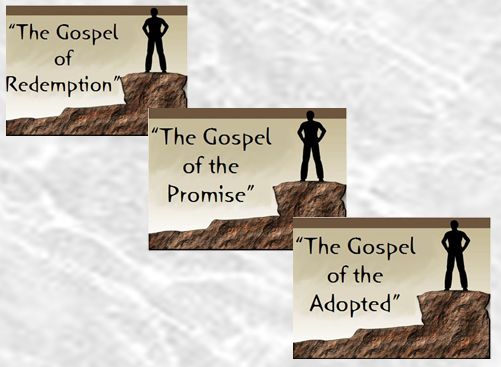
In 3:10-14 he argued that Gentile Christians are already redeemed by what Christ did.

In 3:15-29 he argued that Gentile Christians are already recipients of God’s promise to Abraham.

In 4:1-7 he argued that all Christians are adopted equally into the family of God.

In today’s text Paul goes back to what the Galatians were like before they heard the gospel. He says that they were all enslaved to demons. The Galatians did not need proof of the existence of demons. They had been under demonic bondage until they found freedom by responding to the gospel in faith.

In this culture demons are not taken seriously, but the New Testament takes demons very seriously.

One of Jesus’ ministries when he walked this earth was casting out demons. He actually presented his work of casting out demons as evidence that the kingdom of God had arrived. If demons were a fairy tale, Jesus would have exposed it. Instead, he spent much of his valuable time delivering people from their control. He took them seriously, and so should we.

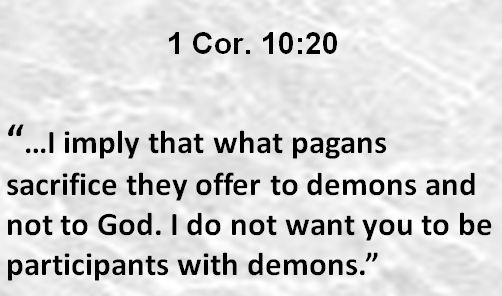
Paul told the Corinthians that demons were behind pagan idolatry. Those gods of wood and stone had enslaved people because there were real spirit beings using them for that very purpose. For that reason he warned the Corinthians not to have anything to do with the idols – not because the idols are powerful, but because the demons behind them are real.

In fact, Paul told the Ephesians that in our Christian life our real battle is not with human enemies, but with these demons. We wrestle against the spiritual forces of evil. These forces are real, even though normally we can’t see them. They work in four ways: they tempt us to sin, they deceive us in our thinking, they accuse us in order to render us powerless through guilt, and (if all else fails) they intimidate us by manifesting.

James takes the devil and his demons seriously as well. He tells us to resist the devil. Resist is a defensive word. It suggests that the devil is on the attack. If we don’t take him and his demons seriously, we will be sitting ducks.

So Peter tells us to be on the watch, because just because you chose to ignore the spirit world does not mean that you cannot become a victim of it. Satan is real, and he is looking for his lunch. Peter says “be watchful.” Don’t become lion lunch.

So Paul continues his chronological argument by reminding the Galatians that when the gospel came, they accepted it gladly. Even though Paul had some kind of sickness when he came to their area, they still flocked to him. He had the answer to their problem. By trusting in Jesus Christ as their Saviour and Lord, these Galatians found freedom from their bondage to demons. They were set free. They found out that they did not have live in fear of these spirit beings anymore. That is good news.

So what happened? What turned these victors in to victims? It was pride. Yes, that’s right… pride. In verse 17, Paul says “They make much of you, but for no good purpose. They want to shut you out, that you may make much of them.” The “they” are the troublers, the Judaizers. They came to Galatia as “super-Christians.” They said to the Galatians “Hey, you overcame your bondage to demons. That’s good. But now it’s time for you take the next step. Become super-Christians like us.

But Paul knew what was really going on. He realised that the temptation to pride was coming from the same place that the demonic bondage had come from. The Galatians were being enticed to go forward when in fact they would really be going backward.

This was the very thing that kept many Jews from receiving the gospel in the first place. They wanted praise from others, and were not willing to humble themselves and put their trust in God alone.

But God chooses to save those who cannot say “I can handle this.” He chooses the low and despised in the world. There are no self-made men in the kingdom of God.

By grace. Through faith. Not your own doing.

This is why the message of Galatians is so important: Anyone who hears the gospel is at risk of abandoning it – while still remaining outwardly Christian.

God has a righteousness available, but those who seek to establish their own will never submit to it. It is an either-or choice. God will not tolerate someone giving their life to him, and then taking it back.

So Paul told the Galatians to turn around because they had gotten turned around. They were going the wrong way. They had abandoned the gospel that they had received. In order to reach them for Christ, Paul had become like them. Now he was asking them to become like him: a person who lives by faith (12).

Paul had given birth to them by bringing them to Christ. Now he is in labour again so that the life of Christ can be formed in them (19).

He wants them to be crucified with Christ. He wants it to no longer be the Galatians who live, but Christ living in them. He wants them to follow his example of living by faith.

John Piper describes that life this way: “Faith is the assurance that what God will make of you, as Christ is formed in your life, is vastly to be preferred over what you can make of yourself. Faith is the confidence that the demonstration of Christ’s work in your life is more wonderful than all the praise you could get for yourself by being a self-made man—or woman. Faith is a happy resting in the all-sufficiency of what Christ did on the cross, what he is doing now in our heart, and what he promises to do for us for ever.”

Now this message applies to us today. It is possible to remain in the church while abandoning the gospel. It is possible to escape one form of demonic deception and then fall for another form. The Galatians had abandoned their idols, but now they were tuning to pride and self-reliance.
———–
LORD, help us to live by faith in the Son of God who died for us. Help us to rest in the all-sufficiency of what Christ did for us on the cross, what he is doing now in our hearts, and what he promises to do for us for ever. In Jesus’ name, Amen.