UNITY

UNITY

Psalm 133 ESV

A Song of Ascents. Of David. 1 Behold, how good and pleasant it is when brothers dwell in unity! 2 It is like the precious oil on the head, running down on the beard, on the beard of Aaron, running down on the collar of his robes! 3 It is like the dew of Hermon, which falls on the mountains of Zion! For there the Lord has commanded the blessing, life forevermore.

Israelite pilgrims probably sang the songs of ascent as they traveled to Jerusalem to worship the Lord during the annual festivals. As the believers climbed toward Jerusalem, they prepared themselves spiritually for the importance of their visit to Mount Zion. This particular Psalm is attributed to David. It celebrates the unity of God’s people.

I believe we Christians should meditate on this Psalm. Unity is also a significant theme in the New Testament. Jesus prayed for us to live in harmony with one another when he asked the Father that we may be one, just as he and the Father are one (John 17:21). The Apostle Paul taught us not to focus on our differences but to see ourselves as one in Christ. He knew that the Christians in his time had a lot of diversity. They had ethnic diversity because the gospel had spread to many nations, and now there were Greek Christians as well as Jewish Christians. He knew the gospel had been preached to both high-class nobility and lower-class slaves. He also knew that the good news had been proclaimed to and by women as well as men. So, he taught that “there is neither Jew nor Greek, there is neither slave nor free, there is neither male nor female — for all of you are one in Christ Jesus (Galatians 3:28).”

Our relationship with Christ allows us to overlook our differences and treat each other as He commanded us to. He taught us to love, respect, and be considerate of one another. In fact, we are warned that if we only claim to love God but do not love each other, we are hypocrites. When we consider all these things the New Testament teaches about unity, we would be surprised if the same principles are not found in the Old Testament, the Bible Jesus read.

Some of the oldest Bible stories actually depict unity in a negative light. Adam and Eve were united in their defiance against the Lord in the garden, and the people of Babel were united in their attempt to disobey God’s command to scatter across the Earth.

But as revelation progresses, it becomes clear that God is not against human unity. He wants to unify us in a way that is different from the way we want to unify ourselves. We want to unify ourselves against his plan and against his heart. He wants to unify us according to his plan and in line with his heart. The way he wants to do that is to unify us in the Messiah. He wants us to be one in Christ.

The final book of the Bible, Revelation, reveals what this will look like in eternity. It shows us a vision of the redeemed from every tribe, language, people, and nation. But this vast multitude of people is one despite their former ethnic, geographic, social, and economic differences. They are the redeemed in Christ, and they are one. That’s what God wants.

Now that we have surveyed the concept of unity in the Bible, let’s examine the teachings of this particular passage.

Unity is a good thing (1).

We don’t use the word “behold” very often now, but it was frequently used in Bible times. We use it when we want to attract people’s attention to something. When we write something, we can do this by changing the font, underlining the word, or putting it in bold print. We are telling our readers to notice this word or phrase because it is crucial.

David wanted his readers to see that fraternal unity was a good and pleasant thing. He paints a picture with his words, portraying the entire nation sitting together as one person. We can understand how David could feel that way as king. He did not want his kingdom to be divided, he did not want civil war, and he wanted peace and harmony among the citizens of his nation.

But his words are more general than that. Perhaps he is expressing his gratitude for the peace that he has known in the United Israel. But he wants us to notice that God wants this of every nation.

Here is where the rubber meets the road for us in 21st-century America. This psalm reminds us that our country’s name is the United States. You all know that I rarely talk politics in the pulpit because I don’t think that is what this pulpit is for. But I need to address the reality that is all too evident in this nation today. We are taking sides and attacking each other. We are defining ourselves as us and condemning them. The last time we were polarized to such an extent, it resulted in a civil war.

God speaks to our current situation and calls us to peace, reconciliation, and unity. We need to recognize that unity is a good thing and that, as a nation, we are far from dwelling together in unity.

Unity is a calling (2).

David uses two similes to explain how good it is for brothers to be unified. In verse 2, he shows Aaron, the nation’s first high priest, being anointed with oil in his ordination ceremony.  We watch as the anointing oil flows freely down Aaron’s head and drips down his beard to the collar of his robes. No one screams, “Somebody get a towel.” Nobody wants to clean up the mess. Why? Because this is the anointing oil. Aaron is the anointed of God. He is called to represent the people before God as their high priest.

Part of explaining Scripture is showing the connections between its words so that the readers understand how they relate. There are several connections here that are not obvious, so I need to point them out. First, as high priest, Aaron unified the whole nation of Israel. They were a multitude of people, coming from a dozen tribes, but they had only one high priest. When Aaron was anointed, he stood as a symbol of the unity of Israel.

Secondly, anointing oil was an ancient symbol of purity. People anointed their heads to cleanse them from impurity and keep bugs out. Thus, oil itself became a symbol of a promise to obey one’s calling with integrity. In the Ancient Near East, three types of people were ordained by an anointing ceremony: prophets, priests, and kings.

Each would be tempted to exercise their position in a self-centered way. Their anointing was a promise and commitment to avoid corruption and selfishness. The oil flowing down their heads was a symbol of a commitment to purity.

Thirdly, every prophet, priest, or king who was anointed realized that the Scriptures predicted a coming anointed one who would be God’s ultimate anointed one. He would be not just a prophet, not just a priest, and not just a king. He would be the prophet, the priest, and the king. He would be all three. He was called the Messiah: the Anointed One. Consequently, every anointing ceremony would itself be a foreshadowing of the great event of the coming of Christ. Thus, everyone who was anointed took on the responsibility of predicting Christ through their own life choices.

Unity is a calling. That is why the Apostle Paul called the church, “those who are sanctified in Christ Jesus, and called to be saints, with all those in every place who call on the name of our Lord Jesus Christ, their Lord and ours” (1 Corinthians 1:2). He says that we “were called to the one hope of your calling, one Lord, one faith, one baptism, one God and Father of all, who is over all and through all and in all” (Ephesians 4:4-6).

We have not all been anointed with oil, but all of us have been anointed with God’s Holy Spirit. We have been given different gifts, but we are expected to use our gifts to build one another up “until we all attain to the unity of the faith and of the knowledge of the Son of God — a mature person, attaining to the measure of Christ’s full stature” Ephesians 4:13). So, just like Aaron in Psalm 133, every Christian is anointed. Our calling is to represent Christ as we grow to be more like him.

Unity is a blessing (3).

The simile changes in verse three. We are told that unity is like the dew of Hermon, but we don’t know who Hermon is. Mount Hermon is a high, snow-capped mountain located in the northern region. The picture is of the dew from this distant high mountain descending into the area of Zion, way to the South. We have heard of mountains being so large that they create their own weather. Something like that seems to be implied here. The difficulty is that there are numerous mountains in Israel, many of them in Judah itself, which is much closer to Jerusalem than Mount Hermon is. So, why did David draw attention to Mount Hermon?

I can only guess, but this is my guess. David chose a distant mountain to show us that the unity we can experience today is only an approximation of the unity we will experience when Christ returns. The dew from Hermon is a blessing upon all the pilgrims from the north as they make their way to Jerusalem for the feast. Our present unity is a blessing as well. But what we have in store when our Savior comes to reign is the blessing that the LORD commanded at Zion.

And what is that blessing? Life forevermore! Unity is good and pleasant, but the command of our God is more than unity. God wants more from us than merely getting along with others. He wants us all to make it to his destiny for us. As pilgrims together, we are blessed by the cooling dew from Mount Hermon, but we are all on our way to something even better. We are on our way to Zion. There the LORD has commanded the ultimate blessing: eternal life.

Some churches teach that we all already have eternal life. But that is not what this church teaches. The word of God speaks of a judgment day. The sheep and the goats will be separated. The goats will go to the punishment of permanent destruction, while the sheep will go to permanent life. The lost will die the second death, while the saved will get a second life. This second life will be the blessing that the LORD pronounced on Zion: life forevermore.

It is fitting that this short psalm about unity concludes by reminding us that something more important than unity exists. The unity in the Garden of Eden ended with our ancestors being expelled from paradise. The unity at Babel resulted in disorder and scattering. As we journey on this pilgrim path, we should all aim to get along with each other. However, our ultimate goal is not merely coexistence but to attain the prize of the upward call of God in Christ Jesus.

Communion Meditation:

Ephesians 2:15

“(Christ) nullified in his flesh the law of commandments in decrees. He did this to create in himself one new man out of two, thus making peace.”

After Christ’s death on the cross, there is only one people of God. He made forgiveness possible for both Jews and Gentiles. He enabled a unity based not on pedigree or works accomplished. His death made it possible for all of us to approach the throne of God based on his perfect work, not our imperfect works.

Resources for preaching Conditionalism


Jefferson Vann is a former missionary with the Advent Christian General Conference who now serves as Pastor of Piney Grove Advent Christian Church in Delco, North Carolina. He is the author of 46 books, including the two series mentioned below.


Conditional Immortality is the belief that eternal life is a blessing reserved only for the saved. Conditionalists hold that unbelievers will be raised at the return of Christ, judged and appropriately punished for their sins, and will die the second death in a place called Gehenna. We do not believe that God created all human beings with an immortal part that even he cannot destroy. When people die, they do not continue to live in a disembodied state. They actually die, ceasing to function until raised to life again consciously. This intermediate state is called “sleep” in the Bible. The Resurrection will wake all the dead, but only the saved will experience permanent life. The lost will literally perish.

Does your pastor preach conditionalism? Here are some resources that would help your pastor understand, preach, and teach the doctrines of conditionalism more clearly.

An Advent Christian Systematic Theology is a four-volume work that answers many typical questions about God, human nature, Christ, sin, salvation, and ultimate destiny.

Each volume is available in paperback (print-on-demand) and is currently being sold by Amazon for $15.

The 4-volume set is $60.


The Afterlife Archives is a series of five books that focus on conditionalism’s doctrines. These doctrines include God’s exclusive immortality, humanity’s potential for immortality, the unconscious sleep of the dead during the intermediate state, the resurrection to eternal life for the saved, and the resurrection to condemnation and the second death for the lost.

The set of all five paperback books in the Afterlife Archives series is currently available for $17.95. These prices may change on October 31st, 2025, but they will stay in effect for those who wish to bless their pastors with these resources during Pastor Appreciation Month (October).

Click on the pictures above to purchase the books.

DAYS OF A HIRED MAN

DAYS OF A HIRED MAN

Job 7:1-10 NET

1 “Does not humanity have hard service on earth? Are not their days also like the days of a hired man? 2 Like a servant longing for the evening shadow, and like a hired man looking for his wages, 3 thus I have been made to inherit months of futility, and nights of sorrow have been appointed to me. 4 If I lie down, I say, ‘When will I arise?’, and the night stretches on and I toss and turn restlessly until the day dawns. 5 My body is clothed with worms and dirty scabs; my skin is broken and festering. 6 My days are swifter than a weaver’s shuttle and they come to an end without hope. 7 Remember that my life is but a breath, that my eyes will never again see happiness. 8 The eye of him who sees me now will see me no more; your eyes will look for me, but I will be gone. 9 As a cloud is dispersed and then disappears, so the one who goes down to the grave does not come up again.10 He returns no more to his house, nor does his place of residence know him any more.

We are now well into our reading of Job, and we are discovering that it differs from the other books we’ve read in the Old Testament in many ways. The other books mainly focus on the historical progress of God’s people, from the patriarchs to the establishment and history of Israel. However, Job doesn’t mention Israel at all. Job may have been a patriarch, but there is no effort within the book to establish any historical or ethnic connection with the Hebrew people.

So, why is the book of Job in the Old Testament, the Hebrew Bible? One reason is that the Old Testament was written to answer questions that God’s people had about life. Some questions didn’t relate to which nation they belonged to. These questions were about the meaning of life, the purpose of living, and how to handle life’s challenges. So, in addition to the Torah and the historical books, a collection of wisdom literature was inspired by the Holy Spirit to address these questions.

Some wisdom literature was created to help people make wise decisions in life. The books of Proverbs and Ecclesiastes focus on this topic. The Song of Songs—often called the Song of Solomon—highlights the beauty and joy of human love and courtship. God wanted His people to understand that human love is not evil. It is a gift from God and should be celebrated and enjoyed within proper boundaries. Proper relationships with the opposite sex are part of God’s wisdom.

Many people have written books, poems, and stories that fall into the category of wisdom literature. Most of this literature is now gone, lost over time. However, some books and documents have been preserved. The Holy Spirit guided the writing and preservation of the Old Testament wisdom literature so that we can all benefit from it.

Most of the wisdom literature addresses what is known as conventional wisdom. This can be summarized as the belief that doing what is morally right will lead to God’s blessing of health and prosperity. Psalm 1 illustrates this by describing the wise person as a tree planted by the water, thriving and bearing fruit. In contrast, the wicked are the opposite of the wise; they will not endure because they have chosen to walk the path that leads to destruction.

With all these teachings that express conventional wisdom, the LORD saw it necessary to provide another kind of wisdom literature. We needed to understand that although it is generally true that the righteous will be blessed and successful in life, it is also true that sometimes the righteous will not experience that blessing. God has a message for those who suffer. Conventional wisdom offers only one answer to that question: you suffer because you made a mistake, you did something wrong, you committed a sin.

In the book of Job, his so-called friends were experts on the subject of conventional wisdom. They delivered long, drawn-out arguments trying to convince Job that he needed to repent and regain God’s favor. To them, the calamities Job suffered, the pain he experienced, and the losses he faced all pointed to some hidden sin he must have committed. We need to be careful when we read Job because sometimes we are reading those arguments, and the Holy Spirit wants us to see that their arguments are flawed.

The book of Job offers another view on the problem of suffering. In Job’s case, he was suffering not because God was angry with him, but because God was proud of him. Satan received permission to hurt Job because he believed that if Job endured enough pain, he would curse God.

The LORD eventually intervenes and rescues Job, but the main point of Job is not about the rescue. God is sovereign over our lives and has every right to allow us to suffer certain things, even if we are His obedient children. This serves as a helpful exception to the usual understanding of God’s justice.

There are also examples of this exception in the New Testament. One example is recorded in John chapter 9. The disciples encounter a man who was born blind. They ask Jesus who committed the sin that caused this man to suffer the fate of blindness at birth. Did his parents do something wrong, or would he do something wrong during his life, and would God punish him for it before he does it? Jesus told them that suffering was not caused by sin. It was allowed because God wanted to perform a miracle in his life. All suffering is caused by the existence of evil in this world, but it cannot always be traced to a particular evil.

Before he suffered, Job was a textbook example of conventional wisdom. He was a good man, obedient to God and considerate of others. God blessed him with great wealth, excellent health, and high honor. He considered himself a free man. However, through a series of unfortunate events, Job lost all his wealth, health, and honor. Today’s text describes how Job felt about that major reversal. He now saw himself as a hired hand, with someone else calling the shots, and Job did not like that at all.

In this section, Job lists several complaints. His description of the days of the hired man is important because it highlights what it truly means to face hardship. Let’s examine each of those complaints one by one.

Job complains about the WORK of a hired man (1-3a).

After years of living as a wealthy landowner, Job is now experiencing what it’s like to be part of the other half. He used to have an army of servants doing the hard work for him; now, it’s just him. So, he describes human life as “hard service,” and the Hebrew word he uses is the same one often translated as “army.” I know a little about what it means to be a soldier in the army, and it can sometimes be grueling work. One of the things that makes it tough is that you’re not doing what you want to do. You’re under someone else’s command—sometimes a lot of people. It can also be useless work.

Tennessee Ernie Ford sang a song about the work of a hired man. It was called “Sixteen Tons.”

“Some people say a man is made out of mud
A poor man’s made out of muscle and blood
Muscle and blood and skin and bones
A mind that’s weak and a back that’s strong

You load sixteen tons, what do you get?
Another day older and deeper in debt
Saint Peter, don’t you call me, ’cause I can’t go
I owe my soul to the company store.”

All of us want to do what is right and succeed. But we all go through times in life when we ask the same questions Job asks here: Why does it have to be so hard? Why does so much of our effort just lead to more effort tomorrow?

Let’s take a moment to step back and understand what’s happening. This is the Bible—God’s word to us. It tells us that God knows what we are going through and how tough it can get. He understands our nature. He remembers that we are made of dust. He sees our sweat. He hears our moaning. His message to us is not, “Quit your complaining; you deserve what you get.” His message is “Come to me, all you who are weary and burdened, and I will give you rest.” He told the Israelites, “My presence will go with you, and I will give you rest.”

Job also complains about the REST of a hired man (3b-4).

He talks about his nights, but he does not spend them resting. He spends them sorrowing. He says, “The night stretches on, and I toss and turn restlessly until the day dawns.” The time he is supposed to rest is full of restlessness. He is consumed by sorrow over his past loss and anxiety about his fears of the future.

God wants His people to rest. He commanded the Israelites to take one full day off each week. They had been slaves, and He understood that they might want to keep working. But He told them to stop what they were doing regularly and trust Him. Why do we struggle so much with resting in the Lord’s presence? God wants us to take our burdens off our backs and give them to Him. Yet, we often want to keep carrying those burdens ourselves.

Job complains about the BODY of a hired man (5)

He says his body is covered with worms and dirty scabs; my skin is broken and oozing. He had spent many years being the picture of health, and now he is the picture of death. Satan was not satisfied with stealing all of Job’s possessions and family. He wanted to steal his health too.

Jesus said that false shepherds are thieves and that all they want to do is steal and kill and destroy, but he came that people might have an abundant life.

We don’t have to go through the same health problems Job faced to see that our bodies often push back against us. As we get older, things tend to stop functioning as they should. We need extra devices to help with weak eyesight, hearing, and even heart issues.

The New Testament tells us that we will receive a new body when Jesus returns. That new body will not grow old or wear out; it is designed for eternity. Job didn’t know all the details about this new body, but he did understand the coming resurrection. He said, “I know that my Redeemer lives, and that as the last he will stand upon the earth. And after my skin has been destroyed, yet in my flesh I will see God” (19:25-26). The only way that could happen is if God raises him from the dead. Job knew that his current mortal body would be replaced by Job 2.0. 

The message is that although our bodies may someday fail us, our God never will. He has a replacement body for us, one that is indestructible and created to glorify Him forever.

Job complains about the END of a hired man  (6-10).

He knows his days are numbered, and it is not a very big number. He is heading for his grave. Someone else will live in his house because he will not be going back there.

Some people teach that death is not real. They believe your body dies, but you keep on living forever somewhere else. That was not what Job believed. His complaint was genuine because death is a fact. The Apostle Paul says that the penalty for sinning is death, and all of us have to pay that bill. The good news is not that death is an illusion. The gospel good news is that a new resurrection life awaits those who put their faith in Christ.

Job experienced a sudden, drastic upheaval in his life. He confronted his mortality, and it didn’t happen gradually. Go outside and look at the clouds, and if you keep watching, they will disperse and disappear. Job’s message is that this is our destiny. Conventional wisdom says that the goal in life is to be wise and successful. Job said that won’t last. We need to understand this. Only by facing our mortality can we learn to look up to God and receive the gift of His grace.

Jesus Christ revealed the promise of resurrection, life, and immortality through the gospel. Job grapples with his mortality, and rightly so—it’s a common struggle for all of us. Yet, we can also cling to his hope of a Redeemer who will come to reclaim us from the grave.

“Many still mourn
And many still weep
For those that they love
Who have fallen asleep
But we have this hope
Though our hearts may still ache
Just one shout from above
And they all will awake

And in the reunion of joy
We will see
Death will be swallowed
In sweet victory

Where is the sting
Tell me, where is the bite
When the grave robber comes
Like a thief in the night
Where is the victory
Where is the prize
When the grave robber comes
And death finally dies”[1]


[1] “Grave Robber” by Petra.

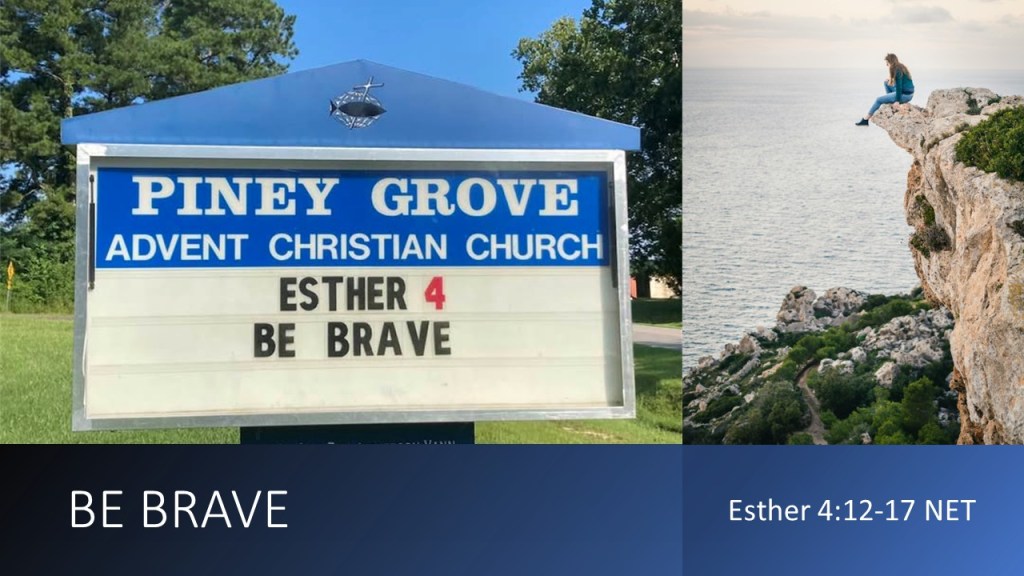
BE BRAVE

BE BRAVE

Esther 4:12-17 NET.

The stories in the Old Testament serve as lessons for us. They show the actions and behaviors that are expected of God’s people or reveal the opposite—the things believers should avoid. We need to pay close attention when reading because some Old Testament characters change their roles halfway through. They might start rebellious and then repent, or begin righteous and make a wrong turn or a terrible mistake. Therefore, reading these Old Testament narratives is not always easy.

We need to read the stories in the order we received them because that provides us with context. Context helps us understand what the characters are doing and why they are doing it. For example, today’s text is set during exile. This is the period when the Israelites are no longer in the land of Israel. They have been condemned by God for their lack of faithfulness and punished by exile. Exile is when people are taken from their land and brought to a new land by their conqueror.

Esther recounts the story of the Jews in Persia. The king had dismissed his queen, and he chose a new queen who happened to be Jewish. The villain of the story is an Agagite named Haman, who was violently anti-Semitic long before Hitler. Haman schemes to use the king’s power to eliminate the Jews.

Another key character in Esther is Mordecai, the cousin and guardian of Esther. Mordecai discovers a plot to destroy the Jews and appeals to Esther to intervene. When she learns of the plot, she wants to help save her people, but there is a problem. The protocol for appealing to the king is that he must first summon you. But Esther had not been called into the King’s presence in a month. Anyone who dares to enter the King’s presence without an invitation risks being executed. Esther understood the situation and chose to bravely enter the King’s presence to plead for her people’s lives.

If we look a little further back, we can see that another layer is at play in the story of Esther. There is a broader background as well as a more immediate one. In Esther, the sovereign God is protecting the people of Israel, from whom the Messiah will eventually come. That is another aspect we should recognize in these Old Testament stories. All of them reveal something about our Lord Jesus Christ. The Old Testament prepares the way for Christ’s first coming.

The book of Esther highlights one aspect of faith. It is a quality of biblical faith that isn’t often emphasized when we discuss what it means to have faith. In the New Testament book of Revelation, we find a list of all the people who will be excluded from eternal life and will be destroyed in the lake of fire. It states this: “But the cowards, faithless, detestable, murderers, sexually immoral, sorcerers, idolaters, and all liars, their share will be in the lake that burns with fire and sulfur, which is the second death” (Revelation 21:8).

I find it interesting that the first item on the list of those who will be destroyed in hell is cowards. Of all the things that the Bible describes as bad or evil, why put cowardice first?

I think there is a very good reason for this. Remember that the New Testament also tells us that our adversary, the devil, is prowling around looking for someone to devour. It does not ask us to hide from him. It does not tell us to run from him. It does not ask us to aim our rifles at him while he is far away and shoot him. It says that we are to resist him. Resistance requires contact. We must put ourselves in harm’s way and trust that God will accomplish his will. There’s no guarantee that we will always win.

There is no bravery without an obstacle.

We learned from Queen Esther not to let obstacles prevent us from standing up against enemies’ attacks. The obstacle Esther faced was that she had to enter the King’s presence to appeal to him on behalf of her people, but doing so could have cost her life.

Other biblical characters face the same challenge. Doing what is right could very likely cost them their lives. Daniel faced the lions in the den, his three companions faced the fire in the furnace, David faced Goliath, and Paul went to his death in Rome because he knew God wanted him to share the gospel with the emperor. One of the signs of faith in the Bible is that the people of God bravely set their sights on doing God’s will even when doing so is dangerous.

Another lesson we learned from Esther is that God is at work in every conflict, but we still must be brave.

I used to enjoy playing certain computer games where you faced dangerous challenges. I especially liked playing those games in what we called God Mode. If you set your settings to God Mode, then the bullets wouldn’t hurt you. The game remained challenging, but you had all the time you needed, and you could make all the mistakes possible without dying. Some people think that Christian life is like playing a game in God Mode. They believe they can face any challenge and don’t need to worry because their faith will protect them from losing. But that’s not what the Christian life is about. Esther is an example to follow, not because she was immune to danger, but because she wasn’t. She truly risked her life to do what was right. The world is full of cowards who aren’t willing to do the same.

God says that if we acknowledge Him before people, He will acknowledge us in the presence of His angels. But cowards hide behind their ignorance. They proclaim themselves as agnostics because they don’t want to offend anyone by claiming that Jesus Christ is Lord of Lords. They think they are saving themselves through their cowardice. But the fact is that refusing to bow the knee to Christ is like what Haman did. He built gallows, intending to hang Mordecai on them. However, he ended up being hanged from the very gallows he built.

The book we are reading today is called Esther because Esther showed faith to stand up and be counted to save her people. Esther had faith, and that faith was brave. But this is not just a story of one person’s faith. Before Esther went into the King’s presence, she told Mordecai to gather all the Israelites praying and fasting for her.

Not every Christian will face the kind of challenges she did, but we should all be ready to support those who do.

The New Testament encourages us all to pray and fast, but not solely for our preservation. Note these specific times when the apostle Paul asked others to pray for him.

  • He asked the Roman Christians to pray that he might be rescued from the unbelievers in Judea (Romans 15:31).
  • He asked the Ephesian Christians to stay alert and persevere in prayer for all the saints (Ephesians 6:18).
  • He also asked them to pray that he would stay bold in proclaiming the gospel even though he was in chains (Ephesians 6:20).
  • He asked the Colossian Christians to pray that God would give him and his team an opportunity to speak the mystery of Christ (Colossians 4:3).
  • He asked the Thessalonians to pray that as he and his team traveled to other places, the word of the Lord would spread quickly and be honored just as it was with them (2 Thessalonians 3:1).

Biblical faith is courageous faith. One reason we can be brave is that we know an army of prayer warriors is backing us up.

Communion Meditation

John 10:18

“No one takes it from me, but I lay it down, and I have the right to take it up again. I received this command from my father.”

We have discussed bravery as an aspect of faith. Esther demonstrated this bravery when she risked her life to save her people. She feared death, so she called for prayer and fasting on her behalf. Her bravery wasn’t the absence of fear; it was the courage to do what was right despite her fears.

Jesus is our example of that kind of courageous faith. He didn’t want to die, but he was brave enough to submit to God’s will and die in our place.

Today’s communion text tells us that God commanded both Christ’s crucifixion and resurrection. The father told the son to do it, and Jesus bravely did it. His one active obedience demonstrated both his compassion for us and his obedience to his father.

MADE ALIVE

MADE ALIVE

1 Corinthians 15:20-26 NET.

20 But now Christ has been raised from the dead, the firstfruits of those who have fallen asleep.21 For since death came through a man, the resurrection of the dead also came through a man.22 For just as in Adam all die, so also in Christ all will be made alive.23 But each in his own order: Christ, the firstfruits; then when Christ comes, those who belong to him.24 Then comes the end, when he hands over the kingdom to God the Father, when he has brought to an end all rule and all authority and power.25 For he must reign until he has put all his enemies under his feet.26 The last enemy to be eliminated is death.

We are reading through the Bible – two chapters a day – and our Sunday morning messages have usually been based on one of the passages we have encountered in our reading. But we have been taking a short break from that practice these past two Sundays. Because last Sunday was Palm Sunday and today is Easter, we are taking a detailed look at what Paul says in 1 Corinthians 15, which is Paul’s presentation of the gospel message. For Paul, the gospel message is focused on the reality of Christ’s resurrection. That is what Easter is all about. When we take away all the cultural traditions and external wrapping, Easter is the holiday of the resurrection. But our holiday does not simply celebrate the hope of resurrection in general. As Paul makes it clear in this chapter, our hope of a future resurrection is forever linked to who Jesus is and the fact of his resurrection.

If we take Christ away from Easter, we will still have all the external celebrations and rituals, but they will have been robbed of their true meaning. That is why we need to focus first on what happened to Jesus on Easter Sunday morning. Before we jump to some other focus, we should be sure what the Bible says about that empty tomb as it relates to the man who was inside that tomb.

Christ is the first to be made alive (20).

The Scripture says that Christ has been raised from the dead. That tells us that he was not merely pretending to be dead, nor was he only partially dead. There is a category of human beings that we refer to as “the dead,” and for a brief period of days, Jesus Christ was in that category. All of us are familiar with the concept. We have enjoyed the company of friends and family members, but we have also lost some of them to the enemy dead. To use Paul’s analogy, death is reigning over us. Even if we are perfectly healthy and completely alive, the spectre of death hangs over us all like a dark cloud, predicting dark days and final defeat by that enemy.

But it is not all bad news. In today’s passage, the Apostle Paul describes the significance of Jesus’s resurrection by painting three different pictures. This first picture is that of a planting and a harvest. Death is compared to the planting of a seed. There is a natural similarity. When we plant seeds, we bury them in the ground. Later, the seeds germinate and sprout, eventually becoming a whole crop of new plants, alive and fruitful. Planting involves a period of dormancy. The seed is there in the ground, hidden from our eyes and sleeping. It is inactive.

Paul describes Christ as having experienced that period of dormancy. Before Easter Sunday morning, he was among the dead, asleep in Hades, but Scripture says that he was not abandoned there. He was among those who had fallen asleep in death. But then he was wakened to life again. He had been planted, but all was not lost. He was planted with a view of experiencing new life again. He did not immediately experience that new life. His death was not an illusion. It was a real death. But it did not end his life permanently. He has been raised from the dead.

The planting analogy continues as we examine the title Paul gives Jesus in these early verses: He is the firstfruits, the first harvest of all those planted. All the other dead continue sleeping in their graves, but not Jesus. It is not simply the fact that he has been resuscitated. Many die and are revived, either by a miracle (like Lazarus was) or but jump-starting their bodies again. But Jesus’s resurrection was different. He was revived, never to experience being planted again. The life he lives now is a different kind of life that the lives you and I live. We live with that dark cloud over us. Even on our best days, our mortality slips through and spoils our joy of living. But Jesus was raised never to die again. He is the only person who has ever experienced what the Bible calls the resurrection unto life.

The word “firstfruits ” offers hope. It speaks of a larger harvest yet to come. It says that Jesus is the first of a larger group of seeds, planted, dormant, and then sprouting to life. The life he is living now is the life we will inherit from him. Every Easter, we have the opportunity to look on our Savior as the first of a new category of human beings. Eternal, immortal, perfected human beings. Human beings free of our present imperfections and made anew into the image of Christ himself. He is the firsfruits, and there will be a later harvest. We can live in expectation not only of living again but of living his kind of life. As John the Baptist went before and prepared the world for Jesus, so Jesus went before us, tasting death for us, but also tasting the new life for us. That is something to celebrate! Jesus is our firstfruits!

Christ is the second Adam (22).

The Bible tells us all about the first Adam. He failed God, and because of his failure, all of us die. We die because when our first ancestors rebelled against God in the garden of Eden, that failure was passed on to everyone that their union would produce. All of their descendants die like they did. We are all born mortal and will all eventually die. That is what it means to be in Adam. We share the characteristics of our first parents. Many of us share characteristics of our immediate parents. We can see and hear the parents of our friends and family members in their children. We sometimes suffer ailments because we inherit deficiencies in our DNA. We are linked to those who have gone on before us through our bloodline. But what is true on that level is also true on the global, planetary level. We inherit things from Adam. He is the first, and we are next down the line. Mortality is one of those things we have inherited from Adam.

But Jesus is the second Adam. All of us belong to Adam, but verse 23 says that some of us also belong to Christ. Because we who have put our faith in Christ now belong to him, we will experience the same kind of resurrection that Christ did when he comes again. There is a resurrection unto life, and there is a resurrection unto condemnation that will end in the second death. Jesus was the second Adam because his resurrection was the first in the chain of resurrections unto life. Today’s text even gives us the order of the resurrections. Christ’s resurrection came first, and our resurrections unto life will happen when Christ comes. The second Adam is alive today in heaven. He wants all of us to experience the fantastic immortal life he is now living. He knows that will happen. But he also knows that it has to happen in the proper order. So, the Lord said that he is coming, and his reward is with him. He does not pass on that reward to people when they die. Death is not graduation day. His return is when all those in Christ will be made alive.

The phrase “second Adam” offers hope. We all know how fantastic it is to be part of the human race. We are amazed at the potential power, beauty, and wisdom that human beings are capable of. Even the lowest of us can think amazing thoughts and overwhelm others with our actions. An unassuming person comes to the auditorium, and the judges of the contest are introduced to the contestant. But for a brief moment, nobody knows what is coming next. Then, the contestant starts to sing or dance or do some acrobatic stunt. All of a sudden, people realize that this is no mere average human being. This is a star. This is a winner. This is exceptional among all us normals.

But the phrase “second Adam” tells us that God plans to create a new category of human beings. We are currently in the normal first-Adam generation. But we will inherit a world of stars, a world of winners, a world of people who are patterned after Christ himself. He is the next big thing, and we have the opportunity to be like him. That is why Paul said that he made it his aim to know Christ and to experience his resurrection. He was not satisfied with simply living out his first-Adam life. He wanted more. Easter reminds us that God wants more of us as well.

So, if you have ever asked yourself, “Is this all there is?” or “Is there nothing more?” you were getting at the question that Easter answers. God has much more in store for you and me than we can imagine. The second Adam has begun a revolution that will spread throughout the universe. We are invited to be part of that new thing.

 Christ will end the reign of death (25-26).

Another way of seeing the reality that Easter reveals is that God plans to undo all that is wrong with this reality. Paul teaches in today’s text that God will not be satisfied with simply collecting all the believers and transporting them to a good place. He plans to cleanse the impure things and make new the old things. He plans to make an end to all the things corrupted by sin. Those things are currently reigning over us. They dominate us. And the worst of all is the enemy death. Paul teaches here that Christ intends to put an end to all rule, authority, and power. Those are all the things in this life that dominate us and keep us from walking in freedom. Not only will Christ free us from the bondage of Hades, but he will also put all these other enemies under his feet. He will eliminate them from the universe. They are his enemies, and they are also our enemies.

The last and most potent of these enemies is death itself. Today, we have no choice but to welcome this enemy into our lives, our homes, and our families. But it will not be welcome in Christ’s new universe. Its reign has peppered our landscapes with monuments and memorial stones. But there will be no such thing on the Earth made new. The last battle will be fought, the last coffin emptied, the last flag rolled. The second death will be the last death. The lake of fire will be the last place of destruction.

Verse 22 says that everyone in Adam dies. We know that from experience. But the verse also says that everyone in Christ will be made alive. This is an easy text to misinterpret – especially as it reads in the NET. The clause “all will be made alive” only applies to the prepositional phrase “in Christ.” The promise of the resurrection unto eternal life only applies to those who are in Christ. Believers will live again never to die again. That is a promise worth living for. That is a hope worth celebrating.