
THE GOSPEL AS THE WORK OF CHRIST

.

.

THE GOSPEL AS THE WORK OF CHRIST

1 Corinthians 15:1–4


INTRODUCTION — THE GOSPEL IS NEWS, NOT DOCTRINE

Here are 20 definitions of the gospel, gleaned from various sources:

  1. The gospel is the announcement that God has fulfilled His eternal plan through Jesus Christ, bringing salvation, reconciliation, and new creation to all who believe.
  2. The gospel is the good news that Jesus, the promised Messiah, died for our sins, was buried, rose again on the third day, and now reigns as Lord over all.
  3. The gospel is God’s declaration that sinners are justified freely by His grace through the redemption accomplished by Christ.
  4. The gospel is the proclamation that through Jesus’ death and resurrection, God has defeated sin, death, and the powers of darkness.
  5. The gospel is the message that God is restoring His world and His people through the crucified and risen Christ.
  6. The gospel is the revelation that in Christ, Jew and Gentile alike have equal access to God and equal standing in His family.
  7. The gospel is the invitation to repent, believe, and enter the kingdom of God under the gracious rule of Jesus.
  8. The gospel is the announcement that eternal life — God’s own life — is now available through union with Christ.
  9. The gospel is the unveiling of God’s love demonstrated in the self-giving sacrifice of His Son for the undeserving.
  10. The gospel is the message that Jesus bore the penalty of sin so that we might receive the gift of righteousness.
  11. The gospel is the proclamation that Jesus is Lord — the true King — and that His resurrection is the proof of His authority.
  12. The gospel is the fulfillment of the Law and the Prophets, revealing God’s faithfulness to His covenant promises.
  13. The gospel is the power of God for salvation, transforming those who believe from the inside out by the Holy Spirit.
  14. The gospel is the story of God’s rescue mission: the Father sending the Son, and the Son sending the Spirit, to redeem a people for His glory.
  15. The gospel is the message that Christ’s resurrection is the firstfruits of the coming new creation and the future resurrection of all believers.
  16. The gospel is the truth that God reconciles enemies to Himself through the blood of the cross, making peace where hostility once reigned.
  17. The gospel is the announcement that forgiveness of sins is granted in Jesus’ name to all nations.
  18. The gospel is the revelation that God has adopted believers as His children, giving them the Spirit who cries, “Abba, Father.”
  19. The gospel is the proclamation that Jesus will return to judge the world in righteousness and to renew all things.
  20. The gospel is the message that through Christ, God is making all things new — beginning with the human heart.

When I collected these definitions, I didn’t weed any out. These are the first 20 definitions I retrieved. What do all these definitions focus on? They all focus on what Jesus did for us.

Brothers and sisters, the gospel is not a set of instructions for how to live a better life. It is not a spiritual self‑help program. It is not a list of moral improvements we must perform to earn God’s favor. It is not a doctrinal definition that true believers must adhere to. The gospel is news — the announcement of what God has already done in Jesus Christ.

Paul says in 1 Corinthians 15 that the gospel is something he received and then delivered. You don’t invent news; you receive it. You don’t improve news; you announce it. And the news Paul received — the news he staked his life on — is that Christ died for our sins, was buried, and rose again on the third day.

The gospel is not about what we do for God. It is not what we can know about God.
The gospel is about what Christ has done for us.

Today we proclaim this good news:
The gospel is the saving work of Jesus Christ — His life, His death, His resurrection, His reign, and His return — offered to sinners as the power of God for salvation.


I. THE GOSPEL IS THE WORK OF CHRIST PROMISED IN SCRIPTURE

(1 Corinthians 15:3–4; Luke 24:25–27)

Paul says Christ died “according to the Scriptures.” That means the gospel is not a divine afterthought. It is not God scrambling to fix a broken world. The gospel is the fulfillment of a plan God set in motion before the foundation of the world.

From the moment Adam and Eve fell, God promised a Redeemer who would crush the serpent’s head. Every sacrifice, every prophet, every king, every psalm — all of it pointed forward to Christ.

When Jesus walked with the two disciples on the road to Emmaus, He opened the Scriptures and showed them that the whole story was about Him. The gospel is not a new story; it is the climax of the old story.

And because the gospel is rooted in Scripture, it is rooted in history. God acted in time and space. Jesus lived in a real body, walked on real soil, died on a real cross, and rose from a real tomb. Our faith is not built on feelings but on fulfilled promises.

When doubts arise, we anchor ourselves not in our emotions or in legal definitions, but in God’s unbreakable Word. The gospel is trustworthy because God is faithful.


II. THE GOSPEL IS THE WORK OF CHRIST IN HIS ATONING DEATH

(Mark 10:45; Romans 3:24–26; 1 Peter 2:24)

Paul says Christ “died for our sins.” That little phrase is the heart of the gospel. Jesus did not die as a martyr for a cause. He did not die as a moral example. He died as a substitute.

  • Substitution: He took our place.
  • Propitiation: He bore the wrath we deserved.
  • Redemption: He purchased our freedom.
  • Reconciliation: He restored us to God.

Mark 10:45 says the Son of Man came “to give His life as a ransom for many.” A ransom is the price paid to set a captive free. At the cross, Jesus paid the price we could never pay.

Peter says, “He Himself bore our sins in His body on the tree.” He didn’t send an angel. He didn’t delegate the task. He Himself carried our sins.

The cross is not the prelude to the gospel; it is the center of the gospel. Without the cross, there is no forgiveness. Without forgiveness, there is no reconciliation. Without reconciliation, there is no gospel.

The cross humbles our pride — because we contributed nothing to our salvation.
The cross assures our forgiveness — because Christ paid it all.
The cross compels our worship — because love like this demands our all.


III. THE GOSPEL IS THE WORK OF CHRIST IN HIS RESURRECTION

(1 Corinthians 15:4, 20–22; Romans 4:25)

Paul says Jesus “was raised on the third day.” The resurrection is not an optional add‑on to the gospel. It is the Father’s public declaration that Christ’s work is complete.

Romans 4:25 says Jesus, “was raised for our justification.” The resurrection is God’s stamp of approval on the cross. It is the divine announcement that the debt has been paid in full.

The resurrection also inaugurates the new creation. Paul calls Jesus “the firstfruits.” The firstfruits are the beginning of the harvest — the guarantee that more is coming. Christ’s resurrection guarantees ours.

Because He lives, we will live also.

The resurrection gives hope in suffering — because death does not have the last word.
It gives courage in evangelism — because we proclaim a living Savior.
It gives confidence in death — because the grave is not the end.


IV. THE GOSPEL IS THE WORK OF CHRIST THAT WILL BE COMPLETED AT HIS RETURN

(Acts 17:31; Revelation 21:1–5; 1 Thessalonians 4:13–18)

The gospel is not only about what Christ has done. It is also about what Christ will do.

He will return to judge the world in righteousness.
He will raise the dead.
He will renew creation.
He will wipe away every tear.
He will make all things new.

The gospel ends in glory. The cross leads to the crown. Suffering leads to resurrection. Faith leads to sight.

Application:
The gospel shapes our hope.
It anchors our endurance.
It fuels our mission.

We live in the present with our eyes fixed on the future — because the gospel story ends with Christ victorious and His people glorified.


CONCLUSION — THE GOSPEL IS CHRIST FROM START TO FINISH

Christ promised.
Christ crucified.
Christ risen.
Christ reigning.
Christ returning.

The gospel is the work of Christ — complete, sufficient, victorious.

So today, the call is simple and urgent:

Repent. Believe. Rest in Christ. Proclaim His work to the world.

I appeal to all my fellow believers. Don’t make the gospel ministry the promotion of a creed that must be strictly adhered to. Focus on preaching the work of Christ!

May the Lord fill our hearts with the joy of this gospel and send us out to preach this gospel.

Amen.
LIFE FROM THE SON

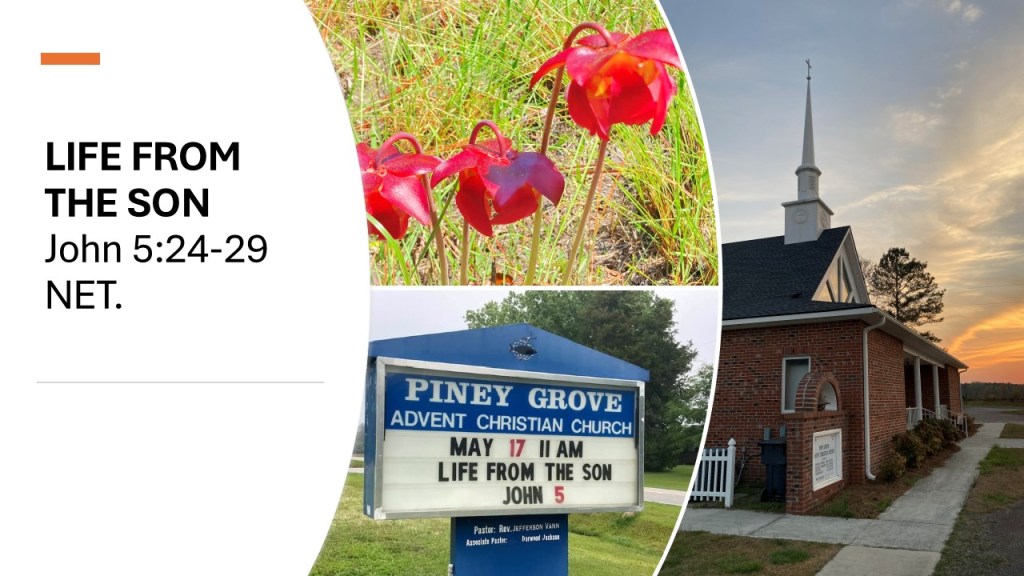
LIFE FROM THE SON

John 5:24-29 NET.

24“I tell you the solemn truth, the one who hears my message and believes the one who sent me has eternal life and will not be condemned but has crossed over from death to life. 25  I tell you the solemn truth, a time is coming — and is now here — when the dead will hear the voice of the Son of God, and those who hear will live. 26 For just as the Father has life in himself, thus he has granted the Son to have life in himself, 27 and he has granted the Son authority to execute judgment, because he is the Son of Man. 28 “Do not be amazed at this, because a time is coming when all who are in the tombs will hear his voice 29 and will come out — the ones who have done what is good to the resurrection resulting in life, and the ones who have done what is evil to the resurrection resulting in condemnation.

One of the important responsibilities of preaching is to slow us down long enough to really hear Scripture. We live in a world where familiar verses come preloaded with assumptions, ideas that almost everyone repeats, but few have traced back to the text itself. When those assumptions go unchallenged, they can blur what God is saying. Preaching becomes an act of love when it clears away that fog and lets the Word speak with its own weight and clarity.

There is something deeply real about this work. It invites us to come before God with open hands, willing to let Him correct us, surprise us, and reshape our understanding. It reminds us that Scripture is not a collection of slogans to confirm what we already think, but a living voice that calls us into truth. When a preacher helps us see what the text truly says—no more, no less—we experience that gentle moment when God realigns our hearts. And in those moments, we remember why we listen at all: because His Word still brings light, and His truth still sets us free.

Today’s passage is one of those places where we need to slow down and listen carefully. Most of us have heard John 5:24 explained the same way: it’s about a spiritual resurrection, a person getting saved, moving from spiritual death to spiritual life. And on the surface, that sounds right. I mean, what else could “crossed over from death to life” mean, if not conversion and new birth?

But you know what? Sometimes a verse we think we already understand is exactly the one that invites us to look again. That’s what I want to do with you this morning. My aim is not to be clever or to dismiss the many faithful teachers and theologians who see spiritual resurrection here. Many of them love Jesus deeply and handle Scripture with great care. I believe, after sitting with this text, that Jesus is talking about something different than what we usually assume.

So together, we’re going to walk slowly through John 5:24-29 and let the passage itself guide us. I hope that, by the end, you’ll see that what Jesus is saying is even richer and more grounded than the familiar explanation—and that your trust in His word will grow deeper, not thinner.

There are Two Life-Givers

Verse 26 says the Father has life in himself, and he has granted the Son to have life in himself. Those are the two sources where life can come from. Now, what kind of life do we get from the Father? Is it spiritual life or is it what we call physical life?

The Bible says that the LORD God formed Adam from dust from the ground and breathed into his nostrils the breath of life, and the man became a living creature.[1] He formed a non-living creature from the clay and breathed life into it, and Adam became alive. This is the kind of life we received from our Father. It was a dependent life. We owed our existence and continued functioning to the one who gave us this life. He is the first life-giver, and that life is (for want of a better description) physical animal life.

We have life, but the life we have is not self-contained. The theologians talk about humans having immortal souls, but the Bible never mentions anything about our souls being immortal. The Old Testament says that the soul who sins shall die.[2] Jesus said that sinful souls will be destroyed in Gehenna hell.[3] So, both Testaments testify that the idea of our having immortal souls by nature is unbiblical.

The life we receive from the Father is mortal, conditional life, temporary life. It can be a wonderful life, or it can be a miserable life, but there is one thing that life from the Father cannot be. It cannot be eternal life. The Father made that decision in Eden. He said that if our ancestors ate of the forbidden tree, we would become mortal and we would all eventually die.

Now, is this life from the Father spiritual life? Paul said that before salvation, all of us are “dead in our trespasses.”[4] We cannot even seek God because our sins have made us dead, not functioning in our relationship to him. So, if we are going to have a relationship with God, we are going to need a new life, another life, other than the natural life we were born into.

Never fear, because the Father, who has life in himself, has also granted the Son to have life in himself. There is another source of life. Now this is where the theologians are quick to explain that the kind of life Jesus offers is spiritual life, and that we need that because we are all spiritually dead. But hold your horses, because the text says something different.

The Son gave life by Physical Resurrection.

In verse 25, Jesus says a time is coming — and is now here — when the dead will hear the voice of the Son of God, and those who hear will live. One of the keys to understanding that statement is the fact that Jesus used the word “now.” He was referring to his earthly ministry. We know that Jesus brought the dead back to life while he walked among us. He took the corpse of Jairus’ daughter by the hand and said Little girl, I say to you, wake up!”[5] She woke up. To the widow’s son at Nain, he said, “Young man, I say to you, wake up!”[6] He woke up. In Bethany, he called Lazarus by name and told him to get out of that tomb.[7] He shuffled out of that tomb. On the night of his crucifixion, many of the saints who were buried and sleeping in their graves came out.[8] They came to life again.

Now, I want to ask you which of those four resurrections could be categorized as a spiritual resurrection? I think it is obvious that none of them were. They were all examples of Jesus literally raising people from the dead.

Jesus Establishes A Second Pattern Of Life-Giving.

In verse 25, Jesus said, “A time is coming — and is now here — when the dead will hear the voice of the Son of God, and those who hear will live.”  If the time that is here meant that Jesus could literally raise the dead during his earthly ministry, what does he mean when he talks about that time that is coming?

We don’t have to guess about that time because Jesus goes on to explain it more fully. He says, “A time is coming when all who are in the tombs will hear his voice and will come out — the ones who have done what is good to the resurrection resulting in life, and the ones who have done what is evil to the resurrection resulting in condemnation.

So, in this time that is coming, Jesus is going to perform the same kind of resurrection as he did during his earthly ministry. He is going to wake the dead and make them alive again. This is not a spiritual resurrection. It, too, is what we might call a literal, physical resurrection. In fact, it appears that there are only three things about this coming resurrection that will be different from the resurrections mentioned in the New Testament.

First, the extent to which the dead are raised. Jairus’ daughter died again. The Widow’s son died again. The saints who were sleeping fell asleep again. Those New Testament resurrections were temporary. They were miracles designed to show who Jesus is. But none of those who were raised were raised immortal.

Second, the purpose of the coming resurrection is Judgment Day. That is why Jesus says that some will be raised to a resurrection that results in condemnation. They, too, will be brought back to life, but not to immortality. Their resurrection is not a doorway into eternal joy but the moment they must stand before the Judge at the Great White Throne and answer for their lives. Every sin, every injustice, every rejection of God’s grace must be dealt with. Scripture is painfully clear: there are only two ways sin can be addressed—either through the atoning death of Christ or through the second death in Gehenna, the lake of fire.

The penalty for sin has always been death. That is the cost. And if we refuse the death of Christ as our substitute, then the only payment left is our own. Hell is not a place for people God dislikes; it is the place where unpaid sin debts are settled. It is a sober reminder that grace is offered freely, but it is not forced. The coming resurrection will reveal who trusted in Christ’s sacrifice and who chose to bear the weight of their own.

But the good news of the gospel is that there is a third and far greater difference between the resurrections Jesus performed during His earthly ministry and the resurrection He will bring about at the end of the age. The people He raised in the Gospels were restored to the same kind of life they had before—beautiful, compassionate miracles, but still temporary. They lived again, but they eventually died again. Their stories point forward, but they are not the destination.

What Jesus promises in the future is something entirely different. He says that some will be raised to a resurrection that results in life—real, lasting, indestructible life. Just as the Father gives life, so the Son gives life. But the life He gives is not mortal life stretched a little longer. It is immortal life, the kind that cannot fade or weaken or slip away. It is not natural life patched up and restarted. It is supernatural life, breathed into us by the One who conquered death. It is not a temporary life borrowed for a season. It is eternal, everlasting, permanent life—life that shares in the very permanence of God Himself.

That is the hope set before us, and it is worth holding with both hands.

This Resurrection Promise Gives us Hope.

Here are five reasons why we can draw confidence and hope from this resurrection promise:

1. The resurrection means death is not the end.

Every funeral, every diagnosis, every reminder of our mortality is not the final word. The resurrection promises that God will reverse what Adam’s fall unleashed. We do not cling to wishful thinking; we cling to a future event God has already previewed in Jesus.

2. The resurrection guarantees that our bodies matter to God.

We are not escaping creation; we are awaiting its renewal. The resurrection tells us that God will raise these very bodies—healed, restored, glorified. Nothing about our embodied life is disposable or forgotten.

3. The resurrection assures us that justice will be done.

So much in this world goes unresolved. But resurrection means God will raise every person and set all things right. No evil will remain unaddressed, and no faithfulness will go unnoticed.

4. The resurrection anchors our hope in Christ’s victory, not our performance.

Our future does not depend on our strength, consistency, or spiritual success. It rests on the risen Christ who conquered death for us. Because He lives, we will live also.

5. The resurrection promises reunion and restoration.

Every tear, every separation, every grave we’ve stood beside will be answered. God will gather His people, restore what was lost, and make all things new. Hope is not abstract. It is personal, relational, and guaranteed.

In conclusion, I am convinced Jesus is not introducing a new or hidden idea of spiritual resurrection in this passage. He is pointing us to the same promise He makes so clearly in John 6, where He says that everyone who looks to the Son and believes in Him has eternal life, and that He Himself will raise that person on the last day. That is the heartbeat of His message. He is not describing an invisible inner event; He is promising a future moment when He will act with resurrection power.

If you belong to Christ today, I cannot promise you a spiritual resurrection that happens quietly inside you. Scripture never speaks that way. But I can promise you something far better and far more concrete. Our Savior knows your name. He has not lost track of you. And one day, He will speak that name with the same authority that called Lazarus out of the tomb. If you are asleep in the dust, you will wake at His voice. If you are in your grave, you will rise and step out into a life that can never be taken from you again. That is the promise He gives, and it is worth holding onto with all your heart.


[1] Genesis 2:7.

[2] Ezekiel 18:4, 20.

[3] Matthew 10:28.

[4] Ephesians 2:1, 5; Colossians 2:13.

[5] Mark 5:21–43, Matthew 9:18–26, and Luke 8:40–56.

[6] Luke 7:11–17.

[7] John 11:1–44

[8] Matthew 27:52–53.

On “eternal generation.”

Good morning. I’d like to offer a response to Eric Reynolds’ recent video on the doctrine of eternal generation. Eric raised this topic because our denomination will soon vote on whether to adopt a new Declaration of Principles. In the proposed declaration, article 3 states that Jesus the Son is “eternally begotten of the Father.” This wording comes from the church’s debate with Arianism and was formally expressed in the Nicene Creed of AD 325: “God from God, Light from Light, true God from true God, begotten, not made, of the same essence as the Father.”

Eric urges Advent Christians to adopt this new Declaration of Principles because it makes clear where we stand in reference to the nature of Christ. It certainly does that. But I suggest that Eric went too far when he said, “You cannot be a Christian and reject the eternal begottenness of Jesus.”

First, many sincere Christians throughout the early centuries wrestled with how Scripture describes Jesus as the monogenēs of the Father (John 1:14, 18; 3:16, 18; 1 John 4:9). The Nicene theologians did not settle on their formulation immediately; their conclusions emerged only after generations of debate and reflection, eventually taking shape centuries later.

Secondly, the New Testament never uses the adjective “eternal” (αἰώνιος) to describe:

Christ as monogenēs, or

Christ’s generation/procession from the Father.

The NT simply does not pair aiōnios with monogenēs, nor with any verb of begetting, sending, or proceeding.

In other words, the Bible does not specifically teach eternal generation. It may be true, but Advent Christians have historically been wary of accepting theological constructions just because other Christians believe them to be true.

Thirdly, it was no surprise to me that, almost immediately after the proposed 2026 Declaration of Principles was published, people from many different perspectives began questioning its language. In several areas, the new proposal uses theological terms with a precision unfamiliar to many Advent Christians, while in other areas it introduces ambiguity where our current Declaration has traditionally been quite clear.

Over the past several weeks, I’ve received many emails and phone calls, and I’ve sat down with people from various backgrounds—all of whom share serious concerns about the proposed changes. Because of these conversations, I am persuaded that 2026 is not the year for our denomination to alter its guiding principles. If you are a delegate at the August triennial convention, please vote NO on the proposed revision to the Declaration of Principles. And if your church is sending delegates, please ask them to vote NO as well.

Thank you.

Jefferson Vann

For the video of the above, see:

THE EVIL DAYS

Photo by Adnan Kale on Pexels.com

THE EVIL DAYS

Ecclesiastes 12:1-5 KJV.

1 Remember now thy Creator in the days of thy youth, while the evil days come not, nor the years draw nigh, when thou shalt say, I have no pleasure in them; 2 While the sun, or the light, or the moon, or the stars, be not darkened, nor the clouds return after the rain: 3 In the day when the keepers of the house shall tremble, and the strong men shall bow themselves, and the grinders cease because they are few, and those that look out of the windows be darkened, 4            And the doors shall be shut in the streets, when the sound of the grinding is low, and he shall rise at the voice of the bird, and all the daughters of musick shall be brought low; 5 Also when they shall be afraid of that which is high, and fears shall be in the way, and the almond tree shall flourish, and the grasshopper shall be a burden, and desire shall fail: because man goeth to his long home, and the mourners go about the streets.

Growing older is a strange experience.

One day you’re young and energetic, and the next day you make a noise when you stand up— a noise you didn’t practice, a noise you didn’t choose, a noise that happens because your joints have decided to speak in tongues.

But aging is not a punishment. It’s a privilege. It’s a long, winding testimony of God’s patience, provision, and sense of humor.

And if we’re wise, we learn to laugh along the way.

Solomon’s final chapter in Ecclesiastes gives us a blunt, unvarnished look at the so‑called “golden years.” He doesn’t soften the reality of aging with polite euphemisms or sentimental language. Instead, he offers a painfully accurate allegory—one only an older man could write. Every image, every metaphor, every fading sense and trembling limb reflects a stage of decline Solomon now knows firsthand. He doesn’t call them the golden years. He calls them the evil days.

This is Ancient Near Eastern humor. Solomon walks us through the slow unraveling of the body: the dimming eyes, the shaking hands, the failing teeth, the stooped back, the sleepless nights, the shrinking appetite, the fear of falling, the loss of desire. It is a house slowly collapsing, a once‑strong structure now creaking under the weight of time. Solomon is not mocking old age; he is describing his own.

Solomon’s honesty is not meant to depress us but to awaken us. He wants the young to understand what he did not: life is precious because it is temporary. Enjoy it while you have it. Honor God while your strength is still intact. Live fully, gratefully, and wisely before the days come when desire fades and opportunities close.

Old age is not a failure; it is a reminder.

  • A reminder that we are creatures, not gods.
  • A reminder that our days are numbered.
  • A reminder that the One who gave us life is the only One who can give it again.

Solomon’s final chapter is not just a description of aging—it is an invitation to live well now, while the light still shines.

Solomon contrasts the fading years of old age with the bright, energetic prime of life—when everything works, everything is clear, and everything feels possible. He has lived those years. He was a sprite young prince, courting a beautiful young shepherd girl. We have that story in the Bible, too. It’s Solomon’s song. We also have a book Solomon wrote in his middle years. It’s his magnum opus, his collection of proverbs. But this book of Ecclesiastes is Solomon’s last. It’s his final reflection.

In it, he teaches us that when we’re young, our eyes look out their windows and see the world in sharp detail. But as the years pass, the days grow dimmer. The world doesn’t change, but our ability to take it in does.

  • Our bladders become like rain clouds that fill up again almost as soon as they empty.
  • Our once‑strong legs—the guardians of our bodies, the pillars of our houses—turn soft and unsteady.
  • Our teeth become few and idle, no longer grinding our food with youthful strength.
  • Our doors of opportunity close; we no longer venture far from home.
  • We miss the sound of business and busyness, the hum of life we once took for granted.
  • We wake at the slightest chirp of a bird, yet we don’t hear nearly as much as we used to.

It is a portrait, both honest and compassionate. Solomon is not mocking old age; he is describing the slow unraveling of a body that was never designed to be immortal in its present form.

And that is his point. Life is short—don’t waste it. We shouldenjoy it fully, especially while we are young and able to savor its gifts. But as we enjoy the gift, we should remember the Giver. The Creator who gave us life is the One who will remain when everything else fades. Our relationship with Him is the one joy that does not diminish with age.

We do not possess endless life in ourselves. Our strength, our senses, our opportunities—all of them are temporary. We live because God gives life, and we will live again only because God gives life again.

So Solomon urges us to use our time wisely.

  • Don’t squander our prime years.
  • Don’t drift through life as if our days are unlimited.
  • Enjoy the world God made, but anchor our joy in the God who made us.

Not only is it appropriate for us to remember our creator in the days of our youth. It is also quite proper for us to remember God when we cannot seem to remember anything else.

  • Remember God when you can’t remember where you put your glasses, your phone, where you left your keys, or where you parked your car.
  • Remember God when you can’t remember why you walked into the kitchen, or why you opened the refrigerator.
  • Remember God when you can’t remember that you already told that story… twice.
  • Remember God when you cannot remember the name of that person you have known for 20 years, and the one you just met 20 seconds ago.
  • Remember God when you cannot remember that birthday, that anniversary, that doctor’s appointment, or what day it is.
  • Remember God when you cannot remember whether you have taken that pill or taken out the garbage.

And don’t get me started on punchlines to jokes, or travel directions, whether you locked the front door, or how to turn off notifications that won’t stop dinging. We are now living in the evil days when everything slips away. But the LORD is the One who remains—and the One who can give life that truly lasts.

Let’s pray:

LORD, thank you for life. Thank you for the air we breathe and the lives you have given us to live. Thank you that no matter where we are, you are there. Thank you also for no matter what point we are in our lives, you are with us and for us. Praise your holy name. Amen.

Joshua 8

Joshua 8 

Joshua 8:1 Yahveh said to Joshua, “Do not be afraid or discouraged. Take all the troops with you and attack Ai. Notice, I have handed over to you the king of Ai, his people, city, and land.

Joshua 8:2 Treat Ai and its king as you did Jericho and its king, except that you may plunder its spoil and livestock for yourselves. Set an ambush behind the city.”

Joshua 8:3 So Joshua and all the troops set out to attack Ai. Joshua selected thirty thousand of his most capable soldiers and sent them out at night.

Joshua 8:4 He commanded them: “Pay attention. Lie in ambush behind the city, not too far from it, and all of you be ready.

Joshua 8:5 Then I and all the people who are with me will approach the city. When they come out against us as they did the first time, we will run from them.

Joshua 8:6 They will come after us until we have drawn them away from the city because they will say, ‘They are running from us like before.’ While we are running from them,

Joshua 8:7 you are to come out of your ambush and seize the city. Yahveh, your God will hand it over to you.

Joshua 8:8 After taking the city, set it on fire. Follow Yahveh’s command – see that you do as I have ordered you.”

Joshua 8:9 So Joshua sent them out, and they went to the ambush site and waited between Bethel and Ai, to the west of Ai. But he spent that night with the troops.

Joshua 8:10 Joshua started early the next morning and mobilized them. Then, he and the elders of Israel led the troops up to Ai.

Joshua 8:11 All those with him went up and approached the city, arriving opposite Ai, and camped to the north of it, with a valley between them and the city.

Joshua 8:12 Now Joshua had taken about five thousand men and set them in ambush between Bethel and Ai, to the west of the city.

Joshua 8:13 The troops were positioned as follows: the main camp to the north of the city and its rear guard to the west of the town. That night, Joshua went into the valley.

Joshua 8:14 When the king of Ai saw the Israelites, the men of the city hurried and went out early in the morning so that he and all his people could engage Israel in battle at a suitable place facing the Arabah. But he did not know there was an ambush waiting for him behind the city.

Joshua 8:15 Joshua and all of Israel pretended to be beaten back by them and ran toward the wilderness.

Joshua 8:16 Then all the troops of Ai were summoned to pursue them, and they pursued Joshua and were drawn away from the city.

Joshua 8:17 Not a man was left in Ai or Bethel who did not go out after Israel, leaving the city exposed while they pursued Israel.

Joshua 8:18 Then Yahveh said to Joshua, “Hold out the javelin in your hand toward Ai because I will hand the city over to you.” So Joshua held out his javelin toward it.

Joshua 8:19 When he held out his hand, the men in the ambush rose quickly from their position. They ran, entered the city, captured it, and immediately set it on fire.

Joshua 8:20 The men of Ai turned and looked back, and smoke from the city was rising to the sky! They could not escape in any direction, and the troops who had fled to the wilderness now became the pursuers.

Joshua 8:21 When Joshua and all Israel saw that the men in ambush had captured the city and that smoke was rising from it, they turned back and struck down the men of Ai.

Joshua 8:22 Then men in ambush came out of the city against them, and the men of Ai were trapped between the Israelite forces, some on one side and some on the other. They struck them down until no survivor or fugitive remained,

Joshua 8:23 but they captured the king of Ai alive and brought him to Joshua.

Joshua 8:24 When Israel had finished killing everyone living in Ai who had pursued them into the open country, and when every last one of them had fallen by the sword, all Israel returned to Ai and struck it down with the sword.

Joshua 8:25 The total of those who fell that day, both men and women, was twelve thousand – all the people of Ai.

Joshua 8:26 Joshua drew back his hand that was holding the javelin when all the inhabitants of Ai were set apart for destruction.

Joshua 8:27 Israel plundered only the cattle and spoil of that city for themselves, according to Yahveh’s command that he had given Joshua.

Joshua 8:28 Joshua burned Ai and left it a permanent mound of ruins, still a sinister desolation today.

Joshua 8:29 He hung the body of the king of Ai on a tree until evening, and at sunset, Joshua commanded that they take his body down from the tree. They threw it down at the entrance of the city gate and put a large pile of rocks over it, which remains today.

Joshua 8:30 At that time, Joshua built an altar on Mount Ebal to Yahveh, the God of Israel,

Joshua 8:31 just like Moses Yahveh’s slave had commanded the Israelites. He built it according to what is written in the book of the law of Moses: an altar of uncut stones on which no iron tool has been used. Then, they offered burnt offerings to Yahveh and sacrificed fellowship offerings on it.

Joshua 8:32 There on the stones, Joshua copied the law of Moses, which he had written in the presence of the Israelites.

Joshua 8:33 All Israel –  resident alien and citizen alike –  with their elders, officers, and judges, stood on either side of the ark of Yahveh’s covenant facing the Levitical priests who carried it. Half of them were in front of Mount Gerizim and half in front of Mount Ebal, as Moses Yahveh’s slave had commanded earlier concerning blessing the people of Israel.

Joshua 8:34 Afterward, Joshua read aloud all the words of instruction—the blessings as well as the curses—according to what was written in the book of instruction.

Joshua 8:35 There was not a word of all that Moses had commanded that Joshua did not read before the entire assembly of Israel, including the women, the dependents, and the resident aliens who lived among them.

links:

a sinister desolation
Ai’s smoke
Ebal’s altar
Maranatha Daily Devotional – October 9, 2015
Maranatha Daily Devotional – Wednesday, June 21, 2023
missions and second chances
night with the troops
not the time
the second confidence
what the king didn’t know

The JOSHUA shelf in Jeff’s library